Psilocybin and Cardiovascular Safety
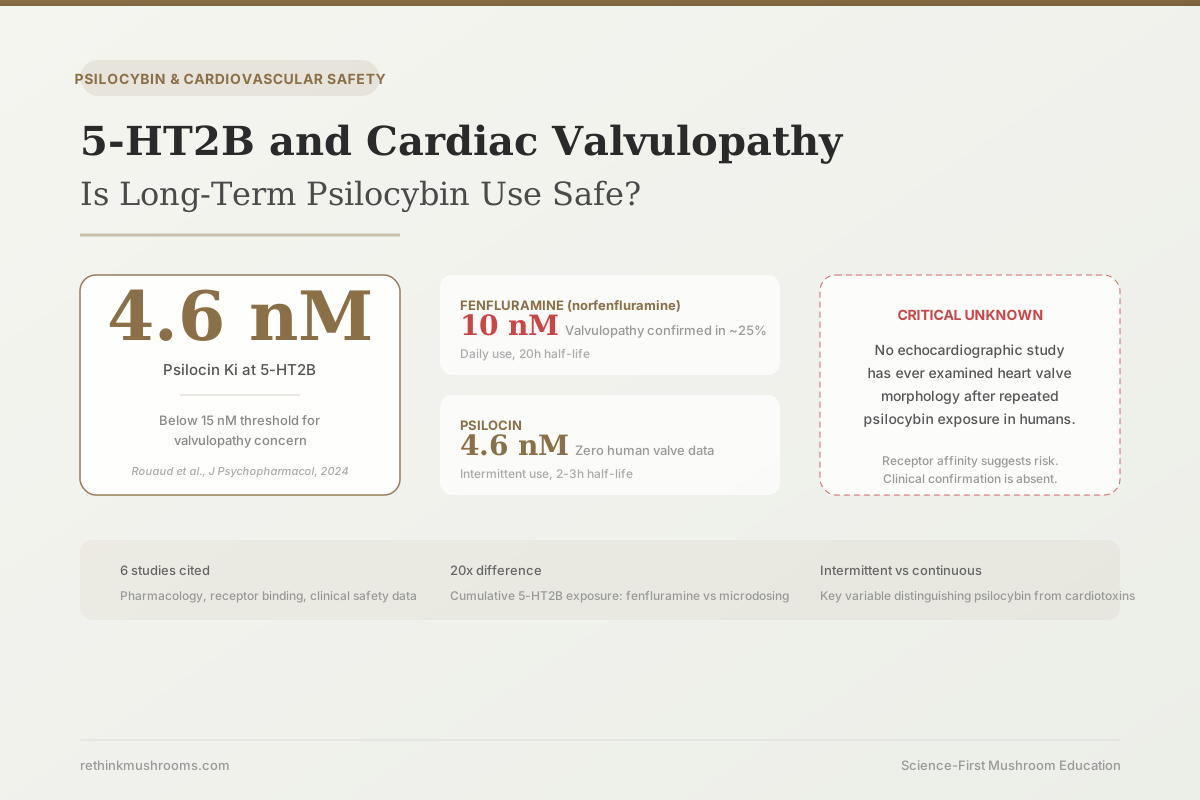
4.6 nM
Psilocin's binding affinity (Ki) at the 5-HT2B receptor falls below the 15 nM threshold associated with drug-induced valvular heart disease from fenfluramine and ergot derivatives.
Rouaud et al., Journal of Psychopharmacology, 2024
5-HT2B Receptor
linked to valve fibrosis
Zero Human Data
on long-term psilocybin + heart valves
25% Incidence
of valvulopathy from fenfluramine
Rouaud et al., Journal of Psychopharmacology, 2024
 View as image ↗
Psilocybin's active metabolite, psilocin, binds to the serotonin 5-HT2B receptor with high affinity. That same receptor, when chronically activated by drugs like fenfluramine and ergotamine, causes fibrotic thickening of heart valve leaflets. This connection has raised a specific question: does repeated psilocybin exposure carry the same cardiac valve risk that pulled fenfluramine from the market?
Rouaud, Calder, and Hasler published the most direct analysis of this question in the Journal of Psychopharmacology in 2024.[1] They compared the receptor pharmacology of psilocin and LSD to established cardiotoxins and found that psilocin's Ki at 5-HT2B (4.6 nM) falls below the threshold historically associated with valvulopathy risk. No human study has examined heart valve morphology after repeated psilocybin exposure. The data that exists is pharmacological, not clinical. The article on blood pressure and heart rate effects during psilocybin sessions covers the acute cardiovascular profile.
Key Takeaways
- Psilocin's binding affinity at 5-HT2B (Ki = 4.6 nM) falls below the 15 nM threshold associated with drug-induced valvular heart disease (Rouaud et al., Journal of Psychopharmacology, 2024)
- Fenfluramine caused valvulopathy in approximately 25% of long-term users through sustained 5-HT2B agonism; it was withdrawn from the market in 1997 (as reviewed in Rouaud et al., 2024)
- Psilocin shows comparable potency to methylergonovine at 5-HT2B in calcium flux assays, a known cardiotoxin (Rouaud et al., 2024)
- No controlled human study has performed echocardiographic monitoring after repeated psilocybin dosing (Goel and Zilate, Cureus, 2022)
- Receptor affinity alone does not predict valvulopathy risk; duration of exposure, biased agonism, and downstream signaling pathways all modify the outcome (McClure-Begley and Roth, Nature Reviews Drug Discovery, 2022)
- Clinical trials using single or few doses of psilocybin for depression report transient blood pressure increases but no cardiac structural changes (Nichols, Pharmacological Reviews, 2016)
What the 5-HT2B Receptor Does in Heart Valves
Human hearts have four valves that open and close with every heartbeat. The structural integrity of those valves depends on interstitial cells, primarily fibroblasts, that produce and maintain the extracellular matrix holding each valve leaflet together. The 5-HT2B receptor is a serotonin receptor subtype expressed at high density on these cardiac valve interstitial cells. When serotonin or a serotonin-like molecule binds this receptor and activates it persistently, those fibroblasts begin to proliferate. They produce excess extracellular matrix proteins, primarily glycosaminoglycans and collagen. The valve leaflets thicken. They lose flexibility. They stop closing properly.
This mechanism was first characterized after fenfluramine (marketed as the diet drug Fen-Phen) caused valvular heart disease in a significant fraction of long-term users. Rothman and colleagues at the National Institute on Drug Abuse showed in 2000 that norfenfluramine (fenfluramine's active metabolite) had high affinity for 5-HT2B and 5-HT2C receptors, and they proposed that 5-HT2B activation was the necessary condition for drug-induced valvulopathy. Approximately 25% of patients taking fenfluramine long-term developed echocardiographically detectable valve changes.[1]
As Nichols documented in his comprehensive review of psychedelic pharmacology, every drug confirmed to cause valvulopathy (fenfluramine, ergotamine, methysergide, pergolide, cabergoline) was a potent 5-HT2B agonist with sustained receptor activation over weeks to months.[2] The pattern was consistent enough that pharmaceutical companies now screen drug candidates for 5-HT2B activity early in development.
Psilocin's Affinity for 5-HT2B
Psilocybin itself is a prodrug. After oral ingestion, alkaline phosphatases in the gut and liver cleave the phosphate group to produce psilocin (4-hydroxy-N,N-dimethyltryptamine), the pharmacologically active compound.[2] Psilocin is the molecule that reaches serotonin receptors throughout the body, including 5-HT2B on cardiac valves.
Rouaud and colleagues compiled receptor binding data from multiple studies.[1] Psilocin's Ki at 5-HT2B is 4.6 nM (from McKenna and Peroutka, 1989). For context:
| Compound | 5-HT2B Ki (nM) | Valvulopathy Confirmed |
|---|---|---|
| Methylergonovine | 0.46 | Yes |
| LSD | 0.98 | No data (chronic use) |
| Psilocin | 4.6 | No data (chronic use) |
| Norfenfluramine | 10 | Yes |
| Ropinirole | 3,802 | No |
A Ki below 15 nM has been the informal pharmacological threshold where concern begins. Psilocin falls well within this zone. In functional assays measuring calcium flux (a downstream marker of receptor activation), psilocin appeared "about as potent at 5-HT2B as methylergonovine," a known cardiotoxin.
This pharmacological profile does not prove that psilocin causes valvulopathy. It establishes that the molecular prerequisite, potent 5-HT2B agonism, is present.
The table above also reveals an important nuance. Ropinirole, a dopamine agonist used for Parkinson's disease, has a 5-HT2B Ki of 3,802 nM and does not cause valvulopathy. That 800-fold difference in affinity compared to psilocin illustrates why the 15 nM threshold exists. Weak 5-HT2B binders appear safe. The risk zone begins when affinity drops into single-digit nanomolar range, where receptor occupancy at therapeutic concentrations becomes pharmacologically meaningful.
Why Affinity Alone Is Not the Full Picture
McClure-Begley and Roth addressed this distinction in Nature Reviews Drug Discovery in 2022.[3] They noted that binding affinity at a receptor tells you how tightly a molecule sticks. It does not tell you what happens after binding. Several factors modify whether 5-HT2B activation translates to fibrosis:
Duration of exposure. Fenfluramine was taken daily for months. Psilocybin in clinical settings is administered once or a few times over weeks. Microdosing protocols involve sub-threshold doses 2-4 times per week for extended periods. The cumulative receptor activation is fundamentally different across these regimens.
Biased agonism. Different molecules can bind the same receptor but activate different intracellular signaling cascades. The profibrotic effect appears linked specifically to beta-arrestin recruitment and subsequent ERK2 phosphorylation.[1] A molecule that activates 5-HT2B through the Gq/calcium pathway but does not recruit beta-arrestin might not trigger the fibrotic cascade. This concept of "functional selectivity" or "biased agonism" means that two drugs with identical binding affinity at 5-HT2B could have completely different effects on valve tissue. Whether psilocin is a biased or unbiased agonist at 5-HT2B has not been fully characterized. This is one of the most important unknowns in the entire risk assessment.
Plasma concentration and half-life. Psilocin has a plasma half-life of approximately 2-3 hours after oral psilocybin administration.[4] Fenfluramine's metabolite norfenfluramine has a half-life of approximately 20 hours. Daily fenfluramine dosing meant continuous 5-HT2B occupancy. A single psilocybin dose produces a few hours of psilocin exposure followed by complete clearance.
Receptor occupancy at microdoses. Madsen and colleagues used PET imaging in eight healthy volunteers given oral psilocybin in the 3–30 mg range and reported dose-related cerebral 5-HT2A receptor occupancies up to 72% at higher doses, with both plasma psilocin and 5-HT2A occupancy tracking subjective psychedelic intensity.[4] Microdoses (roughly 1/10th of a full dose) would produce proportionally lower receptor occupancy at 5-HT2B as well, though the exact 5-HT2B occupancy from microdosing has not been directly measured.
The Microdosing Question
Microdosing is where the cardiac concern is most relevant, because it involves repeated, regular exposure. Rouaud and colleagues framed the core dilemma: "Both LSD and psilocybin share structural similarities with medications which raise the risk of cardiac fibrosis and valvulopathy when taken regularly, including methysergide, pergolide, and fenfluramine."[1]
A typical microdosing protocol involves taking 1-2 mg of psilocybin (or its equivalent in dried psilocybin mushrooms) every 3-4 days for weeks or months. This creates intermittent but repeated 5-HT2B activation. The total cumulative exposure is lower than daily fenfluramine use, but it is not zero.
Rouaud's analysis concluded that "chronic microdosing may carry a risk of fibrosis and valvular heart disease, which should be assessed in future studies." They stopped short of stating that microdosing is dangerous, because no human data exists to confirm or deny the risk. The assessment is based entirely on receptor pharmacology and analogy to other 5-HT2B agonists.
One piece of indirect evidence deserves attention. LSD has been available since the 1960s. Millions of people have used it recreationally over six decades. No systematic reports of valvulopathy have emerged from the LSD-using population. LSD has an even higher 5-HT2B affinity (Ki = 0.98 nM) than psilocin. This absence of signal across decades of widespread use is reassuring but not conclusive, for several reasons. Recreational LSD use is typically intermittent (once every weeks or months, not 2-4 times per week as in microdosing protocols). Echocardiographic screening was never performed on LSD users as a population. And valvulopathy from serotonergic drugs can be subclinical for years before symptoms appear, meaning mild valve changes could exist undetected in a population that was never screened.
The psilocybin mushroom has been used ceremonially in Mesoamerican cultures for centuries, potentially millennia. No historical record describes cardiac valve disease as a consequence, though the dosing pattern (infrequent ceremonial use, not regular microdosing) aligns more closely with the low-risk scenario.
What Clinical Trials Show About Acute Cardiac Effects
Clinical psilocybin trials have measured blood pressure and heart rate during sessions. At standard doses (20-30 mg), pooled data from clinical trials shows psilocybin causes:[5]
- Systolic blood pressure increases to a mean peak of approximately 146 mmHg
- Hypertension (systolic >140 mmHg) in roughly 50% of administrations
- Tachycardia (>100 bpm) in approximately 7% of administrations
- Return to baseline within 6 hours
These are transient hemodynamic changes, not structural valve damage. No clinical trial to date has included echocardiographic analysis as an outcome measure.[5]
Goel and Zilate's 2022 systematic review of psilocybin's therapeutic effects noted that while adverse events in clinical trials were generally mild and transient (anxiety, nausea, headache), cardiovascular monitoring was limited to vital signs.[5] Structural cardiac imaging was not part of any trial protocol they reviewed. Researchers have recommended that chronic psilocybin use in microdose form should include echocardiographic monitoring.[1]
The Gap Between Pharmacology and Proof
The evidence can be summarized in two statements that are both true and in tension with each other:
First, psilocin is a potent 5-HT2B agonist with affinity comparable to drugs that caused valve fibrosis in humans. The molecular mechanism for harm is biologically plausible.
Second, no human study has documented cardiac valve changes from psilocybin use at any dose or frequency. The mechanistic concern remains unconfirmed.
This gap exists because the right study has not been done. Echocardiographic monitoring of participants in microdosing trials, or retrospective echocardiographic screening of long-term psilocybin users, would begin to answer the question. Until those studies exist, the risk assessment is pharmacological, not clinical.
Several factors could mitigate the risk even if psilocin does activate profibrotic pathways at 5-HT2B. The intermittent dosing pattern of microdosing (every 3-4 days, not daily) allows receptor desensitization and fibroblast recovery between exposures. Raval and colleagues demonstrated that a single dose of psilocybin decreases 5-HT2A receptor density in pig brain, suggesting receptor downregulation occurs.[6] Whether similar downregulation occurs at 5-HT2B in cardiac tissue is unknown but biologically plausible.
The distinction between psilocybin's dosing pattern and fenfluramine's is worth quantifying. Daily fenfluramine at therapeutic doses produced continuous 5-HT2B occupancy for the 20-hour half-life of norfenfluramine, repeated every day for months. Over 30 days of daily fenfluramine use, the total hours of meaningful 5-HT2B receptor engagement approaches 600 hours. Psilocybin microdosing at 1-2 mg every 3 days produces intermittent occupancy for approximately 3 hours per dose, followed by 69 hours without exposure. Over 30 days, that is roughly 30 hours of receptor engagement. The cumulative exposure differs by a factor of 20.
Cumulative 5-HT2B Engagement Over 30 Days
Same Receptor Affinity, ~20× Less Exposure
Daily fenfluramine
Continuous occupancy, ~20 h metabolite half-life, dosed every day
Microdosing psilocybin
1–2 mg every ~3 days, ~3 h psilocin exposure per dose, then full clearance
Both molecules bind 5-HT2B in the single-digit-nanomolar range, but cumulative receptor engagement differs by roughly 20-fold: continuous daily occupancy for months versus a few hours of intermittent exposure separated by days of complete clearance. Whether that gap is enough to prevent fibrosis is unknown — the relationship between cumulative 5-HT2B activation and valve fibrosis is not linear, and intermittent versus continuous stimulation has never been studied in cardiac valve tissue.
Estimates from Rouaud et al., Journal of Psychopharmacology, 2024 (microdosing schedule and norfenfluramine ~20 h half-life) and Madsen et al., 2019 (psilocin ~2–3 h half-life). Illustrative cumulative-hours figures, not measured 5-HT2B occupancy.
Whether this 20-fold difference is enough to prevent fibrosis is the unanswered question. The relationship between cumulative 5-HT2B activation and fibrosis onset is not linear. There may be a threshold below which the fibroblasts repair themselves between exposures. There may not be. The cell biology of intermittent versus continuous 5-HT2B stimulation has not been studied in cardiac valve tissue for any drug, let alone psilocybin specifically.
For related cardiovascular questions, see who should be cautious with psilocybin and heart conditions, the QTc prolongation monitoring data, and the broader cardiovascular risk assessment.
Cardiovascular
ModerateA biologically plausible valve risk that no human study has yet measured
Concern
Psilocin is a potent 5-HT2B agonist (Ki = 4.6 nM), an affinity in the same single-digit-nanomolar range as drugs confirmed to cause valvular heart disease. The molecular prerequisite for fibrosis is present, and repeated-exposure patterns such as microdosing are exactly where the theoretical concern concentrates.
What the research says
No controlled human study has performed echocardiographic monitoring after repeated psilocybin dosing, so the risk remains pharmacological rather than clinically documented. The critical mitigating difference is exposure: intermittent dosing produces roughly 20-fold less cumulative 5-HT2B engagement than the continuous daily occupancy that drove fenfluramine valvulopathy.
Particularly relevant for: People considering regular or long-term psilocybin microdosing, and anyone with pre-existing valvular or structural heart disease
What to do
This article is educational information, not medical advice. Anyone with a heart condition, or considering regular microdosing, should consult a qualified clinician; echocardiographic monitoring is the reasonable precaution until dedicated safety studies exist.
Rouaud et al., 2024; Nichols, 2016; Goel and Zilate, 2022
The Bottom Line
Psilocin binds the 5-HT2B receptor at concentrations (Ki = 4.6 nM) comparable to drugs confirmed to cause valvular heart disease. No human study has examined heart valve morphology after repeated psilocybin exposure. The pharmacological concern is real but unconfirmed. The critical difference between psilocybin and established cardiotoxins is exposure duration: hours of intermittent activation versus continuous daily receptor occupancy for months. Echocardiographic monitoring in microdosing studies would begin to resolve this uncertainty.
Frequently Asked Questions
Sources & References
- 1RTHM-00903·Rouaud, Antonin et al. (2024). “Microdosing psychedelics and the risk of cardiac fibrosis and valvulopathy: Comparison to known cardiotoxins..” Journal of psychopharmacology (Oxford.Study breakdown →PubMed →↩
- 2RTHM-00439·Nichols, David E (2016). “Psychedelics..” Pharmacological reviews.Study breakdown →PubMed →↩
- 3RTHM-00787·McClure-Begley, Tristan D et al. (2022). “The promises and perils of psychedelic pharmacology for psychiatry..” Nature reviews. Drug discovery.Study breakdown →PubMed →↩
- 4RTHM-00578·Madsen, Martin K et al. (2019). “Psychedelic effects of psilocybin correlate with serotonin 2A receptor occupancy and plasma psilocin levels..” Neuropsychopharmacology : official publication of the American College of Neuropsychopharmacology.Study breakdown →PubMed →↩
- 5RTHM-00760·Goel, Dev B et al. (2022). “Potential Therapeutic Effects of Psilocybin: A Systematic Review..” Cureus.Study breakdown →PubMed →↩
- 6RTHM-00714·Raval, Nakul Ravi et al. (2021). “A Single Dose of Psilocybin Increases Synaptic Density and Decreases 5-HT2A Receptor Density in the Pig Brain..” International journal of molecular sciences.Study breakdown →PubMed →↩