Psilocybin and Cardiovascular Safety
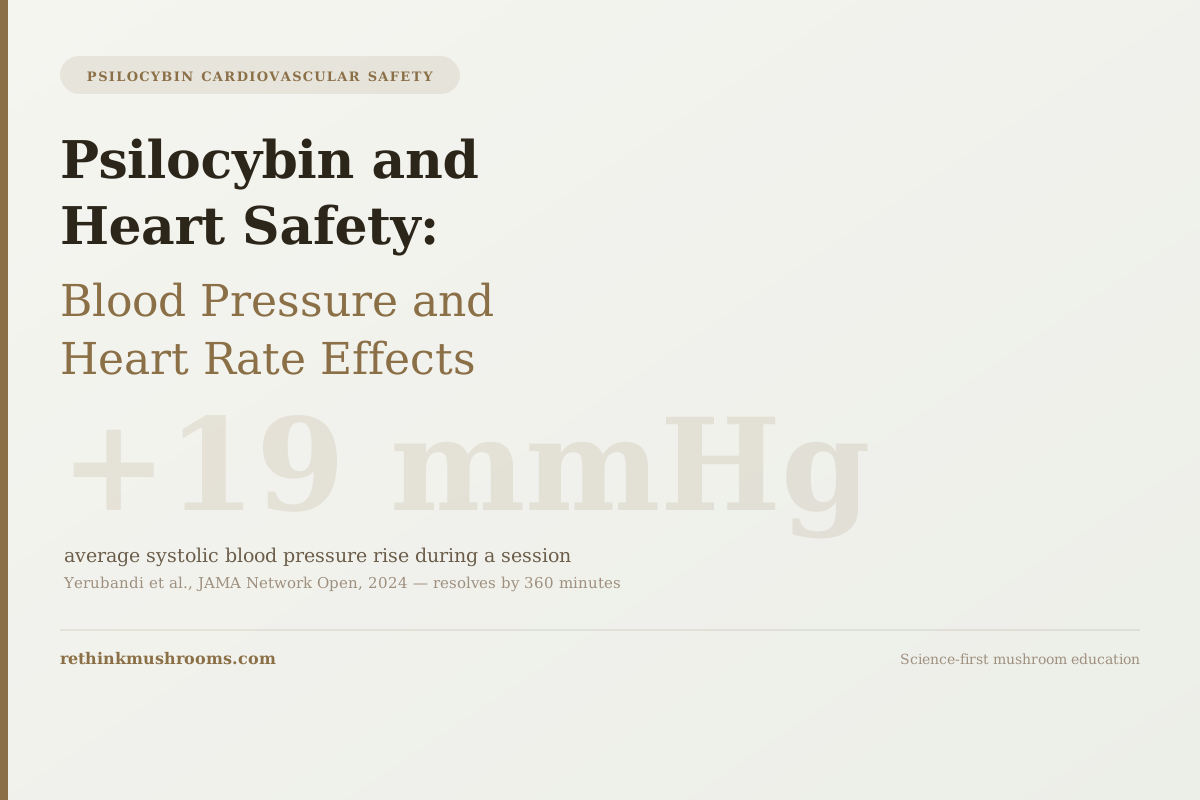
+19 mmHg systolic
A 2022 meta-analysis of controlled psilocybin trials found an average systolic blood pressure rise of 19 mmHg and diastolic rise of 8.66 mmHg during dosing, while the pooled change in heart rate was comparable to placebo. Acute adverse effects resolved within 48 hours in trial data, and no serious cardiac events were recorded.
Yu et al., Journal of Clinical Medicine, 2022
+8.66
mmHg average diastolic rise (Yu 2022 meta-analysis)
≈ placebo
pooled heart-rate change vs placebo (Yu 2022)
0.2%
physical harm rate among 9,233 surveyed recreational users
Yu et al., Journal of Clinical Medicine, 2022
 View as image ↗
Yes, psilocybin raises blood pressure, and heart rate can rise transiently during a session. A 2022 meta-analysis of controlled clinical trials put a specific number on the blood pressure effect that researchers had observed qualitatively for years: an average systolic increase of 19 mmHg (millimeters of mercury, the standard unit for blood pressure measurement) and diastolic increase of 8.66 mmHg during dosing.[7] Notably, that same pooled analysis found the change in heart rate was comparable to placebo, even as blood pressure rose. A separate 2024 meta-analysis confirmed that elevated blood pressure was significantly more likely with psilocybin than placebo, while the acute adverse effect profile overall was tolerable and resolved within 48 hours.[1] These effects are real, documented, and dose-related. They are also transient and, in the clinical trial data, unaccompanied by serious cardiac events.
This article covers what happens to blood pressure and heart rate during a psilocybin session, why it happens, what the real-world risk looks like across thousands of users, and what those numbers mean for people with different starting cardiac profiles. For the broader question of psilocybin's physiological safety profile, see psilocybin's physiological safety: what the data shows. For the overall safety picture, see the complete psilocybin safety research overview.
Key Takeaways
- A 2022 meta-analysis of controlled trials found psilocybin raises systolic blood pressure by an average of 19 mmHg and diastolic by 8.66 mmHg during dosing (Yu 2022)
- In that same pooled analysis, heart rate change was comparable to placebo; a separate 2024 meta-analysis found acute adverse effects were tolerable and resolved within 48 hours (Yu 2022; Yerubandi 2024)
- A 2025 comprehensive safety review found no deaths attributed to cardiovascular causes across all controlled psilocybin trials reviewed (Freitas 2025)
- In a Global Drug Survey sample of 9,233 past-year magic mushroom users, about 0.2% sought emergency medical treatment; cardiac events were rare, with most emergencies driven by psychological distress (Kopra 2022)
- The BP and HR effects are a pharmacological consequence of serotonin receptor activation, not a sign of cardiovascular injury; they are expected and monitored in clinical protocols (Wsół 2023)
- The acute BP and HR changes are manageable in healthy individuals; the population requiring additional caution is people with pre-existing cardiovascular disease, for whom the current clinical evidence base has significant gaps (Nahlawi 2025)
The Exact Numbers: What the Meta-Analyses Found
Most popular health content on psilocybin's cardiovascular effects amounts to "it can raise blood pressure and heart rate." That tells you a direction, not a magnitude. A 2022 systematic review and multivariate meta-analysis by Yu and colleagues, published in the Journal of Clinical Medicine, provides the missing specifics for blood pressure.[7]
Pooling cardiovascular safety data as a secondary outcome across controlled psilocybin trials, the authors found that systolic blood pressure (the higher number in a reading) increased by an average of 19 mmHg, and diastolic pressure (the lower number) by an average of 8.66 mmHg, compared with placebo. To put those numbers in context: a 19 mmHg systolic rise for someone starting at 120/80 (the textbook normal) would bring them to roughly 139/89 at peak, elevated but not dangerously so in an otherwise healthy person.
The heart rate finding is worth emphasizing because it runs against the common assumption. In Yu's pooled analysis, the change in heart rate after psilocybin was comparable to placebo, even though blood pressure rose. Individual sessions can still show transient heart rate increases, but at the level of pooled trial evidence the heart rate signal was small. The authors characterized the overall cardiovascular profile as favorable.
A separate 2024 meta-analysis by Yerubandi and colleagues in JAMA Network Open approached safety from the other direction, pooling six randomized, double-blind trials (528 participants) to ask how often specific adverse effects occurred relative to placebo.[1] Elevated blood pressure was significantly more likely with psilocybin (relative risk 2.29), alongside headache, nausea, anxiety, and dizziness. Crucially, the authors concluded the acute adverse effect profile of a therapeutic single dose was tolerable and resolved within 48 hours, with no serious cardiac events in the trial populations analyzed. The cardiovascular effects were transient, dose-related, and in healthy trial participants, clinically manageable.
Why Psilocybin Affects Blood Pressure: The Mechanism
The blood pressure and heart rate increases are not unexpected or poorly understood. They are a predictable pharmacological consequence of serotonin 2A receptor activation.
When psilocin (psilocybin's active form) activates the 5-HT2A receptor, it triggers a cascade in the nervous system that mimics aspects of the adrenaline response. Blood vessels constrict slightly, and heart rate can rise. This is a sympathomimetic effect, meaning it resembles what happens during sympathetic nervous system activation, the physiological state associated with alertness, stress, or exertion.
This is the same general class of cardiovascular response that mild exercise, caffeine, or stress can produce. It is not a sign of cardiac damage or arrhythmia. It is the cardiovascular signature of a drug that activates serotonin receptors with significant potency. Wsół's 2023 systematic review of cardiovascular safety across classic psychedelics (psilocybin, LSD, DMT, ayahuasca, mescaline) confirmed that serotonergic agonism at 5-HT2A, 5-HT2B, and 5-HT4 receptors is the primary mechanism of cardiovascular concern across this drug class.[3]
A 2025 review from MGH and Harvard cardiologists, published in Nature Cardiovascular Research, provided the most comprehensive framework for thinking about psilocybin's cardiovascular risks.[2] The Nahlawi 2025 team categorized the risks into three domains: electrophysiological (affecting the heart's electrical conduction and rhythm), structural (potential changes to heart valves over long-term use), and vascular (acute blood pressure and blood flow effects). The BP and HR effects discussed in this article fall under the vascular domain, the best-characterized and most immediately observable category.
Understanding which domain a risk belongs to matters. An acute blood pressure rise during a session and a theoretical long-term effect on heart valves are separate concerns requiring different evaluations. For the QTc prolongation question (electrophysiological domain), see psilocybin and QTc prolongation: what cardiac monitoring data shows. For the long-term structural question, see 5-HT2B and cardiac valvulopathy: is long-term psilocybin use safe?.
What 9,000+ Recreational Users Show About Real-World Risk
Clinical trial data is valuable but limited to screened, healthy participants under controlled medical supervision. A 2022 study by Kopra and colleagues extends the picture to uncontrolled, real-world use at scale.[4]
Using data from the 2017 Global Drug Survey, a large anonymous survey of drug users worldwide, Kopra and colleagues examined 9,233 people who reported using magic mushrooms in the past year. Of those, 19 (about 0.2%) had sought emergency medical treatment following use, with a per-event risk estimate of roughly 0.06%. Young age was the only factor that predicted a higher likelihood of an emergency presentation.
More telling than the overall rate is the breakdown of what drove those emergencies. The most common symptoms reported were psychological (anxiety, panic, and paranoia), not physical or cardiac events. Cardiovascular emergencies were rare even among the small group who did seek treatment.
This finding is significant for two reasons. First, it came from uncontrolled recreational settings without medical supervision, without cardiac screening, and often with unknown dosing. If cardiovascular harms from psilocybin were common, they would appear in this population. Second, it suggests that the main safety risks from psilocybin (at typical recreational doses) are psychological rather than cardiac.
These numbers should not be extrapolated to high-risk populations, specifically people with pre-existing heart disease, taking cardiovascular medications, or using doses significantly above what recreational users typically consume. Kopra's data covers a general population, not a cardiac patient population.
The Clinical Trial Safety Record: No Cardiac Deaths
Across the controlled trial literature, the safety record on cardiovascular events is consistently reassuring for healthy populations. A 2025 systematic safety review by Freitas and colleagues synthesized the evidence from psilocybin-assisted psychotherapy trials specifically.[5]
Their conclusion: most adverse cardiovascular effects in controlled trials were transient and mild. No deaths were attributed to psilocybin cardiovascular effects across the trials reviewed. When serious adverse events did occur in psilocybin research, they were primarily psychological (psychosis, severe anxiety, persisting perceptual disturbances) rather than cardiac.
This record extends to older safety reviews. Johnson and colleagues, in a comprehensive 2018 pharmacological safety review published in Neuropharmacology, examined psilocybin against eight factors used to evaluate controlled substances, including physiological harm potential.[6] Their assessment: no cardiac fatalities in controlled studies, physiological risk is very low, and cardiovascular effects are modest and transient at therapeutic doses.
This body of evidence covers healthy, screened participants. The consistency of the finding, across multiple research groups, multiple decades, and multiple review methodologies, makes the conclusion robust for that population.
Dose Matters: Larger Doses Mean Larger Effects
The Yu 2022 meta-analysis captured averages across trials using different doses.[7] The underlying relationship is dose-dependent: larger doses produce larger blood pressure changes. This is consistent with the receptor mechanism: more receptor activation produces more sympathomimetic drive.
At standard clinical doses (typically 25 mg in phase 2 and 3 trials), the average 19 mmHg systolic rise is the best estimate of what occurs. At higher doses, the magnitude is larger. At lower doses, smaller effects are observed.
The Wsół 2023 review noted significant knowledge gaps for two specific populations: people who microdose (sub-perceptual, repeated small doses over weeks or months), and people with pre-existing cardiovascular disease.[3] Neither group has been systematically studied in randomized controlled trials. The safety data for these populations is extrapolated from general healthy populations, not directly measured.
The Nahlawi 2025 review from Nature Cardiovascular Research explicitly listed the lack of data for cardiovascular disease patients as a key knowledge gap in the field.[2] This is not an oversight on the part of researchers. It reflects the reality that cardiovascular patients are typically excluded from early-phase trials to reduce confounding variables and protect participant safety. The consequence is that the evidence most relevant to high-cardiac-risk populations simply does not yet exist in trial form.
What This Means for People With Different Cardiac Starting Points
For a healthy person with normal blood pressure, the cardiovascular profile of psilocybin at clinical doses looks like this: a temporary rise in blood pressure (with a comparatively small heart rate change at the pooled level), confined to the acute session and resolving afterward, with no evidence of permanent cardiovascular change and no cardiac deaths in the clinical trial record. That is a manageable cardiovascular footprint, comparable in magnitude to the physiological effects of moderate exercise or a stressful conversation.
Same Rise, Different Starting Line
A Fixed +19/+8.66 mmHg Lands Differently by Baseline
Controlled trials put the average acute change at roughly +19 mmHg systolic and +8.66 mmHg diastolic during a session, resolving within about six hours. The drug effect is the same size for everyone; what changes is the baseline it is added to. Each row applies that same sourced rise to a different starting blood pressure.
Healthy adultTextbook-normal starting point
120/80 → 139/88.7Peak sits in the elevated-but-manageable range — comparable to the cardiovascular footprint of moderate exercise.
Well-controlled hypertensionOn treatment, at goal
130/85 → 149/93.7The same rise lands higher. A different risk calculation than a healthy person, warranting individual clinical assessment.
Stage 2 hypertensionUncontrolled at baseline
150/90 → 169/98.7Peak reaches a level that warrants closer monitoring — and this population has been excluded from most trials.
How to read it: the grey segment is the person’s starting blood pressure; the colored segment is the same sourced acute rise added on top. In a healthy adult the peak is modest and self-limiting; the higher the baseline, the higher the peak the identical rise produces. Crucially, the clinical trial evidence sits almost entirely in the top row — people with cardiovascular disease have been excluded from most trials, so the bottom rows carry more uncertainty, not necessarily more measured risk.
Source for the +19/+8.66 mmHg acute rise: Yu 2022 meta-analysis [7]. The evidence gap for cardiovascular-disease patients is noted in Nahlawi 2025 [2]. Baseline blood pressures are standard clinical reference points shown illustratively; peaks are those baselines plus the sourced average rise, not separately measured values.
For someone with pre-existing hypertension, the same 19 mmHg rise lands on a different baseline. Starting at 150/90 (stage 2 hypertension), a 19 mmHg systolic increase brings the peak to roughly 169/99, a level that warrants more careful monitoring, particularly if other cardiac risk factors are present. Whether this constitutes a clinically meaningful risk depends on the person's overall cardiovascular status, not just the average rise figure.
For someone with more serious cardiovascular conditions (heart failure, recent heart attack, severe coronary artery disease), the calculus shifts further. For a deep look at which conditions warrant what level of caution, see heart conditions and psilocybin: who should be cautious? and psilocybin and cardiovascular risk assessment.
For anyone asking this question in the context of upcoming psilocybin therapy, who should not take psilocybin: contraindications explained covers the full contraindication landscape including cardiac conditions.
The honest summary: the acute cardiovascular effects of psilocybin are real, known, and quantified. In healthy individuals under clinical conditions, they are transient and not associated with serious outcomes. For people with cardiovascular disease, the same data provides less guidance, not because the risk is necessarily higher, but because those populations have not been systematically studied.
This article is educational and not medical advice. Psilocybin is a controlled substance in most jurisdictions, and its cardiovascular effects have been characterized almost entirely in screened, healthy trial participants under medical monitoring. If you have high blood pressure, known heart disease, take cardiovascular medications, or have any cardiac risk factor, talk to a qualified physician before considering psilocybin in any setting. Nothing here should be used to self-assess personal cardiac risk.
The Bottom Line
Psilocybin produces a predictable, transient cardiovascular response during a session: average systolic blood pressure increases of 19 mmHg and diastolic increases of 8.66 mmHg, while the pooled change in heart rate was comparable to placebo. Acute adverse effects resolved within 48 hours in trial data, with no serious cardiac events in the controlled trial record. The mechanism is serotonin receptor activation producing an adrenaline-like response on the blood vessels. For healthy individuals, this cardiovascular footprint is modest and self-limiting. The main evidence gap is people with pre-existing cardiovascular disease, who have been excluded from most trials and for whom the risk calculation requires more clinical judgment than the current data can fully support.
Frequently Asked Questions
Sources & References
- 1. Source details for this reference are not yet available.
- 2. Source details for this reference are not yet available.
- 3. Source details for this reference are not yet available.
- 4. Source details for this reference are not yet available.
- 5. Source details for this reference are not yet available.
- 6. Source details for this reference are not yet available.
- 7. Source details for this reference are not yet available.