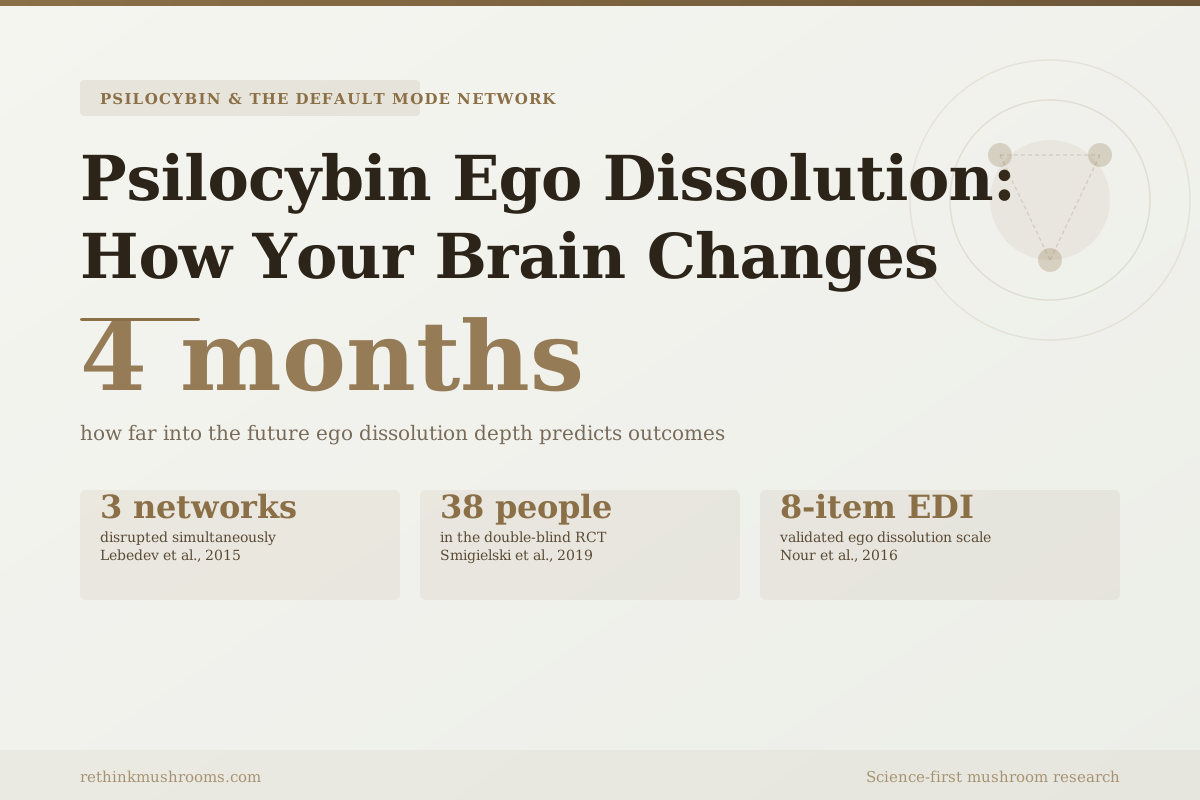
Psilocybin & the Default Mode Network
4 months
In a double-blind RCT, how deeply the brain's self-referential circuit disconnected during ego dissolution predicted how much better people felt four months after a single psilocybin session.
Smigielski et al., NeuroImage, 2019
3 networks
disrupt simultaneously during ego dissolution, not just the default mode network (Lebedev et al., 2015)
38 people
in the double-blind RCT measuring ego dissolution depth and lasting psychosocial outcomes
8 items
in the Ego Dissolution Inventory, the validated scientific scale for measuring this state
Smigielski et al., NeuroImage, 2019
 View as image ↗
The phrase "ego dissolution" appears in psilocybin research papers, retreat marketing, and Reddit threads. In most places it gets treated as a description of something that just happens during a high-dose experience, interesting but loosely defined. What these accounts miss: ego dissolution is a scientifically measured state with validated tools, specific neural correlates spanning three simultaneous network disruptions, and a predictive relationship with long-term outcomes.
This article covers ego dissolution specifically: what it is as a neurobiological event, which brain systems are involved, and what the depth of the experience predicts. For the broader architecture of the default mode network and how psilocybin affects it overall, see our guide on psilocybin and the default mode network.
Key Takeaways
- Ego dissolution has a validated scientific measurement: the Ego Dissolution Inventory (EDI), an 8-item scale developed by Nour et al. in 2016 and used across psilocybin and LSD research
- In a 2015 fMRI study (n=15), ego dissolution correlated with three simultaneous network disruptions, not just DMN suppression: medial temporal lobe disconnection from the cortex, salience network collapse, and reduced interhemispheric communication (Lebedev et al., Human Brain Mapping)
- 5-HT2A receptor binding availability before a session predicts how deep the experience goes. People with more receptors available tend toward more complete ego dissolution at the same dose (Stenbæk et al., J Psychopharmacology, 2021, n=16)
- In a double-blind RCT (n=38), the degree of mPFC-PCC decoupling during ego dissolution predicted positive psychosocial wellbeing four months after the session (Smigielski et al., NeuroImage, 2019)
- A single psilocybin dose produced decreased hippocampal-DMN functional connectivity persisting for weeks, a neurobiological residue of ego dissolution visible in brain scans (Siegel et al., Nature, 2024)
- 5-HT2A receptor changes after a single psilocybin dose correlated proportionally with lasting mindfulness increases at three-month follow-up (Madsen et al., Eur Neuropsychopharmacol, 2020, n=10)
What Makes Ego Dissolution Scientific (Not Just Phenomenological)
The measurement problem in psychedelic research is real: the most important variable is subjective experience, which is hard to quantify. For ego dissolution, that problem was largely solved in 2016 when Nour and colleagues published and validated the Ego Dissolution Inventory (EDI) in Frontiers in Human Neuroscience. It's an 8-item self-report scale in which participants rate specific experiential dimensions on a 0-100 sliding scale after a session.
The items are precise. They ask about loss of the sense of self as a distinct entity, altered experience of personal identity, dissolution of the boundary between self and world, and loss of volitional control over thoughts and actions. The scale was validated against psilocybin and LSD data, demonstrating it captures something real and distinct from general mood alteration or perceptual change (Nour et al., Front Hum Neurosci, 2016).
The EDI appears across most major psilocybin neuroimaging studies published since 2016. When Smigielski measured whether ego dissolution predicted outcomes four months later, she used it. When Lebedev correlated brain connectivity with ego dissolution in 2015, he used self-report measures that captured the same phenomenology the EDI later standardized. Having a common instrument means findings across different labs and different trials can be compared.
This matters for interpreting the research. When a study says ego dissolution predicted outcomes, it means specific scores on a validated instrument predicted those outcomes. Not a researcher's clinical impression. Not a retrospective description. A standardized, validated measure.
It also reframes the experience. Participants who score high on the EDI are fully conscious during the session. They are not sedated, not unresponsive, not asleep. They are having what many describe as among the most profoundly meaningful experiences of their lives while being monitored, their brain activity recorded and their experience captured on a scientific instrument. The word "dissolution" sounds subjective. The measure behind it is not.
Three Networks Break Down at Once: What Lebedev Found in 2015
The popular story of psilocybin and ego dissolution centers on the default mode network. The DMN gets disrupted by psilocybin, and the sense of self dissolves. This is approximately right. But a 2015 study maps the actual neural pattern more precisely, and the picture is considerably more complex.
Lebedev and colleagues scanned 15 healthy adults during psilocybin sessions using fMRI and correlated brain connectivity changes with subjective ego dissolution scores.[1] The question was direct: which specific brain connectivity changes track with the experience of losing the sense of self?
The answer involved three simultaneous disruptions.
The first: the medial temporal lobe loses its connection to the cortex. The medial temporal lobe (MTL) is the brain's autobiographical memory center. It stores personal history, constructs episodic memories, and continuously feeds the brain's self-model with information about who you have been and what you have experienced. Normally the MTL and high-level cortical areas exchange this information constantly, generating the narrative continuity of personal identity. During ego dissolution, Lebedev found that functional connectivity between the MTL and those cortical regions decreased significantly. The continuous "this is who I am and here is my history" exchange breaks down.
The second: the salience network fragments. The salience network flags what deserves attention, specifically what is self-relevant. It's what makes your name jump out of background noise at a noisy party. It's what makes a critical comment feel directed personally at you. Under psilocybin, Lebedev documented salience network disintegration that correlated with ego dissolution scores. When this network fragments, the distinction between self-relevant and non-self-relevant information collapses. Everything arrives at equal weight, or none.
The third: interhemispheric communication decreases. The two hemispheres of the brain coordinate their activity continuously through a dense network of connecting fibers. During ego dissolution, Lebedev found reduced functional communication between hemispheres. The two halves began operating more independently, contributing to the perceptual and spatial alterations that accompany the acute experience.
None of these three disruptions is the DMN simply going dark. They happen alongside the DMN changes, simultaneously, and the subjective experience is the product of multiple normally distinct systems failing in concert.
This nuance matters for interpreting what people actually report during ego dissolution. The loss of autobiographical continuity comes from the MTL disconnection. The collapse of self-other distinctions comes from the salience network disruption. The altered sense of body and space comes partly from the interhemispheric communication changes. These phenomenological features are distinct, even though they arrive together and get labeled with the single term "ego dissolution."
Understanding the three-network picture also limits a common oversimplification: that ego dissolution is simply the conscious mind going quiet. Three separate systems that normally cooperate to construct the self break down simultaneously. What people experience is the product of all three breaking down at once.
Mechanism · Ego Dissolution
Ego Dissolution Is Not One Network Going Offline — It Is Three at Once
The popular “DMN off-switch” framing undersells the science. Lebedev et al. (2015) found ego dissolution correlates with three partly-independent disruptions happening simultaneously — the DMN is necessary but not sufficient.
DMN decoupling
The self-referential hub circuit uncouples. The magnitude of mPFC-PCC decoupling tracks the depth of the experience.
Carhart-Harris 2012 (n=30) · Lebedev 2015
Medial temporal lobe ⇄ cortex
The structure that anchors self in autobiographical and spatial context disconnects from high-level cortex.
Lebedev 2015 (n=15)
Salience network collapse
The system that flags what is personally meaningful loses coherence, so the normal self-relevance filter breaks down.
Lebedev 2015 (n=15)
Because three systems must decouple together, full ego dissolution feels total — it is the coordinated infrastructure of self-experience becoming incoherent across parallel systems, not a single switch. Siegel 2024 reframes even the DMN piece as desynchronization, not suppression.
Source: Lebedev et al. (2015); Carhart-Harris et al. (2012); Siegel et al. (2024)
Why Receptor Density Shapes How Deep the Experience Goes
At a fixed dose of psilocybin, different people have very different experiences. Some reach what researchers describe as complete ego dissolution: high EDI scores, a sense of total boundary dissolution, unity with surroundings, loss of personal identity. Others have altered perception and mood without losing the sense of self in any meaningful way. The variance isn't random.
In a 2019 PET study, Madsen and colleagues gave 8 healthy adults different doses of psilocybin while simultaneously measuring 5-HT2A receptor occupancy and psilocin blood levels alongside subjective psychedelic intensity ratings.[2] The 5-HT2A receptor is the primary serotonin receptor type that psilocybin activates. Higher receptor occupancy, meaning more of those receptors actually bound by psilocin, directly correlated with more intense psychedelic effects. The pharmacokinetics and the phenomenology were connected through a measurable biochemical link.
Stenbæk and colleagues pushed this further in 2021. Using PET imaging in 16 participants, they measured each person's 5-HT2A receptor binding availability at baseline, before any drug, and then gave them psilocybin and measured the resulting mystical experience using validated scales.[3] Baseline receptor availability predicted both the intensity of mystical-type experiences and the degree of temporal distortion. People with more 5-HT2A receptors available before the session tended toward deeper experiences at the same dose.
The implication is specific: the ceiling for how completely the sense of self dissolves under a given dose is partly set by a person's neurobiology before the session begins. Set and setting matter. Dose matters. But receptor density, a variable that can't be changed by preparation or intention, also matters.
This is one reason clinical trials find wide variance in response at fixed doses, and one reason researchers are beginning to consider whether dose individualization informed by neurobiological markers could improve consistency of outcomes. For more on how receptor activation translates into network-level effects at the cellular level, see our article on psilocybin and 5-HT2A receptors.
The mPFC and PCC: Where the Continuous Self Lives
Within the broader three-network disruption, two regions are consistently at the center of the ego dissolution story: the medial prefrontal cortex (mPFC) and the posterior cingulate cortex (PCC).
The mPFC is the brain's self-referential thinking region. It's most active when you evaluate yourself, imagine your future, or model what someone else is thinking about you. The PCC is the brain's autobiographical anchor. It connects current experience to personal history and maintains the continuity of being the same self across time.
These two regions communicate constantly. Their coupling is, in functional terms, the neural substrate of the coherent, persistent sense of self.
In the foundational 2012 fMRI study, Carhart-Harris and colleagues documented a specific finding across 30 participants: psilocybin caused a significant decrease in positive functional coupling between the mPFC and PCC.[4] More important than the disruption itself was its relationship to the experience: the magnitude of mPFC-PCC decoupling directly predicted how intensely altered each participant's consciousness was. More decoupling, more profound subjective alteration. The self-referential circuit doesn't just break down under psilocybin. It breaks down in proportion to the pharmacological effect, creating a dose-response relationship within the network itself.
This finding connects to the Smigielski study in section 5: the same mPFC-PCC coupling magnitude that Carhart-Harris found to predict acute experience intensity turns out to also predict outcomes months later. For the full foundational account of the DMN's anatomy and how psilocybin affects its wider connectivity, see psilocybin and the default mode network.
How Deep Ego Dissolution Goes Predicts Outcomes Four Months Later
The critical question isn't whether ego dissolution is interesting as a brain phenomenon. It's whether depth matters therapeutically, and if so, how much.
A 2019 study by Smigielski and colleagues provides the most direct evidence on this question. The design was rigorous: a double-blind, placebo-controlled RCT in which 38 participants attended a five-day mindfulness meditation retreat and received either a high dose of psilocybin or placebo during the retreat.[5] The mindfulness context was controlled because mindfulness practice itself affects DMN activity. Randomizing within the retreat allowed the study to isolate the psilocybin contribution.
Three things were measured: fMRI connectivity during the session (specifically mPFC-PCC coupling), EDI scores capturing ego dissolution depth, and psychosocial wellbeing at multiple follow-up assessments, including four months after the session.
Two findings stood out.
First: the degree of mPFC-PCC decoupling during the session correlated with the EDI score. Greater circuit decoupling corresponded to higher ego dissolution scores, confirming that the self-referential network's uncoupling is the neural substrate of the subjective experience.
Second, and more important: both the extent of ego dissolution during the session and the lasting DMN connectivity changes observed in the weeks after predicted psychosocial wellbeing four months later. Participants with deeper ego dissolution during the retreat, those with greater mPFC-PCC uncoupling and higher EDI scores, reported better psychological functioning four months out.
The specific implication matters beyond the neuroscience: it's not enough to take psilocybin. It's not enough to have some kind of altered state. How completely the self-referential circuit actually disintegrated during the session predicted the lasting benefit. Partial and complete ego dissolution appear to produce different magnitudes of effect.
This is not a small open-label study with self-selected clinical participants. It's a randomized controlled trial in a structured context with blinding and follow-up. The predictive relationship between ego dissolution depth and four-month outcomes is about as methodologically solid as this literature gets.
Smigielski et al. (2019) · NeuroImage
- Population
- 38 healthy adults in a 5-day mindfulness retreat (double-blind, placebo-controlled RCT)
- Intervention
- High-dose psilocybin (315 µg/kg) during mindfulness retreat + fMRI connectivity and EDI measures
- Comparator
- Placebo within the same retreat setting
- Finding
- Degree of mPFC-PCC decoupling during the session predicted psychosocial wellbeing four months later — deeper ego dissolution correlated with better outcomes; the neural and subjective measures aligned
positive Most methodologically rigorous trial directly linking ego dissolution depth to lasting outcomes
Smigielski L, Scheidegger M, Kometer M et al. NeuroImage. 2019. PMID 30965131
For how this same predictive pattern extends into depression treatment, where the stakes are higher and the baseline DMN hyperactivity is more pronounced, see default mode network and depression. For the specific relationship between ego dissolution and mystical experience, and why the quality of what happened during the session predicts clinical outcomes, see DMN disruption and mystical experience.
What the Brain Looks Like Weeks After: Two Lasting Neurobiological Markers
If the acute ego dissolution state lasts four to six hours, what evidence exists that it leaves any lasting trace in the brain?
Two independent lines of evidence point in the same direction.
The first comes from Siegel and colleagues' 2024 Nature study. Using dense-sampling fMRI across multiple sessions before, during, and after psilocybin, they identified a specific connectivity change that persisted long after the session ended: hippocampal-DMN functional connectivity remained decreased for weeks.[6] The hippocampus is central to memory consolidation and contextual processing. Normally it maintains close functional coupling with DMN regions. After psilocybin, that coupling stayed suppressed. Participants are fully lucid weeks after the experience, so this is not the acute ego dissolution continuing. It may be a structural residue of it: a lasting shift in how personal memory and self-reference communicate, potentially underlying the reduction in rigid self-referential thought patterns that clinical researchers observe.
The second line of evidence operates at the molecular level. In a 2020 longitudinal PET study, Madsen and colleagues followed 10 participants after a single psilocybin dose, measuring neocortical 5-HT2A receptor binding at one week post-session and tracking mindfulness through a three-month follow-up.[7] While mean receptor binding did not change significantly across individuals, a proportional relationship emerged between individual receptor change and lasting mindfulness gains. The serotonin receptors that psilocybin activated, the trigger for the ego dissolution cascade, appeared to remodel in a person-specific way, and that remodeling tracked with downstream psychological change.
This correlation was proportional: participants with the largest receptor downregulation showed the largest lasting mindfulness increase at three months.
Two independent biological measures, one at the brain network level and one at the molecular receptor level, both showed lasting change after a single experience, and both tracked with lasting psychological change. For a fuller account of how these structural changes manifest across the cortex and hippocampus, see our article on psilocybin and neuroplasticity.
What the Simple Story Gets Wrong
The popular account of psilocybin ego dissolution, that psilocybin quiets the ego by turning off the DMN, is useful as a first approximation. It captures something real. But it understates the complexity in two ways worth correcting.
First: ego dissolution is not DMN suppression alone. As Lebedev documented in 2015, it requires simultaneous disruption across the autobiographical memory system, the salience network, and interhemispheric coordination alongside the DMN changes. These systems normally cooperate to construct and maintain the subjective self. The full ego dissolution experience appears to require all of them breaking down together, not just one.
Second: "quieting" misdescribes the mechanism. As Siegel documented in 2024, the more accurate characterization is desynchronization. The networks themselves don't go dark. Their temporal structure, the coordinated firing patterns that make them coherent functional units, dissolves. Something like a symphony losing its conductor while the individual musicians keep playing.
These distinctions matter beyond semantic precision. Understanding that ego dissolution involves the salience network explains why people lose the self-other distinction, not just the self-narrative. Understanding that the mechanism is desynchronization rather than suppression opens a more accurate picture of what recovery looks like: as networks resynchronize in the days after the session, they may resynchronize into a different configuration than before, with Siegel's persistent hippocampal-DMN disconnection providing one structural piece of that evidence. For a closer look at the step-by-step mechanics of what happens as the DMN goes offline and what returns in the days that follow, see what happens when the DMN goes offline.
The simple story built the field's early intuitions and was necessary for getting here. The more precise version is what researchers are now measuring and using to design better therapeutic approaches.
Safety
ModerateNot Medical Advice: Psilocybin Is a Controlled Substance
Concern
Psilocybin remains Schedule I in the United States and is controlled in most countries. All clinical research cited here was conducted in licensed facilities with rigorous screening, medical supervision, and structured support protocols.
What the research says
This article describes peer-reviewed scientific findings about brain mechanisms during psilocybin-induced ego dissolution. It is not a recommendation to use psilocybin, and the research context (controlled RCTs with extensive professional support) differs substantially from unmonitored use.
Particularly relevant for: Anyone with a personal or family history of psychotic disorders, bipolar I, or other contraindicated conditions — clinical trials systematically screen these individuals out
What to do
Consult a qualified healthcare provider before considering any psychedelic-assisted therapy
Smigielski et al. (2019), Stenbæk et al. (2021), Lebedev et al. (2015) — all controlled research settings
The Bottom Line
Ego dissolution on psilocybin is a scientifically measured state, not just phenomenological description. Neuroimaging shows it involves three simultaneous network disruptions, not just DMN suppression, and the depth of that disruption, measured by validated tools, predicts psychosocial outcomes four months later. Two independent neurobiological markers, persistent hippocampal-DMN connectivity changes and receptor-level molecular remodeling tracked at three-month follow-up, confirm the event leaves a structural residue well beyond the acute experience.
Frequently Asked Questions
Sources & References
- 1RTHM-00706·Lebedev, Alexander V et al. (2015). “Finding the self by losing the self: Neural correlates of ego-dissolution under psilocybin..” Human brain mapping.Study breakdown →PubMed →↩
- 2RTHM-00578·Madsen, Martin K et al. (2019). “Psychedelic effects of psilocybin correlate with serotonin 2A receptor occupancy and plasma psilocin levels..” Neuropsychopharmacology : official publication of the American College of Neuropsychopharmacology.Study breakdown →PubMed →↩
- 3RTHM-00720·Stenbæk, Dea Siggaard et al. (2021). “Brain serotonin 2A receptor binding predicts subjective temporal and mystical effects of psilocybin in healthy humans..” Journal of psychopharmacology (Oxford.Study breakdown →PubMed →↩
- 4RTHM-00245·Carhart-Harris, Robin L et al. (2012). “Neural correlates of the psychedelic state as determined by fMRI studies with psilocybin..” Proceedings of the National Academy of Sciences of the United States of America.Study breakdown →PubMed →↩
- 5RTHM-01123·Smigielski, Lukasz et al. (2019). “Psilocybin-assisted mindfulness training modulates self-consciousness and brain default mode network connectivity with lasting effects..” NeuroImage.Study breakdown →PubMed →↩
- 6RTHM-00911·Siegel, Joshua S et al. (2024). “Psilocybin desynchronizes the human brain..” Nature.Study breakdown →PubMed →↩
- 7RTHM-00635·Madsen, Martin Korsbak et al. (2020). “A single psilocybin dose is associated with long-term increased mindfulness, preceded by a proportional change in neocortical 5-HT2A receptor binding..” European neuropsychopharmacology : the journal of the European College of Neuropsychopharmacology.Study breakdown →PubMed →↩