Psilocybin & the Default Mode Network
5 steps
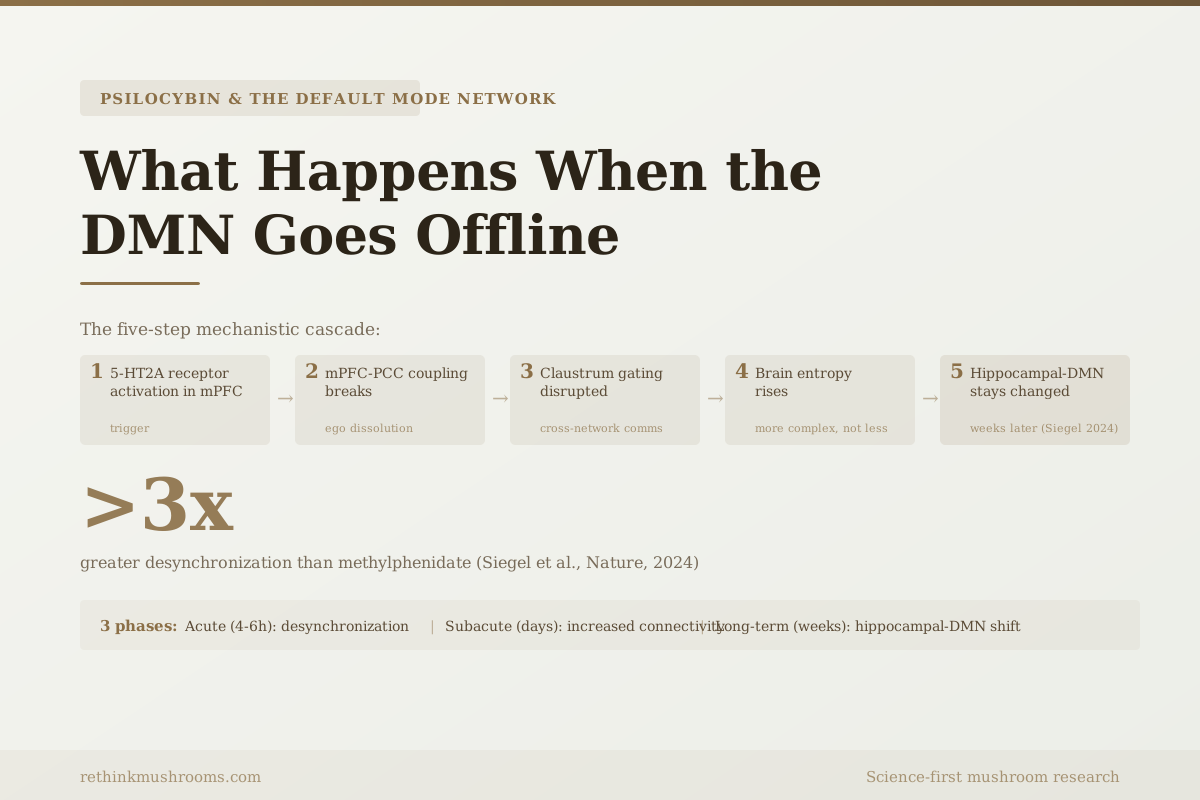
When psilocybin disrupts the default mode network, five distinct changes unfold in sequence: from receptor activation to brain desynchronization to cross-network communication to lasting hippocampal-DMN disconnection weeks later.
Siegel JS et al., Nature, 2024; Carhart-Harris RL et al., PNAS, 2012
>3x
greater brain desynchronization than methylphenidate in the most comprehensive psilocybin brain imaging study conducted (Siegel et al., Nature, 2024)
claustrum
the consciousness-gating hub whose disruption unleashes cross-network communication during the psilocybin state (Barrett et al., 2020)
weeks
how long hippocampal-DMN connectivity stays decreased after a single session, a lasting structural echo of the acute experience (Siegel et al., 2024)
Siegel JS et al., Nature, 2024; Carhart-Harris RL et al., PNAS, 2012
 View as image ↗
Most accounts of psilocybin and the default mode network describe the same thing: the DMN goes quiet, and people experience ego dissolution. This is accurate as far as it goes. But the mechanistic sequence is more specific than "quiet." There is a distinct cascade that starts at the receptor level, disrupts several brain systems in a particular order, and leaves measurable structural changes that last weeks after the acute experience ends.
Understanding the sequence matters because it explains why psilocybin's effects look nothing like other serotonergic drugs, why the experience produces what it does, and why a single four-to-six-hour session can produce lasting changes at all. This article is part of our series on psilocybin and the default mode network.
Key Takeaways
- Psilocybin desynchronizes the brain rather than suppressing it: a 2024 Nature study found it disrupted functional connectivity across all brain networks at more than 3x the magnitude of methylphenidate (Siegel et al., n=7)
- The core DMN disruption is a decrease in mPFC-PCC functional coupling; the magnitude of that decoupling directly predicts subjective experience intensity, creating a dose-response relationship within the network (Carhart-Harris et al., PNAS, 2012, n=30)
- The claustrum, which normally acts as a gating hub coordinating cross-network communication, is disrupted by psilocybin; when it loses its gating function, isolated brain networks begin communicating freely (Barrett et al., NeuroImage, 2020, n=15)
- When the DMN desynchronizes, brain signal diversity actually increases; the brain becomes more information-rich, not less, during the psilocybin state (Schartner et al., Scientific Reports, 2017, n=15)
- The antidepressant effect correlates with increased global brain integration after psilocybin, when previously isolated networks start connecting; not with DMN suppression per se (Daws et al., Nature Medicine, 2022, n=59)
- Hippocampal-DMN functional connectivity stays decreased for weeks after a single psilocybin session, providing a structural basis for lasting change from a single experience (Siegel et al., Nature, 2024)
Not "Quiet": Why the Desynchronization Framing Changes the Story
Default Mode Network
Does psilocybin simply 'switch off' the DMN?
The claim
“Psilocybin quiets or switches off the default mode network, and that suppression is what produces ego dissolution and therapeutic benefit.”
Early popular-science framing of the DMN as the brain's 'ego center' that gets turned down.
What research shows
MisleadingThe most comprehensive human imaging study to date describes desynchronization, not suppression: psilocybin disrupted functional connectivity across all brain networks at more than threefold the magnitude of methylphenidate, dissolving the network's temporal coordination rather than silencing its regions.
Brain signal diversity actually rises during the experience, and the antidepressant effect tracks global integration after the session, not DMN suppression itself.
Siegel et al., Nature, 2024 (n=7); Daws et al., Nature Medicine, 2022 (n=59)
The language used to describe what psilocybin does to the default mode network matters more than it might seem.
Most popular science accounts say psilocybin "quiets" or "turns off" the DMN. Quieting implies a reduction in activity, a silence where there was noise. This framing leads to a specific mental model: the overactive self-narrative gets suppressed, the ego goes offline, and therapeutic change follows from that suppression.
In 2024, Siegel and colleagues published what is likely the most comprehensive human brain imaging study of psilocybin ever conducted, in Nature.[1] Using dense-sampling fMRI with multiple scans across multiple sessions before, during, and after psilocybin, they found that psilocybin disrupted functional connectivity across all brain networks at more than three times the magnitude of methylphenidate. And the characterization they used was not "quieting." It was desynchronization.
Desynchronization describes something distinct from suppression. Brain networks are not defined by their activity levels alone. They're defined by their temporal coordination: the synchronized firing patterns across regions that make a set of areas function as a coherent unit. When psilocybin desynchronizes the DMN, the regions don't necessarily go silent. The coordinated temporal structure that makes them a functional network dissolves. Something like an orchestra losing its conductor while the musicians keep playing.
Siegel et al. (2024) · Nature
- Population
- Healthy adults tracked with roughly 18 MRI visits each, before, during, and for 3 weeks after dosing (n=7)
- Intervention
- High-dose psilocybin (25 mg)
- Comparator
- Methylphenidate (40 mg)
- Finding
- Psilocybin disrupted functional connectivity more than threefold beyond methylphenidate via desynchronization across spatial scales; hippocampal-DMN connectivity stayed decreased for weeks.
positive Largest precision-imaging dataset on psilocybin to date; small N is inherent to the dense-sampling design.
Siegel JS et al., Nature, 2024;632(8023):131-138
This distinction has consequences for understanding what the acute experience feels like and what happens afterward. Desynchronization isn't binary. It can occur at different depths and in different patterns across the network, and the Siegel data shows that the depth of desynchronization correlates with both the subjective experience and the lasting changes.
What Happens in Sequence: Five Steps From Receptor to Brain State
When psilocybin enters the brain, it converts to psilocin, which activates specific serotonin receptors. What follows is a sequence that has been mapped across more than a decade of neuroimaging research.
Step 1: 5-HT2A receptor activation in the DMN's principal hubs. The 5-HT2A serotonin receptor is densely expressed in two specific brain regions: the medial prefrontal cortex (the self-referential thinking region) and the posterior cingulate cortex (the autobiographical anchor that connects current experience to personal history). Psilocin activates these receptors, triggering the downstream cascade.
Step 2: Decreased blood flow and activity within the DMN. As receptor activation propagates, cerebral blood flow in the mPFC decreases. Carhart-Harris and colleagues' 2017 study in 20 patients with treatment-resistant depression documented this directly: psilocybin acutely decreased blood flow in the mPFC, the primary self-referential hub, with the decrease correlating with subjective psychedelic effect intensity.[7]
Step 3: mPFC-PCC coupling breaks, ego dissolution begins. The functional coupling between the mPFC and the posterior cingulate cortex decreases. This is the core DMN disruption. Carhart-Harris et al.'s foundational 2012 fMRI study (n=30) documented that the magnitude of this decoupling directly predicted the intensity of the subjective experience.[2] As the self-referential circuit uncouples, the continuous sense of personal identity temporarily dissolves. Ego dissolution also involves simultaneous disruption of the medial temporal lobe, salience network, and interhemispheric communication, as Lebedev and colleagues documented in 2015 (n=15).[5] For the full picture of what ego dissolution involves neurologically, see our article on psilocybin ego dissolution and brain changes.
Step 4: The claustrum loses its gating function; cross-network communication increases. The claustrum is a thin, sheet-like structure proposed to act as the brain's conductor, coordinating the timing of communication between major brain networks. Under normal conditions, the claustrum gates cross-network communication, keeping attentional networks, sensory systems, and the default mode network operating in their appropriate domains. Barrett and colleagues' 2020 fMRI study (n=15) documented that psilocybin disrupted claustrum connectivity with the DMN and with attentional networks simultaneously.[3] When the gating fails, brain networks that normally operate in isolation begin communicating freely.
Step 5: Brain entropy rises. As the DMN desynchronizes and cross-network communication expands, the overall brain state becomes more information-rich. Schartner and colleagues' 2017 MEG study (n=15) measured neural signal diversity, a marker of brain complexity, before and after psilocybin and found a significant increase during the psilocybin state compared to placebo.[4] The brain doesn't become simpler as the DMN quiets. It becomes more complex. More patterns, more potential states, more information per unit of time.
The Claustrum: The Lost Conductor That Unleashes the Brain
The claustrum is not typically discussed in popular accounts of psilocybin neuroscience. Barrett and colleagues' 2020 study is the reason it should be.
The claustrum is a thin sheet of neurons tucked inside each cerebral hemisphere. Its extensive connectivity to almost all cortical regions gave researchers a hypothesis: that it acts as a global coordinator of brain activity, something like the conductor of an orchestra. It doesn't produce the music, but it controls when different instruments enter and how they relate to each other. The hypothesis, associated with the neuroscientist Francis Crick, is that the claustrum plays a role in coordinating the coherent experience of consciousness.
Barrett's team ran fMRI in 15 healthy volunteers before and after psilocybin and found that psilocybin specifically disrupted claustrum connectivity with both the default mode network and with attentional networks.[3] The claustrum, which normally participates in coordinating the separation between different processing domains, lost its coordinating function under psilocybin.
The experiential consequences fit. When the claustrum stops gating cross-network communication, sensory processing regions begin talking directly to self-referential regions, attentional networks connect to memory systems in novel ways, and the normal boundaries between what is self-relevant and what is environmental dissolve. This is the neural mechanism behind the synesthesia, the loss of boundaries, and the sense that everything is connected that people report during psilocybin experiences.
This is also a significant explanatory contribution that standard DMN accounts miss entirely. "The DMN went quiet" doesn't explain why people experience the merging of senses or the dissolution of the self-environment boundary. "The claustrum lost its gating function" does.
The Entropy Finding: Why the Brain Gets More Complex as the DMN Goes Down
Here is the counterintuitive result that most accounts miss entirely.
When people hear that psilocybin "suppresses" the default mode network, they often assume the brain gets simpler or quieter. Something gets turned off. The overall neural state becomes less active.
The opposite is true.
Schartner and colleagues used magnetoencephalography (MEG) to measure neural signal diversity in 15 participants given psilocybin versus placebo.[4] MEG captures the magnetic fields produced by electrical activity in neurons, and signal diversity measures how unpredictable and complex the patterns of that activity are over time. More diversity means more potential states the brain can occupy, more information encoded per unit of time.
Psilocybin significantly increased neural signal diversity compared to placebo. The brain under psilocybin was generating more distinct patterns of activity, not fewer. The DMN's normal structured coordination contributes to a kind of predictability in the brain's overall behavior. When that structure dissolves, the brain accesses more of its potential state space.
This is the empirical basis for what the theoretical neuroscientist Robin Carhart-Harris called the "entropic brain." The DMN going offline isn't the brain going quiet. It's the brain's normal constraints on its own state space relaxing, allowing access to a wider range of neural patterns. For the full theoretical framework connecting entropy, consciousness, and psilocybin's mechanism, see our articles on how psilocybin increases brain entropy and the entropic brain theory.
Three Distinct Phases: What the Brain Looks Like After the DMN Goes Down
Understanding what happens when the DMN goes offline requires distinguishing three separate time periods, each with a different neural profile.
The acute phase (4-6 hours): Massive desynchronization across all brain networks, as documented by Siegel 2024.[1] DMN connectivity is at its lowest. Claustrum gating is disrupted. Neural entropy is at its peak. The mPFC-PCC coupling is broken. This is the phase that produces the psychedelic experience.
The subacute phase (days to weeks): The desynchronization resolves and connectivity begins recovering, but not necessarily back to baseline. Carhart-Harris and colleagues' 2017 fMRI study in treatment-resistant depression (n=20) documented that after psilocybin, post-treatment functional connectivity actually increased compared to pre-treatment baseline, not just recovered.[7] The brain reorganized into a more connected state than before. Clinicians sometimes describe this period as an "afterglow": participants report feeling unusually open, flexible, and emotionally available. The fMRI data may be explaining why.
The long-term phase (weeks and beyond): Siegel and colleagues' 2024 study identified a specific connectivity change that persisted across the entire follow-up period after the acute state resolved: hippocampal-DMN functional connectivity remained decreased.[1] The hippocampus is central to memory consolidation and contextual processing. Normally it maintains close functional coupling with DMN regions. After psilocybin, that coupling stayed suppressed. This is not the continuation of the acute experience. It's a structural residue of it: a lasting shift in how personal memory and self-reference communicate, measurable on a brain scanner weeks after the session.
These three phases are not just interesting neuroscience. They explain how a single four-to-six-hour experience produces changes that last months.
What "Offline" Means for Depression: The Global Integration Finding
The question that connects all of this to clinical outcomes: which of these brain changes actually predicts antidepressant response?
Daws and colleagues' 2022 Nature Medicine study provided the most direct answer. Using fMRI data from the Carhart-Harris 2021 NEJM clinical trial (n=59), they examined which brain changes after psilocybin correlated with depression recovery over six weeks.[6]
The answer was not DMN suppression per se. It was global brain integration: the degree to which previously isolated brain networks began communicating with each other after the psilocybin session. The DMN's rigid modularity dissolved. Networks that normally operated independently started connecting. The brain's functional architecture became more integrated, less siloed.
This global integration was the specific biomarker that correlated with antidepressant response. Patients who showed more integration after the session showed more depression recovery. Patients who showed less integration showed less recovery.
- Cell / receptor workcompleted
5-HT2A activation in mPFC and PCC mapped as the trigger for the cascade.
- Animal neuroplasticitycompleted
Psilocybin induces cortical and hippocampal plasticity in animal models.
- Human imaging case seriescompleted
Precision fMRI/MEG in small samples documents desynchronization, entropy rise, and claustrum disruption.
- Small clinical trialscurrent
Daws 2022 (n=59, from the Carhart-Harris 2021 NEJM trial) links post-session global integration to depression recovery.
- Large confirmatory RCTsmissing
No large trial has yet confirmed global integration as a prospective biomarker of antidepressant response.
- Meta-analysismissing
Awaiting replication across multiple powered trials.
The mechanism is biologically grounded and supported by human imaging, but the integration-to-recovery link rests on small-trial correlational data. It is a leading hypothesis, not a settled biomarker.
Daws et al., Nature Medicine, 2022 (n=59); Siegel et al., Nature, 2024
The relationship between the sequence described in this article and the therapeutic mechanism is now visible. The DMN goes offline (steps 1-3 in the sequence). Cross-network communication increases via the claustrum and through desynchronization-enabled integration (step 4). The brain's rigid self-referential structure dissolves into broader connectivity. And it's that dissolution into broader connectivity, captured as global integration in the Daws data, that predicts whether someone gets better.
For a deeper look at how this depression-specific mechanism plays out, see default mode network and depression. For the role the mystical experience during the session plays in whether the integration occurs, see DMN disruption and mystical experience.
The Bottom Line
When psilocybin disrupts the default mode network, a specific five-step cascade unfolds: receptor activation in the DMN's principal hubs, decreased blood flow and mPFC-PCC decoupling, loss of claustrum gating, and rising brain entropy as cross-network communication expands. The acute phase produces the psychedelic experience; the subacute phase produces increased connectivity; the long-term phase leaves a persistent hippocampal-DMN disconnection. The antidepressant effect correlates not with the suppression but with the global integration that follows.
Frequently Asked Questions
Sources & References
- 1RTHM-00911·Siegel, Joshua S et al. (2024). “Psilocybin desynchronizes the human brain..” Nature.Study breakdown →PubMed →↩
- 2RTHM-00245·Carhart-Harris, Robin L et al. (2012). “Neural correlates of the psychedelic state as determined by fMRI studies with psilocybin..” Proceedings of the National Academy of Sciences of the United States of America.Study breakdown →PubMed →↩
- 3RTHM-00608·Barrett, Frederick S et al. (2020). “Psilocybin acutely alters the functional connectivity of the claustrum with brain networks that support perception, memory, and attention..” NeuroImage.Study breakdown →PubMed →↩
- 4RTHM-00489·Schartner, Michael M et al. (2017). “Increased spontaneous MEG signal diversity for psychoactive doses of ketamine, LSD and psilocybin..” Scientific reports.Study breakdown →PubMed →↩
- 5RTHM-00706·Lebedev, Alexander V et al. (2015). “Finding the self by losing the self: Neural correlates of ego-dissolution under psilocybin..” Human brain mapping.Study breakdown →PubMed →↩
- 6RTHM-00752·Daws, Richard E et al. (2022). “Increased global integration in the brain after psilocybin therapy for depression..” Nature medicine.Study breakdown →PubMed →↩
- 7RTHM-00463·Carhart-Harris, Robin L et al. (2017). “Psilocybin for treatment-resistant depression: fMRI-measured brain mechanisms..” Scientific reports.Study breakdown →PubMed →↩