Psilocybin & PTSD
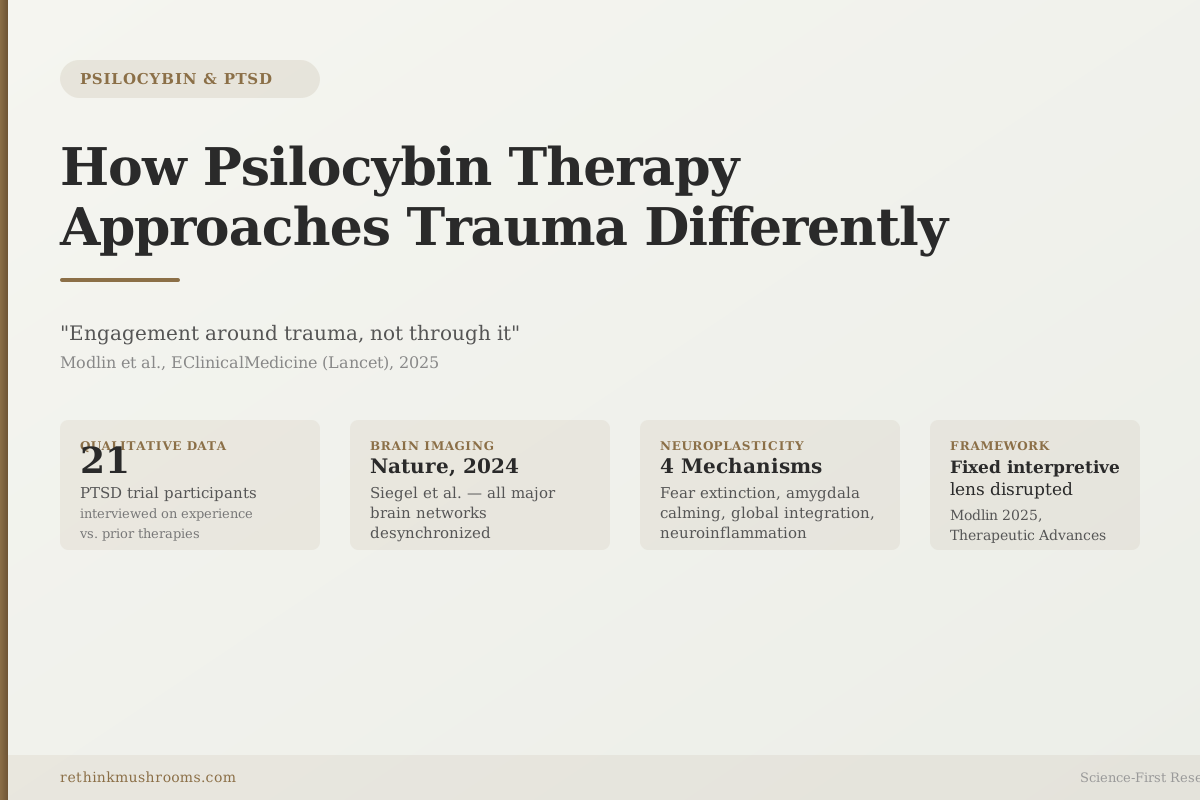
21 participants
In the first qualitative study of psilocybin treatment for PTSD, most participants did not directly relive traumatic memories. They processed affect, body sensations, and self-transcendent states instead.
Modlin et al., EClinicalMedicine (Lancet), 2025
4 mechanisms
mapped specifically to PTSD neurobiology
Not re-exposure
participants processed 'around' trauma
2025 neuroscience
Siegel et al., Nature — psilocybin desynchronizes all brain networks
Modlin et al., EClinicalMedicine (Lancet), 2025
 View as image ↗
Every established trauma therapy works by confronting the memory. EMDR uses eye movements to reprocess it. Cognitive Processing Therapy builds a structured narrative around it. Prolonged Exposure requires repeatedly recounting it in clinical detail. The underlying logic is the same: the traumatic memory must be engaged directly to lose its grip.
Psilocybin does something different — and the data on how it differs is only just arriving. A 2025 qualitative study nested inside a clinical PTSD trial found that most participants did not relive their traumatic memories during psilocybin sessions at all. They engaged with affect, physical sensations, and experiences that felt larger than self-narrative. And they described this indirect route as reaching places that direct confrontation never could.[2]
This article looks at what psilocybin actually does in the brain during and after a session — and why those specific changes are particularly relevant to trauma. For a review of the clinical trial evidence in PTSD patients, see Psilocybin for PTSD: What the Clinical Trials Show.
Key Takeaways
- In a 2025 qualitative study of psilocybin PTSD treatment (Modlin et al., EClinicalMedicine, n=21), most participants did not directly revisit traumatic memories — they processed affect, body sensations, and self-transcendent states "around" the trauma
- A parallel 2025 paper (Modlin et al., Therapeutic Advances) proposes that PTSD traps the brain in a "pre-determined interpretive framework" that filters all experience through trauma — and that psilocybin's unique value is disrupting this framework, not just reducing symptoms
- Psilocybin promotes new cell growth in the brain region responsible for memory and fear learning (hippocampal neurogenesis), which enhances fear extinction — the brain's process for unlearning conditioned threat responses (Catlow et al., 2013)
- A 2024 Nature study (Siegel et al., n=12) found that psilocybin simultaneously desynchronizes all major brain networks — the largest psilocybin neuroimaging dataset to date — with effects that persist for weeks after a single dose
- Psilocybin also reduces activity in the brain's threat-detection center (amygdala) after treatment, with fMRI evidence from Carhart-Harris et al. (2017, n=20) showing decreased reactivity to negative stimuli
- Neuroinflammation is a documented feature of chronic PTSD; a 2025 study found psilocybin reduces microglial (brain immune cell) activity through a pathway separate from serotonin signaling (Laabi et al., International Immunopharmacology)
"Around" the Trauma, Not "Through" It: What Participants Actually Reported
The standard model of trauma therapy holds that the memory must be accessed to be changed. You return to it, under controlled conditions, until the fear response is extinguished. This is not comfortable, but it has decades of evidence behind it.
When Modlin and colleagues interviewed 21 participants enrolled in a psilocybin PTSD clinical trial, they were trying to understand what the treatment experience actually looked like from the inside.[2] What they found contradicted the exposure model almost entirely.
Most participants did not revisit traumatic memories during their psilocybin sessions. What they processed instead fell into three categories: emotional affect (grief, fear, sadness, love) that felt unanchored to specific events; physical body sensations, sometimes intense; and experiences that participants described as self-transcendent — a loosening of the usual sense of being a bounded self with a fixed history.
Participants consistently described this as distinct from any prior therapy. They used phrases like "getting underneath" the trauma, or engaging with its emotional residue without confronting the narrative of what happened. Several described being able to approach the emotional weight of traumatic events without the dissociation or flooding that had blocked direct engagement in prior treatments.
The study identified four core themes in participant experience: (1) non-pharmacological safety factors — the therapist relationship and physical environment shaped the quality of the experience substantially; (2) the experiential and embodied nature of the treatment, distinct from talk therapy; (3) engagement with trauma-related material, but through affect and sensation rather than narrative; and (4) comparison with prior therapies, with most describing psilocybin as enabling something previous treatments had not.
The finding that stands out is not that psilocybin helped — it's how. The most common prior therapies among participants had required them to confront the traumatic memory directly and had not produced lasting relief. Psilocybin produced engagement "around" the trauma that participants described as reaching it more effectively.
The Fixed Lens: Why PTSD Is Not Just Severe Anxiety
Understanding why psilocybin might work differently for PTSD requires understanding what PTSD actually does to the brain — and it's more than a fear response that won't turn off.
A 2025 paper by Modlin and colleagues in Therapeutic Advances in Psychopharmacology proposes a framework for thinking about this.[3] They describe PTSD as establishing what they call a "pre-determined interpretive framework" — a fixed lens through which all new experience gets processed. Sensory input, social interactions, future possibilities — all filtered through the prior conclusion that the world is dangerous and the self is damaged or at fault.
This is not simply heightened anxiety. It is a perceptual and cognitive rigidity. The trauma doesn't just cause distress in the moment; it rewrites the default interpretation of experience going forward.
SSRIs, the most commonly prescribed treatments for PTSD, reduce the emotional intensity of this processing — they turn down the volume on distress. But they do not restructure the framework itself. The interpretive lens remains; it just generates less acute suffering. This explains why SSRI response rates in PTSD are lower than in depression, and why discontinuation of SSRIs in PTSD patients frequently leads to return of symptoms rather than lasting remission.
The hypothesis in Modlin 2025 is that psilocybin's value in PTSD is specifically its capacity to disrupt this fixed framework — not just to reduce symptoms, but to temporarily dissolve the lens through which trauma filters all experience, creating a window in which the framework can be reconstructed less rigidly.
This clinical conceptualization is distinct from the depression protocol, and it suggests that PTSD treatment with psilocybin may require different therapeutic support structures than the depression protocol on which most current trials are modeled.[10]
How Psilocybin Disrupts the Fixed Lens: Four Mechanisms From the Neuroscience
A 2024 review by Choi and colleagues in the Journal of Psychopharmacology mapped psilocybin's pharmacology specifically to the neurobiology of PTSD — the most comprehensive such mapping to date.[1] Four pathways are relevant.
Fear extinction via new brain cell growth. The brain's fear learning center (the hippocampus — the seahorse-shaped structure in the temporal lobe responsible for forming and contextualizing memories) can generate new neurons. This capacity, called neurogenesis, is required for the brain to learn that a previously threatening situation is now safe. In PTSD, this process is impaired — the brain keeps activating fear responses to contextually safe cues because it cannot update its threat model.
A 2013 animal study by Catlow and colleagues found that even low doses of psilocybin enhanced new cell growth in the hippocampus and accelerated the extinction of conditioned fear responses in mice.[4] This was the first mechanistic evidence linking psilocybin to the specific neuroplasticity failure that maintains PTSD symptoms — not the first evidence that psilocybin changes the brain, but the first showing it targets the right change for fear-based disorders.
Amygdala calming after treatment. The amygdala, the brain's threat-detection center, is chronically overactive in PTSD. It reacts to reminders and neutral stimuli as if they were genuine threats, generating the hyperarousal and intrusive reactivity that define the disorder.
Carhart-Harris and colleagues found in a 2017 fMRI study of treatment-resistant depression patients that psilocybin produced a post-acute reduction in amygdala reactivity to negative stimuli.[5] Participants' threat-detection centers became less hair-trigger after treatment — not blunted, but recalibrated to respond more proportionately. This effect was not present during the acute session; it emerged in the days following.
Global brain integration. In PTSD, specific brain regions can become functionally isolated — the emotional processing networks and the cognitive regulatory networks stop communicating effectively, which is part of why trauma memories feel unintegrated and intrusive rather than processed and filed as past events.
A 2022 study by Daws and colleagues in Nature Medicine found that psilocybin therapy increased global integration across previously uncoupled brain networks in depressed patients.[6] The degree of this cross-network integration predicted therapeutic outcome — the more the brain's isolated networks started talking to each other, the better patients did. For PTSD, where isolation between memory, emotion, and regulation networks is a core feature, this kind of global reconnection is mechanistically relevant.
Acute desynchronization of all networks simultaneously. The newest and most striking piece of evidence is a 2024 study by Siegel and colleagues published in Nature, representing the largest psilocybin neuroimaging dataset assembled to date.[7] The finding: during a psilocybin session, all major brain networks simultaneously desynchronize. The usual patterns of which regions activate together and which stay quiet together — patterns that define a person's habitual modes of processing — temporarily dissolve.
This desynchronization persists for weeks after a single session. It is the neural correlate of what participants in Modlin 2025 described as the "fixed lens" dissolving. The rigid patterns that maintain the pre-determined interpretive framework are not slowly eroded by repeated sessions — they are disrupted acutely, creating a window for new patterns to form.
A 2025 review by Miller and Zoladz in the Journal of Pharmacology and Experimental Therapeutics synthesized these mechanisms into a coherent PTSD-specific model: 5-HT2A agonism targets amygdala fear circuitry, DMN suppression reduces intrusive self-referential threat processing, and BDNF-TrkB neuroplasticity effects specifically address the extinction learning impairments at the core of PTSD.[9]
For a deeper exploration of how the brain's self-referential network (the default mode network) is altered by psilocybin, see Psilocybin and the Default Mode Network: How It Quiets the Ego.
The Neuroinflammation Angle: A Mechanism Most People Miss
The mechanisms above all involve the serotonin system — psilocybin binds to the 5-HT2A serotonin receptor, which triggers most of its downstream effects. But a 2025 study by Laabi and colleagues found that psilocybin also affects the brain's immune cells through a completely different pathway.[8]
Microglia are the brain's resident immune cells. When chronically activated — as happens in PTSD, where the ongoing stress response keeps the threat-detection system on high alert — they produce inflammatory signaling molecules that interfere with synaptic plasticity, memory function, and mood regulation.
Laabi and colleagues found that psilocybin reduces microglial activation via aryl hydrocarbon receptor (AhR) signaling — a pathway entirely separate from serotonin. The implication is that psilocybin's anti-neuroinflammatory effect is not a side consequence of its psychedelic properties; it is a pharmacologically distinct mechanism that may contribute independently to therapeutic outcomes.
Neuroinflammation in chronic PTSD has been documented in multiple imaging and biomarker studies. A treatment that addresses both the fear circuitry dysfunction and the underlying neuroinflammation simultaneously — through different mechanisms — is a different proposition from either SSRIs or exposure therapy alone.[10]
Why PTSD Requires a Different Clinical Conceptualization Than Depression
Most current psilocybin trials use protocols developed for treatment-resistant depression: two or three high-dose sessions, preparation and integration therapy, non-directive support during the session itself.
PTSD may require something different. Khan and colleagues noted in a 2022 review that fear extinction and DMN disruption are the two primary mechanistic pathways most relevant to PTSD — and both operate differently in PTSD than in depression.[10] Fear extinction requires neuroplasticity in specific hippocampal circuits that may need more than a single session to fully re-stabilize. DMN disruption in PTSD involves not just quieting self-referential thought (relevant in depression) but specifically disrupting the threat-referential narrative that trauma has installed.
The Compass Psychological Support Model used in COMP360 PTSD trials addresses this with trauma-informed therapist training and modified preparation protocols. But the Modlin 2025 framework suggests the support model itself may need further adaptation — if participants are not reliving trauma during sessions, therapists need to know how to support affect-based and somatic processing rather than narrative re-engagement.
This is an active area of debate in the clinical research community. The answer matters: a protocol designed for depression patients who need help processing difficult memories may not be optimized for PTSD patients who need help loosening the interpretive framework that those memories built. For the regulatory and trial landscape, see COMP360 for PTSD: Compass Pathways Trial Results and After Lykos: What Psilocybin Means for Psychedelic PTSD Treatment.
The Bottom Line
Psilocybin approaches trauma through mechanisms that are structurally different from exposure-based therapies. The first qualitative data from a PTSD clinical trial found that participants processed affect, body sensations, and self-transcendent experience around trauma rather than confronting it directly. The neuroscience suggests why: psilocybin simultaneously promotes new fear-learning circuitry via hippocampal neurogenesis, reduces amygdala reactivity, and acutely desynchronizes all major brain networks — disrupting the fixed interpretive framework that PTSD installs rather than simply reducing the volume on its symptoms.
Frequently Asked Questions
Sources & References
- 1RTHM-01874·Choi, Charles et al. (2024). “Mechanisms of psilocybin on the treatment of posttraumatic stress disorder..” Journal of psychopharmacology (Oxford.Study breakdown →PubMed →↩
- 2RTHM-02152·Modlin, Nadav Liam et al. (2025). “Investigational psilocybin treatment for post-traumatic stress disorder: a qualitative study of participant experience, trauma engagement, and differences from standard treatment..” EClinicalMedicine.Study breakdown →PubMed →↩
- 3RTHM-00946·Modlin, Nadav Liam et al. (2025). “Clinical conceptualisation of PTSD in psilocybin treatment: disrupting a pre-determined and over-determined maladaptive interpretive framework..” Therapeutic advances in psychopharmacology.Study breakdown →PubMed →↩
- 4. Source details for this reference are not yet available.
- 5. Source details for this reference are not yet available.
- 6. Source details for this reference are not yet available.
- 7. Source details for this reference are not yet available.
- 8RTHM-00934·Laabi, Salma et al. (2025). “Psilocybin and psilocin regulate microglial immunomodulation and support neuroplasticity via serotonergic and AhR signaling..” International immunopharmacology.Study breakdown →PubMed →↩
- 9RTHM-02149·Miller, Claire E et al. (2025). “Evaluating the potential for psilocybin as a treatment for post-traumatic stress disorder..” The Journal of pharmacology and experimental therapeutics.Study breakdown →PubMed →↩
- 10RTHM-00770·Khan, Amanda J et al. (2022). “Psilocybin for Trauma-Related Disorders..” Current topics in behavioral neurosciences.Study breakdown →PubMed →↩