Psilocybin & PTSD
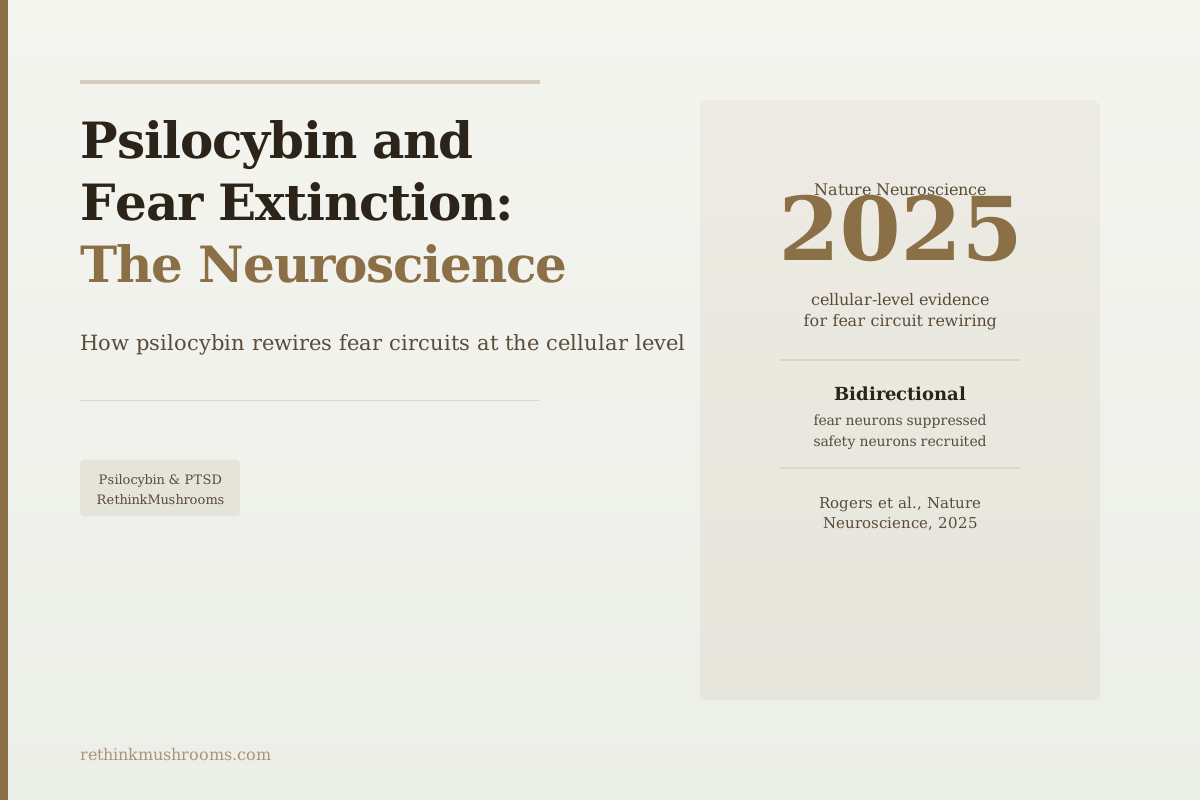
2025 — Nature Neuroscience: psilocybin rebalances fear circuits at the single-neuron level
Rogers, Heller and Corder imaged individual neurons in the mouse retrosplenial cortex and found a single dose suppressed fear-active neurons while recruiting extinction-active ones — and the size of that swing predicted how well fear extinguished.
Rogers, Heller & Corder, Nature Neuroscience, 2025
5-HT2A required
blocking 5-HT2A abolished extinction, extinction retention and the block on fear renewal; blocking 5-HT1A attenuated only fear renewal (Woodburn 2024)
Concurrent only
the drug must be onboard during the extinction session — dosing before fear learning, or right after extinction, did nothing (Woodburn 2024)
Animal-only mechanism
every mechanistic finding here is rodent; the sole human PTSD trial is open-label, uncontrolled, n=22 (McGowan 2025)
Rogers, Heller & Corder, Nature Neuroscience, 2025
 View as image ↗
In 2025, Rogers, Heller, and Corder published what may be the clearest cellular-level evidence yet for how psilocybin acts on fear-based learning. Using longitudinal single-cell calcium imaging in the mouse retrosplenial cortex across a five-day trace fear conditioning and extinction assay, they showed that a single dose of psilocybin oppositely modulated two neuron populations: it suppressed the neurons active during fear expression and recruited the neurons active during extinction. The size of that bidirectional swing predicted how strongly fear extinguished. Published in Nature Neuroscience, this is the mechanistic proof-of-concept that psilocybin fear extinction neuroscience has been building toward for over a decade.[1]
The mechanism that makes this possible is fear extinction: the brain's process for learning that a previously dangerous situation is now safe. This is not memory erasure. It is new learning laid over an old fear. This article covers the neuroscience — what happens at the serotonin receptor level, why the timing of the drug relative to therapy matters more than most people realize, why the new safety associations can persist after psilocybin clears, and, just as importantly, where the evidence runs out. For a broader look at how this mechanism translates to clinical PTSD treatment, see psilocybin for PTSD: what the clinical trials show.
Key Takeaways
- Fear extinction is not forgetting — it is new learning: the brain learns that a previously dangerous situation is now safe, while the original fear memory remains stored[4]
- Rogers et al. (Nature Neuroscience, 2025) provided the cellular evidence: single-dose psilocybin suppressed fear-active neurons and recruited extinction-active neurons in the mouse retrosplenial cortex, and the degree of that rebalancing predicted extinction strength[1]
- Timing is the strictest constraint: Woodburn et al. (2024) found psilocybin robustly enhanced extinction when given acutely before the extinction session, but did nothing when given before fear learning or immediately after extinction — concurrent extinction experience is required[2]
- The receptors divide the labour: a 5-HT2A antagonist blocked psilocybin's effects on extinction, extinction retention and fear renewal, while a 5-HT1A antagonist attenuated only the effect on fear renewal[2]
- Catlow et al. (2013) is often miscited: only low doses sped extinction, and psilocybin caused significant dose-dependent decreases in new hippocampal neurons — at the low effective doses neurogenesis was merely not decreased[3]
- Every mechanistic finding above is from rodents. The only published human PTSD trial is open-label, uncontrolled and industry-sponsored (n=22) and did not measure fear extinction at all[6]
Fear Extinction vs. Forgetting: What the Science Shows About Trauma Memories
Fear extinction is the neuroscience term for a specific kind of learning: the brain acquires new information that a previously dangerous signal is no longer threatening. When someone with PTSD is exposed to a memory of a car crash while sitting safely in a therapist's office, and that experience is repeated until the memory no longer triggers a fear response, the process is fear extinction.
The crucial point that separates fear extinction from forgetting: the original fear memory is not erased. It remains stored in the brain. What extinction does is create a competing memory: safety. The brain now holds two pieces of information about the same cue. Under normal circumstances, the safety memory gradually wins, and the fear response diminishes.
In PTSD, this process breaks down. The original fear memory is stored with unusual strength, and the safety learning does not take hold the way it should. Exposure-based therapies like prolonged exposure and EMDR work by facilitating fear extinction under safe conditions. The problem is that PTSD patients often struggle to engage with trauma material without being retraumatized, and fear extinction in PTSD brains is difficult to establish and easy to reverse.
This is where psilocybin enters the picture. If psilocybin can enhance the fear extinction process itself at the neurological level, it would address the core mechanism through which PTSD maintains itself: a fear circuit that has become too powerful for normal safety learning to override.
A 2025 Nature Neuroscience Discovery: Psilocybin Moves Fear Neurons in Both Directions
Rogers, Heller, and Corder performed longitudinal single-cell calcium imaging — a technique that tracks the activity of the same individual neurons across days — in the retrosplenial cortex of mice running a five-day trace fear learning and extinction assay, comparing animals given a single dose of psilocybin against those that were not.[1]
Rogers, Heller & Corder (2025) · Nature Neuroscience
- Population
- Mice, longitudinal single-cell calcium imaging of the retrosplenial cortex across a 5-day trace fear conditioning and extinction assay
- Intervention
- A single dose of psilocybin
- Comparator
- Undosed animals; plus a computational model of the same microcircuit
- Finding
- Psilocybin altered cortical ensemble turnover and oppositely modulated fear- and extinction-active neurons. Suppression of fear-active neurons together with recruitment of extinction-active neurons predicted enhanced fear extinction.
preliminary Strong within-model causal detail, but rodent-only, and the recorded region is cortex — not the amygdala that most PTSD models centre on.
Rogers, Heller & Corder, Nature Neuroscience, 2025
The finding was specific. During extinction training, psilocybin produced a bidirectional effect on cortical ensembles — the coordinated groups of neurons that represent and process fear memories. Neurons that normally increased their firing during fear expression were suppressed. Simultaneously, neurons associated with extinction learning were recruited and more strongly activated. The authors then built a computational model of the microcircuit and found that inhibiting simulated fear-active units modulated the recruitment of extinction-active units and the variability of freezing behaviour, matching what the animals actually did.
This bidirectional pattern matters because it is what effective fear extinction requires: not just suppressing fear, but actively building the competing safety representation. And the degree to which the two populations were rebalanced predicted how strong the extinction was.
That predictive relationship is what distinguishes Rogers 2025 from earlier research. Previous studies showed that psilocybin produces better behavioural outcomes in fear extinction tests. Rogers 2025 offers part of the why: the drug shifts the cellular balance in the direction that makes extinction learning easier and stronger.
Two limits deserve naming up front. This study used animal models — the recording techniques involved are not feasible in human brains with current technology. And the region imaged was the retrosplenial cortex, a hub for contextual memory. That is not the amygdala, which is where most mechanistic accounts of PTSD, including the one in the next section, place the action.
The Serotonin-to-Amygdala Pathway: A Proposed Model
The most widely cited account of how psilocybin reaches the fear circuit runs through the amygdala. It is worth being precise about its evidentiary status: this is a mechanistic model assembled in a 2024 review by Choi and colleagues, not something directly demonstrated in a human fear-extinction experiment.[4]
The amygdala is the brain region responsible for detecting and responding to threats. In PTSD, the amygdala is chronically overactivated: it responds too strongly to trauma cues, floods the body with fear signals, and overwhelms the prefrontal cortex's attempts to put those signals in context.
Psilocybin's active form (psilocin) is a serotonin analog. It activates serotonin receptors throughout the brain, but the receptor most implicated in fear extinction is the 5-HT2A receptor. On the proposed model, 5-HT2A stimulation activates GABA interneurons in the amygdala. GABA is the brain's primary inhibitory neurotransmitter, so activating these interneurons suppresses the amygdala's output neurons and reduces the fear signal the amygdala sends onward.
Woodburn and colleagues supply the closest thing to a causal receptor test, and it is more nuanced than the usual summary. Blocking the 5-HT2A receptor with an antagonist abolished psilocybin's effects across the board — extinction, extinction retention, and the suppression of fear renewal. Blocking the 5-HT1A receptor attenuated only one of those: the effect on fear renewal, the return of fear when an extinguished cue reappears in a new context.[2] So 5-HT2A is necessary for everything psilocybin does here; 5-HT1A appears to make a selective contribution to keeping fear from coming back.
Why Psilocybin Only Works for Fear Extinction If the Timing Is Right
Woodburn and colleagues (2024) made a finding with direct implications for how any psilocybin-assisted trauma therapy would need to be designed — and it is the single most frequently garbled result in this literature.[2]
Using a delay fear conditioning paradigm in male and female mice, they found that psilocybin robustly enhanced fear extinction when given acutely before the extinction session, at every dose tested. It also produced longer-term effects — better extinction retention and suppressed fear renewal in a novel context — though those were dose-sensitive, and females responded across a narrower dose range than males.
What failed was administration at the wrong moment. Giving psilocybin before fear learning — the conditioning phase, a different session entirely — produced no behavioural change. Giving it immediately after extinction, once the learning had already happened, likewise produced nothing. The authors' conclusion: concurrent extinction experience is necessary for the drug's effects.
The Timing Constraint
Psilocybin Only Enhances Fear Extinction If the Drug Overlaps the Extinction Session
Three administration windows, one behavioural readout. The variable that decides the outcome is not “before vs. after” — it is whether extinction learning is actually happening while psilocybin is active.
Drug exposure vs. extinction learning window
Before the extinction session
EffectRobust enhancement — at every dose tested. Drug is onboard while extinction learning happens. Also elevated extinction retention and suppressed fear renewal in a novel context, though those longer-term effects were dose-sensitive.
Overlaps: Extinction · drug active during extinction learning
Before fear learning
No effectNo change in behaviour. Drug overlaps the conditioning phase instead — a different session, with no extinction learning to amplify.
Overlaps: Conditioning · no extinction learning while drug is active
Immediately after extinction
No effectNo change in behaviour. The learning window has already closed by the time the drug is active. Post-hoc consolidation support was not observed.
Overlaps: Extinction (already over) · no extinction learning while drug is active
The authors’ conclusion: concurrent extinction experience is necessary for the drug’s effects. Sex mattered too — females responded across a narrower range of doses than males.
Source: Woodburn, Levitt, Koester & Kwan (2024), ACS Chemical Neuroscience 15(16):3034–3043. Delay fear conditioning in male and female mice.
The distinction matters. "Give it beforehand and it doesn't work" is wrong — dosing acutely before the extinction session is precisely the protocol that works, because psilocin is onboard while extinction is happening. What does not work is dosing around a session in which no extinction learning occurs, or arriving after the learning window has closed.
This specificity implies psilocybin is not simply reducing anxiety or producing a generically receptive brain state. It is amplifying what the brain is actively doing during extinction. The drug interacts with the learning in real time — which is why the Rogers 2025 finding of bidirectional ensemble modulation during extinction training is so mechanistically coherent.
For therapy design, the implication is that what happens during a psilocybin session matters as much as the pharmacology. A session that is safe and pleasant but involves no engagement with trauma material — no fear cue, no extinction learning — would not be expected to produce the effect the animal data demonstrates.
How the Brain Locks In New Safety Associations After the Session Ends
One of the more striking aspects of psilocybin's effects is their duration. Psilocin clears quickly: published elimination half-life estimates range from roughly 1.4 hours to about 4 hours depending on dose, formulation and assay, and the acute subjective effects are typically over within about six hours. Yet behavioural changes from psilocybin-assisted therapy — in addiction, depression, and fear extinction — have been documented to persist for weeks to months.
The leading explanation is neuroplasticity. Zhao and colleagues (2024) tested this in a chronic corticosterone mouse model of depression — not a fear-extinction model — and found that a single dose of psilocybin reversed the stress-induced suppression of plasticity in the prefrontal cortex and hippocampus. Specifically, it increased dendritic branching and dendritic spine density, raised synaptic protein levels (p-GluA1, PSD95, synapsin-1), activated BDNF–TrkB–mTOR signalling, and increased the number of DCX-positive cells, a marker of new neurons.[5]
That is a plausible substrate for durable extinction learning: safety associations need to be encoded in synaptic structure to survive, and without structural reinforcement a safety memory can fade and the original fear response can return. But the inference is a bridge between two literatures, not a single result. Zhao measured plasticity in a depression paradigm; nobody has yet shown that these specific structural changes are what maintain psilocybin-enhanced fear extinction.
A widely repeated miscitation
“Psilocybin grows new neurons, which is how it fixes fear”
The claim
“Catlow et al. (2013) showed psilocybin enhanced fear extinction and increased hippocampal neurogenesis at the same time.”
The paper's title pairs 'hippocampal neurogenesis' with 'extinction of trace fear conditioning', and secondary coverage collapsed the two into a single positive finding.
What research shows
MisleadingCatlow found that psilocybin, the 5-HT2A agonist 25I-NBMeO and the 5-HT2A/C antagonist ketanserin all produced significant dose-dependent DECREASES in the number of newborn hippocampal neurons. Only LOW doses of psilocybin sped extinction — faster than both high-dose psilocybin and saline. At those low effective doses, neurogenesis was not decreased and merely 'tended toward an increase'.
The authors themselves cautioned that extinction may be mediated outside the hippocampus — for example in the amygdala — and noted psilocybin is not purely 5-HT2A selective. The extinction benefit and any neurogenesis benefit were never causally linked.
Catlow et al., Experimental Brain Research, 2013
What Catlow 2013 Actually Found
Extinction and Neurogenesis Move in Opposite Directions Across the Dose Range
The paper is routinely cited as showing psilocybin boosted both fear extinction and hippocampal neurogenesis. It showed neither cleanly: extinction improved only at low doses, and neurogenesis fell in a dose-dependent way.
Direction of effect as dose increases
Low dose
Fear extinction
Significantly faster extinction than high-dose psilocybin OR saline
Hippocampal neurogenesis
Not decreased — "tended toward an increase" (a trend, not a significant rise)
High dose
Fear extinction
No extinction advantage over saline
Hippocampal neurogenesis
Significantly decreased newborn hippocampal neurons
The authors’ own caveats: the 5-HT2A agonist 25I-NBMeO and the 5-HT2A/C antagonist ketanserin both also decreased neurogenesis; extinction may be mediated outside the hippocampus, such as in the amygdala; and psilocybin is not purely selective for 5-HT2A receptors. The extinction and neurogenesis findings were never causally linked.
Source: Catlow, Song, Paredes, Kirstein & Sanchez-Ramos (2013), Experimental Brain Research 228(4):481–91. Trace fear conditioning in mice; BrdU cell counts in the dentate gyrus.
Catlow 2013 remains the historically important first controlled demonstration that psilocybin facilitates extinction of a classically conditioned fear response — the finding that opened this research line and that the authors explicitly framed as a reason to explore psilocybin for PTSD. It is simply not the neurogenesis result it is routinely reported to be, and the low-dose specificity it uncovered is a genuinely useful signal that dose matters in a non-linear way.
What Animal Data Can and Cannot Tell Us About Human Trauma
Every mechanistic study cited in this article used animal models. The single-cell imaging from Rogers 2025, the dose, timing and receptor-antagonist experiments from Woodburn 2024, the neurogenesis and extinction work from Catlow 2013, and the plasticity measurements from Zhao 2024 all come from controlled laboratory conditions with mice.
Animal models of fear extinction are well-validated: Pavlovian fear conditioning produces behavioural and neural changes analogous to human fear memory, and the 5-HT2A receptor pathway characterised in rodents is the same receptor system psilocybin activates in human brains. That makes the mechanism biologically plausible in people.
Where the Evidence Actually Sits
Six Findings, Six Different Places — and They Are Not the Same Experiment
The popular account narrates one smooth mechanism from serotonin receptor to amygdala to durable relief. In the published record, each link was measured in a different structure, in a different paradigm, and in most cases in a different animal.
Retrosplenial cortex
Mice
Activity of individual fear- and extinction-active neurons across 5 days
Longitudinal single-cell calcium imaging + computational microcircuit model · Rogers 2025
Serotonin receptors (systemic)
Mice
Whether 5-HT2A / 5-HT1A blockade abolishes the behavioural effect
Antagonist co-treatment, delay fear conditioning, both sexes, dose range · Woodburn 2024
Hippocampus (dentate gyrus)
Mice
Number of newborn neurons alongside extinction speed
BrdU birth-dating, trace fear conditioning · Catlow 2013
Prefrontal cortex + hippocampus
Mice
Dendritic branching, spine density, synaptic proteins, BDNF–TrkB–mTOR
Chronic corticosterone DEPRESSION model — not a fear-extinction paradigm · Zhao 2024
Amygdala
—
Nothing measured directly for psilocybin + fear extinction
Narrative mechanistic review assembling a proposed 5-HT2A → GABA interneuron model · Choi 2024
Whole human, clinical
Humans (n=22)
Safety, tolerability, CAPS-5 and PCL-5 symptom scores — no mechanism, no extinction
Phase 2 open-label, nonrandomised, no control group, industry-sponsored · McGowan 2025
Read the two ends together: the amygdala — the structure the story is usually told around — is the one row with no direct measurement behind it, and the human row is the one row with no mechanism behind it. Everything rigorous in between is rodent.
Sources: Rogers (2025); Woodburn (2024); Catlow (2013); Zhao (2024); Choi (2024); McGowan (2025)
The honest gap is larger than plausibility can close. Human PTSD involves autobiographical memory, social context, identity, and the complexity of real traumatic events; rodent conditioning models these in radically simplified form. The Choi 2024 review integrates the animal data into a theoretical account of human PTSD treatment, but that integration remains theoretical — not confirmed by human neuroimaging or brain-recording studies.[4]
The current human picture is thinner than it is often made to sound. There is no published placebo-controlled randomised trial of psilocybin for PTSD. The only published human PTSD trial is McGowan and colleagues' Phase 2 study: nonrandomised, open-label, no control group, 22 participants, conducted and largely staffed by Compass Pathways. A single 25 mg dose with psychological support was safe and well tolerated — 117 treatment-emergent adverse events, most commonly headache, nausea, crying and fatigue, none serious. Pre-post CAPS-5 scores fell by a mean of 29.9 points at week 4 and 29.5 at week 12, with the change associated with the intensity of the psychedelic experience.[6]
- Cell & circuit workcompleted
Single-cell calcium imaging plus a computational microcircuit model (Rogers 2025).
- Animal studiescompleted
Dose, timing, context and receptor-antagonist controls in mice (Woodburn 2024; Catlow 2013; Zhao 2024).
- Case reports & qualitative workcompleted
Published participant-experience and qualitative reports from investigational psilocybin PTSD treatment.
- Small human trialcurrent
One Phase 2 open-label, nonrandomised, uncontrolled, industry-sponsored trial, n=22 — and it did not measure fear extinction (McGowan 2025).
- Large randomised controlled trialmissing
No placebo-controlled randomised trial of psilocybin for PTSD has been published.
- Meta-analysismissing
Not possible — there is no body of controlled trials to pool.
The mechanistic case is unusually detailed for a rodent literature, and unusually thin in humans. Nothing published measures fear extinction in human PTSD patients given psilocybin.
Rogers 2025; Woodburn 2024; Catlow 2013; Zhao 2024; McGowan 2025
Those are real numbers, and a ~30-point CAPS-5 drop sustained to week 12 is clinically meaningful in size. But an uncontrolled open-label design cannot separate drug effect from expectancy, therapeutic contact, regression to the mean or natural recovery — and PTSD is a condition with substantial placebo response in controlled trials. The study's own conclusion is deliberately hedged: psilocybin "may be safe, well-tolerated and associated with symptomatic improvement," and "further investigation is warranted." It measured safety, not mechanism. Whether psilocybin enhances human fear extinction through the pathway documented in mice is an empirically open question — plausible, coherent with the animal data, and untested.
Before drawing conclusions
CriticalThis mechanism is not a self-treatment protocol
Concern
The animal data show psilocybin amplifies whatever fear learning the brain is actively doing. That cuts both ways: a session in which trauma material surfaces without structured therapeutic support is a session in which the drug is amplifying an uncontained fear experience, not an extinction experience.
What the research says
In every trial that reported benefit, psilocybin was given as a single supervised dose alongside psychological support, with screening, preparation and integration. Psilocybin is a Schedule I substance in the United States and remains illegal in most jurisdictions; access outside an approved clinical trial or a state-regulated programme is unlawful and unsupervised.
Particularly relevant for: People with PTSD or trauma histories, and anyone with a personal or family history of psychosis or bipolar disorder, for whom classic psychedelics carry additional risk.
What to do
Treat this article as an explanation of a research mechanism, not medical advice. Decisions about PTSD treatment belong with a qualified clinician; if psilocybin interests you, ask about enrolling in a registered clinical trial.
McGowan et al., Journal of Psychopharmacology, 2025; Woodburn et al., ACS Chemical Neuroscience, 2024
For where the human clinical evidence currently stands, see how psilocybin therapy approaches trauma differently, and for the larger question of what the trials have actually shown, see psilocybin versus MDMA for PTSD: different mechanisms, different strengths. The cluster's central concepts — how fear extinction and reconsolidation together explain psilocybin's effects on trauma — are tied together in psilocybin and trauma processing: how it facilitates healing.
The Bottom Line
The neuroscience of psilocybin fear extinction now has cellular-level evidence: a 2025 Nature Neuroscience study imaged individual neurons in the mouse retrosplenial cortex and found psilocybin suppressed fear-active neurons while recruiting extinction-active ones, with the size of that swing predicting extinction strength. Receptor work shows 5-HT2A is required for the whole effect while 5-HT1A contributes selectively to preventing fear renewal, and timing is strict — the drug must be onboard during the extinction session itself. Durability is plausibly explained by BDNF-driven structural plasticity, though that evidence comes from a depression model rather than a fear paradigm, and the frequently cited claim that psilocybin raises hippocampal neurogenesis misreads Catlow 2013, which found dose-dependent decreases. All mechanistic data remains rodent. The only published human PTSD trial is open-label, uncontrolled and industry-sponsored, and it did not measure fear extinction; no placebo-controlled randomised trial has been published.
Frequently Asked Questions
Sources & References
- 1RTHM-02170·Rogers, Sophie A et al. (2025). “Psilocybin-enhanced fear extinction linked to bidirectional modulation of cortical ensembles..” Nature neuroscience.Study breakdown →PubMed →↩
- 2RTHM-02020·Woodburn, Samuel C et al. (2024). “Psilocybin Facilitates Fear Extinction: Importance of Dose, Context, and Serotonin Receptors..” ACS chemical neuroscience.Study breakdown →PubMed →↩
- 3RTHM-00279·Catlow, Briony J et al. (2013). “Effects of psilocybin on hippocampal neurogenesis and extinction of trace fear conditioning..” Experimental brain research.Study breakdown →PubMed →↩
- 4RTHM-01874·Choi, Charles et al. (2024). “Mechanisms of psilocybin on the treatment of posttraumatic stress disorder..” Journal of psychopharmacology (Oxford.Study breakdown →PubMed →↩
- 5RTHM-00920·Zhao, Xiangting et al. (2024). “Psilocybin promotes neuroplasticity and induces rapid and sustained antidepressant-like effects in mice..” Journal of psychopharmacology (Oxford.Study breakdown →PubMed →↩
- 6RTHM-00941·McGowan, Niall M et al. (2025). “Investigating the safety and tolerability of single-dose psilocybin for post-traumatic stress disorder: A nonrandomized open-label clinical trial..” Journal of psychopharmacology (Oxford.Study breakdown →PubMed →↩