Psilocybin & PTSD
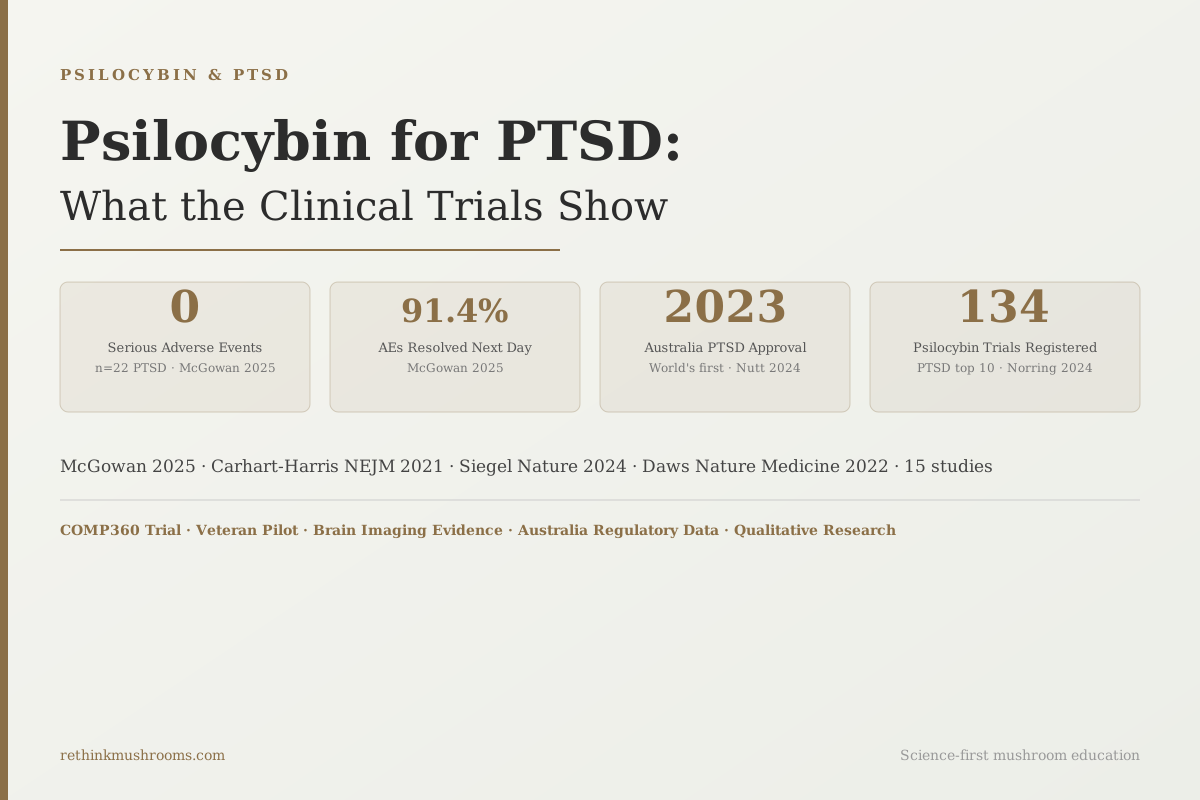
0 Serious Adverse Events
In the first published clinical trial specifically testing psilocybin in PTSD patients (n=22, 25mg COMP360), a single dose produced zero serious adverse events and rapid, sustained PTSD symptom improvement over 12 weeks — in an open-label trial with no control group.
McGowan, Rucker, Yehuda, Goodwin et al., J Psychopharmacol, 2025
91.4%
of dosing-day adverse events resolved by the next day (headache 50%, nausea 36.4%, crying 27.3%)
1
published trial has ever tested psilocybin in PTSD patients — and it enrolled 22 people with no control arm
134
psilocybin clinical trials registered on ClinicalTrials.gov across 54 indications — with 0 marketing approvals (Norring 2024)
McGowan, Rucker, Yehuda, Goodwin et al., J Psychopharmacol, 2025
 View as image ↗
In 2025, McGowan, Rucker, Yehuda, Goodwin, and colleagues published the first clinical trial specifically designed to test psilocybin in PTSD patients. Twenty-two people received a single 25mg dose. Zero experienced serious adverse events. The adverse events that did occur (headache, nausea, crying, fatigue) resolved in 91.4% of cases by the end of the next day. And participants showed rapid, sustained PTSD symptom improvement over a 12-week follow-up.[1]
That is the most important clinical data point in psilocybin PTSD research right now. It also illustrates how early this field is. Twenty-two patients. One open-label trial. No randomized control group. Promising, but not yet the definitive evidence base.
This article synthesizes everything published on psilocybin for PTSD through 2025: what the PTSD-specific trial found, what the larger depression trial literature does and does not imply for PTSD, what brain imaging studies show about why this might work, what participants themselves describe experiencing, and where the research is heading. It also corrects a claim that appears in a great deal of popular coverage — that Australia approved psilocybin for PTSD in 2023. It did not.
Key Takeaways
- The only published clinical trial specifically in PTSD patients (McGowan et al. 2025, n=22) found single-dose 25mg psilocybin produced zero serious adverse events and a mean CAPS-5 drop of 29.9 points at Week 4 and 29.5 points at Week 12 — but the trial was open-label with no control arm, so the change cannot be attributed to the drug alone
- Australia did not approve psilocybin for PTSD. Its 2023 rescheduling authorised psilocybin for treatment-resistant depression and MDMA for PTSD — two different compounds for two different conditions. No country has approved psilocybin as a prescription medicine for PTSD
- A 2025 meta-analysis (Bahji, 18 studies) covering psilocybin, LSD, MDMA and ayahuasca found a large pooled effect for depression symptoms in a transdiagnostic population — psilocybin g = -1.92, MDMA g = -0.71 — but rated evidence certainty low to very low, and reported no separate PTSD-specific effect size
- The landmark NEJM escitalopram comparison (Carhart-Harris 2021, n=59) did not show a significant difference between psilocybin and escitalopram on its primary outcome (P = 0.17); secondary outcomes favoured psilocybin but were uncorrected for multiple comparisons
- A 2024 Nature study found psilocybin desynchronizes brain networks with effects on hippocampal–default mode connectivity persisting for weeks — but it was conducted in healthy adults, and no clinical outcome was measured
- A qualitative study (Modlin 2025, n=21) found participants engaged with trauma material both directly and indirectly, with psilocybin enabling a broader indirect route via emotional, bodily and self-transcendent experiences rather than the direct confrontation standard therapies require
- Three of the central PTSD studies in this field — McGowan, Modlin, and the Kirlic support model — were sponsored by Compass Pathways, the company developing COMP360
The Short Answer: Where the Evidence Stands
Psilocybin has not been approved for PTSD anywhere in the world. Clinical trials are underway. The only published PTSD-specific trial (McGowan et al. 2025, n=22) found a single 25mg dose was well-tolerated with no serious adverse events and was followed by rapid, sustained symptom improvement over 12 weeks — in a design that cannot separate the drug's effect from expectancy and therapeutic support. Larger randomized trials are the necessary next step.
That is the accurate, evidence-based short answer. Everything below shows where those findings come from, what they do and do not establish, and why PTSD has emerged as one of the most compelling potential targets for psilocybin therapy.
PTSD is a condition characterized by hyperactive threat processing, intrusive trauma memories, emotional numbing, and avoidance behaviors. Current pharmacological and psychological treatments are insufficient for most patients; nonresponse rates to standard pharmacotherapy often exceed 50%.[7] That treatment gap, more than any single positive result, is what drives interest in psilocybin.
Evidence Reach · Psilocybin & PTSD
Which Studies Were Actually Done in People With PTSD
Most evidence cited for psilocybin and PTSD was collected in people who did not have PTSD. This ladder sorts the studies in this article by how directly they bear on the question, from tested-in-PTSD-patients at the top to healthy-volunteer imaging at the bottom.
Directly answers the question — but neither study has a control arm.
| Study | Who was enrolled | n | Controlled? |
|---|---|---|---|
| McGowan 2025 [1] | Adults with PTSD | 22 | No — open-label |
| Modlin 2025 [8] | Adults with PTSD (qualitative) | 21 | No — nested sub-study |
PTSD patients were enrolled, yet the trial was designed to measure something else.
| Study | Who was enrolled | n | Controlled? |
|---|---|---|---|
| Ellis 2025 [12] | Veterans with treatment-resistant depression, some with comorbid PTSD | 15 | No — open-label pilot |
The strongest designs in the field — conducted in a different disorder.
| Study | Who was enrolled | n | Controlled? |
|---|---|---|---|
| Carhart-Harris 2021 [2] | Moderate-to-severe major depressive disorder | 59 | Yes — double-blind RCT |
| Daws 2022 [11] | Depression (two trials, fMRI) | Two trials | Partly — one RCT, one open-label |
| Mertens 2020 [16] | Treatment-resistant depression | 19 | No — open-label |
Mechanistic imaging in healthy volunteers; no clinical outcome was measured.
| Study | Who was enrolled | n | Controlled? |
|---|---|---|---|
| Siegel 2024 [10] | Healthy adults | Small, densely scanned | Yes — methylphenidate comparator |
How to read it: notice the trade-off running down the ladder. The two studies conducted in PTSD patients have no control group, and the studies with the strongest designs were run in depression or in healthy volunteers. No published study to date is both controlled and conducted in a PTSD population — which is precisely the gap a Phase 3 trial would close.
Sources: enrolled populations and designs as reported in each cited study — McGowan 2025 [1], Carhart-Harris 2021 [2], Modlin 2025 [8], Siegel 2024 [10], Daws 2022 [11], Ellis 2025 [12], Mertens 2020 [16].
The Only Published PTSD Trial: What McGowan et al. Found in 22 Patients
The McGowan 2025 trial was a Phase 2, nonrandomized, open-label, multicenter study run across three sites in two countries, with investigators based at King's College London, the Icahn School of Medicine at Mount Sinai, and Sunstone Therapies in Rockville, Maryland.[1] Participants were 22 adults with a PTSD diagnosis (63.6% female; mean age 39.0 years). Each received a single 25mg dose of COMP360 (Compass Pathways' synthetic psilocybin) along with structured psychological support before, during, and after the session. The trial is registered as NCT05312151.
The trial generated 117 treatment-emergent adverse events total. These sound like a lot until you look at what they were and how long they lasted. Seventy of them (59.8%) occurred on the dosing day itself, and 64 of those 70 (91.4%) had resolved by the end of the next day. The most common: headache in 50.0% of participants, nausea in 36.4%, crying in 27.3%, and fatigue in 27.3%. No participant experienced a serious adverse event. No participant withdrew because of adverse events.
The clinical significance is what makes the trial important. Participants with documented PTSD — a population with significant comorbidity, complex trauma history, and prior treatment failures — tolerated a high dose of psilocybin well. The safety picture from this specific population aligned with what the broader depression trial literature predicted.
On efficacy, the trial reported a clinically meaningful change from baseline on the Clinician-Administered PTSD Scale for DSM-5 (CAPS-5): a mean drop of 29.9 points at Week 4 and 29.5 points at Week 12. Scores on the self-reported PTSD Checklist (PCL-5) showed symptom reduction that was rapid and sustained through Week 12, and measures of functional impairment (Sheehan Disability Scale) and quality of life (EQ-5D-5L) improved similarly.
CAPS-5 Symptom Change · McGowan 2025 (n = 22)
How Much PTSD Symptoms Actually Changed — and How Much They Varied
CAPS-5 is the standard clinician-administered PTSD severity scale, scored 0–80. Bars show the average drop from baseline; the lighter band on each bar is one standard deviation either side, which is where the honest uncertainty lives at this sample size.
Week 4
−29.9 pts · SD 14.06Range at ±1 SD: −15.8 to −44.0 pts
Week 12
−29.5 pts · SD 15.43Range at ±1 SD: −14.1 to −44.9 pts
22
Participants enrolled
63.6%
Female
39.0
Mean age (SD 7.91)
The caveat that governs this chart: this was a nonrandomized, open-label trial with no placebo or comparison arm. Everyone knew they were receiving psilocybin. That means the change shown here is the change that occurred — not the change caused by the drug. Expectancy, regression to the mean, and the structured psychological support wrapped around the dosing day are all folded into these bars, and this design cannot pull them apart.
Source: McGowan et al. 2025, Journal of Psychopharmacology [1]; Phase 2 nonrandomized open-label multicenter trial, ClinicalTrials.gov NCT05312151. Bar length is the reported mean change from baseline; the lighter band is ±1 reported SD.
Two caveats govern how much weight those numbers can carry. First, this was an open-label study without a randomized control group, so the improvement cannot be attributed to psilocybin with any certainty — expectancy effects, regression to the mean, and the therapeutic support wrapped around the dosing day all contribute to outcomes in psychedelic trials, and this design cannot separate them. Second, the magnitude of symptom change was associated with the intensity of the psychedelic experience on dosing day, a correlation that is open to more than one interpretation: it may reflect a dose-dependent therapeutic mechanism, or it may reflect the fact that participants who felt more happened to them expected more to change.
The open-label design was nonetheless appropriate for a first-in-PTSD-population safety and tolerability study, which was the trial's stated primary aim. Efficacy was a secondary outcome, and the authors present it as warranting further investigation rather than as a demonstrated effect.
For a complete analysis of the COMP360 PTSD trial design, results, and what they mean for the field, see COMP360 for PTSD: Compass Pathways Trial Results.
What Depression Trials Tell Us About PTSD Potential
Because no large randomized psilocybin trial has been run specifically in PTSD, the field draws heavily on two sources: the depression trial literature and comparative meta-analyses. Both require care, because both are answering a different question than the one PTSD patients are asking.
The anchor trial is Carhart-Harris and colleagues' 2021 paper in the New England Journal of Medicine.[2] In this phase 2 double-blind randomized trial, 59 adults with long-standing moderate-to-severe major depressive disorder — not treatment-resistant depression — were assigned to either two 25mg doses of psilocybin three weeks apart plus daily placebo, or two 1mg doses plus six weeks of daily escitalopram. All participants received psychological support.
The result is frequently misreported. On the primary outcome — change in QIDS-SR-16 score at week 6 — the trial did not show a significant difference between the two arms: −8.0 points for psilocybin versus −6.0 for escitalopram, a between-group difference of 2.0 points (95% CI −5.0 to 0.9, P = 0.17). Several secondary outcomes did favour psilocybin, including response (70% versus 48%) and remission (57% versus 28%), but the authors explicitly note these analyses were not corrected for multiple comparisons. Adverse event incidence was similar in both groups. The honest summary is that psilocybin performed comparably to a standard SSRI in a trial that was not powered to establish superiority — which is genuinely notable, but is not the same as "psilocybin matched antidepressants."
Two meta-analyses bring cross-diagnostic evidence to bear. Bahji and colleagues, publishing in the Journal of Psychoactive Drugs in 2025, systematically reviewed four psychedelic-assisted therapies — psilocybin, LSD, MDMA, and ayahuasca — across depression, anxiety, and PTSD symptoms in adults.[3] Across 18 identified studies, the therapies were well tolerated and produced a large pooled effect for depression symptoms in a transdiagnostic population: psilocybin g = −1.92 (95% CI −2.73 to −1.11) and MDMA g = −0.71 (95% CI −1.39 to −0.03). Two things are worth noting carefully. The review did not report a separate PTSD-specific effect size for psilocybin. And the authors rated evidence certainty as low to very low, citing methodological limitations, small sample sizes, blinding problems, study heterogeneity, and publication bias.
Yao and colleagues, publishing in Psychiatry Research in 2024, conducted a broader meta-analysis of psychedelics across mental disorders, pooling 126 articles.[4] Psilocybin showed the strongest therapeutic effect of the four agents examined (Hedges' g = −1.49, 95% CI −1.67 to −1.30), ahead of ayahuasca, MDMA, and LSD. Their conclusion on PTSD specifically is more restrained than the headline effect size suggests: they describe psychedelics as having "potential efficacy" in PTSD, listing it alongside substance-use disorders as an area supported by a smaller body of evidence than the mood-disorder findings.
The blinding problem that Bahji flags deserves emphasis, because it applies to essentially every study in this article. In a trial of a compound that produces unmistakable perceptual effects, participants can usually tell which arm they are in. That functional unblinding can inflate apparent effect sizes through expectancy alone, and it is the central methodological reason the certainty ratings in this literature remain low despite impressive-looking numbers.
Why PTSD Is a Different Target: What the Mechanism Research Shows
PTSD is not simply depression in response to trauma. It has distinct neurobiological features that make it both a challenging target for existing treatments and a potentially interesting one for psilocybin. What follows is the mechanistic case as researchers have proposed it — and it is worth stating plainly at the outset that this case is built on animal models, depression trials, and healthy-volunteer imaging, not on demonstrated mechanisms in PTSD patients.
Khan and colleagues, reviewing the field in Current Topics in Behavioral Neurosciences in 2022, made the early case for investigating psilocybin in trauma-related disorders.[5] At the time of writing, they noted, no study had yet investigated psilocybin or psilocybin-assisted psychotherapy as a treatment for PTSD. The converging evidence they cited was indirect: an open-label study in traumatized AIDS survivors in which psilocybin-assisted psychotherapy reduced PTSD symptoms, attachment anxiety, and demoralization; several psychedelic-assisted psychotherapy trials showing preliminary benefit in confronting traumatic memories, decreasing emotional avoidance, and increasing self-compassion; and early evidence that other classic psychedelics may reduce PTSD symptoms in combat veterans. Their own summary of the state of the field was cautious: the literature is small, mechanisms are not well understood, and the risks need further study.
Fear extinction is the brain's process for learning that a previously threatening stimulus is no longer dangerous. In PTSD, this process is impaired — the brain repeatedly reactivates fear responses even after the actual threat has passed. Existing therapies (exposure-based treatments like prolonged exposure and EMDR) work by driving fear extinction through repeated confrontation with trauma-related stimuli. But many PTSD patients cannot tolerate that confrontation, or their brains do not achieve lasting extinction even after completing treatment.
Two reviews have mapped psilocybin's pharmacology onto this picture. Choi and colleagues, writing in the Journal of Psychopharmacology in 2024, examined the neurobiology of PTSD alongside psilocybin's mechanism of action and concluded — on both pharmacodynamic and psychoanalytic grounds — that psilocybin may be an underexplored treatment option for PTSD, though further research is required.[6] Miller and Zoladz, in a 2025 review in the Journal of Pharmacology and Experimental Therapeutics, summarised the behavioral effects of psilocybin observed in preclinical and clinical work and linked them to PTSD-related symptoms, while cataloguing both the drawbacks of therapeutic use and the practical challenges facing investigators who want to study it properly.[7]
The molecular account underlying both reviews centres on neuroplasticity. Psilocin, psilocybin's active metabolite, has long been understood to act principally through the serotonin 5-HT2A receptor, but a 2025 review in Trends in Pharmacological Sciences describes a more nuanced picture involving multiple serotonin receptor subtypes, non-serotonergic targets including TrkB, biased agonism, and — notably — receptor localization inside the cell rather than only on its surface.[17] The proposed relevance to PTSD is that a period of heightened plasticity could make consolidated fear memories more amenable to change. That remains a hypothesis about PTSD; the plasticity findings themselves come largely from animal work and from depression research.
One human finding complicates the intuitive version of this story. Mertens and colleagues, studying 19 patients with treatment-resistant depression in 2020, found that psilocybin therapy increased amygdala responsiveness to fearful faces, and that this increase correlated with treatment efficacy.[16] Following up on connectivity, they found decreased ventromedial prefrontal cortex–right amygdala coupling during face processing after treatment, driven specifically by responses to fearful and neutral faces, with the size of the change associated with rumination one week later. Their interpretation is that psilocybin therapy revives emotional responsiveness rather than blunting it — the opposite of the emotional flattening commonly reported on SSRIs. If that holds, psilocybin would not be working by turning the fear circuit down. It would be working by making emotional material accessible enough to process, which is a meaningfully different mechanism with different implications for who it might suit.
What Participants Actually Experience During Psilocybin PTSD Therapy
One of the most informative findings in psilocybin PTSD research comes not from a quantitative trial but from a qualitative study nested within one.
Modlin and colleagues published a qualitative analysis in EClinicalMedicine (a Lancet journal) in 2025, drawing on semi-structured interviews with 21 participants in the COMP360 PTSD trial, conducted before treatment, the day after, and 12 weeks post-treatment.[8] Reflexive thematic analysis identified four core themes: non-pharmacological factors supporting psychological safety and trust; the experiential nature of the treatment; engagement with trauma-related material during the session; and comparative reflections on prior therapies.
The finding most often reported in summaries is that participants did not relive their traumas. That overstates it. What the study actually describes is that the treatment facilitated both direct and indirect engagement with trauma-related material, and that psilocybin appeared to enable a broader, indirect route — via affective, somatic, and self-transcendent experiences such as moments of perceived unity, dissolution of self, or felt connection with something larger. The contrast the authors draw is with standard treatments that require direct confrontation with trauma memories. Psilocybin, on this account, does not forbid direct engagement; it removes the requirement for it.
That distinction matters clinically. A therapy that permits indirect processing may be tolerable for patients who cannot complete exposure-based treatment — which is a substantial fraction of the PTSD population — without implying that trauma material is bypassed altogether.
Modlin and colleagues, writing separately in Therapeutic Advances in Psychopharmacology in 2025, proposed a conceptual framework for why this happens.[9] PTSD patients, they argue, develop a pre-determined and over-determined maladaptive interpretive framework — a fixed lens through which experience is filtered. This framework evolved as a survival adaptation but becomes maladaptive, automatically interpreting neutral situations as threatening and preventing genuine processing of the trauma. Psilocybin's proposed value, in this framework, is not symptom suppression but disruption of the interpretive lens itself. This is a conceptual model offered by the authors, not a tested mechanism.
The Brain Evidence: Why One Session Might Produce Weeks of Change
A persistent puzzle in psilocybin research is why a single session lasting four to six hours can be followed by effects lasting weeks or months. Two neuroimaging studies provide the best mechanistic answers available — with the significant caveat that neither was conducted in PTSD patients.
Siegel and colleagues, publishing in Nature in 2024, tracked individual brain changes using longitudinal precision functional mapping, with roughly 18 MRI visits per participant.[10] The participants were healthy adults, not patients. They were scanned before, during, and for three weeks after 25mg psilocybin and 40mg methylphenidate as an active comparator, then brought back for an additional psilocybin dose 6–12 months later. Psilocybin massively disrupted functional connectivity across cortex and subcortex, acutely producing more than threefold greater change than methylphenidate. The disruption was driven by desynchronization across spatial scales, dissolving network distinctions by reducing correlations within networks and anticorrelations between them. Changes were strongest in the default mode network. Individual differences in connectivity change were strongly linked to the subjective psychedelic experience, and having participants perform a perceptual task reduced the effect.
The finding with the most obvious therapeutic relevance is that psilocybin caused a persistent decrease in connectivity between the anterior hippocampus and the default mode network, lasting for weeks. The authors' own framing is appropriately hedged: this persistent decoupling "may represent" a neuroanatomical and mechanistic correlate of the proplasticity and therapeutic effects of psychedelics. Because the study enrolled healthy volunteers, no clinical outcome was measured, and no correlation with therapeutic benefit could be — or was — established.
Daws and colleagues, publishing in Nature Medicine in 2022, assessed the subacute impact of psilocybin on brain function across two depression trials: an open-label trial in treatment-resistant depression, and the double-blind randomized trial comparing psilocybin therapy with escitalopram.[11] In both, antidepressant response to psilocybin was rapid, sustained, and correlated with decreases in fMRI brain network modularity — that is, with a global increase in brain network integration. Network cartography indicated that 5-HT2A-receptor-rich higher-order networks became more interconnected and more flexible after treatment.
The most informative comparison in that paper is the control condition. The antidepressant response to escitalopram was milder, and no changes in brain network organization were observed in the escitalopram arm at all. Two drugs, both producing some antidepressant effect, with only one of them reorganizing network architecture. In PTSD terms, the relevant hypothesis is that a brain locked into rigid threat-processing patterns might show increased capacity for flexible network communication after psilocybin — but this was measured in depression, and the extension to PTSD is inference, not evidence.
For a deeper look at how psilocybin's effects on the default mode network specifically relate to the ego-dissolution experience and its therapeutic implications, see Psilocybin and the Default Mode Network: How It Quiets the Ego.
Veterans and Psilocybin: First Data from a High-Need Population
Military veterans represent one of the highest-burden PTSD populations. Enduring and severe depression among veterans is associated with high rates of suicide and disability, and conventional pharmacotherapy and therapy-based treatments leave many veterans inadequately served.[12]
Ellis and colleagues published the first-in-kind study administering psilocybin to US military veterans in the Journal of Affective Disorders in 2025.[12] Fifteen veterans with severe treatment-resistant depression — defined as a major depressive episode failing to respond to five or more treatments, or lasting more than two years — received a single 25mg dose. At three weeks, 60% met response criteria and 53% met remission criteria on the Montgomery-Åsberg Depression Rating Scale. At 12 weeks, 47% maintained response and 40% remission. Participants who needed antidepressants restarted were counted as non-responders from that point (n = 4), which is a conservative accounting choice.
Two findings from this study bear directly on PTSD. First, comorbid PTSD did not significantly influence study outcomes — veterans with PTSD did about as well as those without, which is at least compatible with psilocybin retaining its effect in the presence of trauma pathology. Second, and pointing the other way, the intensity of the psychedelic experience as measured on the Five-Dimensional Altered States of Consciousness scale did not correlate with response. That is a direct tension with McGowan 2025, where symptom change was associated with experience intensity on dosing day. Two small open-label trials disagreeing on whether the subjective experience matters is a reminder of how little is settled here, and how easily a single small study can be over-read.
The Ellis study was not a PTSD-primary trial, and it was an open-label pilot without a control group. But it provided the first published safety evidence that psilocybin is tolerable in a veteran population with complex psychiatric presentations, which is a prerequisite for the larger randomized veteran PTSD trials that researchers are now designing.
For the complete analysis of veteran-focused psilocybin PTSD research, see Psilocybin and Veteran PTSD: The Push for Military-Focused Research.
The Treatment Protocol and Where the Research Is Going
Psilocybin trials are not drug-only interventions, and the psychological scaffolding around the dose is not incidental to the results. The support model used in Compass-sponsored COMP360 trials was described by Kirlic and colleagues in the American Journal of Psychiatry in 2025.[13] The Compass Psychological Support Model sets out a structured framework for supporting participants through what the authors acknowledge can be a challenging experience, together with the therapist training, mentoring, and fidelity-assessment programs intended to keep delivery consistent across sites. The published account describes the model as used in treatment-resistant depression trials.
This protocol structure is important context for interpreting the safety data. The zero serious adverse events in McGowan 2025 and the predominantly positive participant experiences in Modlin 2025 are, in part, outcomes of the psychological support infrastructure rather than a property of the drug alone. It also means results from supervised trials say very little about what happens when psilocybin is taken outside that structure.
It is worth being explicit about who funded this work. Compass Pathways sponsored the McGowan PTSD trial and the Modlin qualitative study nested within it, and the Kirlic support model is the company's own protocol. This does not invalidate the findings — industry sponsorship is normal in drug development, and these are peer-reviewed papers in reputable journals — but it does mean the three most PTSD-specific sources in this article share a single commercial sponsor with an interest in the outcome. Independent replication is not a formality here.
Looking at the broader research landscape: Norring and Spigarelli, in a 2024 review in Drug Design, Development and Therapy, analyzed all 134 psilocybin clinical trials then registered on ClinicalTrials.gov, spanning 54 potential indications and producing zero marketing approvals.[14] Their assessment of the field is blunt. The typical psilocybin trial is an unblinded study of 10–20 participants recruited over years at a single site. Only three advanced trials (one Phase 2/3 and two Phase 3) had been submitted, all within the preceding two years. Their conclusion is that the proliferation of small exploratory trials across dozens of indications may actually be slowing the path to approval and consuming capital without generating the sequential, adequately powered, properly blinded, professionally run multicenter evidence that regulators require.
For PTSD specifically, that means the infrastructure for large-scale efficacy testing is still being built. The psilocybin PTSD literature currently consists of one open-label trial of 22 people and a qualitative study nested inside it.
Australia TGA · Effective 1 July 2023
Australia Did Not Approve Psilocybin for PTSD
Australia’s 2023 rescheduling is routinely described as the world’s first approval of psilocybin for PTSD. It was not. Two compounds were authorised for two different conditions — and the PTSD indication went to MDMA, not psilocybin.
| Compound | Authorised for | Not authorised for |
|---|---|---|
| Psilocybin | Treatment-resistant depression | PTSD |
| MDMA | PTSD | Treatment-resistant depression |
How to read it: both authorisations are real, and both took effect 1 July 2023 — but they are not interchangeable. Prescribing is restricted to psychiatrists approved under the TGA’s Authorised Prescriber Scheme. As of this writing, no country has approved psilocybin as a prescription medicine for PTSD.
Source: Nutt et al. 2024, British Journal of Pharmacology [15], which states that under the rescheduling “psilocybin can only be used for treatment resistant depression and MDMA can only be used for PTSD.”
The most significant real-world regulatory milestone occurred outside the United States, and it is routinely misdescribed. In 2023, Australia's Therapeutic Goods Administration rescheduled both psilocybin and MDMA, effective 1 July 2023. Nutt and colleagues analysed the decision in the British Journal of Pharmacology in 2024 and state the terms unambiguously: under the rescheduling, psilocybin can only be used for treatment-resistant depression, and MDMA can only be used for PTSD.[15] Prescribing rights are limited to psychiatrists who have become authorised prescribers under the TGA's Authorised Prescriber Scheme.
Australia is therefore not a real-world test case for psilocybin in PTSD. It is a test case for psilocybin in treatment-resistant depression and, separately, for MDMA in PTSD. The claim that Australia approved psilocybin for PTSD — which appears widely in popular coverage and in some secondary summaries — is simply incorrect. As of this writing, no country has approved psilocybin as a prescription medicine for PTSD.
For the context of how the FDA rejection of MDMA-assisted therapy in 2024 shifted attention toward psilocybin as a psychedelic PTSD candidate, see After Lykos: What Psilocybin Means for Psychedelic PTSD Treatment.
For a direct comparison of psilocybin and MDMA as PTSD treatments, including where each is in the clinical development pipeline, see Psilocybin vs. MDMA for PTSD: Comparing Psychedelic Treatments.
For a deeper look at the safety and tolerability data from psilocybin PTSD trials, see Psilocybin for PTSD: Safety and Tolerability Data.
For a detailed view of the current clinical trial landscape and what specific trials are enrolling, see Psilocybin for PTSD: Current Clinical Trials and Preliminary Data.
For the full mechanistic picture of how psilocybin addresses trauma differently from existing therapies, see How Psilocybin Therapy Approaches Trauma Differently.
What This Means If You Have PTSD
Psilocybin is not an available treatment for PTSD. It is a Schedule I controlled substance in the United States, it has not been approved for PTSD in any country, and the entire published evidence base in PTSD patients is a single 22-person trial with no control group.
The trials described in this article were conducted under conditions that bear no resemblance to unsupervised use: medically screened participants, pharmaceutical-grade compound at a precisely known dose, continuous supervision by trained clinicians, and structured preparation and integration sessions. Psilocybin can precipitate acute psychological distress, and PTSD populations carry elevated rates of the comorbidities that raise that risk. Unsupervised use also carries risks this literature says nothing about, including drug interactions — particularly with serotonergic medications many PTSD patients already take — and the substantial uncertainty of dose and identity in non-pharmaceutical material.
For anyone considering participation in research, ClinicalTrials.gov lists actively recruiting studies, and enrolment in a supervised trial is the only setting in which the risk-management infrastructure described above actually exists.
This article is a review of published research. It is not medical advice, and nothing in it should be used to make treatment decisions. If you are living with PTSD, discuss treatment options — including established evidence-based therapies — with a qualified clinician.
The Bottom Line
The psilocybin PTSD evidence base is promising but very early. The only published PTSD-specific trial (McGowan 2025, n=22) found single-dose psilocybin well-tolerated with zero serious adverse events and a mean CAPS-5 drop of roughly 30 points sustained to 12 weeks — in an open-label design that cannot attribute that change to the drug. Depression trials and meta-analyses support psilocybin's therapeutic profile in overlapping symptom domains, but the strongest of them found no significant difference from an SSRI on its primary outcome, and meta-analytic certainty is rated low to very low. Brain imaging offers plausible mechanisms via network desynchronization and increased integration, though the key Nature study was conducted in healthy volunteers. Contrary to widespread reporting, Australia approved psilocybin for treatment-resistant depression and MDMA for PTSD — no country has approved psilocybin for PTSD. Randomized controlled trials in PTSD populations are the critical next step that will determine whether the early signals hold.
Frequently Asked Questions
Sources & References
- 1RTHM-00941·McGowan, Niall M et al. (2025). “Investigating the safety and tolerability of single-dose psilocybin for post-traumatic stress disorder: A nonrandomized open-label clinical trial..” Journal of psychopharmacology (Oxford.Study breakdown →PubMed →↩
- 2RTHM-00675·Carhart-Harris, Robin et al. (2021). “Trial of Psilocybin versus Escitalopram for Depression..” The New England journal of medicine.Study breakdown →PubMed →↩
- 3RTHM-02055·Bahji, Anees et al. (2025). “Efficacy and Safety of Four Psychedelic-Assisted Therapies for Adults with Symptoms of Depression, Anxiety, and Posttraumatic Stress Disorder: A Systematic Review and Meta-Analysis..” Journal of psychoactive drugs.Study breakdown →PubMed →↩
- 4RTHM-02028·Yao, Yuan et al. (2024). “Efficacy and safety of psychedelics for the treatment of mental disorders: A systematic review and meta-analysis..” Psychiatry research.Study breakdown →PubMed →↩
- 5RTHM-00770·Khan, Amanda J et al. (2022). “Psilocybin for Trauma-Related Disorders..” Current topics in behavioral neurosciences.Study breakdown →PubMed →↩
- 6RTHM-01874·Choi, Charles et al. (2024). “Mechanisms of psilocybin on the treatment of posttraumatic stress disorder..” Journal of psychopharmacology (Oxford.Study breakdown →PubMed →↩
- 7RTHM-02149·Miller, Claire E et al. (2025). “Evaluating the potential for psilocybin as a treatment for post-traumatic stress disorder..” The Journal of pharmacology and experimental therapeutics.Study breakdown →PubMed →↩
- 8RTHM-02152·Modlin, Nadav Liam et al. (2025). “Investigational psilocybin treatment for post-traumatic stress disorder: a qualitative study of participant experience, trauma engagement, and differences from standard treatment..” EClinicalMedicine.Study breakdown →PubMed →↩
- 9RTHM-00946·Modlin, Nadav Liam et al. (2025). “Clinical conceptualisation of PTSD in psilocybin treatment: disrupting a pre-determined and over-determined maladaptive interpretive framework..” Therapeutic advances in psychopharmacology.Study breakdown →PubMed →↩
- 10RTHM-00911·Siegel, Joshua S et al. (2024). “Psilocybin desynchronizes the human brain..” Nature.Study breakdown →PubMed →↩
- 11RTHM-00752·Daws, Richard E et al. (2022). “Increased global integration in the brain after psilocybin therapy for depression..” Nature medicine.Study breakdown →PubMed →↩
- 12RTHM-00923·Ellis, Sara et al. (2025). “Single-dose psilocybin for U.S. military Veterans with severe treatment-resistant depression - A first-in-kind open-label pilot study..” Journal of affective disorders.Study breakdown →PubMed →↩
- 13RTHM-00930·Kirlić, Namik et al. (2025). “Compass Psychological Support Model for COMP360 Psilocybin Treatment of Serious Mental Health Conditions..” The American journal of psychiatry.Study breakdown →PubMed →↩
- 14RTHM-01959·Norring, Sarah A et al. (2024). “The Promise of Therapeutic Psilocybin: An Evaluation of the 134 Clinical Trials, 54 Potential Indications, and 0 Marketing Approvals on ClinicalTrials.gov..” Drug design.Study breakdown →PubMed →↩
- 15RTHM-00898·Nutt, David J et al. (2024). “The Australia story: Current status and future challenges for the clinical applications of psychedelics..” British journal of pharmacology.Study breakdown →PubMed →↩
- 16RTHM-01252·Mertens, Lea J et al. (2020). “Therapeutic mechanisms of psilocybin: Changes in amygdala and prefrontal functional connectivity during emotional processing after psilocybin for treatment-resistant depression..” Journal of psychopharmacology (Oxford.Study breakdown →PubMed →↩
- 17RTHM-02182·Sonda, Sonia et al. (2025). “Emerging mechanisms of psilocybin-induced neuroplasticity..” Trends in pharmacological sciences.Study breakdown →PubMed →↩