Psilocybin & PTSD
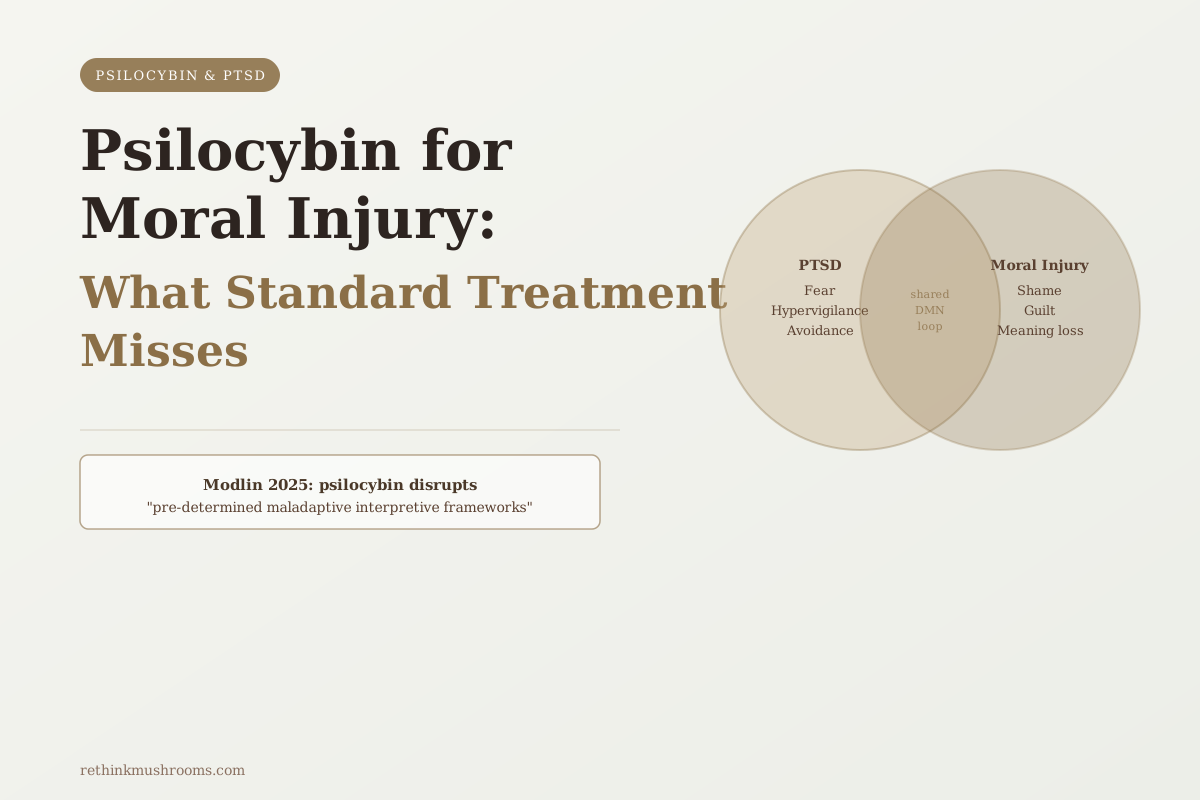
No RCTs testing psilocybin for moral injury specifically
The mechanistic case for psilocybin in moral injury is specific and grounded. The clinical case is not there yet. Here is what the evidence shows and where it runs out.
Modlin et al., Ther Adv Psychopharmacol, 2025
2025
year Modlin et al. proposed psilocybin disrupts rigid trauma narratives (Ther Adv Psychopharmacol)
MDMA
reduces fear arousal; psilocybin promotes insight and meaning-making (Bird 2021)
DMN
default mode network: hyperactive in both PTSD and moral injury, disrupted by psilocybin
Modlin et al., Ther Adv Psychopharmacol, 2025
 View as image ↗
Every year, tens of thousands of veterans carry something that looks like PTSD from the outside and feels different from the inside. It is organized around guilt and shame rather than fear. It involves a specific rupture: the sense that what happened violated one's most fundamental beliefs about right and wrong. This condition is called moral injury, and standard PTSD treatments often leave it largely untouched. Psilocybin's mechanism may address moral injury more precisely than any current approved treatment.
There are no published clinical trials testing psilocybin specifically for moral injury. The mechanistic case is specific and grounded, but the clinical evidence has not arrived. This article is part of the broader series on psilocybin for PTSD. The focus here is narrower: what makes moral injury different from fear-based PTSD, and why psilocybin's mechanism may fit that difference in a way that current treatments do not.
Key Takeaways
- Moral injury and PTSD share surface symptoms but have different emotional cores: PTSD is organized around fear, moral injury around guilt, shame, and a violated sense of what is right
- Standard first-line PTSD treatments — prolonged exposure, cognitive processing therapy — were designed to reduce fear and avoidance; they often fail to address the meaning-violation at moral injury's center
- A 2025 clinical review argues psilocybin disrupts "pre-determined and over-determined maladaptive interpretive frameworks" — the rigid self-narrative that defines moral injury — more directly than any current approved treatment (Modlin et al., Ther Adv Psychopharmacol, 2025)[1]
- Psilocybin and MDMA target different aspects of trauma: MDMA reduces fear arousal, psilocybin promotes insight and meaning-making — a distinction directly relevant to moral injury's narrative component (Bird et al., Int Rev Psychiatry, 2021)[2]
- Participants in a 2025 qualitative study (eClinicalMedicine) described engaging with traumatic memories under psilocybin as more like witnessing than reliving — creating space for moral re-evaluation that exposure approaches do not[9]
- No published clinical trial has tested psilocybin specifically for moral injury; the mechanistic case is strong but awaits direct clinical testing
Fear vs. Meaning: Why Moral Injury Requires a Different Treatment Approach
PTSD is primarily organized around fear. The brain learns that a certain class of stimuli is dangerous and over-generalizes that learning — treating a backfire as an ambush, treating a crowded room as a threat zone. Exposure-based therapies work by returning the person to the feared stimulus repeatedly, in a safe context, until the fear response extinguishes. This approach has decades of evidence behind it.
Moral injury operates differently. It is not primarily a fear disorder. It involves a violation of one's own moral code — doing something that transgresses one's deepest sense of right and wrong, witnessing such a transgression without being able to stop it, or being betrayed by someone in authority who violated a code one trusted. The central emotions are guilt, shame, and a sense that the world or the self no longer makes the kind of moral sense it once did.
| Feature | PTSD | Moral Injury |
|---|---|---|
| Core emotion | Fear, hypervigilance | Guilt, shame, loss of meaning |
| What caused it | Perceived threat to survival | Violation of moral framework |
| Primary symptom pattern | Re-experiencing, avoidance, startle response | Persistent shame, moral distress, spiritual rupture |
| Standard treatment | Prolonged exposure, CPT, EMDR | Adaptive Disclosure Therapy (limited evidence base) |
| What healing requires | Fear extinction, reduced avoidance | Moral re-evaluation, restored meaning |
| Psilocybin mechanism fit | DMN disruption, fear extinction facilitation | Narrative flexibility, meaning-making, ego dissolution |
This distinction has direct clinical consequences. Prolonged exposure asks the patient to relive traumatic events until the fear response extinguishes. For moral injury, reliving the event without changing its moral interpretation can reinforce the shame rather than reduce it. The patient re-experiences not just the memory but the conclusion the memory carries: I did something unforgivable. That fact about me does not change.
That conclusion is the problem. It is not a fear response. It is a story — a rigid narrative about the self that has become impervious to new information, updating every experience to confirm what it has already decided.
The DMN and the Stuck Story: What Brain Science Tells Us About Moral Injury
The default mode network is the brain's self-referential circuit. It activates when the mind turns inward: rumination, self-evaluation, narrative construction, imagining the past or future from a first-person perspective. It is the circuit most associated with the sense of who you are and the story you tell about yourself.
In PTSD, the default mode network tends to run hot, cycling through traumatic memories and catastrophic predictions with a compulsiveness that patients describe as impossible to interrupt. In moral injury, the default mode network runs hot in a different gear: rather than looping through fear, it loops through self-judgment. The shame narrative plays on repeat.
A 2023 systematic review by Gattuso and colleagues examined the effects of psilocybin, LSD, DMT, and ketamine on default mode network activity across multiple studies.[5] The finding across compounds was consistent: psychedelics disrupt default mode network hyperactivity. The normally tight self-referential cycling loosens. The review noted that this disruption likely underlies both the subjective effects of psychedelics and their therapeutic potential across depression, PTSD, and related conditions.
If the stuck narrative of moral injury is a product of a hyperactive default mode network running the same shame story on repeat, then a compound that specifically disrupts that over-firing may disrupt the narrative itself. Not by arguing against the story. Not through repeated exposure. But by temporarily reducing the brain's capacity to run the story at all.
The Stories Trauma Survivors Tell Themselves, and Why Psilocybin May Disrupt Them
The most specific mechanistic link between psilocybin and moral injury comes from a 2025 clinical review by Modlin and colleagues, published in Therapeutic Advances in Psychopharmacology.[1]
Modlin and colleagues argue that psilocybin works in PTSD by disrupting what they call "pre-determined and over-determined maladaptive interpretive frameworks." In plain language: the brain, after trauma, builds a rigid explanatory framework for what happened and what it means. The framework becomes over-determined — it filters out contradictory evidence and reinforces its own conclusions. Every new experience gets processed through the traumatic template.
This description fits moral injury with unusual precision. The moral injury sufferer is not primarily stuck in fear. They are stuck in an interpretive framework that has reached a specific conclusion: I violated a code I believe in. That fact about me is immovable. Therapy can challenge this reasoning. But the framework has a way of absorbing challenges and converting them into further confirmation.
Psilocybin, Modlin and colleagues argue, works not by providing arguments against the framework but by temporarily dissolving the framework itself. The acute disruption of the brain's predictive processing system — its tendency to run established interpretive scripts — creates a window in which the script is not running. In that window, new interpretations become possible in a way they are not when the framework is fully operational.
For a broader look at how psilocybin engages traumatic memory and the processing that follows, see psilocybin and trauma processing: how it facilitates healing.
Psilocybin vs. MDMA for Moral Injury: Why the Mechanism Distinction Matters
When researchers discuss psychedelic therapy for veterans, MDMA and psilocybin are often discussed as though they compete for the same therapeutic target. Their mechanisms differ substantially, and those differences are directly relevant to moral injury.
Bird, Modlin, and Rucker laid out this distinction in a 2021 review in the International Review of Psychiatry.[2] MDMA produces oxytocin release, fear suppression, and heightened trust — a pharmacological state that reduces the arousal response to traumatic material and allows the patient to revisit memories without the normal emotional overwhelm. This is a strong match for the fear-based component of PTSD. The traumatic memory can be accessed while the fear response is pharmacologically quieted.
Psilocybin works differently. Rather than suppressing fear, it promotes insight, ego dissolution, and meaning-making. The experience often involves a felt sense of perspective — viewing one's own story from outside, seeing it as something one is in rather than something one simply is.
For moral injury, Bird 2021's analysis points toward psilocybin as the mechanistically closer match. Moral injury is not primarily a fear problem. It is a meaning problem — a narrative about the self that has hardened into certainty. MDMA can reduce the arousal around engaging with that narrative. Psilocybin may reduce the grip of the narrative itself.
This is not a claim that one is superior. Veterans whose presentations center on fear-based hyperarousal and intrusive fear memories may respond differently than those whose presentations center on entrenched shame and moral distress. The two mechanisms may address different components of a complex presentation. For the full mechanistic comparison, see psilocybin vs. MDMA for PTSD: comparing psychedelic treatments.
How Trauma Gets Rewritten: The Memory Reconsolidation Mechanism
A 2022 review by Raut and colleagues examined effective PTSD treatments across a wide range of approaches: EMDR, cognitive processing therapy, prolonged exposure, ketamine, psilocybin, propranolol.[4] The finding across all of them: they converge on memory reconsolidation as a shared mechanism.
Memory reconsolidation is the process by which an established memory, when reactivated, briefly becomes malleable. In this window, the memory can be updated — new information can be incorporated, the emotional charge can change. After the reconsolidation window closes, the memory restabilizes, ideally in a modified form. All effective trauma treatments, Raut and colleagues argued, work by opening and influencing this window.
For fear-based PTSD, psilocybin may facilitate this through its effects on fear extinction. A 2024 preclinical review found that psilocybin facilitates fear extinction in a dose- and context-dependent way, primarily through 5-HT2A receptor activation.[6] When the brain's learned association between a stimulus and danger is weakened in the presence of that stimulus, the fear memory itself may update.
For moral injury, the application is less direct but not implausible. Moral injury memories are not primarily fear memories. They are shame memories — experiences that have been categorized as evidence of a moral flaw. If psilocybin can reactivate those memories in a context of increased openness and reduced narrative rigidity, the memory may reconsolidate with a different moral interpretation. Not because logic changed the conclusion, but because the memory was revisited from a position outside the framework that had locked the conclusion in place.
For a deeper look at the reconsolidation evidence base, see reconsolidation theory: how psilocybin may rewrite trauma.
What Participants Actually Report: The Witnessing Quality of Psilocybin Experience
In 2025, a qualitative study published in eClinicalMedicine — a Lancet journal — reported on the subjective experience of PTSD patients who received psilocybin in a clinical setting.[9]
What emerged from participants' accounts was a description of engaging with traumatic memories that felt distinctly different from standard trauma therapy. Participants did not experience the traumatic material with the same immediacy and overwhelm they had encountered in prolonged exposure. They described something more like witnessing: observing their own history with some degree of distance, rather than being fully inside it.
Participants also described the experience as more insight-generating and less aversive than exposure-based approaches. This is not avoidance — the memories were present and engaged. But the position from which they were engaged had changed.
For moral injury, this witnessing quality may be particularly relevant. The problem in moral injury is not that the person cannot access the memory. They can. The problem is the interpretation the memory carries every time it is accessed — the conclusion about the self that arrives automatically along with the event. Standard approaches aim to change the interpretation through argument and evidence. What participants describe in this qualitative study is something different: a state in which the memory is present but the interpretation is no longer experienced with the same degree of identification. The person is watching it, not simply being it.
That shift in position — from inside the story to outside it — is what ego dissolution, the default mode network disruption, and Modlin's interpretive framework all describe from different angles. And it is what moral injury's stuck narrative specifically requires in order to change.
The Neuroplasticity Piece: Can Psilocybin Structurally Repair a Brain Changed by Chronic Shame?
Moral injury that goes untreated tends to persist and worsen. Chronic shame and guilt are not merely psychological states — they involve sustained stress responses that affect brain structure over time. The prefrontal cortex, involved in moral reasoning and self-evaluation, and the hippocampus, involved in memory and context, both show structural changes in chronic stress and trauma.
A 2018 study by Ly and colleagues at the Olson lab, published in Cell Reports, provided the clearest evidence that psychedelics can promote structural repair in the brain: dendritic spine growth and synaptogenesis in cortical neurons, on timescales faster than conventional antidepressants.[10] This 2018 Cell Reports paper established that psychedelics are not only experiential interventions — they are structural ones, physically changing the architecture of synaptic connections.
A 2024 mechanistic review on psilocybin for PTSD specifically highlighted that these neuroplasticity effects — including BDNF upregulation, synaptic remodeling, and hippocampal changes — may be particularly relevant for trauma recovery.[7] Trauma changes the brain physically. A treatment that promotes structural repair alongside narrative disruption addresses both dimensions of what chronic moral injury does.
None of the neuroplasticity evidence is specific to moral injury. But the argument that psilocybin might address both the psychological rigidity and the structural consequences of entrenched shame is mechanistically coherent, even in the absence of moral injury-specific neuroplasticity data.
The Honest Ledger: What Clinical Evidence Exists and What It Cannot Yet Tell Us
The mechanistic case for psilocybin in moral injury is specific, coherent, and grounded in peer-reviewed research. The clinical case is not yet there.
No published clinical trial has specifically recruited patients with moral injury and tested psilocybin as a treatment. A 2022 clinical review from Khan and colleagues at UCSF reviewed psilocybin's potential for trauma-related disorders broadly, identifying strong mechanistic overlap with PTSD but acknowledging the absence of moral injury-specific data.[3] A 2025 evaluation by Miller and Zoladz argued the mechanistic case for psilocybin in PTSD is strong, but noted that the field is still extrapolating to trauma populations from depression and anxiety trials where most of the controlled evidence exists.[8]
What does exist is an active clinical trial — NCT05554094, run by Ohio State University and Baylor College of Medicine — that administers psilocybin-assisted therapy to veterans with severe treatment-resistant PTSD and includes moral injury as a secondary outcome measure. That trial is the closest the field has come to directly testing the moral injury hypothesis. Its results, when published, will be among the most significant data points in this area.
The mechanistic case rests on a convergence of evidence: Modlin 2025's narrative framework, Bird 2021's mechanism comparison, Gattuso 2023's DMN systematic review, the qualitative accounts of witnessing from the 2025 Lancet study, and the neuroplasticity evidence from Ly 2018. Each piece points the same direction. Whether they add up to clinical benefit for people specifically suffering from moral injury requires the kind of evidence that is still forthcoming.
For a broader look at psychedelic therapy options for populations with PTSD-adjacent presentations, see can psilocybin help first responders with PTSD?, which covers overlapping clinical territory.
The Bottom Line
Moral injury is not a fear disorder, which is why the treatments built for fear-based PTSD often leave it untouched. Psilocybin's mechanism — disrupting the brain's rigid interpretive frameworks via Modlin 2025's model, quieting the default mode network's shame narrative per Gattuso 2023, and creating the witnessing perspective that participants in the 2025 qualitative study describe — maps more precisely to moral injury's pathology than any current approved treatment. The neuroplasticity evidence from Ly 2018 adds a structural dimension. What is missing is clinical data from trials specifically targeting moral injury. NCT05554094 includes moral injury as a secondary outcome and will provide the first direct signal. Until then, the case is mechanistic: specific, grounded, and awaiting confirmation.
Frequently Asked Questions
Sources & References
- 1RTHM-00946·Modlin, Nadav Liam et al. (2025). “Clinical conceptualisation of PTSD in psilocybin treatment: disrupting a pre-determined and over-determined maladaptive interpretive framework..” Therapeutic advances in psychopharmacology.Study breakdown →PubMed →↩
- 2RTHM-01328·Bird, Catherine I V et al. (2021). “Psilocybin and MDMA for the treatment of trauma-related psychopathology..” International review of psychiatry (Abingdon.Study breakdown →PubMed →↩
- 3RTHM-00770·Khan, Amanda J et al. (2022). “Psilocybin for Trauma-Related Disorders..” Current topics in behavioral neurosciences.Study breakdown →PubMed →↩
- 4RTHM-01606·Raut, Sanket B et al. (2022). “Diverse therapeutic developments for post-traumatic stress disorder (PTSD) indicate common mechanisms of memory modulation..” Pharmacology & therapeutics.Study breakdown →PubMed →↩
- 5. Source details for this reference are not yet available.
- 6. Source details for this reference are not yet available.
- 7. Source details for this reference are not yet available.
- 8. Source details for this reference are not yet available.
- 9. Source details for this reference are not yet available.
- 10RTHM-00983·Ly, Calvin et al. (2018). “Psychedelics Promote Structural and Functional Neural Plasticity..” Cell reports.Study breakdown →PubMed →↩