Military / Moral Injury
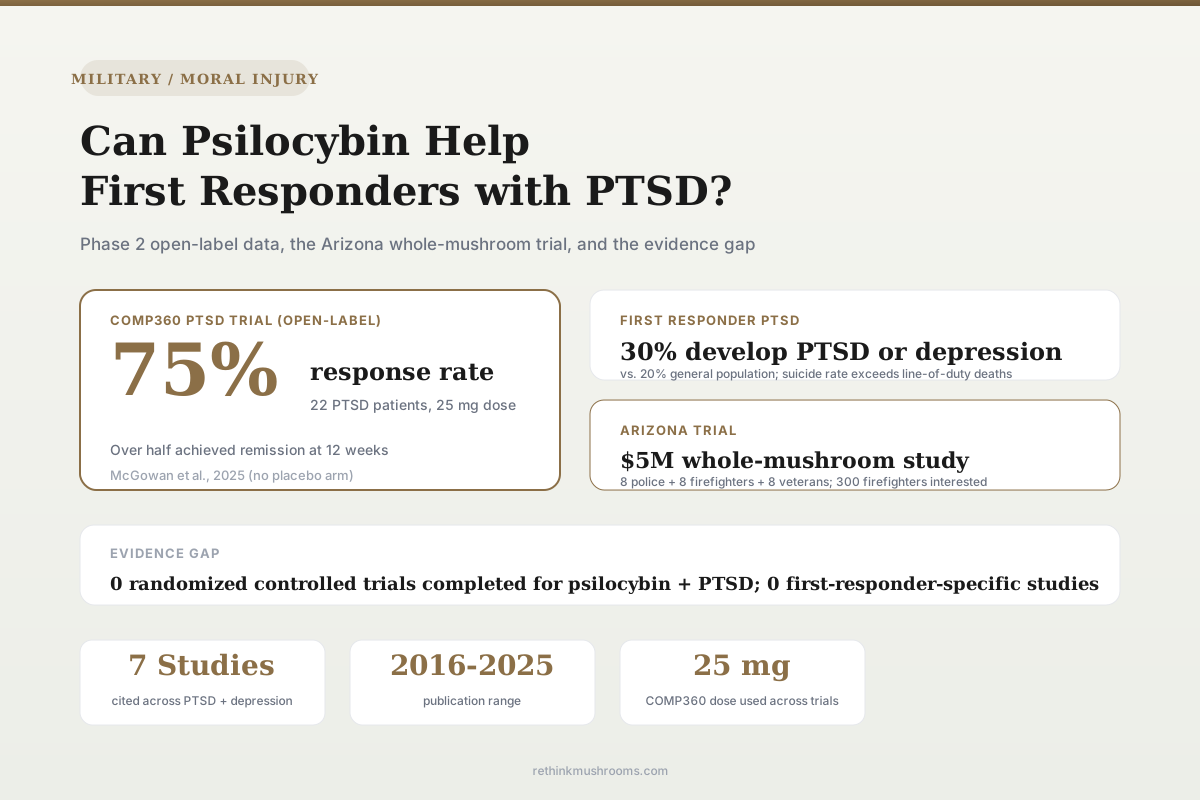
75% response rate
In a Phase 2 open-label trial of 25 mg COMP360 psilocybin for PTSD, over 75% of 22 participants were classified as treatment responders, and over half achieved remission at 12 weeks.
McGowan et al., Journal of Psychopharmacology, 2025
30%
of first responders develop PTSD or depression vs. 20% general population
$5 million
Arizona trial enrolling police, firefighters, and veterans for whole-mushroom psilocybin
0 RCTs
randomized controlled trials of psilocybin for PTSD have been completed
McGowan et al., Journal of Psychopharmacology, 2025
 View as image ↗
First responders occupy a specific position in the PTSD treatment landscape. Police officers, firefighters, paramedics, and emergency dispatchers face repeated occupational trauma exposure rather than single-incident trauma, accumulating hundreds or thousands of distressing events over a career. Approximately 30% develop PTSD or depression, and the suicide rate among firefighters (18 per 100,000) and police officers (17 per 100,000) exceeds the general population rate of 13 per 100,000. More firefighters and police officers die by suicide than in the line of duty. Standard trauma-focused therapies (prolonged exposure, EMDR, cognitive processing therapy) were developed for single-incident civilian trauma and have variable efficacy in occupational trauma populations.
Psilocybin research for PTSD is in its earliest clinical phase. One open-label trial of 22 patients exists. No randomized controlled trial has been completed. No study has specifically enrolled first responders as a defined population. What exists is a convergence of circumstance: a mental health crisis in first responder communities, promising but preliminary psilocybin data in adjacent conditions (depression, end-of-life anxiety), and several trials now actively recruiting. For how military veterans are driving parallel research, see psilocybin and veteran PTSD: the push for military-focused research.
Key Takeaways
- In a Phase 2 open-label trial, 25 mg COMP360 psilocybin with psychological support produced treatment response in over 75% of 22 PTSD patients and remission in over half at 12 weeks, with no serious adverse events (McGowan et al., 2025)
- A first-in-kind pilot study of single-dose psilocybin in U.S. military veterans with severe treatment-resistant depression found significant reductions in depression severity, establishing safety and feasibility in a population with high PTSD comorbidity (Ellis et al., 2025)
- Psilocybin for trauma-related disorders operates through 5-HT2A-mediated fear extinction enhancement, default mode network disruption, and increased emotional processing flexibility, all relevant to PTSD pathophysiology (Khan et al., 2022)
- A single 25 mg psilocybin dose significantly reduced depression in treatment-resistant patients at 3 weeks in the largest NEJM trial, establishing the dose that PTSD trials now use (Goodwin et al., 2022)
- Psilocybin-assisted therapy produced response rates equivalent to escitalopram for major depression on the primary outcome, with secondary measures favoring psilocybin (Carhart-Harris et al., 2021)
- In a randomized clinical trial, two psilocybin sessions with supportive psychotherapy produced large, rapid, and sustained antidepressant effects, with 71% of participants showing greater than 50% reduction in depression severity at 4 weeks (Davis et al., 2021)
The COMP360 PTSD Trial
McGowan et al. (2025) published the first clinical trial data for psilocybin in PTSD. This was a Phase 2, nonrandomized, open-label, multicenter study in which 22 adults with PTSD received a single 25 mg dose of COMP360 psilocybin with psychological support. The primary endpoint was safety and tolerability at 12 weeks.[1]
The safety profile was favorable. Of 117 treatment-emergent adverse events, 70 (59.8%) occurred on administration day, and 91.4% of those resolved by the following day. The most common events were headache (50%), nausea (36.4%), crying (27.3%), and fatigue (27.3%). There were no serious adverse events and no study withdrawals.
The efficacy signal was strong for an open-label design: over 75% of participants were classified as treatment responders, and over half achieved remission. These response rates exceed typical SSRI response rates for PTSD, which hover around 60% in clinical trials and are lower in practice.
The critical limitations are the absence of a placebo arm and the small sample size. Open-label psychedelic studies consistently produce high response rates that diminish when placebo controls are introduced, partly because the subjective experience of psychedelic effects makes blinding difficult and expectancy effects large. The trial establishes that psilocybin can be safely administered to PTSD patients and that symptom improvement occurs, but it cannot determine what proportion of improvement is attributable to the drug versus the therapeutic context, attention, and expectation.
Why First Responders Are Different
First responder PTSD differs from civilian PTSD in ways that matter for treatment design. The Diagnostic and Statistical Manual defines PTSD around a single qualifying traumatic event, but first responders experience chronic cumulative trauma: hundreds of calls involving death, injury, child abuse, or threats to personal safety over a 20- to 30-year career. This creates a layered trauma profile where individual events compound rather than standing alone.
Standard evidence-based therapies (prolonged exposure, EMDR, cognitive processing therapy) achieve response rates of 60 to 80% in civilian populations with single-incident trauma. Response rates in occupational trauma populations are less well-documented and likely lower, partly because the therapy model requires processing a specific index trauma while the first responder's distress emerges from the cumulative weight of many events. Treatment dropout is also higher in populations with occupational stigma around mental health help-seeking.
The cultural dimension amplifies the treatment gap. First responder organizations have historically discouraged psychological vulnerability. Seeking treatment can carry career consequences: mandatory fitness-for-duty evaluations, loss of firearm privileges, or removal from active service. This suppression of help-seeking means that first responders who do enter treatment often present with more severe, chronic, treatment-resistant PTSD than the average clinical trial participant. For how this connects to the concept of moral injury, which extends beyond fear-based PTSD into guilt, shame, and betrayal, see psilocybin and moral injury: healing beyond standard PTSD treatment.
The Arizona Whole-Mushroom Trial
Arizona has funded a $5 million clinical trial that represents a deliberate departure from the synthetic psilocybin approach used by COMPASS Pathways and other pharmaceutical developers. This trial will use whole psilocybin mushrooms rather than isolated synthetic psilocybin, testing whether the full spectrum of mushroom compounds (including baeocystin, norbaeocystin, and other tryptamines) produces different therapeutic effects than the single molecule.
The initial cohort will include eight police officers, eight firefighters, and eight military veterans with diagnosed PTSD. This is the first controlled trial to specifically enroll first responders as a defined study population, rather than including them incidentally within a broader PTSD sample. The interest has been substantial: nearly 300 firefighters and over 50 police officers have expressed interest in participation.
The trial design raises an important question for the field: does whole-mushroom psilocybin differ pharmacologically from synthetic psilocybin at equivalent psilocybin doses? The answer is unknown. Whole mushrooms contain dozens of tryptamine compounds in varying ratios, but whether any of these meaningfully contribute to therapeutic effects beyond psilocybin itself has not been established. For the broader military research landscape, see military psychedelic research: veterans leading the way.
Evidence from Adjacent Conditions
The strongest psilocybin evidence comes from depression and cancer-related distress, not PTSD. But PTSD and treatment-resistant depression share neurobiological features (default mode network hyperconnectivity, amygdala hyperreactivity, prefrontal hypofunction) that make the depression data relevant to PTSD predictions.
Ellis et al. (2025) conducted the first psilocybin pilot study in U.S. military veterans with severe treatment-resistant depression. A single dose produced significant reductions in depression severity. This population has high PTSD comorbidity, making the findings directly relevant to the first responder question even though PTSD was not the primary outcome measure.[2]
Davis et al. (2021) found that two psilocybin sessions with supportive psychotherapy produced rapid antidepressant effects in a randomized trial: 71% of participants showed greater than 50% reduction in depression severity at 4 weeks, and 54% were in remission.[6] The magnitude and speed of response exceed typical antidepressant timelines and suggest that psilocybin-assisted therapy can produce clinically meaningful change in severe, entrenched psychopathology.
Goodwin et al. (2022) established the 25 mg dose now used in PTSD trials. In treatment-resistant depression, a single 25 mg dose significantly reduced MADRS scores at 3 weeks compared to a 1 mg control, while a 10 mg dose did not separate from control.[4] Griffiths et al. (2016) demonstrated that psilocybin produced substantial and sustained decreases in both depression and anxiety in patients with life-threatening cancer, effects that persisted at 6-month follow-up in 80% of participants.[7] The cancer-distress literature is particularly relevant to first responders because existential distress, moral questioning, and loss of meaning are features shared across both populations, even though the proximate causes differ.
Proposed Mechanisms for PTSD
Khan et al. (2022) reviewed the theoretical basis for psilocybin in trauma-related disorders. Three mechanisms are hypothesized to be relevant to PTSD.[3]
Fear extinction enhancement. PTSD involves impaired extinction of conditioned fear responses. Psilocybin's 5-HT2A agonism in the amygdala and prefrontal cortex may facilitate the reconsolidation of traumatic memories with reduced emotional intensity. Animal models show that serotonergic psychedelics enhance fear extinction learning, which is the same process targeted by prolonged exposure therapy but through a different pharmacological route.
Default mode network disruption. The default mode network (DMN) is hyperactive in PTSD, supporting rumination, trauma-related memory intrusion, and rigid self-referential processing. Psilocybin reliably suppresses DMN activity during acute effects and increases global brain connectivity. This temporary disruption may allow PTSD patients to access traumatic material with reduced defensive avoidance.
Emotional processing flexibility. Psilocybin increases emotional lability during acute effects and enhances emotional empathy in the days following administration. For PTSD patients who use emotional numbing as a coping strategy (common in first responders), this increased emotional range may be therapeutically useful if channeled within a supportive therapeutic framework. For how psilocybin compares to escitalopram for depression specifically, see mushrooms vs. SSRIs for mental health: can they compare?.
What the Evidence Does Not Yet Show
No randomized, placebo-controlled trial of psilocybin for PTSD has been completed. The COMP360 data is open-label with 22 patients. The Arizona trial has not yet reported results. No study has measured PTSD outcomes specifically in first responders. No study has compared psilocybin to prolonged exposure, EMDR, or any evidence-based PTSD therapy.
The MDMA-assisted therapy literature for PTSD is further advanced (Phase 3 completed, though with regulatory complications), and the psilocybin PTSD field is watching that trajectory carefully. If MDMA's path illustrates anything, it is that open-label and Phase 2 excitement does not guarantee Phase 3 success or regulatory approval.
The first responder community's enthusiasm for psilocybin research is running ahead of the evidence. This is understandable given the severity of the problem and the limitations of existing options, but it creates a risk of premature adoption outside of clinical trial settings. Several U.S. states have enacted or are considering legislation to fund psilocybin research specifically for first responders and veterans, creating a policy environment that may move faster than the clinical data supports. Underground and international retreat use of psilocybin among first responders is already occurring, generating anecdotal reports that are compelling on an individual level but do not constitute clinical evidence.
What exists right now is a plausible mechanism, a favorable safety signal, encouraging open-label results, and active trials. What does not exist is proof of efficacy from the study designs required to establish it. For how advocacy efforts are shaping research priorities, see psilocybin for veterans with PTSD: research and advocacy.
The Bottom Line
Psilocybin for first responder PTSD is at the earliest stage of clinical investigation. One open-label trial of 22 patients showed a 75% response rate and favorable safety. A $5 million Arizona trial is specifically enrolling police, firefighters, and veterans. The strongest supporting evidence comes from psilocybin depression trials, which share neurobiological overlap with PTSD. No randomized controlled trial, no first-responder-specific study, and no comparison to existing PTSD therapies have been completed.
Frequently Asked Questions
Sources & References
- 1RTHM-00941·McGowan, Niall M et al. (2025). “Investigating the safety and tolerability of single-dose psilocybin for post-traumatic stress disorder: A nonrandomized open-label clinical trial..” Journal of psychopharmacology (Oxford.Study breakdown →PubMed →↩
- 2RTHM-00923·Ellis, Sara et al. (2025). “Single-dose psilocybin for U.S. military Veterans with severe treatment-resistant depression - A first-in-kind open-label pilot study..” Journal of affective disorders.Study breakdown →PubMed →↩
- 3RTHM-00770·Khan, Amanda J et al. (2022). “Psilocybin for Trauma-Related Disorders..” Current topics in behavioral neurosciences.Study breakdown →PubMed →↩
- 4RTHM-00761·Goodwin, Guy M et al. (2022). “Single-Dose Psilocybin for a Treatment-Resistant Episode of Major Depression..” The New England journal of medicine.Study breakdown →PubMed →↩
- 5RTHM-00675·Carhart-Harris, Robin et al. (2021). “Trial of Psilocybin versus Escitalopram for Depression..” The New England journal of medicine.Study breakdown →PubMed →↩
- 6RTHM-00682·Davis, Alan K et al. (2021). “Effects of Psilocybin-Assisted Therapy on Major Depressive Disorder: A Randomized Clinical Trial..” JAMA psychiatry.Study breakdown →PubMed →↩
- 7RTHM-00426·Griffiths, Roland R et al. (2016). “Psilocybin produces substantial and sustained decreases in depression and anxiety in patients with life-threatening cancer: A randomized double-blind trial..” Journal of psychopharmacology (Oxford.Study breakdown →PubMed →↩