Psilocybin, Veterans & PTSD
85% of veteran psychedelic users reported benefit
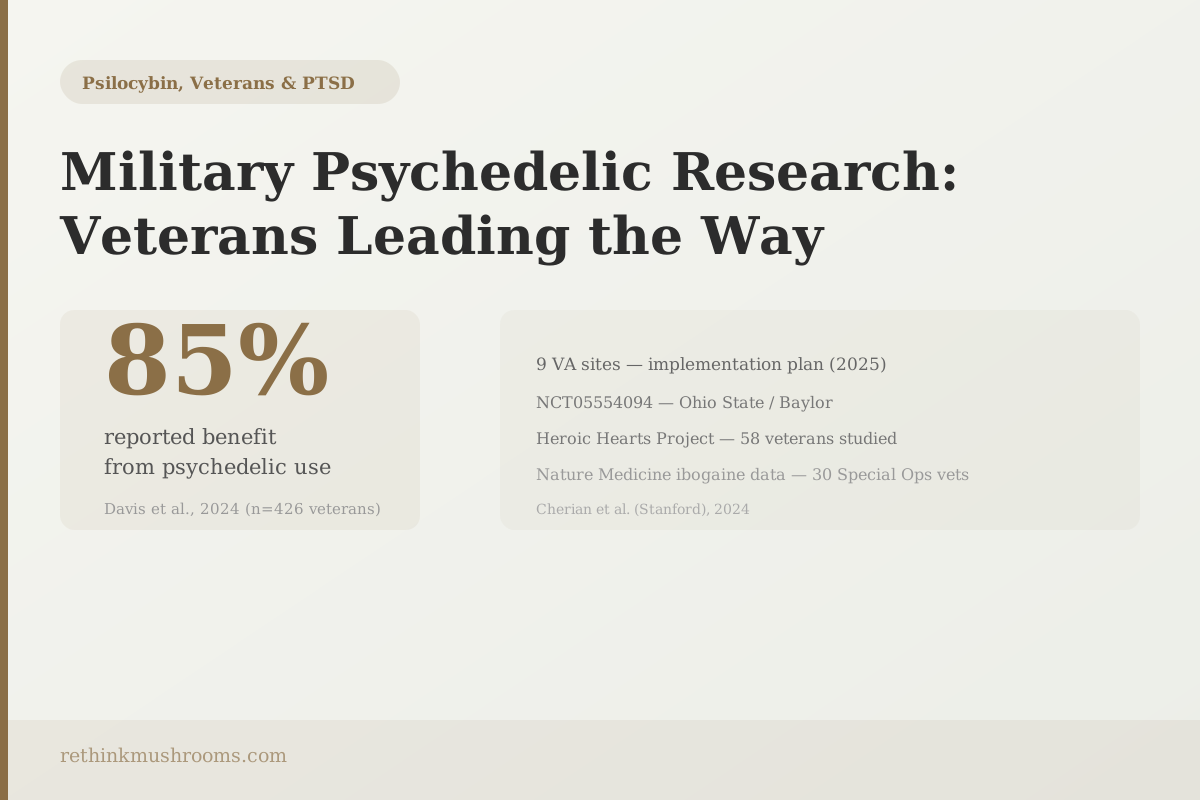
A survey of 426 US military veterans found that 85% of those who had used psychedelics reported a net benefit — and those veterans were more likely to return to the VA if psychedelic-assisted therapy was formally offered.
Davis et al., Journal of Psychoactive Drugs, 2024
51%
of surveyed veterans had used psychedelics; 70% specifically for healing or treatment
58 veterans
attended psilocybin or ayahuasca retreats through Heroic Hearts Project (Calnan 2025)
9 VA sites
now involved in psychedelic research implementation (Wolfgang et al., 2025)
Davis et al., Journal of Psychoactive Drugs, 2024
 View as image ↗
In early 2022, a group of 30 special operations veterans traveled to a clinic in Mexico and received ibogaine. Many of them had severe PTSD, traumatic brain injury, and had attempted or were considering suicide. Stanford researchers flew in to assess them before and after. Fourteen months later, their results were published in Nature Medicine.[1]
That paper did not originate in a NIH grant process or a pharmaceutical company pipeline. It originated in veterans refusing to wait. The veterans organized it, funded part of it through veteran networks, and then recruited the Stanford team to document what happened. The results, which showed dramatic improvements in PTSD, depression, anxiety, and disability, triggered significant institutional attention. More importantly for the psilocybin field, it showed that veteran-driven psychedelic research could produce data compelling enough for the highest-tier journals.
The military psychedelic research landscape today is the direct result of that kind of bottom-up momentum. Veterans with treatment-resistant conditions sought out illegal retreats and foreign clinics, documented what happened, and in doing so created the evidence base and the political pressure that finally moved the VA. This article covers the organizations, the trials, the data, and the policy landscape they produced. For a deeper look at the specific evidence on psilocybin for PTSD, see the complete guide to psilocybin for PTSD.
Key Takeaways
- Davis et al. (2024) surveyed 426 US military veterans; 51% had used psychedelics, 70% specifically for healing or treatment, 85% reported benefit, and veterans were more likely to return to VA care if psychedelic-assisted therapy was offered
- Calnan et al. (2025), studying 58 veterans through Heroic Hearts Project retreats, found significant improvements in PTSD, depression, anxiety, and reintegration; psilocybin showed stronger results for depression and post-concussion symptoms, ayahuasca for PTSD
- Cherian et al. (2024) published in Nature Medicine the results of ibogaine therapy in 30 special operations veterans, showing dramatic PTSD relief and setting a benchmark for veteran-specific psychedelic research
- Wolfgang et al. (2025) reported in the American Journal of Psychiatry that the VA chartered a formal Integrated Project Team in April 2024 to plan psychedelic research implementation across 9 facilities with four workstreams
- NCT05554094 (Ohio State/Baylor) is the first published protocol for psilocybin-assisted therapy specifically in US military veterans with PTSD — two psilocybin sessions at 15 mg and 25 mg combined with structured psychotherapy
- Mitchell et al. (2023) published a Phase 3 MDMA trial showing 67% of treated patients no longer met PTSD criteria; MDMA's subsequent FDA rejection in 2024 increased institutional urgency for psilocybin research as the alternative pathway
When 30 Special Ops Veterans Went to Mexico and Ended Up in Nature Medicine
The Cherian et al. paper is important not just for its findings but for its origin story.[1] These were 30 special operations veterans, many with histories of TBI, PTSD, suicidal ideation, and failed conventional treatment. They organized the trip themselves through networks of veterans who had already tried ibogaine abroad. Stanford's Nolan Williams joined to document outcomes systematically.
The results at one month were striking. Compared to baseline, participants showed large improvements in PTSD symptom severity, depression, anxiety, and functional disability. Suicidal ideation decreased substantially. The improvements were larger than what had been reported in any previous controlled study of an available treatment for this population.
This study did not answer whether ibogaine is a safe long-term treatment. Ibogaine carries real cardiac risks, requires careful screening, and is a controlled substance in the United States. But the Nature Medicine publication accomplished something specific: it demonstrated that veteran populations with severe, complex, treatment-resistant conditions could benefit dramatically from psychedelic-assisted therapy when the research was designed around their actual needs rather than academic exclusion criteria.
That point matters for understanding the entire landscape. Much of the psychedelic research base excludes people with PTSD, TBI, suicidal ideation, and psychiatric comorbidities — precisely the conditions that define the veteran population in greatest need. The Cherian study used a population that standard clinical trials would have screened out.
What Epidemiology Shows: Half of Veteran Psychedelic Users Already Report Benefit
While ibogaine was making headlines, another dataset was quietly developing. Davis and colleagues published epidemiological data on psychedelic use among US military veterans in 2024, based on surveys of 426 respondents.[2]
The numbers: 51% of respondents had used psychedelics at some point, and 70% of those who used them did so for healing or treatment purposes — not recreation. Spiritual or personal growth motivated 48%. Among users, 85% reported that psychedelic use had been net beneficial for their mental health.
These are self-selected veterans who chose to respond to a survey about psychedelic use, so the 85% figure reflects a population already inclined toward positive experiences. But several additional findings are harder to explain away. Psilocybin users reported fewer adverse outcomes than users of other psychedelics. And veterans who had used psychedelics were substantially more likely to say they would return to VA care if psychedelic-assisted therapy was offered there — a finding with direct policy implications.
The VA's challenge with veteran PTSD is not only clinical. Veterans with the most severe PTSD are often the least engaged with formal care. They don't trust institutions. They don't respond to traditional outreach. If psychedelic therapy is a pathway that brings them back to the VA rather than away from it, that has practical value beyond any individual trial outcome.
Calnan and colleagues published the retreat-level data in 2025, studying 58 veterans who attended facilitated psychedelic retreats through the Heroic Hearts Project, a veteran-focused nonprofit organization.[3] Participants attended psilocybin sessions in Jamaica or ayahuasca ceremonies in Peru. Both groups showed significant improvements in PTSD, depression, anxiety, and social reintegration. Psilocybin produced stronger improvements in depression, anxiety, post-concussion symptoms, and reintegration metrics. Ayahuasca produced stronger improvements specifically on PTSD symptom measures.
Neither the Heroic Hearts retreats nor the epidemiology data are controlled research. Self-selection is the dominant limitation in both. But together they establish the baseline: substantial numbers of veterans are already using psychedelics for treatment, most report benefit, and the real-world data is consistent enough to justify formal research.
The Institutional Response: How the VA Finally Started Moving
Wolfgang and Hoge, both from Walter Reed, published a comprehensive review in Current Psychiatry Reports in 2023 documenting what the VA would need to address before implementing psychedelic-assisted therapy: legal barriers, training infrastructure, safety monitoring, and integration with existing evidence-based treatments.[5] At the time of that review, there were zero published psilocybin clinical trials for PTSD in any population. The paper read partly as a roadmap and partly as a warning that institutional implementation would require more than enthusiasm.
Two years later, Wolfgang was a co-author on a very different paper. Published in the American Journal of Psychiatry in 2025 and co-authored with VA and Walter Reed researchers, it reported that the VA had chartered a formal Integrated Project Team in April 2024 specifically to plan psychedelic research implementation.[4] The IPT had four structured workstreams: research design, clinical implementation, provider training, and evaluation. Nine VA facilities were identified for multi-year studies.
The progression from "here's what we'd need to do this" in 2023 to "here's the implementation plan" in 2025 reflects the speed of the field. The political and clinical pressure from veteran advocacy groups, combined with results like the ibogaine Nature Medicine paper, accelerated institutional timelines in a way that rarely happens in federal healthcare systems.
For a broader view of why veteran PTSD specifically creates the case for psilocybin research beyond existing treatments, see Psilocybin and Veteran PTSD: The Push for Military-Focused Research.
The Current Military Psychedelic Research Landscape: Active Trials
The most established veteran-specific psilocybin trial protocol was published by Davis and colleagues in 2023.[6] NCT05554094, run jointly by Ohio State University and Baylor College of Medicine, is the first dedicated US veteran psilocybin PTSD trial. The protocol involves two psilocybin sessions at 15 mg and 25 mg combined with structured psychotherapy in US military veterans with severe, treatment-resistant PTSD. Enrollment target is 15 participants.
This is a small study. It is designed as an open-label proof-of-concept, not a powered efficacy trial. The point is to establish safety, tolerability, and preliminary signals in a veteran population — the foundation that larger controlled trials would require. The 2023 publication of the protocol represents the commitment to proceed. Results have not yet been published as of this writing.
Additional trials involving veteran populations are registered under NCT06407635 and NCT05876481, covering psilocybin-assisted therapy for PTSD and related conditions. The VA's nine-site research infrastructure, documented in the Wolfgang 2025 AJP paper, will be the eventual mechanism for larger multi-site trials.
For context on where psilocybin sits within the broader clinical trial ecosystem for PTSD and related conditions, see Psilocybin for PTSD: Current Clinical Trials and Preliminary Data. For how veteran PTSD compares to first responder populations, see Can Psilocybin Help First Responders with PTSD?.
Why the MDMA Rejection Shifted Everything Toward Psilocybin
For much of the decade between 2015 and 2024, MDMA-assisted therapy was the lead candidate for veteran PTSD among psychedelic treatments. The evidence was compelling. Mitchell and colleagues published a Phase 3 randomized controlled trial in Nature Medicine in 2023 showing that 67% of patients in the MDMA arm no longer met diagnostic criteria for PTSD, compared to 32% in the placebo arm.[7] That effect size, from a fully blinded Phase 3 trial, was larger than anything previously published for any PTSD pharmacotherapy.
In 2024, the FDA advisory committee declined to recommend approval for Lykos Therapeutics' MDMA-assisted therapy application. The committee had concerns about functional unblinding, data reliability issues at specific trial sites, and what they viewed as insufficient evidence on abuse potential. The FDA subsequently issued a complete response letter denying approval.
The MDMA rejection created an unusual shift in the research landscape. The veteran community, which had heavily invested politically and emotionally in MDMA as the near-term solution, now needed a second path. Psilocybin represents that path — a different mechanism, a different clinical profile, and a different regulatory history.
Bird and colleagues, reviewing psilocybin and MDMA for trauma-related disorders in 2021, articulated what the mechanistic difference means clinically.[8] MDMA works primarily by reducing fear arousal — it allows patients to process traumatic material without being overwhelmed by the emotional activation that material triggers. Psilocybin works differently: it disrupts rigid patterns of thought and creates conditions for insight and meaning-making. For PTSD with a strong fear-extinction component, MDMA's profile is well-suited. For the moral injury component of veteran PTSD — the guilt, shame, and narrative rupture that comes from witnessing or participating in morally distressing events — psilocybin's mechanism of promoting narrative flexibility may offer something distinct.
For a deeper comparison of how these two compounds approach PTSD from different directions, see Psilocybin vs. MDMA for PTSD: Comparing Psychedelic Treatments. For what happened to the PTSD treatment landscape after the MDMA rejection, see After Lykos: What Psilocybin Means for Psychedelic PTSD Treatment.
The Legislative Push: From Advocacy Organizations to 9 VA Sites
The policy landscape around veteran psychedelic therapy has shifted rapidly since 2021. Siegel and colleagues, writing in JAMA Psychiatry in 2023, documented the US legislative momentum: state-level decriminalization in multiple cities and counties, Oregon and Colorado legalization frameworks, and federal proposals including the Expanding Access to Psychedelics for Veterans Act and the Innovative Therapies Centers of Excellence Act.[9] The JAMA paper specifically noted veteran advocacy as a key driver of legislative momentum, distinguishing veteran-led lobbying from broader psychedelic reform advocacy.
Organizations driving this include Veterans Exploring Treatment Solutions (VETS), which funds veterans' travel to legal retreat settings and advocates for research funding; the Heroic Hearts Project, which runs the retreats whose outcomes Calnan and colleagues studied; the Disabled American Veterans (DAV), which has formally called for VA research into psychedelic therapies; and the Congressional PATH Caucus (Psychedelic Access, Treatment, and Healthcare), which has championed the legislative agenda on Capitol Hill.
The scale of the broader psilocybin research push is documented by Norring and Spigarelli, who analyzed the ClinicalTrials.gov database in 2024: 134 registered psilocybin clinical trials, 54 potential therapeutic indications, and zero marketing approvals anywhere in the world at that time.[10] Australia is the partial exception — the Therapeutic Goods Administration approved psilocybin as a prescription medicine in 2023, making it the first country to do so, as documented in a 2024 review of the Australian experience.[11]
The gap between 134 trials and zero approvals captures the moment the veteran research push is operating in: massive investment of resources, substantial human data accumulating, but no regulatory pathway in the US yet established. The nine VA sites in Wolfgang's 2025 implementation plan represent an institutional commitment to building that pathway from within the federal healthcare system, rather than waiting for it to appear from outside.
For the advocacy and research landscape specifically focused on what veterans need from psilocybin therapy, see Psilocybin for Veterans with PTSD: Research and Advocacy. For the moral injury angle — the part of veteran trauma that standard PTSD treatments often miss — see Psilocybin and Moral Injury: Healing Beyond Standard PTSD Treatment.
The Bottom Line
Military psychedelic research has been shaped less by top-down funding than by veterans who sought out treatment themselves, documented their results, and created political and scientific pressure that institutions eventually responded to. The Cherian ibogaine Nature Medicine paper, the Heroic Hearts retreat data, and the epidemiology showing 85% of veteran psychedelic users reporting benefit preceded the VA's formal implementation plan by years. The current landscape — nine VA sites, multiple active trials, and a legislative push in Congress — is the institutional response to that bottom-up momentum. Psilocybin is now the leading candidate following MDMA's FDA rejection in 2024.
Frequently Asked Questions
Sources & References
- 1. Source details for this reference are not yet available.
- 2. Source details for this reference are not yet available.
- 3. Source details for this reference are not yet available.
- 4. Source details for this reference are not yet available.
- 5RTHM-01820·Wolfgang, Aaron S et al. (2023). “Psychedelic-Assisted Therapy in Military and Veterans Healthcare Systems: Clinical, Legal, and Implementation Considerations..” Current psychiatry reports.Study breakdown →PubMed →↩
- 6. Source details for this reference are not yet available.
- 7. Source details for this reference are not yet available.
- 8RTHM-01328·Bird, Catherine I V et al. (2021). “Psilocybin and MDMA for the treatment of trauma-related psychopathology..” International review of psychiatry (Abingdon.Study breakdown →PubMed →↩
- 9. Source details for this reference are not yet available.
- 10. Source details for this reference are not yet available.
- 11. Source details for this reference are not yet available.