Psilocybin and PTSD
-29.9 CAPS-5 Points
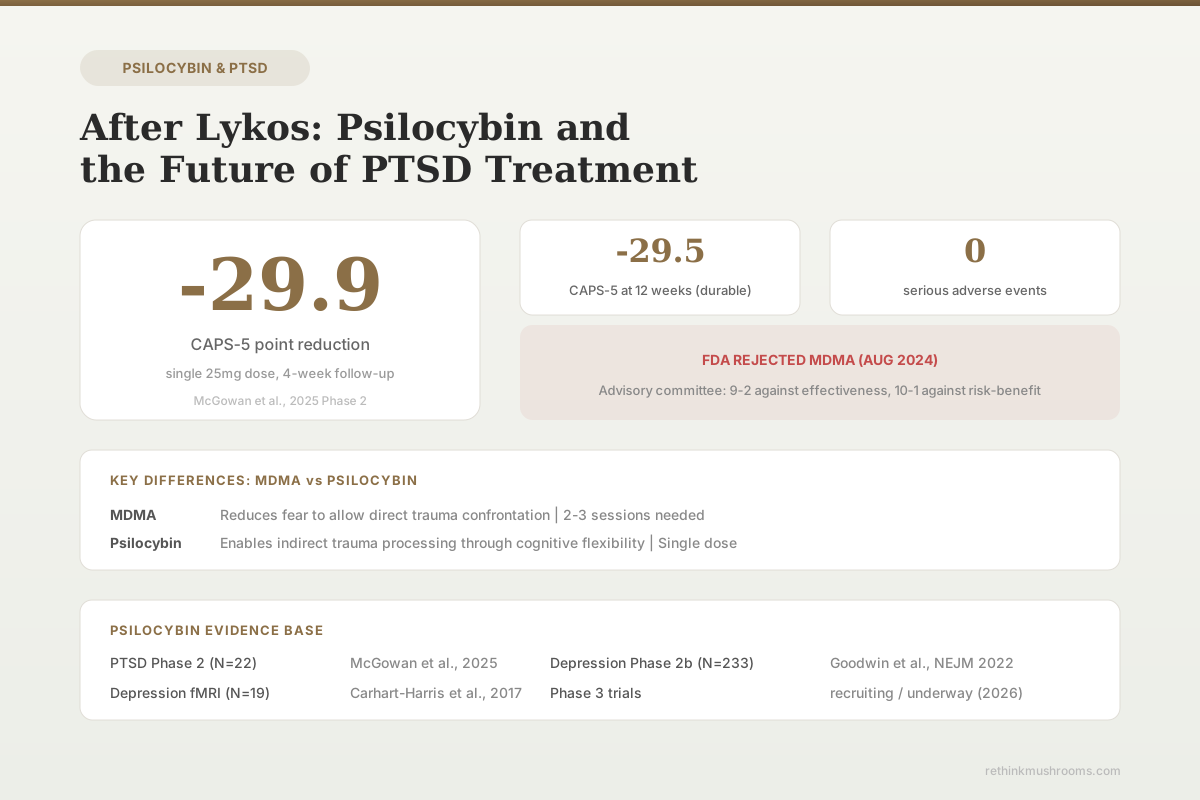
In a 2025 Phase 2 open-label trial, a single 25mg dose of COMP360 psilocybin reduced PTSD symptom scores by 29.9 points on the CAPS-5 scale at 4 weeks. The improvement held at 12 weeks (-29.5 points). No serious adverse events were reported.
McGowan et al., Journal of Psychopharmacology, 2025
22 Participants
Phase 2 open-label PTSD trial
Single Dose
one 25mg psilocybin session
FDA Rejected MDMA
August 2024, Complete Response Letter
McGowan et al., Journal of Psychopharmacology, 2025
 View as image ↗
On August 9, 2024, the FDA issued a Complete Response Letter to Lykos Therapeutics, declining to approve MDMA-assisted therapy for post-traumatic stress disorder. The advisory committee had voted 9-2 against effectiveness and 10-1 against the risk-benefit profile. After decades of research and two Phase 3 trials, the most advanced psychedelic therapy in the regulatory pipeline was sent back to the starting line.
That rejection reshaped the psychedelic medicine landscape. MDMA had been the frontrunner. Now the question is whether psilocybin, which works through an entirely different pharmacological mechanism, can succeed where MDMA stalled. The early clinical data suggests it can, but through a fundamentally different approach to trauma processing. For a deeper comparison of how MDMA and psilocybin differ mechanistically, that analysis gets its own article. The complementary approaches of MDMA for fear and psilocybin for meaning are covered separately.
Key Takeaways
- The FDA rejected Lykos Therapeutics' MDMA-assisted therapy for PTSD in August 2024, with the advisory committee voting 9-2 against effectiveness and citing safety concerns, functional unblinding, and insufficient durability data
- A 2025 Phase 2 open-label trial of COMP360 psilocybin (25mg single dose) in 22 PTSD patients showed a 29.9-point reduction in CAPS-5 scores at 4 weeks, maintained at 12 weeks (-29.5 points) (McGowan et al., Journal of Psychopharmacology, 2025)
- No serious adverse events or study withdrawals occurred in the psilocybin PTSD trial; 91.4% of administration-day side effects resolved by the next day
- MDMA works primarily by reducing fear response to trauma memories through serotonin and norepinephrine release; psilocybin appears to enable indirect engagement with traumatic material through 5-HT2A receptor agonism
- A Phase 2b trial of psilocybin for treatment-resistant depression (N=233) published in the New England Journal of Medicine established the 25mg dose as effective (Goodwin et al., NEJM, 2022)
- Multiple Phase 2 and Phase 3 psilocybin trials for PTSD are now recruiting or underway, including Compass Pathways' expanded program
What Happened to MDMA
The Lykos Therapeutics (formerly MAPS Public Benefit Corporation) MDMA program had two completed Phase 3 trials, MAPP1 and MAPP2. Both showed large reductions in PTSD symptom severity. On paper, the data was strong. In practice, the FDA advisory committee identified problems that the company could not resolve before the August 2024 deadline.
Functional unblinding: MDMA produces obvious subjective effects (euphoria, empathy, warmth). In the trials, participants and therapists could largely tell who received MDMA and who received placebo. This undermines the double-blind design. The committee questioned whether expectation effects, rather than pharmacological effects, accounted for some of the observed improvement.
Safety documentation: The FDA noted that pivotal trials lacked systematic documentation of abuse-related adverse events. Since MDMA is a Schedule I substance with known abuse potential, the committee wanted more rigorous safety monitoring than the trials provided.
Durability: The MAPP trials followed participants for 18 weeks after treatment. PTSD is a chronic condition. The committee wanted evidence that benefits persisted longer than 18 weeks, and that data did not exist.
Ethical concerns: Reports emerged of boundary violations during some therapeutic sessions, raising questions about the safety framework for psychedelic-assisted therapy more broadly.
The Complete Response Letter did not say MDMA does not work. It said the evidence submitted was not sufficient for approval under the FDA's standards. Lykos was told to conduct an additional Phase 3 trial addressing these concerns.
Why Psilocybin Is Different
MDMA and psilocybin work through completely different mechanisms, which means the FDA's concerns about MDMA do not automatically apply to psilocybin.
MDMA floods the synapse with serotonin, norepinephrine, and dopamine. It reduces amygdala reactivity (the brain's fear center) and increases activity in the prefrontal cortex. This creates a state of emotional openness and reduced fear that allows patients to revisit traumatic memories without the usual terror response. The therapeutic model requires 2-3 eight-hour sessions with trained therapists.
Psilocybin is a 5-HT2A receptor agonist. It disrupts default mode network connectivity, reduces amygdala reactivity through a different pathway, and triggers neuroplasticity via synaptic density increases. Rather than directly suppressing the fear response, psilocybin appears to create a state of cognitive flexibility where rigid trauma-related thought patterns can be disrupted and reorganized. A single session, lasting 6-8 hours, may be sufficient.
The blinding problem is also different. Both compounds produce obvious subjective effects, making true double-blinding difficult. However, the psilocybin depression trials addressed this by using a very low dose (1mg) as an active control rather than an inert placebo. This gave control group participants some subjective effects while delivering negligible therapeutic benefit, partially addressing the functional unblinding issue. For a direct comparison of psilocybin vs MDMA for PTSD treatment, that head-to-head analysis is available separately.
The COMP360 Psilocybin PTSD Trial
Compass Pathways published the first dedicated psilocybin PTSD trial results in 2025.[1] McGowan, Rucker, Yehuda, and colleagues conducted a Phase 2, multicenter, open-label trial testing a single 25mg dose of COMP360 psilocybin in 22 patients diagnosed with PTSD.
The participants were assessed using the CAPS-5 (Clinician-Administered PTSD Scale for DSM-5), the gold-standard diagnostic instrument for PTSD severity. A higher score means more severe PTSD. A change of 10-12 points is typically considered clinically meaningful.
Results at 4 weeks: Mean CAPS-5 total score decreased by 29.9 points from baseline. That is roughly 2.5 times the threshold for clinical significance.
Results at 12 weeks: The improvement held. Mean CAPS-5 reduction was 29.5 points, indicating the effect was durable through the 3-month follow-up period.
Safety: There were 117 treatment-emergent adverse events across the 22 participants. Of those, 70 (59.8%) occurred on the day of psilocybin administration, and 64 of those 70 (91.4%) resolved by the end of the next day. Common side effects included headache (50%), nausea (36.4%), crying (27.3%), and fatigue (27.3%). No serious adverse events. No study withdrawals. No participants discontinued due to side effects.
The trial was open-label with no control group, which means the 29.9-point improvement cannot be separated from placebo effects, expectation effects, or the therapeutic support provided alongside psilocybin. But the magnitude of the effect, the speed of onset (4 weeks after a single dose), and the durability through 12 weeks are signals that Phase 3 trials with control groups will test rigorously.
How Psilocybin Engages With Trauma Differently
A qualitative sub-study of the COMP360 trial, published in eClinicalMedicine (The Lancet), interviewed 21 participants about their experience. Four core themes emerged:
Non-pharmacological factors for safety: Participants emphasized the importance of the therapeutic setting, the relationship with facilitators, and feeling physically and emotionally safe during the session.
Experiential nature of treatment: Unlike standard PTSD therapies (CPT, PE, EMDR) that require direct cognitive engagement with trauma memories, psilocybin enabled engagement through affective, somatic, and self-transcendent experiences. Participants described processing trauma through feelings and body sensations rather than through explicit verbal retelling of traumatic events.
Indirect trauma engagement: This is the key distinction from both MDMA therapy and standard therapies. MDMA reduces fear to allow direct confrontation with trauma memories. Cognitive Processing Therapy and Prolonged Exposure require deliberate, repeated engagement with trauma narratives. Psilocybin appeared to allow participants to process traumatic material indirectly, through metaphorical imagery, emotional release, and shifts in self-perception, without necessarily reliving the traumatic event in detail.
Comparison with prior treatments: Participants who had previously tried standard PTSD treatments described the psilocybin experience as qualitatively different. Several noted that standard therapy felt like "going through the motions" while psilocybin created a sense of genuine psychological movement.
The Depression Evidence Base Supports PTSD Application
Psilocybin's most advanced clinical data is in depression, not PTSD. But the two conditions share neurobiological features (amygdala hyperreactivity, prefrontal cortex dysfunction, default mode network dysregulation), which makes the depression data relevant.
Goodwin and colleagues published the landmark Phase 2b trial in the New England Journal of Medicine in 2022.[2] The trial enrolled 233 patients with treatment-resistant depression across 22 sites in 10 countries. Participants were randomized to a single dose of 25mg, 10mg, or 1mg (control) COMP360 psilocybin.
The 25mg dose reduced depression scores significantly more than the 1mg control over 3 weeks. The 10mg dose did not separate from control. This established 25mg as the effective dose, the same dose used in the subsequent PTSD trial.
Carhart-Harris and colleagues had previously shown in 2017 that psilocybin therapy reduced depressive symptoms in 19 patients with treatment-resistant depression, with decreased amygdala cerebral blood flow correlating with symptom improvement.[3] At 5 weeks, 47% met criteria for treatment response. The brain imaging showed reduced default mode network connectivity, the same network implicated in PTSD rumination and hypervigilance.
What the FDA Will Require
Based on the MDMA rejection, psilocybin PTSD programs face clear regulatory expectations:
Durability data: The MDMA program was criticized for only 18 weeks of follow-up. Psilocybin trials will need to demonstrate that improvements persist for at least 6-12 months.
Active control design: The 1mg psilocybin control used in the depression trials partially addresses blinding concerns. PTSD trials will likely need the same approach, or an active comparator like an existing PTSD treatment.
Systematic safety monitoring: Rigorous tracking of all adverse events, including psychological adverse events during and after sessions, will be essential. The COMP360 trial's detailed AE reporting (117 events catalogued) suggests the sponsors are already preparing for this standard.
Abuse potential assessment: The FDA will require formal abuse liability studies, though psilocybin's pharmacology (no dopamine release, no reinforcing effects, rapid tolerance) suggests lower abuse potential than MDMA.
Replicability across sites: The NEJM depression trial was conducted across 22 sites in 10 countries, demonstrating that the therapeutic model can be standardized. PTSD trials will need similar multi-site evidence.
The Regulatory Timeline
Multiple psilocybin PTSD trials are now active or recruiting:
- Compass Pathways is expanding its Phase 2 program based on the McGowan 2025 results
- The VA (Department of Veterans Affairs) is funding psilocybin research for veteran PTSD populations
- Academic centers at Johns Hopkins, NYU, and Imperial College London have active psychedelic PTSD research programs
- An open-label pilot study showed 12-month sustained benefits for veterans with severe treatment-resistant depression, supporting the case for long-term efficacy
Phase 3 results, if positive, could reach the FDA by 2028-2030. The Lykos MDMA setback added approximately 2-3 years to the MDMA timeline, but it also provided a clear roadmap for what the FDA expects from psychedelic therapy applications. Psilocybin programs that address those expectations from the design phase have a clearer path forward than MDMA had. The detailed comparison of MDMA and psilocybin mechanisms for PTSD explores why these different pharmacological approaches may suit different PTSD subtypes.
The Bottom Line
The FDA's August 2024 rejection of MDMA-assisted therapy for PTSD shifted attention to psilocybin as the next psychedelic candidate. A 2025 Phase 2 trial of COMP360 psilocybin showed a 29.9-point CAPS-5 reduction from a single 25mg dose, maintained through 12 weeks, with no serious adverse events. Psilocybin engages with trauma through a different mechanism than MDMA: indirect processing through cognitive flexibility rather than direct fear reduction. The depression evidence base (233-patient NEJM trial, multiple open-label studies) provides pharmacological and dosing data that supports PTSD application. Phase 3 PTSD trials are underway, with FDA submission possible by 2028-2030.
Frequently Asked Questions
Sources & References
- 1RTHM-00941·McGowan, Niall M et al. (2025). “Investigating the safety and tolerability of single-dose psilocybin for post-traumatic stress disorder: A nonrandomized open-label clinical trial..” Journal of psychopharmacology (Oxford.Study breakdown →PubMed →↩
- 2RTHM-00761·Goodwin, Guy M et al. (2022). “Single-Dose Psilocybin for a Treatment-Resistant Episode of Major Depression..” The New England journal of medicine.Study breakdown →PubMed →↩
- 3RTHM-00463·Carhart-Harris, Robin L et al. (2017). “Psilocybin for treatment-resistant depression: fMRI-measured brain mechanisms..” Scientific reports.Study breakdown →PubMed →↩