Psilocybin vs. MDMA for PTSD
Parallel paths to fear extinction
MDMA and psilocybin target fear extinction through different receptors but converge on the same hippocampal plasticity pathway. A 2024 study confirmed both work via parallel cellular mechanisms despite producing completely different experiences.
Woodburn et al., ACS Chemical Neuroscience, 2024
Not a psychedelic
MDMA is an empathogen, a different receptor class entirely
5-HT2A agonist
how psilocybin activates the brain's serotonin system
Same target
both reach hippocampal fear extinction via different routes
Woodburn et al., ACS Chemical Neuroscience, 2024
 View as image ↗
MDMA and psilocybin are often grouped together as psychedelic medicines, but that grouping obscures something important: they are fundamentally different types of drugs that work on different brain systems and produce different therapeutic states. MDMA is an empathogen that floods the brain with serotonin and dopamine to create a window of reduced fear and heightened emotional openness. Psilocybin is a serotonin receptor agonist that disrupts the brain's default narrative network to enable a shift in how a person relates to their memories and identity. Understanding the distinction is not just academic. It points toward what each compound does best, which conditions may respond to one versus the other, and why researchers increasingly see them as complementary rather than competing. For the broader clinical picture of psilocybin's role in PTSD treatment, see Psilocybin for PTSD: What the Clinical Trials Show.
Key Takeaways
- MDMA is not a classical psychedelic. It is an empathogen that triggers massive monoamine release (serotonin, dopamine, norepinephrine) without directly activating the 5-HT2A receptor that defines psychedelics
- Psilocybin's active compound, psilocin, directly activates 5-HT2A serotonin receptors, disrupting the default mode network (the brain's self-talk circuit) and enabling recontextualization of traumatic memories
- Both compounds promote fear extinction through hippocampal plasticity, but via different receptor pathways: MDMA through monoamine-driven amygdala suppression, psilocybin through 5-HT2A-mediated neurogenesis (Woodburn et al., 2024; Catlow et al., 2013)
- MDMA's empathy surge and fear reduction make it uniquely suited for processing specific traumatic memories within a therapeutic relationship, an effect psilocybin cannot reliably replicate
- Psilocybin disrupts rigid cognitive schemas (the mental frameworks that maintain PTSD between triggers) in a way that MDMA, which reduces fear reactivity but not the underlying narrative, cannot (Modlin, 2025)
- Yao et al.'s 2024 meta-analysis of psychedelic-assisted therapies for mental disorders ranked psilocybin strongest overall (Hedges' g ≈ −1.49), with MDMA at g ≈ −0.83; Bahji et al.'s 2025 meta-analysis of four psychedelic-assisted therapies reported a moderate-to-large pooled effect for MDMA (g ≈ −0.71, 95% CI −1.39 to −0.03), while rating overall certainty of evidence low to very low
At the Receptor Level, They Work on Completely Different Systems
Start with the chemistry, because the rest follows from it.
MDMA (3,4-methylenedioxymethamphetamine) does not directly activate serotonin receptors in the way that psychedelics do. It works by causing neurons to flood the synaptic gap with three neurotransmitters at once: serotonin, dopamine, and norepinephrine, the brain's signaling chemicals for mood, motivation, and alertness. It also blocks their reuptake, so the surge persists for hours. This mechanism is why MDMA is classified as an empathogen and entactogen, not as a classical psychedelic. It produces emotional openness and heightened social connection without the perceptual distortion or ego dissolution that psychedelics produce.
Psilocybin is converted to psilocin in the body, which directly activates the 5-HT2A serotonin receptor. This is the receptor subtype responsible for the psychedelic effect. The 5-HT2A receptor is found densely in the prefrontal cortex and the default mode network. When psilocin activates it, the default mode network temporarily loses its dominant hold on perception. This network is the brain's self-referential processing circuit, responsible for the ongoing internal narrative about who you are and what things mean. The result is a loosening of fixed mental frameworks, perceptual changes, and an altered relationship to self.
Bird, Modlin, and Rucker's 2021 systematic review mapped both mechanisms specifically for trauma-related pathology, establishing that the two compounds operate through distinct pathways: MDMA primarily reduces the fear center's (amygdala's) hyperreactivity through the oxytocin and serotonin surge, while psilocybin disrupts the self-narrative network to enable recontextualization of traumatic meaning.[1]
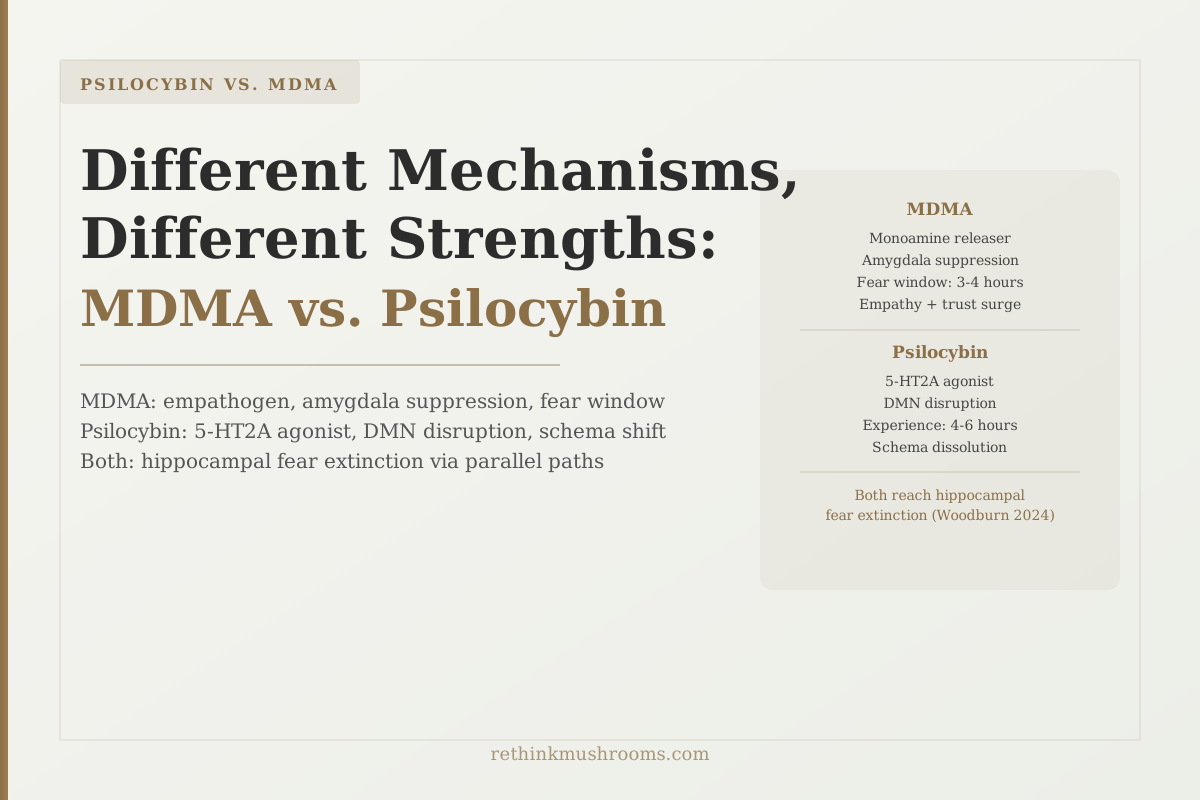
| Feature | MDMA | Psilocybin |
|---|---|---|
| Drug class | Empathogen / entactogen | Classical psychedelic |
| Primary mechanism | Monoamine release (serotonin, dopamine, norepinephrine) | 5-HT2A serotonin receptor agonist |
| Main brain target | Amygdala suppression, reward circuits | Default mode network disruption |
| Subjective experience | Empathy surge, reduced fear, emotional openness | Perceptual shift, ego loosening, meaning-recontextualization |
| Therapeutic window | 3-4 hours of peak therapeutic state | 4-6 hour full experience |
| Core strength | Processing specific fear memories with a therapist | Disrupting rigid cognitive frameworks |
What MDMA's Empathy Mechanism Actually Does in the Brain
The surge of serotonin that MDMA triggers does two things relevant to trauma treatment.
First, it suppresses activity in the amygdala, the brain region that generates fear responses and threat-detection signals. Under normal PTSD conditions, the amygdala is chronically overactive, treating everyday stimuli as potentially dangerous. MDMA's serotonin flood lowers that alarm threshold, creating a window of reduced fear reactivity that typically lasts three to four hours.
Second, MDMA triggers a pronounced surge in oxytocin, a hormone that promotes feelings of social trust and bonding. Elevated oxytocin reduces defensive behavior and increases willingness to engage with threatening material within the context of a trusting relationship. In guided therapy, this means a person can revisit traumatic memories while feeling safe and supported by the therapist in the room. Trauma typically makes that state very difficult to achieve any other way.
Bird et al. (2021) described this as the "therapeutic window" that makes MDMA-assisted therapy distinct: the combination of fear reduction and trust enhancement creates conditions where traumatic memories can be processed in a way that standard therapy struggles to replicate.[1] Bahji et al.'s 2025 systematic review and meta-analysis of four psychedelic-assisted therapies reported a moderate-to-large pooled effect size for MDMA (Hedges' g ≈ −0.71), with the authors flagging low to very low certainty of evidence due to small sample sizes, heterogeneity, and methodological limitations across the underlying trials.[7]
MDMA does not produce ego dissolution, and it does not suppress the default mode network. The person undergoing MDMA-assisted therapy remains oriented, can communicate with the therapist throughout, and retains their sense of who they are. This is both a feature (the therapeutic relationship stays intact) and a limitation (the kind of identity reconstruction that some PTSD patients need does not happen).
What Psilocybin's Default Mode Network Disruption Actually Does
Psilocybin's active form, psilocin, binds primarily to 5-HT2A serotonin receptors concentrated in the brain's prefrontal and default mode network regions.
The default mode network (DMN) is the brain's self-referential circuit. It becomes active when the mind wanders, when we think about ourselves, when we replay memories, and when we interpret events through the lens of our personal narrative. In PTSD, the DMN can be stuck in a loop: the same interpretive framework ("I am in danger," "I cannot be safe," "what happened defined me") activates repeatedly, maintaining the disorder between triggering events.
Choi's 2024 review of psilocybin's mechanisms for PTSD documented three distinct pathways the compound activates: it upregulates BDNF (brain-derived neurotrophic factor, a protein that supports new neural connection growth), it suppresses hyperconnectivity between the ACC (anterior cingulate cortex, the brain's emotional regulation region) and the amygdala, and it disrupts the DMN's dominant hold on perception.[2]
Translated into experiential terms: psilocybin loosens the grip of fixed mental frameworks. The stories that maintain PTSD ("I am fundamentally broken," "the world is permanently unsafe") lose their certainty during the psilocybin experience. For some patients, this creates space to reconstruct a different relationship to their trauma and their identity. This reconstruction does not happen under MDMA's fear-reduction state.
The Surprising Convergence: Both Reach Fear Extinction Through the Same Cellular Route
Despite their different mechanisms at the experiential level, MDMA and psilocybin converge on the same fundamental biological target at the cellular level.
Fear extinction is the brain's process of unlearning a fear response. In PTSD, this process is impaired: the brain keeps generating fear responses to stimuli associated with trauma, even when there is no longer any threat. Both compounds appear to restore this process, but researchers recently found they do it through parallel pathways.
Woodburn et al. (2024) published the key study in ACS Chemical Neuroscience, examining how psilocybin produces fear extinction in animals.[3] The findings: psilocybin's fear extinction is dose-dependent and mediated specifically by 5-HT2A receptors (not 5-HT1A, as had been previously theorized). The mechanism reaches the hippocampus, the brain's memory center, and promotes new neural growth there. This is the same hippocampal plasticity pathway that MDMA's monoamine surge activates, just via a different receptor family.
Catlow et al.'s 2013 animal study had established the earlier piece of this: psilocybin-treated animals showed enhanced fear extinction and increased hippocampal neurogenesis (new cell growth in the memory center).[4]
The implication is significant: MDMA and psilocybin are not just "different approaches to the same problem." They are different triggers of the same underlying cellular repair process. They arrive at hippocampal plasticity from different directions: one through the brain's fear circuit, one through its serotonin signaling system. Both end up supporting the same fundamental healing mechanism.
What MDMA Does That Psilocybin Cannot Replicate
MDMA's therapeutic window is unique in several ways that psilocybin cannot match.
The empathy surge from MDMA's oxytocin activation is pharmacological and reliable. Under therapeutic conditions, MDMA creates a state where the person can engage with traumatic material within an emotionally close therapeutic relationship, with reduced defensiveness and reduced fear. For trauma that involves violated trust (assault, betrayal, relational abuse), this may be particularly important: MDMA's chemistry temporarily repairs the neurobiological capacity for trust that severe trauma disrupts.
Psilocybin does not produce this effect. The psilocybin experience can include feelings of love and connection, but these are variable and not pharmacologically induced in the same reliable way. More significantly, psilocybin can produce disorientation and a temporary loss of familiar self-reference that some patients find deeply challenging rather than healing. MDMA-assisted therapy maintains the therapeutic relationship as the anchor throughout the session. Psilocybin-assisted therapy typically involves less active engagement between therapist and patient during the experience itself.
Bird et al. (2021) noted that MDMA's fear-reduction and trust-enhancement combination produces a state that is qualitatively distinct from any other pharmacological intervention for trauma, including psilocybin.[1]
What Psilocybin Does That MDMA Cannot Reach
Here is where the two mechanisms diverge most significantly for treatment planning.
MDMA reduces fear reactivity. What it does not reliably do is disrupt the rigid cognitive framework that fear reactivity is embedded within. A person can process specific traumatic memories with MDMA and still emerge with the same underlying narrative about themselves and the world that the trauma created. The fear of the specific memory decreases. The interpretive system around it may not change.
Modlin's 2025 paper in Therapeutic Advances in Psychopharmacology proposed a clinical theory for this gap.[6] PTSD, Modlin argued, is maintained not just by fear reactivity but by what he termed an "over-determined interpretive framework," meaning a repetitive cognitive schema that filters all new experience through the lens of the trauma. Fear reduction alone leaves this framework intact. The person feels less afraid of the memory but continues to inhabit the same mental architecture that the trauma built.
Psilocybin's DMN disruption works at the level of this schema. The temporary dissolution of the default narrative mode creates a period where the rigid interpretive framework loses its authority. Patients have described encountering traumatic memories from a different perspective during psilocybin sessions. Modlin characterized this as a "compassionate observer" stance that standard trauma therapy and MDMA-assisted therapy cannot reliably produce. This distinction means psilocybin may reach a layer of PTSD that MDMA's empathy mechanism cannot, particularly for patients whose disorder involves identity disruption, chronic shame, or the sense that trauma has fundamentally defined who they are.
For a deeper look at psilocybin's cardiovascular safety profile compared to MDMA (MDMA carries cardiovascular contraindications that psilocybin does not), see Psilocybin Cardiovascular Safety: Why It's Considered Low-Risk Compared to MDMA. The sibling article After Lykos: What Psilocybin Means for Psychedelic PTSD Treatment covers how the FDA's rejection of MDMA-assisted therapy in August 2024 changed the clinical landscape for both compounds. For a practical comparison of which patients may respond better to each, see MDMA for Fear and Psilocybin for Meaning: Complementary Approaches.
Why the Mechanism Differences Matter for Treatment
The distinction is not merely academic. It points toward a clinically useful framework: MDMA and psilocybin may be most valuable at different stages of trauma recovery, or for different types of traumatic presentation.
MDMA's fear reduction window is most powerful when there are specific traumatic memories to process within an established therapeutic relationship. It requires a patient who can tolerate the social and emotional intensity of the session.
Psilocybin's schema disruption is most relevant when the primary obstacle to recovery is not fear reactivity but a rigid interpretive framework that maintains the disorder, including chronic shame, identity restructuring needs, or PTSD with co-occurring depression that MDMA leaves untreated.
Yao et al.'s 2024 meta-analysis of 126 studies across mental disorders ranked psilocybin strongest by overall effect size (Hedges' g ≈ −1.49), with MDMA at g ≈ −0.83.[5] Bahji et al.'s 2025 meta-analysis of four psychedelic-assisted therapies reported a moderate-to-large pooled MDMA effect (g ≈ −0.71, 95% CI −1.39 to −0.03), with low to very low certainty of evidence overall.[7] The evidence base is still small enough that the mechanisms tell a more useful clinical story than the headline effect sizes: different compounds may be better for different people at different points in recovery.
The Bottom Line
MDMA and psilocybin work on different receptor systems: MDMA floods the brain with monoamines to create fear reduction and empathy, while psilocybin activates 5-HT2A receptors to disrupt the default mode network and loosen rigid cognitive frameworks. Despite these different mechanisms, both converge on hippocampal fear extinction at the cellular level via parallel pathways (Woodburn et al., 2024). Modlin (2025) proposed that psilocybin uniquely disrupts the "over-determined interpretive schemas" maintaining PTSD that MDMA's fear-reduction approach cannot reach, suggesting the compounds are complementary rather than competing.
Frequently Asked Questions
Sources & References
- 1RTHM-01328·Bird, Catherine I V et al. (2021). “Psilocybin and MDMA for the treatment of trauma-related psychopathology..” International review of psychiatry (Abingdon.Study breakdown →PubMed →↩
- 2RTHM-01874·Choi, Charles et al. (2024). “Mechanisms of psilocybin on the treatment of posttraumatic stress disorder..” Journal of psychopharmacology (Oxford.Study breakdown →PubMed →↩
- 3RTHM-02020·Woodburn, Samuel C et al. (2024). “Psilocybin Facilitates Fear Extinction: Importance of Dose, Context, and Serotonin Receptors..” ACS chemical neuroscience.Study breakdown →PubMed →↩
- 4RTHM-00279·Catlow, Briony J et al. (2013). “Effects of psilocybin on hippocampal neurogenesis and extinction of trace fear conditioning..” Experimental brain research.Study breakdown →PubMed →↩
- 5RTHM-02028·Yao, Yuan et al. (2024). “Efficacy and safety of psychedelics for the treatment of mental disorders: A systematic review and meta-analysis..” Psychiatry research.Study breakdown →PubMed →↩
- 6RTHM-00946·Modlin, Nadav Liam et al. (2025). “Clinical conceptualisation of PTSD in psilocybin treatment: disrupting a pre-determined and over-determined maladaptive interpretive framework..” Therapeutic advances in psychopharmacology.Study breakdown →PubMed →↩
- 7RTHM-02055·Bahji, Anees et al. (2025). “Efficacy and Safety of Four Psychedelic-Assisted Therapies for Adults with Symptoms of Depression, Anxiety, and Posttraumatic Stress Disorder: A Systematic Review and Meta-Analysis..” Journal of psychoactive drugs.Study breakdown →PubMed →↩