Psilocybin & PTSD
3-4 hours MDMA therapeutic fear window
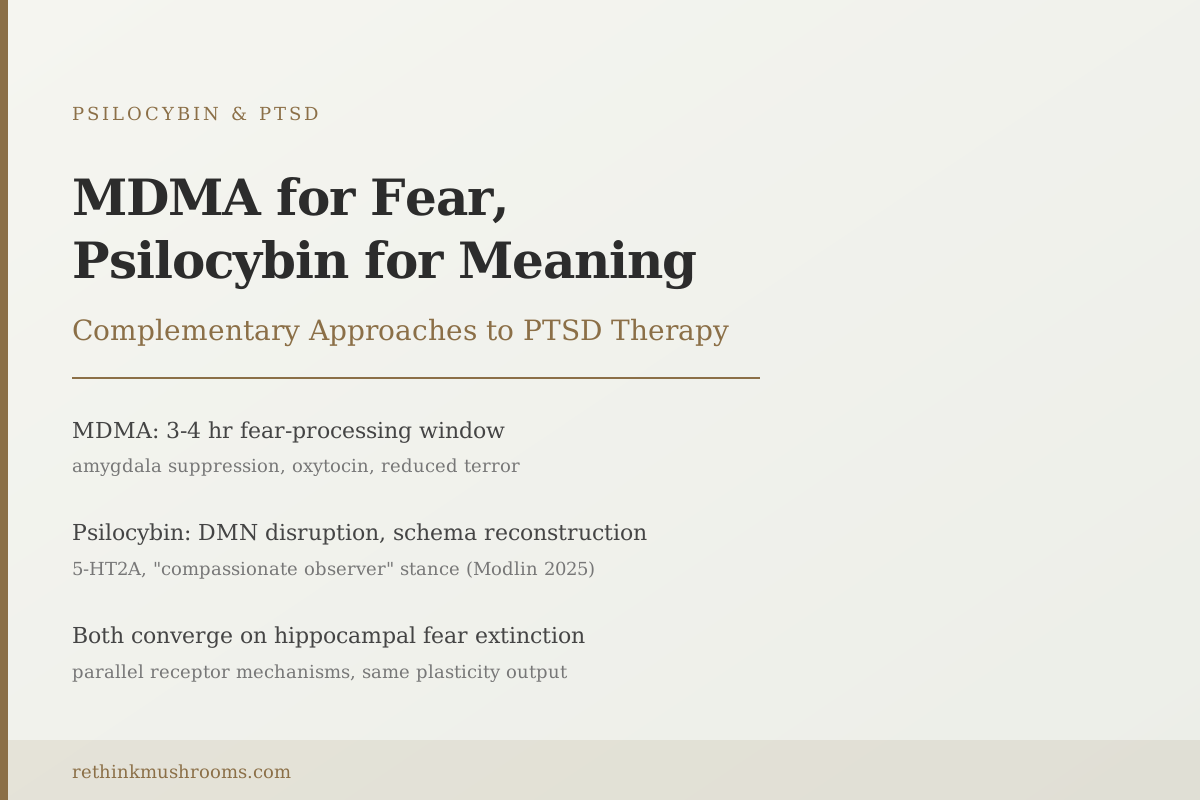
MDMA opens a 3-4 hour window of reduced amygdala reactivity during which traumatic memories can be processed without overwhelming fear. Psilocybin's DMN disruption operates differently, enabling a shift in how trauma is integrated into identity and worldview.
Bird, Modlin & Rucker, Int Rev Psychiatry, 2021
Fear reduction
MDMA's mechanism: amygdala suppression via oxytocin and serotonin release
Schema disruption
psilocybin's unique contribution via DMN suppression (Modlin, Ther Adv Psychopharmacol, 2025)
5-HT2A
the receptor through which psilocybin also enhances hippocampal fear extinction (Woodburn 2024)
Bird, Modlin & Rucker, Int Rev Psychiatry, 2021
 View as image ↗
The debate about MDMA versus psilocybin for PTSD often gets framed as a competition. Which one works better? Which should the FDA approve first? Which has stronger effect sizes?
But that framing may miss the more interesting clinical question: what if they do different things, and those different things are both needed?
MDMA reduces the fear response that makes traumatic memories unbearable. It opens a window in which a person can approach their worst experiences without being overwhelmed by them. What it does not do is change the interpretive framework through which a person makes sense of their trauma, themselves, and their place in the world.
Psilocybin, through a completely different mechanism, may do exactly that. It temporarily disrupts the brain's default mode network, the region most associated with self-referential thought and narrative identity, and in doing so may allow a person to see their trauma from a vantage point they cannot access through ordinary consciousness or MDMA therapy.
This article covers the clinical theory for how the two compounds might work in sequence or in parallel, grounded in the mechanistic research and clinical observations now emerging in the literature. For the clinical trial comparison and effect size data, see psilocybin for PTSD: what the clinical trials show.
Key Takeaways
- MDMA is an empathogen (not a classical psychedelic): it releases oxytocin and serotonin to suppress amygdala hyperreactivity, opening a 3-4 hour window during which traumatic memories can be approached without overwhelming terror (Bird et al., 2021)
- Modlin (2025) proposes that PTSD is maintained by an "over-determined interpretive framework," a rigid cognitive schema organizing experience around the trauma, and that MDMA, despite reducing fear, cannot disrupt this schema
- Psilocybin via 5-HT2A agonism suppresses the default mode network (the brain's narrative self) and disrupts these rigid meaning structures; participants in Modlin's qualitative study described a "compassionate observer" stance toward traumatic memories unavailable in either MDMA therapy or CBT
- Both compounds enhance fear extinction through hippocampal plasticity via separate receptor mechanisms: MDMA through monoamine release, psilocybin through 5-HT2A-mediated neuroplasticity (Woodburn 2024; Catlow 2013)
- Khan (2022) identified psilocybin's specific advantages for PTSD with co-occurring depression and attachment-based trauma; conditions where MDMA's empathy enhancement may be insufficient
- Miller (2025) notes psilocybin's cardiovascular safety advantage, enabling use in patients with heart conditions that preclude MDMA; in Australia, both compounds are now legally approved, giving clinicians the option to deploy them sequentially
MDMA's Fear Window: What Opens During Therapy That Normally Stays Closed
To understand why the two compounds might be complementary, it helps to understand exactly what MDMA does mechanistically.
MDMA is not a classical psychedelic. It does not bind primarily to the 5-HT2A serotonin receptor and does not produce the visual phenomena, ego dissolution, or default mode network suppression associated with psilocybin and other psychedelics. MDMA is a monoamine releaser: it floods the synapse with serotonin, dopamine, and norepinephrine, and triggers oxytocin release. This combination produces its characteristic effects: emotional warmth, heightened empathy, reduced defensiveness, and crucially for trauma therapy, reduced amygdala hyperreactivity.
The amygdala is the brain's threat-detection center. In PTSD, it becomes chronically hyperactivated, treating reminders of the traumatic event as immediate danger signals. This is why trauma processing in conventional therapy is so difficult: approaching traumatic memories triggers the same fear response as the original trauma, making it hard to stay in the "window of tolerance" where processing is possible.
MDMA temporarily reduces amygdala reactivity without fully suppressing emotional engagement. Bird, Modlin, and Rucker, in their 2021 systematic review, characterized this as the therapeutic mechanism: under MDMA, patients can approach traumatic memories with reduced terror while retaining emotional access to the material.[1] The therapeutic window lasts approximately 3-4 hours (the duration of the MDMA experience), during which the therapist guides the patient through trauma-focused sessions.
This is genuinely powerful. The Phase 3 MDMA-assisted therapy trials showed large effects for PTSD symptom reduction, with the majority of participants achieving diagnostic remission. But the mechanism has a structural limit that Modlin's 2025 work illuminates.
Where MDMA May Not Reach: The Over-Determined Schema Problem
Modlin (2025) proposes a specific theory about what PTSD actually is, at the psychological level, and why fear reduction alone may leave something critical untouched.[2]
The argument: PTSD is not only maintained by conditioned fear responses (the intrusive memories, hyperarousal, avoidance). It is also maintained by what Modlin calls an "over-determined interpretive framework," a rigid cognitive and narrative schema through which the person organizes all subsequent experience. After trauma, many people develop a comprehensive meaning system built around the traumatic experience: "I am permanently damaged." "The world is fundamentally unsafe." "I do not deserve safety or connection." These are not simply thoughts to be challenged with cognitive restructuring. They are the lens through which everything is interpreted.
MDMA reduces the fear associated with specific traumatic memories. It makes it possible to revisit them without the same terror. What it does not do is disrupt the meta-level interpretive structure. A person can process a specific memory under MDMA while still returning to a worldview organized entirely around their trauma.
This is not a criticism of MDMA therapy. Its Phase 3 results are among the strongest in psychiatric research. But it is a mechanistic observation about what MDMA's fear-reduction mechanism can and cannot access.
For the full mechanism comparison and the 2025 meta-analytic effect size data, see different mechanisms, different strengths: MDMA vs. psilocybin.
Psilocybin's Meaning Layer: How DMN Disruption Enables Recontextualization
Psilocybin targets a completely different neural system. Its primary receptor is 5-HT2A, and its most-replicated neural effect is suppression of the default mode network (DMN).
The DMN is a network of brain regions most active during self-referential thought: rumination, autobiographical memory, future simulation, and what neuroscientists sometimes call the "narrative self," the ongoing story a person tells about who they are. Ordinarily, the DMN maintains continuity of personal identity. In PTSD, it maintains the over-determined schema that organizes experience around the trauma.
When psilocybin suppresses the DMN, this narrative structure temporarily loosens. Choi (2024) documented that psilocybin targets PTSD through 5-HT2A-mediated BDNF upregulation, DMN suppression, and normalization of hyperconnectivity between the anterior cingulate cortex and amygdala, the circuit most associated with emotional self-regulation.[3]
What this produces in practice was captured by Modlin's qualitative study of eight participants who underwent psilocybin therapy for PTSD.[4] Participants described what Modlin calls a "compassionate observer" stance toward their traumatic memories: the ability to witness the trauma from a position of distance and perspective, rather than re-experiencing it with the full emotional force of the original event. This is qualitatively different from what MDMA provides.
Under MDMA, the patient is less afraid of the memory but is still inside their ordinary identity and interpretive structure. Under psilocybin, the ordinary self temporarily dissolves, and with it, the narrative that has organized everything around the trauma. Patients can see the traumatic experience as one event among many in their life, rather than as the defining event that explains everything about who they are.
Where Both Converge: Fear Extinction at the Cellular Level
Despite their different mechanisms at the receptor and network levels, MDMA and psilocybin appear to converge on the same cellular outcome: hippocampal plasticity and enhanced fear extinction.
Woodburn and colleagues (2024) found that psilocybin facilitates fear extinction in a dose-dependent manner, and that this effect is mediated specifically by 5-HT2A receptors, not 5-HT1A.[5] The cellular pathway runs through hippocampal plasticity, the same mechanism by which MDMA enhances fear extinction, despite MDMA not being a 5-HT2A agonist. Two different receptor entry points; the same hippocampal plasticity output.
Catlow and colleagues (2013) documented enhanced fear extinction and increased hippocampal neurogenesis in psilocybin-treated rodents, directly addressing the impaired fear extinction mechanism characteristic of PTSD.[6]
The significance for the complementary approaches framework: if both compounds enhance hippocampal plasticity through parallel but independent mechanisms, they may be additive at the cellular level. Psilocybin's 5-HT2A-mediated neuroplasticity could reinforce and consolidate the fear extinction gains achieved through MDMA therapy, even though psilocybin's primary clinical contribution is the meaning-reconstruction layer rather than additional fear reduction.
For a deep dive on the fear extinction neuroscience, see fear extinction and psilocybin: how psychedelics may reprocess trauma memories.
When Psilocybin Reaches What MDMA Cannot: Two Specific Clinical Cases
Two clinical populations have been identified in the literature where psilocybin may have specific advantages over MDMA.
The first is PTSD with co-occurring major depression. Khan (2022) noted that psilocybin's 5-HT2A mechanism promotes fear extinction and neurogenesis in ways particularly suited to PTSD complicated by depression, a very common comorbidity.[7] MDMA's empathy enhancement, while effective for fear-based PTSD, does not directly address the depressive meaning-making and anhedonia that often persist alongside PTSD. Psilocybin's consistent antidepressant effect adds a dimension of action that MDMA lacks.
The second is PTSD originating in early attachment disruption or relational trauma. MDMA's empathy surge and oxytocin release can be profoundly helpful for interpersonal reconnection, but some trauma researchers argue that the deepest structural disruptions in early relational trauma require the kind of perspective shift that psilocybin's meaning-level mechanism provides. The "compassionate observer" stance Modlin documented may be especially important for people who have constructed their entire relational self around the experience of being unsafe with others.
The third consideration is medical: Miller (2025) noted that psilocybin does not carry the cardiovascular risks associated with MDMA, including elevated heart rate and blood pressure that contraindicate MDMA for patients with certain cardiac conditions.[8] For patients with established cardiovascular disease who need psychedelic-assisted therapy, psilocybin may be the only viable option of the two. For more on this, see psilocybin cardiovascular safety: why it's considered low-risk compared to MDMA.
The Sequential Protocol: Where Clinical Theory Is Heading
No published randomized trial has tested a sequential MDMA-then-psilocybin protocol for PTSD. This is clinical theory, not established practice.
But the theoretical framework is coherent: MDMA first, to reduce fear conditioning enough that the specific traumatic memories can be approached and processed in guided sessions. Then psilocybin, to disrupt the broader interpretive schema that fear reduction alone may not touch. The fear extinction work done under MDMA may be reinforced and consolidated by psilocybin's hippocampal plasticity effects, while psilocybin contributes the meaning-reconstruction layer that MDMA cannot access.
Several factors suggest this will become a testable hypothesis in coming years. Some jurisdictions have approved both compounds for clinical use, giving therapists the legal framework to deploy them sequentially, and real-world clinical experience will likely shape how research protocols are designed.
The Bird 2021 systematic review anticipated exactly this framing: MDMA and psilocybin enhance neuroplasticity and fear extinction through distinct pathways, and both contribute to trauma recovery, suggesting complementary rather than competing clinical use.[1]
For the current psilocybin PTSD trial landscape and what Phase 2-3 data shows, see psilocybin PTSD clinical trials: preliminary data. For the safety and tolerability comparison, see psilocybin for PTSD: safety and tolerability data. For an overview of where each compound stands after the FDA rejection of MDMA, see after Lykos: what psilocybin means for psychedelic PTSD treatment.
The Bottom Line
MDMA and psilocybin treat PTSD through mechanistically distinct pathways that may be complementary rather than competing. MDMA suppresses amygdala fear reactivity to open a processing window; psilocybin disrupts the default mode network to enable recontextualization of the meaning structures built around trauma. Both enhance hippocampal fear extinction through parallel receptor mechanisms. Psilocybin has specific advantages for PTSD with depression, attachment-based trauma, and cardiovascular contraindications to MDMA. No sequential protocol trial has been published; Australia is the first jurisdiction where clinicians can use both legally and may generate the first real-world data on complementary use.
Frequently Asked Questions
Sources & References
- 1. Source details for this reference are not yet available.
- 2. Source details for this reference are not yet available.
- 3. Source details for this reference are not yet available.
- 4. Source details for this reference are not yet available.
- 5. Source details for this reference are not yet available.
- 6. Source details for this reference are not yet available.
- 7. Source details for this reference are not yet available.
- 8. Source details for this reference are not yet available.