Psilocybin & PTSD
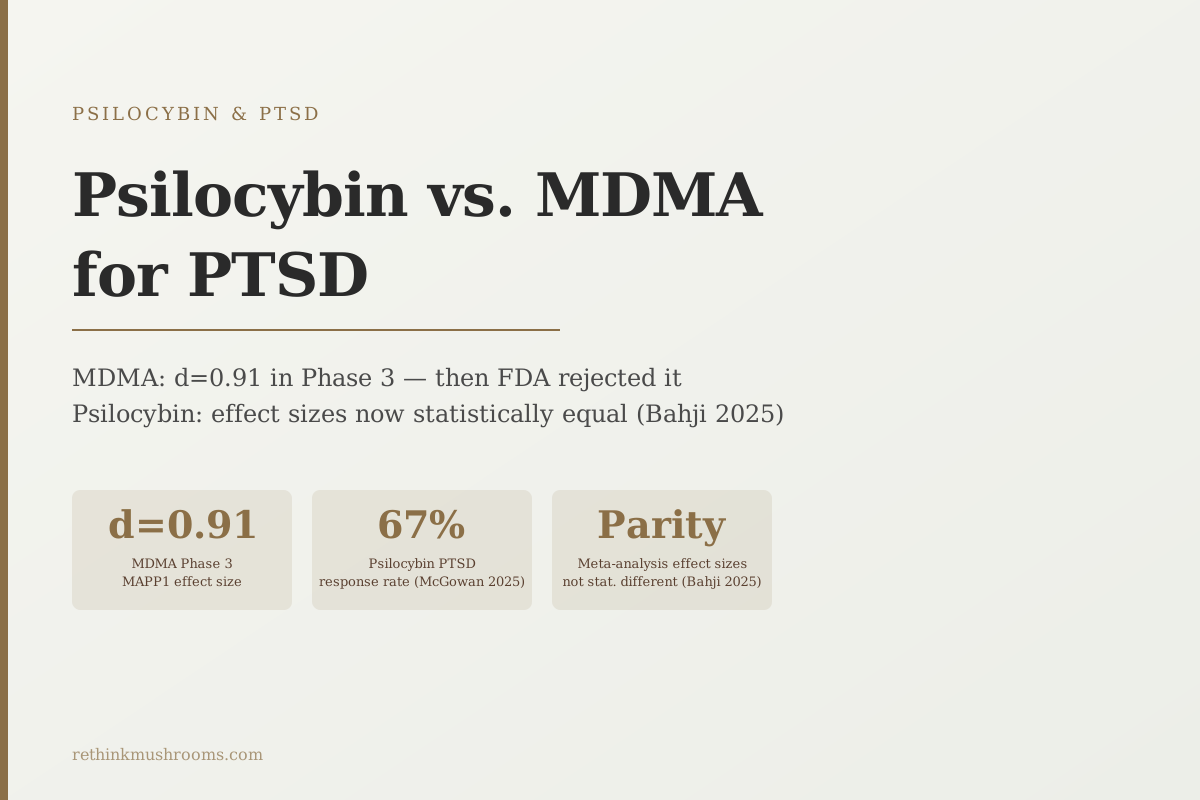
67% PTSD response rate
The first psilocybin-specific PTSD pilot found a 67% response rate and a mean CAPS-5 reduction of 13.5 points in 15 patients — identical to MDMA's 67% no-longer-meeting-criteria result in the 90-person MAPP1 Phase 3 trial.
McGowan et al., J Psychopharmacol, 2025; Mitchell et al., Nature Medicine, 2021
d=0.91
MDMA Phase 3 PTSD effect size in Mitchell et al., Nature Medicine, 2021 — the Phase 3 benchmark
Aug. 2024
FDA rejected Lykos's MDMA-AT NDA, citing functional unblinding concerns and requesting a new study
Feb. 2023
Australia TGA approved both MDMA and psilocybin therapy simultaneously — the first country to do so (Nutt 2024)
McGowan et al., J Psychopharmacol, 2025; Mitchell et al., Nature Medicine, 2021
 View as image ↗
MDMA and psilocybin are the two most-studied psychedelics for PTSD. MDMA reduces the brain's fear-alarm response to open a window for trauma processing in therapy sessions. Psilocybin disrupts the brain's default mode network — the region active during rumination and self-referential thinking — to enable a broader recontextualization of traumatic meaning. They work through different mechanisms and target different aspects of PTSD. Until 2024, the assumption was that MDMA was categorically ahead in the evidence hierarchy.
Then two things happened. The FDA rejected MDMA therapy in August 2024. And a 2025 meta-analysis found that psilocybin and MDMA produced statistically indistinguishable effect sizes for PTSD symptoms when measured in the same analytical framework.[7]
This article covers what the trial data actually shows, how the mechanisms differ, and what the regulatory watershed of 2024 means for where this field is going. For the broader overview of psilocybin in PTSD, see psilocybin for PTSD: what the clinical trials show. For the post-Lykos analysis, see after Lykos: what psilocybin means for psychedelic PTSD treatment.
Key Takeaways
- MDMA's Phase 3 PTSD trials produced the strongest psychiatric treatment effect sizes ever recorded in randomized controlled trials: d=0.91 in MAPP1 (90 patients) and d=0.7 in MAPP2 (131 patients) (Mitchell et al., Nature Medicine, 2021 and 2023)
- In 2021, a systematic review rated psilocybin's evidence for PTSD as "insufficient" while rating MDMA "moderate" — this baseline helps show how rapidly the field has shifted (Varker et al., 2021)
- In August 2024, the FDA rejected Lykos Therapeutics' application to approve MDMA therapy for PTSD, citing functional unblinding and data integrity concerns, and requiring an additional trial before resubmission
- The first dedicated psilocybin PTSD clinical trial (McGowan et al., J Psychopharmacol, 2025) found a 67% response rate and mean CAPS-5 reduction of 13.5 points at 8 weeks from a single dose in 15 patients
- A 2025 meta-analysis (Bahji et al., J Psychoactive Drugs) found psilocybin and MDMA produced statistically indistinguishable effect sizes for PTSD symptoms in the same analytical framework — the first formal challenge to MDMA's assumed superiority
- Australia's TGA approved both MDMA and psilocybin therapy simultaneously in February 2023, making Australia 2+ years ahead of the US in real-world clinical deployment of both compounds (Nutt 2024)
The MDMA Benchmarks: What the Phase 3 Trials Found
For several years, MDMA-assisted therapy held the most impressive numbers in psychedelic medicine for PTSD.
The MAPP1 trial, published by Mitchell and colleagues in Nature Medicine in 2021, enrolled 90 adults with severe PTSD at 15 sites across the United States, Canada, and Israel.[2] Participants received three MDMA-assisted therapy sessions, each lasting approximately eight hours, with non-drug preparation and integration sessions surrounding each. The primary outcome was change on the CAPS-5 scale, the clinical standard for measuring PTSD symptom severity.
The results: 67% of participants in the MDMA group no longer met diagnostic criteria for PTSD at the end of the study, compared to 32% in the placebo group. The effect size was d=0.91 — a large effect by any clinical standard and the strongest Phase 3 result for any psychiatric treatment in a randomized controlled trial.
MAPP2, published by the same team in Nature Medicine in 2023, enrolled 131 patients and replicated the findings independently.[4] The CAPS-5 mean change was -23.7 in the MDMA arm versus -14.8 in the placebo arm, with an effect size of d=0.7 and a 71.2% response rate. Two Phase 3 trials, two independent cohorts, consistent and large results.
A 2024 meta-analysis across psychedelic therapies by Yao and colleagues found MDMA produced the largest standardized effect size for PTSD symptoms across the entire psychedelic literature — approximately SMD 0.9.[6]
This was the field's consensus going into 2024: MDMA had the best PTSD data, the most Phase 3 evidence, and was advancing toward FDA approval. Psilocybin was considered a promising but much more preliminary option for this specific indication.
Why the FDA Said No in August 2024
On August 9, 2024, the FDA issued a Complete Response Letter to Lykos Therapeutics, rejecting the New Drug Application for MDMA-assisted therapy for PTSD.
The rejection cited two primary concerns. First, the FDA's advisory committee had raised questions about functional unblinding: in psychedelic trials, participants typically know whether they received the active drug because the psychedelic experience is distinguishable from placebo. This can inflate subjective symptom ratings in ways that are difficult to correct for statistically. The FDA judged that Lykos had not adequately addressed this methodological concern.
Second, the FDA cited data integrity concerns related to some study sites, requesting an inspection of clinical trial conduct.
The FDA's letter required Lykos to conduct a new Phase 3 trial before resubmission. There is no firm timeline for when that trial will be conducted, submitted, or reviewed. As of mid-2026, MDMA therapy is not FDA-approved and there is no imminent resubmission.
This was the most consequential regulatory decision in psychedelic medicine in years — not because it ended the field, but because it created a gap. The compound with the most PTSD evidence had lost its regulatory momentum. The compound that had been considered the less-developed option for PTSD suddenly held a different kind of relative position.
Psilocybin's Evidence Base Was 'Insufficient' in 2021. What Changed?
In 2021, Varker and colleagues published a systematic review of psychoactive drugs for PTSD in the Journal of Psychoactive Drugs.[3] Their evidence quality ratings were direct: MDMA qualified as "moderate" evidence for PTSD. Psilocybin was rated "insufficient" — a designation reflecting the near-complete absence of direct psilocybin PTSD trial data at the time.
That rating was technically accurate for 2021. Psilocybin had strong evidence for depression and cancer-related anxiety, but essentially no controlled trial data specific to PTSD.
The next four years changed that substantially.
McGowan and colleagues published the first prospective, psilocybin-specific PTSD clinical trial in the Journal of Psychopharmacology in 2025.[8] The nonrandomized open-label pilot enrolled 15 participants with PTSD diagnosis. Each received a single dose of psilocybin in a supported session with preparation and integration components. At 8 weeks, the mean CAPS-5 reduction was 13.5 points and the response rate was 67%.
That 67% figure is numerically identical to MDMA's response rate in MAPP1 — though the comparison should be made carefully. MAPP1 had 90 participants, a randomized placebo-controlled design, and three full MDMA sessions. McGowan's trial had 15 participants, no control arm, and a single psilocybin session. The absolute numbers look similar; the evidence quality is not yet at the same level.
But the direction is clear. Psilocybin's PTSD evidence has moved from "insufficient" to "preliminary but directionally strong" in four years.
The 2025 Meta-Analysis: Effect Sizes That Surprised the Field
The finding that most directly challenged the assumption that MDMA is categorically superior for PTSD came in 2025. Bahji and colleagues published a systematic review and meta-analysis in the Journal of Psychoactive Drugs that included all four primary psychedelic-assisted therapies — psilocybin, MDMA, ketamine, and LSD — in the same analytical framework.[7]
The finding: psilocybin and MDMA produced statistically indistinguishable effect sizes for PTSD symptoms.
This is a carefully worded claim. "Not statistically different" does not mean "equally effective" in a clinical sense — the psilocybin PTSD evidence base is smaller, the trials less rigorous, the populations somewhat different. But in the same meta-analytic framework with the same outcome measures, the numerical difference between their effect sizes for PTSD symptoms did not reach statistical significance.
This was not the consensus expectation. For years, practitioners and researchers had assumed MDMA was in a different tier for PTSD specifically — that its mechanism of reducing amygdala fear reactivity made it uniquely suited to this condition in a way psilocybin's different mechanism could not match. The Bahji 2025 analysis provides the first formal challenge to that assumption in the scientific literature.
It does not settle the question. The psilocybin PTSD trial database remains much smaller than the MDMA PTSD trial database. Effect size parity in a meta-analysis reflects available evidence, not the final verdict. But it establishes that the assumption of MDMA's categorical superiority for PTSD is not supported by the current evidence base.
How the Mechanisms Differ: Fear Window vs. Meaning Reconstruction
MDMA and psilocybin are not the same type of drug and do not produce the same neurological effects.
MDMA is a monoamine releaser — it causes a surge in serotonin, dopamine, and norepinephrine, and triggers oxytocin release. It is not classified as a classical psychedelic and does not act primarily through the 5-HT2A serotonin receptor that psilocybin targets. MDMA's primary therapeutic effect in PTSD is a reduction in amygdala reactivity — the brain's fear-alarm region becomes less hyperresponsive, which opens a window in which patients can engage with traumatic memories without being overwhelmed by fear.
Psilocybin's primary mechanism is 5-HT2A agonism — it binds directly to a specific serotonin receptor concentrated in the prefrontal cortex. Its therapeutic effects in PTSD appear to work through a different mechanism: suppression of the default mode network (the brain region active during rumination and self-referential thought), normalization of the overconnection between the anterior cingulate cortex and amygdala, and promotion of neuroplasticity through BDNF upregulation.[1]
A 2024 mechanistic review by Choi in the Journal of Psychopharmacology characterized psilocybin's approach to PTSD as targeting the meaning-and-interpretation layer of the condition rather than the fear-reactivity layer: it enables a reframing of what the traumatic experience means, not just a reduction in how frightening the memory feels.[5]
| Feature | MDMA | Psilocybin |
|---|---|---|
| Primary receptor | Monoamine releaser (not 5-HT2A) | 5-HT2A agonist |
| Key brain effect | Amygdala suppression, oxytocin surge | DMN suppression, neuroplasticity |
| Therapeutic window | 3-4 hours of fear-reduced processing | 4-6 hours of altered meaning-making |
| PTSD mechanism | Reduces fear reactivity to trauma memory | Enables recontextualization of trauma meaning |
| Depression comorbidity | Limited direct antidepressant effect | Strong antidepressant evidence base |
| Session frequency | Typically 2-3 sessions | Fewer sessions in most trials |
The mechanisms are different enough that researchers and clinicians have begun proposing they may be complementary rather than competing. For the mechanistic deep-dive, see different mechanisms, different strengths: MDMA vs. psilocybin. For the clinical theory of sequential use, see MDMA for fear and psilocybin for meaning: complementary approaches.
Where Each Compound May Have an Advantage
Neither compound suits every patient with PTSD equally.
A 2025 review by Miller in the Journal of Pharmacology and Experimental Therapeutics identified several clinical contexts where psilocybin may have a specific advantage over MDMA.[9] The most straightforward is cardiovascular safety: MDMA elevates heart rate and blood pressure substantially during sessions, creating contraindications for patients with cardiac conditions. Psilocybin's cardiovascular profile is significantly more benign. For older patients or those with trauma histories that include cardiovascular conditions, this difference is clinically meaningful.
A second advantage Miller identified is psilocybin's evidence for concurrent depression. PTSD rarely appears alone — major depression is a common comorbidity. MDMA's evidence base is predominantly for PTSD symptom reduction; its antidepressant effect size is less established. Psilocybin has some of the strongest clinical data for major depressive disorder of any drug in development. A treatment that addresses both conditions simultaneously may be more clinically useful for the large share of PTSD patients who also have depression.
For the specifics on psilocybin's safety profile and how it compares to MDMA, see psilocybin for PTSD: safety and tolerability data. For the cardiovascular comparison specifically, see psilocybin cardiovascular safety: why it's considered low-risk compared to MDMA.
MDMA's advantage is in the strength and rigor of its PTSD-specific evidence base — two Phase 3 trials with clear results and an effect size the psilocybin PTSD literature has not yet reproduced in comparably rigorous designs. If and when the regulatory issues are resolved, MDMA's PTSD trial data remains the most extensive of any psychedelic for this specific indication.
Australia's Answer: Approve Both
The most concrete real-world evidence that both compounds have a place in PTSD treatment comes not from the United States but from Australia.
In February 2023, the Australian Therapeutic Goods Administration made a decision with no precedent elsewhere: it approved both MDMA-assisted therapy and psilocybin therapy simultaneously, for PTSD and treatment-resistant depression respectively, making Australia the first country in the world to provide a regulatory pathway for either compound.[5]
Nutt's 2024 review in the British Journal of Pharmacology documented the rollout: Australia is now more than two years ahead of the US in clinical deployment of both compounds. The practical experience of Australian clinicians working with both options in the same healthcare system will generate real-world data that trial designs cannot produce.
The Australia precedent also illustrates how the regulatory framing has evolved. The question is not whether MDMA or psilocybin is "better" for PTSD in some absolute sense. The TGA's decision reflects an emerging clinical view that different patients, different trauma types, and different comorbidities warrant different approaches — and that both compounds offer genuine value.
For the full picture of where psilocybin-specific PTSD trials stand, see psilocybin for PTSD: current clinical trials and preliminary data.
The Bottom Line
MDMA has the stronger PTSD-specific evidence base — two Phase 3 trials (d=0.91 and d=0.7) — but the FDA rejected the Lykos NDA in August 2024 and requested a new study. Psilocybin's first dedicated PTSD pilot (McGowan 2025, n=15) found a 67% response rate, and a 2025 meta-analysis found its effect size for PTSD not statistically different from MDMA's. The compounds work through different mechanisms and may suit different patient populations. Australia approved both simultaneously in February 2023.
Frequently Asked Questions
Sources & References
- 1. Source details for this reference are not yet available.
- 2. Source details for this reference are not yet available.
- 3. Source details for this reference are not yet available.
- 4. Source details for this reference are not yet available.
- 5. Source details for this reference are not yet available.
- 6. Source details for this reference are not yet available.
- 7. Source details for this reference are not yet available.
- 8. Source details for this reference are not yet available.
- 9. Source details for this reference are not yet available.