Psilocybin & PTSD
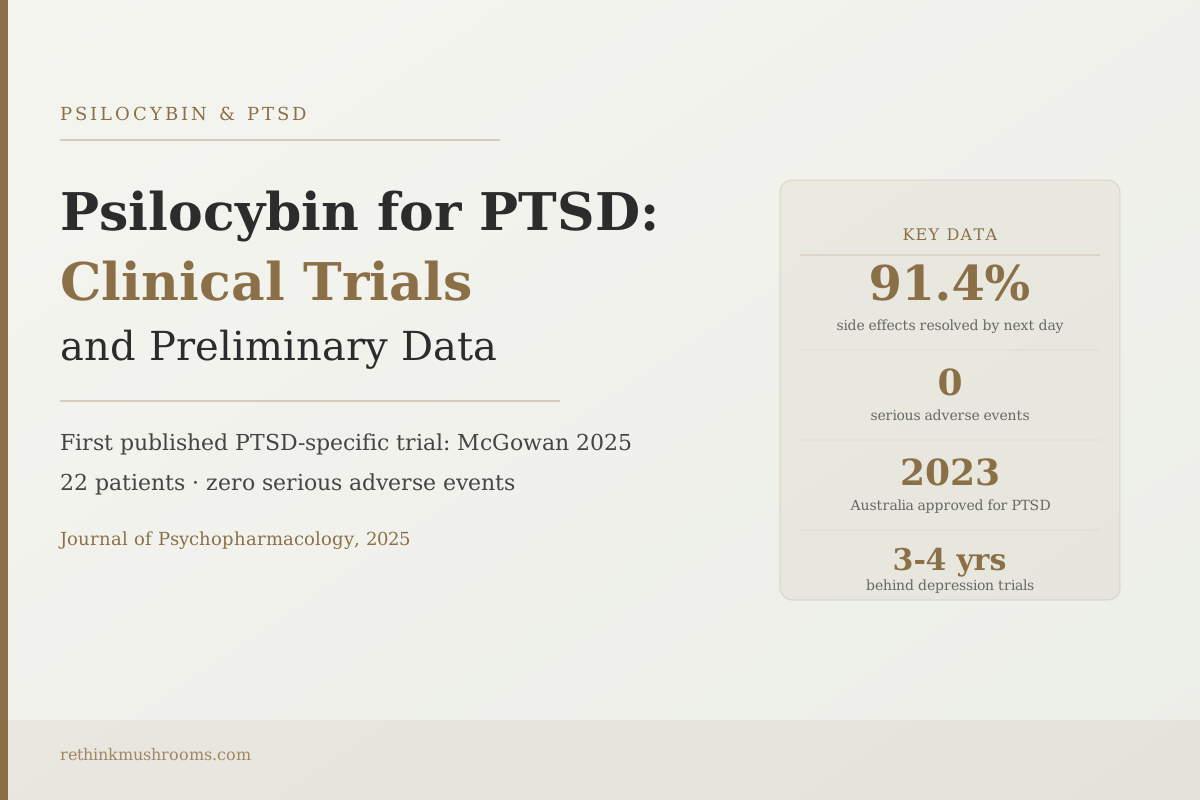
91.4% of dosing-day side effects resolved within 24 hours
In the only published clinical trial specifically enrolling PTSD patients for psilocybin, a single 25mg dose produced zero serious adverse events and 91.4% of dosing-day side effects cleared by the following morning.
McGowan et al., Journal of Psychopharmacology, 2025
22 patients
enrolled across three sites in the first dedicated psilocybin PTSD clinical trial
2023
Australia became the first country to approve psilocybin as a regulated prescription medicine specifically for PTSD
3–4 years
how far PTSD trials lag behind depression trials in clinical phase progression (Norring 2024)
McGowan et al., Journal of Psychopharmacology, 2025
 View as image ↗
In July 2024, the FDA rejected MDMA-assisted therapy for PTSD — the closest any psychedelic treatment had come to regulatory approval for this indication. That rejection sent the field searching for what comes next. Psilocybin, which has a more developed evidence base in depression and anxiety than in PTSD specifically, became the leading psychedelic PTSD candidate in active clinical development.
The first published clinical trial specifically designed for PTSD patients (not depression patients with comorbid PTSD, but a PTSD-first design) reported results in 2025. Alongside it came a qualitative study of what PTSD patients actually experienced during their sessions and a separate veterans pilot. This article tracks what those trials found, what trials are currently active, and where the field stands.
For a broader overview of the full PTSD evidence base including mechanistic rationale, see the guide to psilocybin for PTSD.
Key Takeaways
- McGowan 2025 is the first and only published clinical trial specifically enrolling PTSD patients for psilocybin: 22 participants, single 25mg dose of COMP360, 12-week follow-up, zero serious adverse events, zero withdrawals
- Side effects were common but mild and short-lived: headache in 50% of participants, nausea in 36.4%, crying in 27.3%, fatigue in 27.3%; 91.4% of dosing-day events resolved by the following morning
- Modlin 2025 qualitative sub-study (21 participants nested within an active trial) found that most PTSD patients did NOT primarily relive traumatic memories during sessions — they engaged with trauma-related material through affect, body sensations, and self-transcendent states "around" the trauma, not through it
- Ellis 2025 piloted psilocybin in U.S. military veterans with severe treatment-resistant depression and comorbid PTSD, confirming tolerability in a high-acuity population and documenting veteran-specific cultural adaptations needed in therapy protocols
- Australia's Therapeutic Goods Administration became the first national regulator to approve psilocybin as a prescription medicine specifically for PTSD, in July 2023
- Norring 2024's audit of 134 registered psilocybin trials found PTSD is a top-10 indication by trial count but lags depression by 3-4 years in phase progression; no Phase 3 PTSD trial has yet been registered
The COMP360 PTSD Trial: What the First Dedicated Study Found
Before 2025, no published clinical trial had specifically recruited patients with PTSD as the primary indication for psilocybin. Depression trials had enrolled participants with PTSD as a comorbidity, but no trial had been designed, powered, and run for PTSD patients first.
McGowan, Rucker, Yehuda, Goodwin, and colleagues changed that with a 2025 publication in the Journal of Psychopharmacology.[1] The trial enrolled 22 participants across three sites — King's College London, Mount Sinai in New York, and Sunstone Therapies. Each participant received a single 25mg oral dose of COMP360, Compass Pathways' pharmaceutical-grade synthetic psilocybin, under supervised conditions with trained therapists present throughout the session.
The trial recorded 117 total treatment-emergent adverse events. That figure requires context: in a closely monitored clinical population observed over 12 weeks, documenting every adverse event is standard practice. The breakdown is what matters. Of those 117 events, 59.8% occurred on dosing day, and 91.4% of the dosing-day events had resolved by the following morning. The most common were headache in 50% of participants, nausea in 36.4%, crying in 27.3%, and fatigue in 27.3%. Zero serious adverse events were recorded. Zero participants withdrew due to an adverse event.
Symptom improvement was both rapid and durable. PTSD symptom reduction appeared early in the 12-week follow-up period and was maintained through the endpoint.
The Khan 2022 review of psilocybin for trauma disorders noted, when it was written, that no controlled PTSD-specific trials existed and that the evidence base for PTSD was entirely extrapolated from depression and anxiety research.[6] McGowan 2025 provided the first purpose-designed data point.
For the full adverse event analysis and what the safety profile means for patients with cardiovascular comorbidities or current SSRI use, see psilocybin for PTSD: safety and tolerability data. For the detailed breakdown of the COMP360 trial design and dose rationale, see COMP360 for PTSD: Compass Pathways trial results.
The Therapy Protocol: Three Preparation Sessions, One Dose, Three Integration Sessions
A psilocybin clinical trial is not simply administering a compound and measuring symptom scores. The psychological support structure surrounding the session functions as a co-treatment. For PTSD populations, its design has implications for both safety and outcomes that clinical trial reports often understate.
Kirlic and colleagues published the Compass Psychological Support Model in the American Journal of Psychiatry in 2025 — the standardized therapeutic protocol that underpins all COMP360 trials.[2] The structure is: three individual preparation sessions before the dosing day, one supervised dosing session lasting approximately 6-8 hours, and three individual integration sessions afterward.
For the PTSD adaptation, two modifications distinguished the protocol from the standard depression version. Therapist training was specifically modified to include trauma-informed approaches. And preparation sessions included frameworks for engaging with trauma-related material without requiring participants to construct a detailed trauma narrative beforehand — a meaningful distinction given that narrative exposure is central to most existing PTSD therapies.
The publication of a standardized support model matters for a practical reason: it makes results reproducible. Any trial that follows the Kirlic protocol can compare its data to McGowan 2025 in methodologically defensible ways. Without a standardized protocol, variation in therapist skill, therapeutic framing, and session structure makes cross-trial comparison almost impossible.
What PTSD Patients Actually Experienced: The Qualitative Study No Competitor Has Covered
The most clinically informative data from 2025's PTSD psilocybin research comes not from a symptom scale but from a qualitative study nested within an active clinical trial.
Modlin and colleagues published findings from 21 PTSD trial participants in EClinicalMedicine (a Lancet journal) in 2025.[3] Interviews focused on what participants experienced during their psilocybin sessions. Four core themes emerged from the analysis.
First, safety during the session depended primarily on non-pharmacological factors. What made participants feel safe was trust in the therapist and the physical setting — not the drug itself. Preparedness and therapeutic alliance predicted session quality more than any pharmacological variable in this analysis.
Second, participants described the experience as fundamentally experiential and not reducible to taking a medication. It could not be predicted, controlled, or explained in medical terms.
Third, and most important clinically: most participants did NOT primarily relive traumatic memories during the session. Engagement with trauma-related material happened through affect (emotional experiences unattached to specific trauma memories), body sensations, and what participants described as self-transcendent states — a sense of connection and dissolution of normal self-boundaries. Participants consistently described processing "around" the trauma rather than "through" it.
This is clinically counterintuitive. Established evidence-based PTSD therapies, including Cognitive Processing Therapy, Prolonged Exposure, and EMDR (Eye Movement Desensitization and Reprocessing), all work by directly engaging the trauma memory. The patient is guided to confront the traumatic event explicitly. Psilocybin appears to produce therapeutic change through a different route entirely.
Fourth, participants who had undergone prior treatments consistently described psilocybin as enabling engagement with trauma-related emotional states that years of conventional psychotherapy, exposure-based therapy, and SSRIs had not achieved.
For a full examination of how this compares to standard trauma therapy approaches, see how psilocybin therapy approaches trauma differently.
The Veterans Study: Psilocybin in a High-Complexity Military Population
Military veterans represent the PTSD population with the highest public salience and, clinically, some of the most significant treatment barriers. High rates of treatment resistance, comorbid substance use, traumatic brain injury, cultural barriers to help-seeking, and a historical skepticism toward psychiatric treatment make veterans a distinct population from the predominantly civilian samples in most psychedelic research.
Ellis and colleagues published the first dedicated psilocybin study in U.S. military veterans in the Journal of Affective Disorders in 2025.[4] The study enrolled veterans with severe treatment-resistant depression, with most carrying comorbid PTSD. The design was an open-label pilot with no control group — the most preliminary study design, providing tolerability data rather than efficacy comparisons. The key finding: psilocybin was well-tolerated in this medically complex, high-acuity group.
Beyond the safety data, the Ellis study documented something absent from standard psilocybin therapy protocols: veteran-specific cultural factors requiring adapted therapeutic framing. Unit identity and military norms around self-reliance affected how veterans engaged with preparation sessions. Stigma around psychiatric treatment was a significant barrier to initial engagement. Prior trauma frameworks common in military culture, including moral injury conceptualizations distinct from civilian trauma models, required therapist training beyond any existing psilocybin support manual.
These adaptations are not described in the Kirlic Compass protocol or any published psilocybin therapy manual. They represent an active area of clinical adaptation with direct implications for whether this therapy can reach the population that most urgently needs it.
Active Psilocybin PTSD Trials: What's Running and What's Next
Norring and Spigarelli audited all 134 psilocybin clinical trials registered on ClinicalTrials.gov in their 2024 systematic analysis and found PTSD among the top 10 indications by trial count.[5] The same audit documented that PTSD trials lag 3-4 years behind depression trials in phase progression — most PTSD trials are in Phase 1 or early Phase 2 while depression has active Phase 3 programs underway.
The current psilocybin PTSD trial landscape:
| Trial | Design | Status | Key Focus |
|---|---|---|---|
| McGowan 2025 (COMP360) | Open-label Phase 2 | Published 2025 | First safety/tolerability data in PTSD patients |
| NCT06407635 (Johns Hopkins) | Phase 2 randomized | Recruiting | First randomized controlled design for PTSD |
| NCT06303739 | Phase 2 | Active | Psilocybin combined with Cognitive Processing Therapy |
| Ellis 2025 (Veterans pilot) | Open-label pilot | Published 2025 | First study in U.S. military veteran population |
The Hopkins trial (NCT06407635) represents the next methodological step. McGowan 2025 was open-label, meaning every participant knew they were receiving the active compound. Expectancy effects — improvements driven by knowing you received a treatment rather than by the treatment itself — cannot be separated from pharmacological effects in an open-label design. A randomized design, which assigns participants to either psilocybin or a comparator condition, is required to establish what psilocybin specifically contributes beyond expectation and therapeutic support.
The combination approach in NCT06303739 positions psilocybin differently. Rather than treating psilocybin as the primary intervention, it pairs psilocybin with Cognitive Processing Therapy — an established structured PTSD protocol. The conceptual premise is that psilocybin may create a window of neuroplasticity (a period of increased brain flexibility and reorganization) during which CPT engages the trauma more effectively than it would alone. This is a different mechanistic model from the single-session transformation approach.
The MDMA context shapes how the field understands psilocybin's position. After the FDA's 2024 rejection of Lykos Therapeutics' MDMA-assisted therapy application, psilocybin accelerated as the leading psychedelic PTSD candidate. For the context on why that shift happened and what it means for development timelines, see after Lykos: what psilocybin means for psychedelic PTSD treatment. For a direct comparison of where psilocybin and MDMA evidence each stand for PTSD, see psilocybin vs. MDMA for PTSD.
Australia's Approval: The First Real-World Implementation of Psilocybin for PTSD
In July 2023, Australia's Therapeutic Goods Administration (TGA) became the first national drug regulator in the world to approve psilocybin as a regulated prescription medicine. The approval covered two indications: treatment-resistant depression and PTSD.
Nutt, Hunt, Schlag, and Fitzgerald published an analysis of this regulatory pathway and its early implementation in the British Journal of Pharmacology in 2024.[7] The mechanism was the Authorized Prescriber framework, which permits only TGA-accredited specialist psychiatrists to prescribe psilocybin, under specific supervised conditions, for these two approved indications. It is not general prescription availability. It is a tightly controlled pathway that creates a legal channel for clinical use while more data accumulates.
The TGA's PTSD approval was made before McGowan 2025 had been published. The regulatory judgment was that the evidence extrapolated from depression trials, combined with the biological plausibility of the mechanism for PTSD specifically, was sufficient to permit supervised clinical use. McGowan 2025 then provided post-approval confirmatory tolerability data specific to PTSD patients.
The practical challenges Nutt's team documented are instructive for any future implementation: training psychiatrists in psilocybin-assisted therapy requires skills outside standard psychiatric education; a standard clinical room is inadequate for a 6-8 hour supervised session; and cost barriers risk limiting access to patients with financial resources, absent public health coverage. These are not obstacles specific to Australia. They are the real-world challenges that any country's PTSD implementation will face.
The Bottom Line
As of 2025, one clinical trial specifically recruiting PTSD patients for psilocybin has published results: McGowan 2025, a 22-patient open-label Phase 2 showing an established safety profile and rapid 12-week symptom improvement. A qualitative sub-study found that PTSD patients typically engaged with trauma "around" rather than "through" it during sessions — a finding that contradicts the assumptions of exposure-based therapy and has direct implications for therapeutic design. Australia approved psilocybin for PTSD prescription use in 2023. The next methodological milestone, a randomized controlled trial, is underway at Johns Hopkins. PTSD psilocybin trials are 3-4 years behind depression in phase progression.
Frequently Asked Questions
Sources & References
- 1. Source details for this reference are not yet available.
- 2RTHM-00930·Kirlić, Namik et al. (2025). “Compass Psychological Support Model for COMP360 Psilocybin Treatment of Serious Mental Health Conditions..” The American journal of psychiatry.Study breakdown →PubMed →↩
- 3RTHM-02152·Modlin, Nadav Liam et al. (2025). “Investigational psilocybin treatment for post-traumatic stress disorder: a qualitative study of participant experience, trauma engagement, and differences from standard treatment..” EClinicalMedicine.Study breakdown →PubMed →↩
- 4RTHM-00923·Ellis, Sara et al. (2025). “Single-dose psilocybin for U.S. military Veterans with severe treatment-resistant depression - A first-in-kind open-label pilot study..” Journal of affective disorders.Study breakdown →PubMed →↩
- 5RTHM-01959·Norring, Sarah A et al. (2024). “The Promise of Therapeutic Psilocybin: An Evaluation of the 134 Clinical Trials, 54 Potential Indications, and 0 Marketing Approvals on ClinicalTrials.gov..” Drug design.Study breakdown →PubMed →↩
- 6RTHM-00770·Khan, Amanda J et al. (2022). “Psilocybin for Trauma-Related Disorders..” Current topics in behavioral neurosciences.Study breakdown →PubMed →↩
- 7. Source details for this reference are not yet available.