Psilocybin for PTSD
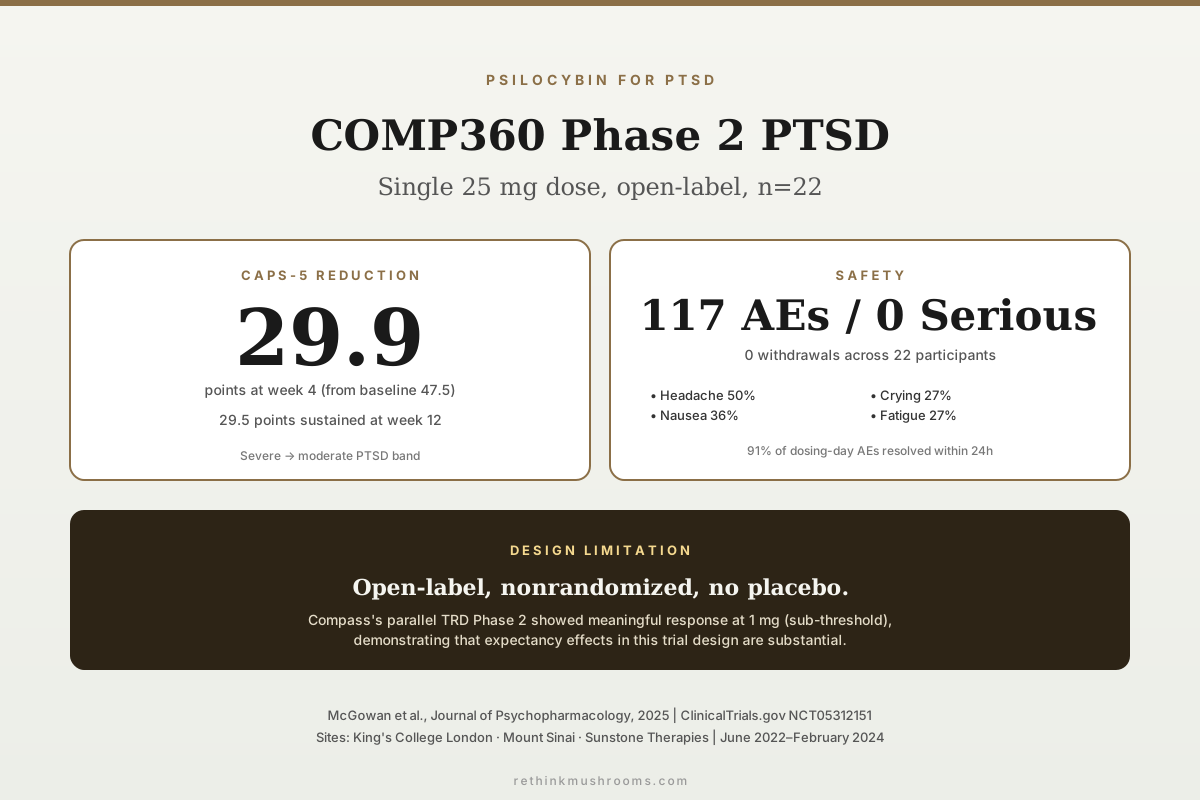
-29.9 points CAPS-5 at Week 4
Compass Pathways' Phase 2 open-label trial of single-dose 25 mg COMP360 psilocybin in 22 PTSD patients produced a 29.9-point reduction on the Clinician-Administered PTSD Scale for DSM-5 at week 4, with a 29.5-point reduction sustained at week 12. Zero serious adverse events. Zero study withdrawals. Headache (50%), nausea (36%), crying (27%), and fatigue (27%) were the most common adverse events.
McGowan et al., Journal of Psychopharmacology, 2025
N=22, open-label
nonrandomized single-arm multicenter Phase 2 trial across UK and US sites, June 2022 to February 2024
Baseline CAPS-5 47.5
mean score at enrollment, indicating severe PTSD across participants
0 serious AEs
no treatment-emergent serious adverse events and no withdrawals across 117 total adverse events
McGowan et al., Journal of Psychopharmacology, 2025
 View as image ↗
Compass Pathways released the first Phase 2 results for single-dose COMP360 psilocybin in post-traumatic stress disorder in 2025, published by McGowan and colleagues in the Journal of Psychopharmacology. The trial was a nonrandomized, open-label, multicenter design across three sites: King's College London, Mount Sinai Hospital in New York, and Sunstone Therapies in Rockville, Maryland. Twenty-two patients with PTSD received a single 25 mg dose of COMP360 with protocolised psychological support. The primary outcome was safety and tolerability at week 12; the secondary outcomes included clinician-rated and self-rated PTSD symptom measures, functional impairment, and quality of life. The study met its primary endpoint and produced a clinically meaningful symptom-reduction signal, though the open-label design without placebo control limits what can be concluded about efficacy.[1] For the broader evidence context, see psilocybin for ptsd: what the clinical trials show and psilocybin for ptsd: safety and tolerability data.
Key Takeaways
- McGowan et al. (2025) reported a 29.9-point reduction in mean CAPS-5 total score from a baseline of 47.5 at week 4, sustained at a 29.5-point reduction at week 12 following a single 25 mg dose of COMP360 psilocybin in 22 PTSD patients
- The trial was an open-label, nonrandomized, multicenter Phase 2 study (ClinicalTrials.gov NCT05312151) conducted between June 2022 and February 2024 across three sites in the UK and US
- 117 treatment-emergent adverse events occurred across 22 participants; 70 (59.8%) on administration day, with 64 of those 70 (91.4%) resolving by the end of the next day; no serious adverse events and no study withdrawals
- Common adverse events were headache (50%), nausea (36.4%), crying (27.3%), and fatigue (27.3%), consistent with the adverse event profile documented in Compass Pathways' larger depression trial programme
- PCL-5 self-report PTSD scores showed rapid symptom reduction sustained through week 12; Sheehan Disability Scale and EQ-5D-5L index scores improved in parallel
- Symptom reduction magnitude was associated with the intensity of the acute psychedelic experience on dosing day, a dose-response pattern seen in Compass's parallel depression trial programme (Goodwin et al., 2022)
- The open-label design without placebo control is a substantial limitation; psilocybin trials have documented large expectancy effects, and single-arm data cannot separate drug effect from expectation and attention effects
What COMP360 Is
COMP360 is Compass Pathways' proprietary synthetic psilocybin formulation, manufactured under pharmaceutical good manufacturing practice. The molecule is chemically identical to psilocybin produced by Psilocybe cubensis and other naturally occurring psilocybin-producing fungi, but the source, purity, and batch-to-batch consistency are controlled at drug-approval standards. COMP360 is the specific preparation tested in Compass's depression programme and, now, in this PTSD Phase 2 trial. Clinical trial data on COMP360 apply to that specific formulation and the specific psychological support protocol used alongside it; they do not automatically extrapolate to unstandardised psilocybin mushroom preparations.
Trial Design and Primary Endpoint
The McGowan trial was a Phase 2, nonrandomized, open-label, multicenter study.[1] Open-label means all participants knew they were receiving psilocybin; nonrandomized means there was no placebo or active comparator arm; multicenter means three sites contributed data (King's College London, Mount Sinai, Sunstone Therapies). The design is appropriate for an initial safety and tolerability readout but carries well-understood limitations for interpreting efficacy signals.
Twenty-two participants with PTSD received a single oral 25 mg dose of COMP360, the same dose used in Compass's treatment-resistant depression programme. Participants were 63.6% female with mean age 39.0 ± 7.91 years. All dosing sessions were conducted with protocolised psychological support: preparation sessions before dosing, a therapist or facilitator present throughout the dosing experience, and integration sessions afterward, following the clinical-trial supportive non-directive framework.
The primary endpoint was safety and tolerability at week 12 post-dose, measured by treatment-emergent adverse events (TEAEs), serious adverse events, and withdrawals. Secondary endpoints included:
- Clinician-Administered PTSD Scale for DSM-5 (CAPS-5): the gold-standard structured diagnostic interview for PTSD severity, rated by blinded independent clinicians.
- PTSD Checklist for DSM-5 (PCL-5): self-report PTSD symptom measure.
- Sheehan Disability Scale (SDS): self-report functional impairment across work, social, and family domains.
- EQ-5D-5L: standardised quality-of-life utility measure used in health economics evaluations.
Assessments were collected at baseline and at multiple post-dose timepoints through week 12.
The Safety and Tolerability Results
A total of 117 treatment-emergent adverse events occurred across the 22 participants over 12 weeks.[1] Of those, 70 (59.8%) were reported on dosing day itself, and 64 of those 70 (91.4%) had resolved by the end of the following day. The most common events were:
- Headache: 11 participants (50.0%)
- Nausea: 8 participants (36.4%)
- Crying: 6 participants (27.3%)
- Fatigue: 6 participants (27.3%)
Zero serious treatment-emergent adverse events occurred. Zero participants withdrew from the study due to adverse events. This adverse event profile is consistent with the pattern documented in Compass's parallel Phase 2 treatment-resistant depression programme (Goodwin et al., 2022, n=233, across three doses), where the dose-related AE signal was transient and concentrated on dosing day.[2] The single 25 mg dose used here is at the upper end of the depression trial dosing range, and the adverse event profile reproduces what the depression literature predicts.
The safety signal in a PTSD population specifically is important. PTSD patients have elevated baseline rates of panic, dissociation, and acute distress, any of which could plausibly be triggered or amplified by a high-dose psychedelic experience. That none of the 22 participants experienced a serious adverse event and none withdrew is a meaningful early signal that the clinical support protocol can contain the acute experience in this population. It does not guarantee that rare serious events would not emerge in a larger sample; it does establish that the protocol tolerability floor for PTSD patients is at least comparable to the depression programme floor.
The CAPS-5 and PCL-5 Signal
CAPS-5 is the structured clinical interview that serves as the regulatory-grade primary endpoint for PTSD drug trials. Baseline mean CAPS-5 total score in the trial was 47.5, which indicates severe PTSD (CAPS-5 scoring: 0 to 20 minimal, 21 to 40 moderate, 41 to 60 severe, 61+ extreme).
At week 4, mean CAPS-5 reduction was 29.9 points (standard deviation 14.06). At week 12, the reduction remained at 29.5 points (standard deviation 15.43). This is a clinically meaningful change by standard thresholds, which typically define clinically meaningful CAPS-5 reduction as ≥10 to 15 points. A 29.9-point drop from a severe-category baseline moves the typical responder from severe into the moderate or mild PTSD range.
PCL-5 self-report scores showed a parallel trajectory: rapid reduction after dosing, sustained through week 12. SDS functional impairment and EQ-5D-5L quality-of-life scores improved on similar timelines. The convergence of clinician-rated, self-rated, functional, and quality-of-life measures into a single directional signal is an internal consistency check that strengthens the interpretation beyond any single scale.
The authors also reported that the magnitude of symptom reduction was associated with the intensity of the acute psychedelic experience on dosing day. This dose-response-like pattern appears repeatedly across psilocybin trials (Goodwin et al., 2022 for TRD; Ellis et al., 2025 for veteran TRD)[2][3] and is one of the mechanistic arguments that the acute experience is functionally linked to the downstream clinical effect rather than incidental to it.
What Open-Label Design Does Not Rule Out
The single most important interpretive caveat: this was an open-label, nonrandomized, single-arm trial. No placebo control. No active comparator. Participants knew they were receiving psilocybin. Clinicians rating CAPS-5 were blinded to timepoint in some analytic approaches but were not blinded to treatment allocation because there was no allocation to blind.
The expectancy effect in psilocybin trials is well documented. Compass's own Phase 2 TRD programme with 233 participants across three doses (1 mg, 10 mg, 25 mg) showed meaningful symptom reduction at all three doses in a randomised design, with the 25 mg dose producing the largest and most durable effect. The presence of meaningful response at 1 mg in that trial (a pharmacologically subthreshold dose) is the clearest demonstration in the literature that expectancy alone can produce measurable symptom reduction in Compass's trial infrastructure.[2]
For the PTSD Phase 2 readout, this means a portion of the 29.9-point CAPS-5 reduction is plausibly attributable to expectancy, therapeutic alliance with the facilitators across multiple visits, regression to the mean from a severe-category baseline, and the attention effects of being in a high-touch clinical trial. Only a randomised placebo-controlled Phase 3 design can separate drug effect from these other effects. Compass has publicly stated that a late-stage PTSD trial design is being finalised in consultation with FDA.
Where This Fits in the Broader Psilocybin-PTSD Evidence
Before McGowan et al. (2025), there was no published clinical trial of psilocybin specifically for PTSD. Khan et al. (2022) reviewed the theoretical rationale for psilocybin in trauma-related disorders and cataloged the indirect evidence: open-label work in AIDS survivors with trauma, mechanistic animal data on fear extinction learning (Catlow et al., 2013, showing psilocybin effects on hippocampal neurogenesis and trace fear conditioning extinction in mice), and the emerging depression and end-of-life distress clinical trial literature.[4][5] The McGowan trial is therefore the first dedicated PTSD Phase 2 readout in the peer-reviewed literature.
Parallel work in veteran populations has shown a related signal. Ellis et al. (2025) conducted the first open-label trial of single-dose 25 mg psilocybin in 15 US military veterans with severe treatment-resistant depression, a population with very high PTSD comorbidity.[3] The trial was not PTSD-focused and used MADRS (Montgomery-Åsberg Depression Rating Scale) as its primary endpoint, but the demographic overlap is substantial for anyone trying to generalise the McGowan data to real-world PTSD populations.
Compass's lead depression programme is further advanced than its PTSD programme. The company announced successful Phase 3 TRD results in 2025 and a second successful Phase 3 in 2026, with commercial launch plans accelerating. The PTSD programme remains at the end of Phase 2 with late-stage design discussions ongoing. This sequencing matters for timing expectations: any FDA approval for psilocybin in PTSD is downstream of approval in TRD, which itself is in the FDA review pipeline.
For ongoing clinical trial status across PTSD indications, see psilocybin for ptsd: current clinical trials and preliminary data, and for how the therapeutic approach to trauma differs from standard PTSD treatment, see how psilocybin therapy approaches trauma differently.
The Phase 3 Question
Compass has stated publicly that a Phase 3 PTSD design is being finalised taking FDA feedback into account. Several design questions are mechanically important:
Placebo design. A true placebo in a psilocybin trial is almost impossible because participants reliably recognise whether they received an active dose or inactive placebo within the first hour of dosing, defeating the blind. Options discussed in the field include active-comparator designs using a psychoactive but non-psychedelic agent, very low-dose psilocybin (1 mg) as an active placebo (used in Compass's TRD Phase 2), or niacin-based "active placebo" approaches. The design chosen will materially shape what the Phase 3 data can establish.
Number of doses. A single 25 mg dose produced the signal in the McGowan trial. Phase 3 may test single versus two-dose protocols, which changes both the efficacy and cost calculus.
Psychological support standardisation. The clinical-trial-grade psychological support protocol is labour-intensive and not directly transferable to ordinary outpatient psychiatric practice. How Phase 3 operationalises support and how that maps to real-world delivery will shape post-approval rollout.
PTSD subtype and comorbidity inclusion. Combat-related, interpersonal-violence-related, and childhood-abuse-related PTSD may respond differently. Comorbid substance use disorder is explicitly excluded in most current trials. A Phase 3 design that carves PTSD into responsive subgroups would generate more actionable data than a pan-PTSD design but would also complicate regulatory interpretation.
The Bottom Line
Compass Pathways' Phase 2 open-label trial of single-dose 25 mg COMP360 psilocybin in 22 PTSD patients (McGowan et al., 2025) produced a 29.9-point CAPS-5 reduction at week 4 from a severe-category baseline of 47.5, sustained at 29.5 points at week 12, with convergent improvements on PCL-5, Sheehan Disability Scale, and EQ-5D-5L. Safety was strong: 117 adverse events across 22 participants, zero serious events, zero withdrawals, with on-dosing-day events (most commonly headache at 50%, nausea at 36%, crying at 27%, fatigue at 27%) resolving within 24 hours in 91% of cases. The signal magnitude is clinically meaningful and internally consistent across clinician-rated, self-rated, functional, and quality-of-life endpoints. The single most important limitation is the open-label nonrandomized design without placebo control, which prevents separating drug effect from expectancy and therapeutic alliance effects that Compass's own 1 mg comparator arm in the parallel TRD Phase 2 showed to be substantial. A Phase 3 PTSD trial is in late design consultation with FDA. Compass's lead depression programme is further advanced, with two successful Phase 3 TRD trials completed and commercial launch planning accelerated. Psilocybin for PTSD remains an investigational treatment with one published Phase 2 readout.
Frequently Asked Questions
Sources & References
- 1RTHM-00941·McGowan, Niall M et al. (2025). “Investigating the safety and tolerability of single-dose psilocybin for post-traumatic stress disorder: A nonrandomized open-label clinical trial..” Journal of psychopharmacology (Oxford.Study breakdown →PubMed →↩
- 2RTHM-00761·Goodwin, Guy M et al. (2022). “Single-Dose Psilocybin for a Treatment-Resistant Episode of Major Depression..” The New England journal of medicine.Study breakdown →PubMed →↩
- 3RTHM-00923·Ellis, Sara et al. (2025). “Single-dose psilocybin for U.S. military Veterans with severe treatment-resistant depression - A first-in-kind open-label pilot study..” Journal of affective disorders.Study breakdown →PubMed →↩
- 4RTHM-00770·Khan, Amanda J et al. (2022). “Psilocybin for Trauma-Related Disorders..” Current topics in behavioral neurosciences.Study breakdown →PubMed →↩
- 5RTHM-00279·Catlow, Briony J et al. (2013). “Effects of psilocybin on hippocampal neurogenesis and extinction of trace fear conditioning..” Experimental brain research.Study breakdown →PubMed →↩