Mushrooms & Mental Health
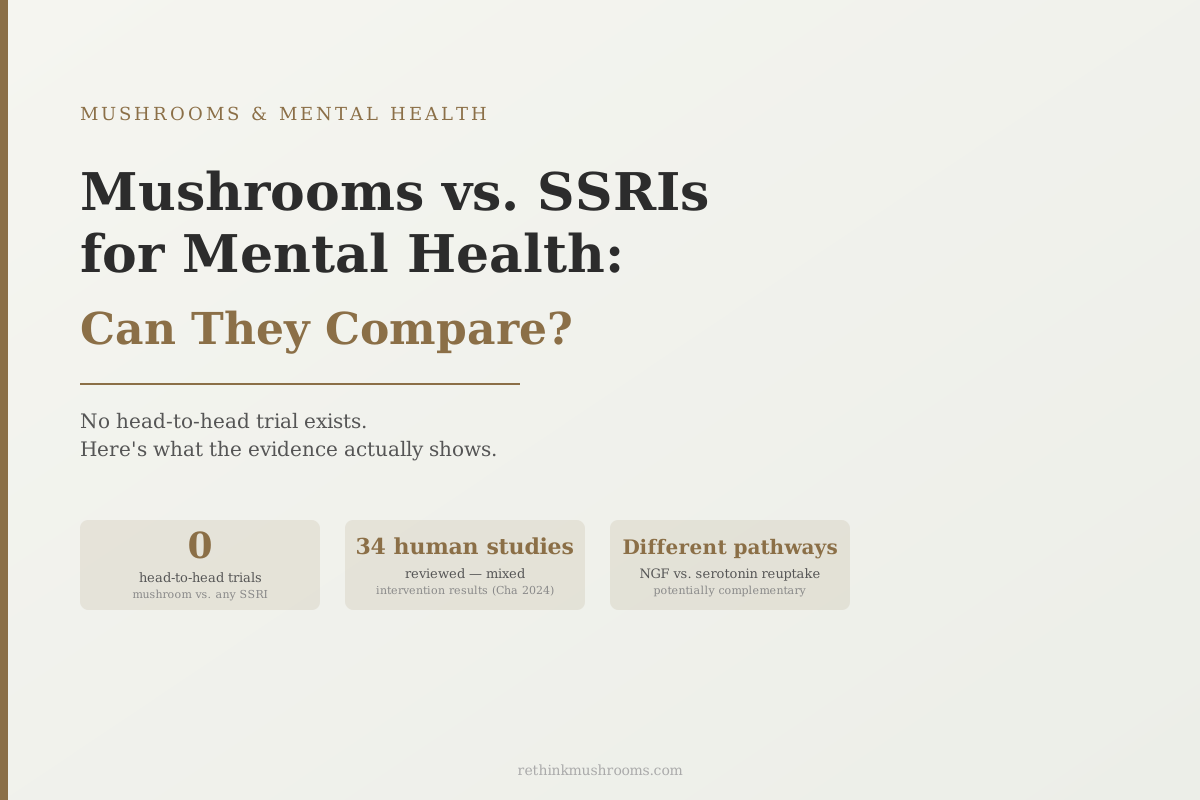
0 head-to-head trials
No randomized trial has ever directly compared a functional mushroom to an SSRI. The most recent large review examined 34 human studies and found population-level evidence consistently positive; clinical intervention results were mixed, and a 2025 double-blind RCT in healthy younger adults found no mood benefit.
Cha et al., Neurosci Biobehav Rev, 2024; Surendran et al., Front Nutr, 2025
Different pathways
SSRIs block serotonin reuptake; Lion's Mane stimulates nerve growth factor; Reishi modulates neuroinflammation and cortisol. These are different mechanisms targeting depression differently (da Silva et al., Nutrients, 2025)
Population-specific effects
Lion's Mane showed mood benefits in menopausal women and overweight adults in small positive trials; showed no benefit in healthy younger adults in a 2025 double-blind RCT (Surendran et al., 2025)
Reishi: RCT-positive data
Ganoderma lucidum improved mood and quality of life vs. placebo in women with fibromyalgia in a randomized controlled trial (Collado-Mateo et al., J Clin Med, 2020)
Cha et al., Neurosci Biobehav Rev, 2024; Surendran et al., Front Nutr, 2025
 View as image ↗
The comparison people want to make between functional mushrooms and SSRIs runs into an immediate problem: there is no head-to-head trial. No study has randomized participants to Lion's Mane versus fluoxetine, or Reishi versus sertraline, and measured outcomes. Without a direct comparison, any answer to "can they compare?" is built from indirect evidence and mechanistic reasoning rather than clinical data.
That doesn't make the comparison useless. It just changes what the honest version of it looks like. SSRIs have been evaluated in hundreds of large randomized trials for clinical depression. Functional mushrooms have been evaluated in a handful of small studies, mostly in non-clinical populations. The evidence quality gap is real and measurable. Understanding what is actually known about mushrooms vs. SSRIs for mental health requires looking at both that gap and what functional mushrooms might offer that SSRIs do not.
For the foundational context on how adaptogenic mushrooms support the stress response, see Adaptogenic Mushrooms for Stress: How They Help Your Body Cope.
Key Takeaways
- No randomized controlled trial has ever directly compared any functional mushroom to any SSRI; any comparison is built from separate evidence bases, not head-to-head data
- SSRIs have a number-needed-to-treat (NNT) of roughly 7 to 8 for moderate-to-severe clinical depression in large meta-analyses; the equivalent metric for functional mushrooms is unknown because no large-scale RCTs in clinical depression populations exist
- The 2024 Cha review of 34 human studies found epidemiological evidence consistently linking mushroom consumption to better mood outcomes, but clinical intervention studies showed mixed results
- A 2025 double-blind RCT found no significant mood benefit from a standardized Lion's Mane extract in healthy younger adults; effects may be population-specific (Surendran et al., Front Nutr, 2025)
- Functional mushrooms appear to target mechanisms distinct from SSRIs: NGF/BDNF neurogenesis (Lion's Mane), neuroinflammation reduction, and HPA axis modulation (Reishi). These are pathways SSRIs do not directly address (da Silva et al., Nutrients, 2025)
- The positive human studies for Lion's Mane and Reishi have primarily been in specific populations: menopausal women, people with overweight-related mood effects, and fibromyalgia patients; not primary clinical depression
The Honest Answer: No Direct Comparison Exists
When someone searches "mushrooms vs. SSRIs for mental health," they usually want to know whether they can skip the prescription and try mushrooms instead. That's a reasonable question with a specific answer: the current evidence does not support this as an equivalent substitution for clinical depression or anxiety disorders.
Here is why that answer can be stated clearly. SSRIs are among the most studied interventions in psychiatric medicine. Meta-analyses pooling hundreds of randomized trials estimate the number needed to treat (NNT) for SSRIs in moderate-to-severe depression at roughly 7 to 8, meaning that for every 7 to 8 people who take an SSRI rather than a placebo, one additional person achieves remission because of the drug. That NNT is modest, which is why SSRIs are often criticized, but it is established from very large clinical trials in people with diagnosed depressive disorders.
Functional mushrooms have no equivalent dataset. The Cha 2024 comprehensive review identified 34 human studies on mushrooms and mood or cognition.[5] Twenty-four of those were epidemiological studies (observational data about people who eat more mushrooms). Ten were clinical interventions. The epidemiological findings were consistently positive. The clinical interventions (the kind of study that tells you whether the treatment works) showed mixed results.
The most recent controlled trial, Surendran and colleagues (2025), tested a standardized Lion's Mane extract in a double-blind, placebo-controlled RCT in healthy younger adults and found no significant mood benefit overall.[8] That is a null result in a well-designed study, and it belongs in the comparison as prominently as the positive findings.
What SSRIs Do vs. What Functional Mushrooms Do
The pharmacological comparison is more interesting than the evidence gap alone, because these two approaches do not appear to target the same biological processes.
SSRIs (selective serotonin reuptake inhibitors) block a transporter protein that normally clears serotonin from the synapse after a neuron fires. By blocking that reuptake, SSRIs increase the available serotonin concentration in the synapse. Serotonin signaling affects mood, sleep, appetite, and anxiety. SSRIs work relatively quickly at the synapse level, but the therapeutic effect on mood typically takes two to six weeks, suggesting that the useful change is not the immediate serotonin increase but rather the downstream structural adaptation that follows.
Lion's Mane (Hericium erinaceus) works through a different mechanism. Its bioactive compounds, hericenones and erinacines, stimulate the production of nerve growth factor (NGF) and brain-derived neurotrophic factor (BDNF). These are proteins that support the survival and growth of neurons and the formation of new synaptic connections, a process called neuroplasticity. The 2025 da Silva review describes how Lion's Mane promotes hippocampal neurogenesis (the growth of new neurons in the brain region central to memory and mood) as one of its candidate antidepressant mechanisms.[7] The neurogenesis hypothesis of antidepressant action proposes that SSRIs also work partly by promoting BDNF and hippocampal neuroplasticity. If so, Lion's Mane and SSRIs may converge on a downstream mechanism despite different entry points.
Reishi (Ganoderma lucidum) approaches mood from still another angle. Its triterpenoids and polysaccharides modulate neuroinflammation and regulate the HPA axis, the hormonal stress-response system that becomes dysregulated in chronic depression and anxiety. Da Silva and colleagues (2025) published a comprehensive review positioning functional mushrooms as candidate natural antidepressants, specifically because their mechanisms target neuroinflammation, NGF production, and gut-brain axis pathways that serotonin-focused medications do not directly address.[7]
The mechanistic implication is important: if mushrooms and SSRIs target different biological contributors to depression, they are not necessarily competing. They may be addressing different components of a multifactorial problem.
For the detailed mechanistic case on how Lion's Mane and Reishi affect mood pathways, see Functional Mushrooms for Depression: Non-Psychedelic Options and Reishi and Mood Regulation: Antidepressant Research.
The Positive Studies: Which Populations Showed Benefits
The human evidence that functional mushrooms improve mood is real but narrow in scope. Understanding what populations produced positive results matters for interpreting whether they apply to any given reader.
Nagano and colleagues (2010) conducted the first human RCT on Lion's Mane and mood: 30 menopausal women who consumed Lion's Mane-containing cookies for four weeks showed significantly lower depression, anxiety, and irritability scores compared to the placebo group.[1] This is a foundational study, and it is positive. But the population is specific: menopausal women, a group experiencing hormonal fluctuations that secondary affect mood. Whether the result would replicate in people with primary depressive disorder is unknown.
Vigna and colleagues (2019) found that eight weeks of Lion's Mane supplementation improved mood and sleep disorder scores in overweight and obese patients, with increased circulating pro-BDNF levels as a biomarker of neurotrophin activity.[2] Again the population has a specific characteristic: overweight-related metabolic disruption, which is associated with chronic low-grade inflammation and secondary mood effects. This is not primary MDD.
Collado-Mateo and colleagues (2020) found that Reishi (Ganoderma lucidum) supplementation significantly improved mood and health-related quality of life compared to placebo in women with fibromyalgia, a chronic pain condition with high rates of comorbid depression and anxiety.[3] The RCT design and the positive mood outcome give this study more weight than observational data. And again, the population has secondary mood symptoms (from chronic pain and fatigue) rather than primary depressive disorder.
Leung and colleagues (2024) published the most recent clinical data on Reishi for depression and anxiety, providing an additional 2024 human data point supporting Reishi's mood effects.[6]
The pattern across positive studies is consistent: functional mushrooms appear to produce mood benefits in populations where depression or anxiety is secondary to another physiological disruption (hormonal, metabolic, chronic pain, inflammatory). This is not the same as primary clinical depression, and this distinction matters for interpreting whether the evidence applies to readers with diagnosed mood disorders.
The Honest Counterpoint: When Lion's Mane Showed No Effect
The supplement industry's version of this story ends with the positive studies above. The honest version includes what happened when researchers tested Lion's Mane in a more controlled, better-powered trial in a different population.
Surendran and colleagues (2025) tested a standardized Lion's Mane extract against placebo in a double-blind RCT in healthy younger adults.[8] The result was a null: no significant overall mood benefit compared to placebo. This is recent, double-blind, and well-designed.
What does this null result mean? The most likely interpretation: Lion's Mane may only produce mood effects in people whose mood is already disrupted by some underlying physiological factor (hormonal changes, chronic inflammation, metabolic stress). In people without that disruption, who are younger and in relatively good health, there may be nothing the NGF-stimulating compounds in Lion's Mane are correcting. A healthy young person does not have depleted NGF or suppressed hippocampal neurogenesis in the way that a menopausal or obese or chronically ill patient might.
The Cha 2024 review drew a similar conclusion from its survey of the clinical intervention literature: epidemiological data consistently shows benefits from dietary mushroom consumption, but controlled interventions show mixed results that may reflect population heterogeneity.[5] The people who eat more mushrooms in population studies are not the same as the people enrolled in short-term supplement trials.
The Complementarity Case: Why "Support, Not Replacement" Is More Than a Hedge
Beelman and colleagues (2022) made the mechanistic case for edible mushrooms as dietary adjuvants for major depressive disorder, specifically because the compounds in mushrooms target depression pathways that antidepressants do not directly address.[4] SSRIs address serotonin availability. They do not directly target neuroinflammation, oxidative stress, or the neurotrophin deficits that characterize some depression subtypes. Mushroom compounds, particularly ergothioneine and NGF-stimulating hericenones, do address those targets.
This creates a genuine complementarity argument that is distinct from "mushrooms might work as well as SSRIs." The argument is not that Lion's Mane replaces fluoxetine. It is that for a patient on an SSRI who still has residual symptoms (a common clinical reality, since SSRIs produce full remission in only a fraction of patients), adding a compound that targets neuroinflammation or BDNF might address a gap that the SSRI cannot fill by itself.
That argument requires more clinical research to validate, specifically trials of mushrooms as adjuvants to SSRIs in treatment-resistant or partially-responding patients. Those trials do not yet exist. But the mechanistic rationale for why the combination might outperform either alone is coherent in a way that "mushrooms as standalone alternatives" is not.
For more on how mushrooms might serve as mental health support tools alongside existing treatment, see The Case for Mushrooms as Mental Health Support, Not Replacement.
For the psilocybin vs. antidepressants question, which involves different evidence and different regulatory status, see Do You Need Multiple Psilocybin Sessions for Lasting Depression Relief?.
The Bottom Line
No head-to-head trial comparing functional mushrooms to SSRIs exists. SSRIs have robust RCT data for clinical depression; functional mushrooms have small positive trials in specific non-clinical populations and one clear null result in healthy younger adults. The mechanistic comparison is more interesting than the evidence gap: functional mushrooms target NGF, neuroinflammation, and HPA axis modulation. These are pathways distinct from serotonin reuptake inhibition, making them more plausibly complementary than competitive. The practical conclusion is the same in every honest review of this topic: functional mushrooms are not an established replacement for prescription treatment of clinical depression.
Frequently Asked Questions
Sources & References
- 1RTHM-00194·Nagano, Mayumi et al. (2010). “Reduction of depression and anxiety by 4 weeks Hericium erinaceus intake..” Biomedical research (Tokyo.Study breakdown →PubMed →↩
- 2RTHM-00590·Vigna, Luisella et al. (2019). “Hericium erinaceus Improves Mood and Sleep Disorders in Patients Affected by Overweight or Obesity: Could Circulating Pro-BDNF and BDNF Be Potential Biomarkers?.” Evidence-based complementary and alternative medicine : eCAM.Study breakdown →PubMed →↩
- 3. Source details for this reference are not yet available.
- 4. Source details for this reference are not yet available.
- 5RTHM-00868·Cha, Sara et al. (2024). “A review of the effects of mushrooms on mood and neurocognitive health across the lifespan..” Neuroscience and biobehavioral reviews.Study breakdown →PubMed →↩
- 6. Source details for this reference are not yet available.
- 7. Source details for this reference are not yet available.
- 8RTHM-00952·Surendran, Geyan et al. (2025). “Acute effects of a standardised extract of Hericium erinaceus (Lion's Mane mushroom) on cognition and mood in healthy younger adults: a double-blind randomised placebo-controlled study..” Frontiers in nutrition.Study breakdown →PubMed →↩