Mushrooms and Mental Health
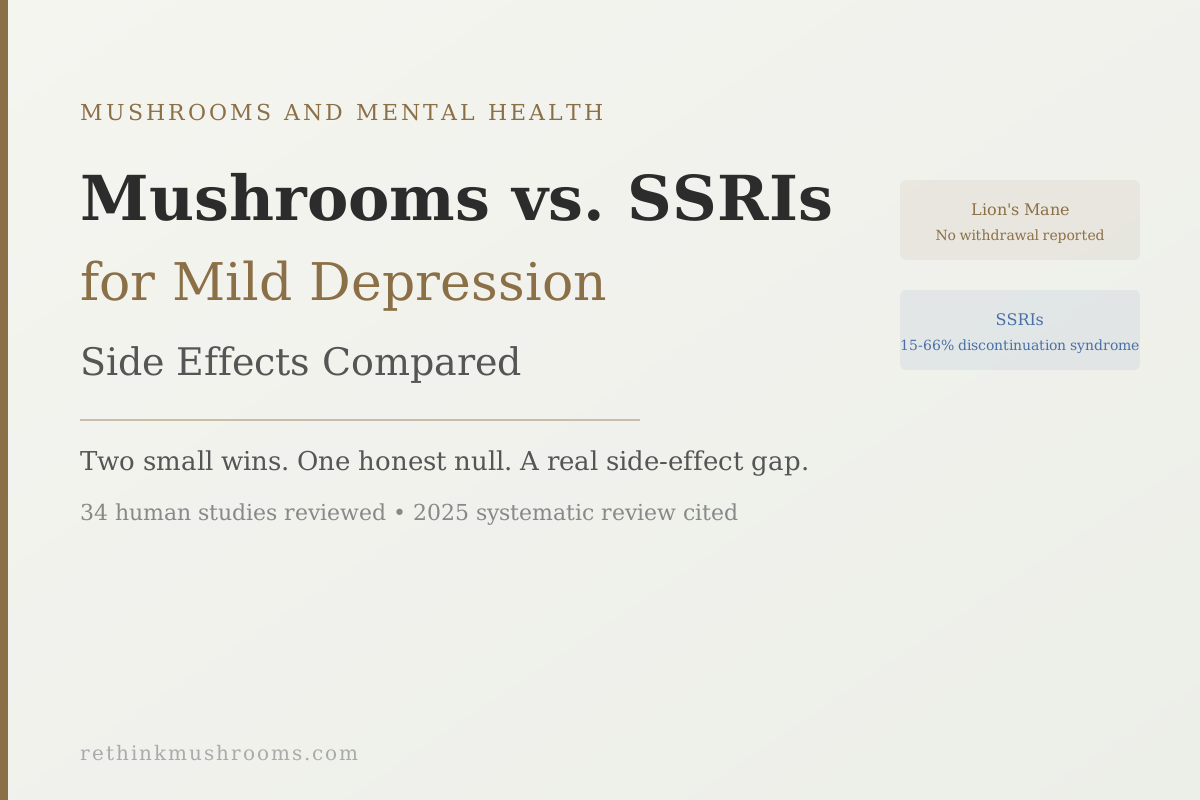
15–66% SSRI discontinuation syndrome
Between 15% and 66% of people who stop SSRIs experience discontinuation syndrome. A 2025 systematic review of Lion's Mane found no withdrawal effects. Here is what the evidence actually shows for mild depression.
Chen et al., Nutrients, 2025
2 positive
Lion's Mane human RCTs for depression, both in specific populations (menopausal women, overweight adults)
1 null
2025 RCT found no mood benefit in healthy younger adults (Surendran et al.)
34 studies
reviewed by Cha 2024; epidemiological positive, intervention results mixed
Chen et al., Nutrients, 2025
 View as image ↗
If you've searched for "mushrooms vs. SSRIs for mild depression," you're probably not asking whether a forest mushroom can outperform a pharmaceutical drug in a clinical trial. You're asking something more practical: whether functional mushrooms are worth trying for low-grade mood issues, and whether the side effects of SSRIs are a real concern at the mild end of the depression spectrum. Both are reasonable questions, and the research gives partial answers to each. For the broader picture of how adaptogenic mushrooms support stress and mental health, see Adaptogenic Mushrooms for Stress: How They Help Your Body Cope.
Here is a direct summary before the full analysis: Lion's mane has two small positive human studies for mood improvement (in menopausal women and overweight adults), one null result in healthy younger adults (2025), and a 2024 review of 34 human studies showing mixed intervention results. SSRIs have hundreds of large RCTs with a number needed to treat (NNT) of roughly 7 to 8 for moderate depression, but weaker evidence specifically for mild depression. The side effect comparison is asymmetric: SSRIs have documented discontinuation syndrome, sexual dysfunction, and weight gain; functional mushrooms show minimal adverse effects in a 2025 systematic review.
Key Takeaways
- "Mild depression" (PHQ-9 score 5-9) is the specific zone where SSRI evidence is weakest and lifestyle interventions are most clinically relevant; this is where the comparison is most fair
- SSRIs have an NNT of roughly 7-8 for moderate-to-severe depression; for mild depression, NNT estimates are higher (approaching 10-12), meaning fewer people benefit relative to those who experience side effects
- Lion's mane showed reduced depression and anxiety scores in two small studies (30 menopausal women in Nagano 2010; overweight/obese patients in Vigna 2019) but showed no significant mood benefit in healthy younger adults in a 2025 double-blind RCT (Surendran et al.)
- A 2024 review of 34 human studies (Cha et al.) found that epidemiological data consistently links mushroom consumption to better mood, but clinical intervention studies showed mixed results
- The side effect profiles are not comparable: SSRIs cause discontinuation syndrome in 15-66% of users, sexual dysfunction in 30-40%, and emotional blunting in many; a 2025 systematic review of Lion's Mane found no withdrawal effects and no serious adverse events (Chen et al.)
- A 2025 review in Nutrients identified mechanistically distinct pathways: SSRIs block serotonin reuptake; mushrooms stimulate NGF/BDNF and reduce neuroinflammation, suggesting potential complementarity rather than competition
What "Mild Depression" Means, and Why It Changes the Comparison
Depression exists on a severity spectrum. The PHQ-9 questionnaire, one of the most widely used clinical screening tools, categorizes symptom severity in four bands: minimal (0-4), mild (5-9), moderate (10-14), and severe (15-27). The clinical and regulatory evidence for SSRIs is strongest at moderate-to-severe levels. This is important context.
Most large SSRI meta-analyses, including those that arrive at the NNT figure of roughly 7-8, aggregate data from patients with PHQ-9 scores above 10. At the mild end of the spectrum (5-9), the evidence for SSRIs is substantially weaker. Some analyses suggest NNT for mild depression approaches 10-12, meaning 10 to 12 people need to take an SSRI for one person to experience benefit beyond placebo. At that level, the side effect burden becomes a more significant part of the calculation.
Major guidelines in the UK (NICE) and elsewhere recommend psychological therapies, exercise, and lifestyle modifications as first-line treatment for mild depression rather than antidepressants for this reason.
This framing matters for the mushroom comparison: the question is not whether lion's mane can compete with SSRIs for clinical depression. It's whether, in the mild depression zone specifically, functional mushrooms have any meaningful evidence alongside a better-characterized side effect profile.
What SSRIs Do: The Mechanism and Evidence in Brief
SSRIs (selective serotonin reuptake inhibitors) work by blocking the proteins that pull serotonin back into neurons after it has been released. Serotonin stays in the space between neurons longer, which is thought to amplify serotonin signaling. The therapeutic effect typically takes two to six weeks to develop, which itself suggests the immediate chemical change is not the full story; current thinking is that downstream effects on neuroplasticity, neurogenesis, and HPA axis regulation contribute meaningfully to antidepressant action.
SSRIs are FDA-approved treatments for major depressive disorder (MDD) and several anxiety disorders. The evidence base is substantial: hundreds of randomized controlled trials, dozens of systematic reviews, and real-world effectiveness data across millions of patients. For moderate-to-severe depression, SSRIs are a well-established first-line intervention.
For mild depression, the picture is less clear. A Cochrane review and several meta-analyses have found that the benefit-to-risk ratio deteriorates at lower symptom severity. Regulators and clinical guidelines in some countries have moved toward recommending non-pharmacological approaches for mild depression precisely because the absolute benefit at that severity level is modest compared to the documented side effect burden.
The Mushroom Evidence Landscape: Two Small Wins, One Honest Null
A 2024 narrative review by Cha and colleagues evaluated 34 human studies examining mushroom effects on mood and cognitive health across the lifespan: 24 epidemiological studies and 10 clinical intervention studies.[3] The summary from that review is nuanced in a way most mushroom articles ignore.
The epidemiological studies were consistently positive: populations that eat more mushrooms show better mood outcomes and lower depression rates. The intervention studies, however, showed mixed results. Some interventions produced mood improvements; others did not. This gap between observational data and clinical trial data is common in nutrition research and doesn't mean mushrooms don't work for mood. It means the effects are not large enough, consistent enough, or well-characterized enough to predict who benefits from supplementation.
The two studies most cited in mushroom-for-mood arguments are both from lion's mane:
Nagano and colleagues (2010) ran the first human RCT: 30 menopausal women consumed lion's mane-containing cookies or placebo for four weeks.[1] The lion's mane group showed significantly lower depression, anxiety, and irritability scores. This was the foundational study, and it was positive. It was also n=30, in a specific population (menopausal women), for a short duration, using lion's mane baked into cookies.
Vigna and colleagues (2019) observed mood and sleep improvements in overweight and obese patients after eight weeks of lion's mane supplementation, with increases in circulating pro-BDNF, a neuroplasticity biomarker shared with antidepressant mechanisms of action.[2] The study was observational rather than randomized, so placebo effects cannot be excluded.
Then there is the null result most mushroom sites don't mention.
Surendran and colleagues (2025) ran a rigorous double-blind, randomized, placebo-controlled study testing a standardized lion's mane extract in healthy younger adults.[6] The result: no significant overall mood benefit compared to placebo. This was an acute single-dose design, which matters for interpretation, but the finding still stands as meaningful negative evidence for a particular population.
Who Responds to Lion's Mane (and Who Doesn't): The Population Pattern
Looking across the positive and null results, a pattern emerges that is genuinely useful for readers trying to assess whether any of this applies to them.
The positive results cluster in people who have existing mood disruption from an identifiable biological cause: menopausal hormonal changes (Nagano 2010), obesity-related metabolic and inflammatory changes (Vigna 2019), and fibromyalgia-associated chronic pain and fatigue. These are populations experiencing secondary mood symptoms on top of a primary condition.
The null result (Surendran 2025) was in healthy younger adults with no identified mood disruption. They didn't improve because they didn't have much room to improve.
A 2025 comprehensive review in Nutrients reinforced this pattern: the evidence for functional mushrooms as "candidate natural antidepressants" is most credible for people with neuroinflammation, HPA axis dysregulation, or subthreshold mood disturbance rather than for healthy people seeking performance enhancement or prevention.[4]
What this means practically: the population most likely to see benefit from lion's mane for mood includes middle-aged and older adults, people experiencing mood disruption secondary to metabolic or inflammatory conditions, and people with mild rather than clinical depression. For healthy younger adults with no mood concerns, the existing evidence does not support mood enhancement as a realistic expectation.
For a deeper look at lion's mane's neurological mechanisms, see Lion's Mane and Neuroplasticity: Can a Mushroom Rewire Your Brain?.
The Side Effect Comparison No Competitor Has Done
This is the data that genuinely differentiates the two options, and it's almost entirely absent from consumer content.
SSRIs have well-documented side effects established through decades of post-marketing surveillance and clinical reporting:
Sexual dysfunction affects 30 to 40% of SSRI users and includes reduced libido, difficulty reaching orgasm, and erectile dysfunction. Unlike many SSRI side effects, sexual dysfunction often persists for the duration of treatment and does not reliably resolve with dose adjustment.
Discontinuation syndrome affects between 15% and 66% of people who stop SSRIs, with estimates varying widely by drug, dose, and duration of use. Symptoms include dizziness, electric-shock-like sensations, irritability, and flu-like symptoms. These effects are often described as withdrawal, though the clinical framing is discontinuation syndrome. They are real and can be severe enough to make stopping SSRIs difficult without medical supervision.
Emotional blunting, sometimes described as emotional numbing or apathy, is reported by a substantial minority of SSRI users. Patients describe feeling less emotional range: less sadness, but also less joy, reduced motivation, and a flattened quality to experience. This is increasingly recognized in the clinical literature as a meaningful treatment-emergent effect.
Weight gain and metabolic effects are documented with several SSRIs, particularly paroxetine, though the extent varies by drug.
Functional mushrooms present a very different side effect profile.
A 2025 systematic review of Hericium erinaceus (lion's mane) covering human studies from 2000 to 2024 found that side effects were minimal, with no withdrawal syndrome reported and no serious adverse events in clinical studies.[5] A small number of studies reported mild gastrointestinal symptoms in some participants. No sexual dysfunction, no emotional blunting, and no discontinuation effects appear in the literature.
The asymmetry is real and clinically relevant: SSRIs carry a documented side effect burden that is particularly relevant for the mild depression population where clinical benefit is modest; functional mushrooms have a cleaner safety profile in current evidence, even if their efficacy evidence is substantially weaker.
This does not mean mushrooms work as well as SSRIs for depression. It means the risk-benefit calculation looks different at mild severity levels, where treatment benefit is smaller and treatment burden is the same as at moderate severity.
For the reishi-specific evidence, see Reishi and Mood Regulation: Antidepressant Research. For the broader functional mushrooms depression evidence, see Functional Mushrooms for Depression: Non-Psychedelic Options.
Different Mechanisms: Why They Target Different Problems
One framing that consumer content consistently misses: SSRIs and functional mushrooms are not competing for the same mechanism. They operate on different systems.
SSRIs block the reuptake transporter for serotonin at the synapse. They increase the effective level of serotonin in synaptic gaps. Their therapeutic benefit is thought to come from downstream neuroplastic changes that this sustained serotonin elevation produces, including hippocampal neurogenesis and HPA axis normalization.
Functional mushrooms work through different pathways. A 2025 review in Nutrients identified the primary mechanisms: lion's mane stimulates nerve growth factor (NGF) and brain-derived neurotrophic factor (BDNF), which support neurogenesis and neural circuit maintenance. Reishi reduces neuroinflammation and modulates the HPA axis, the stress-response system that is hyperactive in many depressed people. Both mushrooms also influence the gut-brain axis through prebiotic and immune-modulating effects.[4]
The review explicitly positioned these as complementary targets: SSRIs address downstream neurotransmitter availability; functional mushrooms address upstream neuroinflammation, neuroplasticity support, and gut-brain signaling. A 2022 review also made this case, identifying mushroom bioactives as targeting depression pathways (neuroinflammation, oxidative stress, neurogenesis deficits) that SSRIs do not directly address.[4]
If this mechanistic complementarity holds in future clinical trials, the framing of "mushrooms vs. SSRIs" may be less accurate than "mushrooms alongside SSRIs" for people already on antidepressants. That is a question for clinical investigation, not something currently supported by RCT evidence. For the full argument around functional mushrooms as mental health support rather than replacement, see The Case for Mushrooms as Mental Health Support, Not Replacement.
For the broader comparison of mushrooms against anxiety medications specifically, see Natural Mushroom Supplements vs. Prescription Anxiety Meds.
The Bottom Line
For mild depression specifically, the comparison between SSRIs and functional mushrooms is more nuanced than at moderate or severe levels. SSRIs have strong evidence for moderate depression but weaker efficacy data at mild severity, combined with a substantial side effect burden. Functional mushrooms, primarily lion's mane and reishi, have small positive human studies in specific populations (menopausal women, overweight adults) but a 2025 null result in healthy younger adults, and mixed results across a 2024 review of 34 human studies. The side effect asymmetry is real: SSRIs carry documented withdrawal syndrome and sexual dysfunction risks; functional mushrooms show minimal adverse effects. These two options appear to work through different mechanisms, suggesting potential complementarity rather than direct competition.
Frequently Asked Questions
Sources & References
- 1RTHM-00194·Nagano, Mayumi et al. (2010). “Reduction of depression and anxiety by 4 weeks Hericium erinaceus intake..” Biomedical research (Tokyo.Study breakdown →PubMed →↩
- 2RTHM-00590·Vigna, Luisella et al. (2019). “Hericium erinaceus Improves Mood and Sleep Disorders in Patients Affected by Overweight or Obesity: Could Circulating Pro-BDNF and BDNF Be Potential Biomarkers?.” Evidence-based complementary and alternative medicine : eCAM.Study breakdown →PubMed →↩
- 3RTHM-00868·Cha, Sara et al. (2024). “A review of the effects of mushrooms on mood and neurocognitive health across the lifespan..” Neuroscience and biobehavioral reviews.Study breakdown →PubMed →↩
- 4. Source details for this reference are not yet available.
- 5. Source details for this reference are not yet available.
- 6RTHM-00952·Surendran, Geyan et al. (2025). “Acute effects of a standardised extract of Hericium erinaceus (Lion's Mane mushroom) on cognition and mood in healthy younger adults: a double-blind randomised placebo-controlled study..” Frontiers in nutrition.Study breakdown →PubMed →↩