Psilocybin & Trauma Processing
0 human trials have measured the memory trace
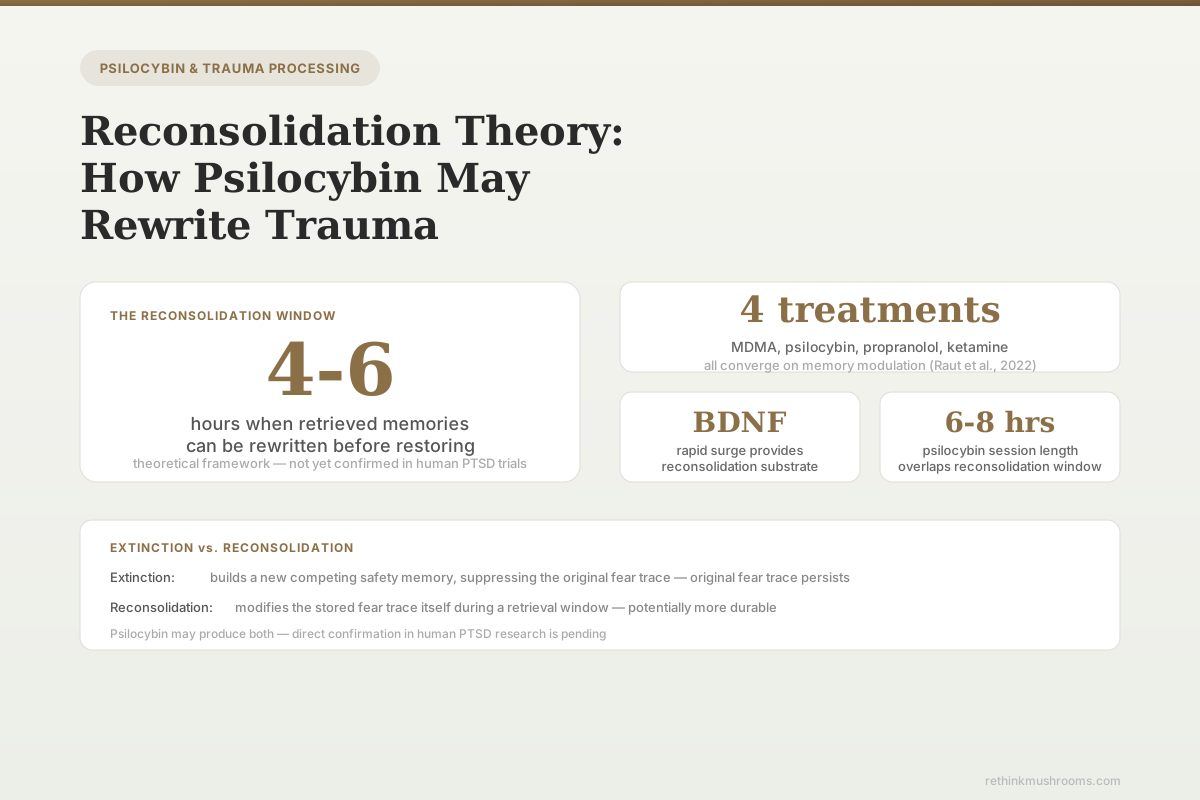
When a stored memory is retrieved, it briefly becomes unstable before restoring. Raut et al. (2022) found that MDMA, psilocybin, propranolol, and ketamine all appear to converge on disrupting consolidated fear memories, suggesting memory modulation may be the shared mechanism of PTSD treatment. Whether psilocybin specifically works by rewriting the trace has never been measured in a human trial.
Raut et al., Pharmacology & Therapeutics, 2022
4 treatments
MDMA, psilocybin, propranolol, and ketamine all converge on memory modulation as a core PTSD mechanism
BDNF surge
brain-derived neurotrophic factor increase by psilocybin may provide the synaptic substrate for memory rewriting — shown in a mouse depression model (Zhao et al., 2024)
opposite direction
a review of ~400 rodent studies found psychedelics tend to impair reconsolidation at doses that enhance extinction (Werle & Bertoglio, 2024)
not proven
reconsolidation as a specific psilocybin mechanism has not been directly tested in human PTSD trials
Raut et al., Pharmacology & Therapeutics, 2022
 View as image ↗
A trauma memory works differently from most memories. It doesn't soften with time the way ordinary memories do. It stays sharp, emotionally charged, and quick to activate in response to cues that only vaguely resemble the original event. The question behind memory reconsolidation research is whether this can be changed: not by building a competing memory on top of the old one, but by catching the trauma memory in a brief window when it is temporarily unstable and rewriting it before it re-stores.
Psilocybin memory reconsolidation as a therapeutic mechanism for trauma is an appealing story, and it is told with more confidence than the evidence supports. Three things are true at once, and most coverage reports only the first. The theory is coherent and has genuine mechanistic backing. The single human experiment most often cited to justify it did not survive independent re-analysis. And the largest review of the animal literature finds that psychedelics tend to push reconsolidation in the opposite direction from the one the popular account assumes. This article separates those layers. It is part of the broader exploration of psilocybin and trauma processing and the full clinical landscape at psilocybin for PTSD: what the clinical trials show.
Key Takeaways
- Memory reconsolidation is distinct from fear extinction: rather than building a competing safety memory, it involves catching the original fear memory in a brief unstable window and modifying it before it restores
- Raut et al. (2022) found that MDMA, psilocybin, propranolol, and ketamine (four pharmacologically different PTSD treatments) all appear to work by disrupting consolidated fear memories through either extinction or reconsolidation, suggesting memory modulation may be the shared mechanism of effective PTSD treatment[1]
- The most-cited human demonstration that memories can be therapeutically updated inside a reconsolidation window (Schiller et al., Nature, 2010) was re-analysed in 2020 by an independent group who obtained the original data files; every reported group difference in fear recovery depended on qualitative participant exclusions, and under any principled exclusion rule the groups looked highly similar
- A review of nearly 400 rodent studies (Werle & Bertoglio, 2024) found that psychedelics typically impair memory reconsolidation at the same doses that enhance extinction — an effect that could still be therapeutic, but is not the "rewrite the memory with better content" mechanism usually described
- Zhao et al. (2024) showed psilocybin produces a rapid BDNF surge and drives structural plasticity in prefrontal cortex and hippocampus, which may provide a biological substrate for memory modification — though this was a chronic-corticosterone depression model, not a trauma model[4]
- Rogers et al. (2025), the single piece of evidence closest to an actual fear memory, found psilocybin suppressed fear-active neurons and recruited extinction-active neurons — pointing at extinction, the competing mechanism[7]
- Modlin et al. (2025) proposed that psilocybin disrupts "over-determined maladaptive interpretive frameworks" in PTSD, a theoretical model that maps onto reconsolidation: the rigid meaning schemas built around trauma become temporarily malleable and can be revised[2]
- Reconsolidation as a specific mechanism of psilocybin therapy in PTSD has not been directly tested or confirmed in controlled human research; the hypothesis is untested rather than disproven
Two Ways to Change a Fear Memory: Extinction vs. Reconsolidation
Neuroscience identifies two fundamentally different ways a fear memory can lose its grip on behavior. Understanding them separately is necessary before making sense of reconsolidation theory, and they are routinely conflated in popular coverage of psychedelic trauma therapy.
Fear extinction creates a new memory that inhibits the old one. The original fear trace remains stored. What changes is that the brain learns a new association: the thing that was feared is now safe. This new safety association can override the fear memory when it is strong enough. In PTSD, extinction learning is impaired: the fear association repeatedly reasserts itself over the safety one, which is why exposure therapy requires extensive repetition and has a high relapse rate.
Memory reconsolidation works differently. When a stored memory is retrieved, it briefly loses its stability. Before it restores, there is a window during which the stored memory trace can be modified. If new information or new emotional context enters the system during this window, that new content can alter what gets re-stored. The fear memory itself changes, rather than being inhibited by a competing memory.
The practical difference is significant. Extinction requires building a new memory strong enough to suppress the old one, but the old one is still there and can resurface under stress. Reconsolidation, if it works as the theory proposes, would modify the stored fear trace itself. The trauma memory would restabilize with different emotional content. The fear association would be weaker not because something is inhibiting it, but because the stored representation has changed.
Mechanism Contrast · The Distinction Everything Rests On
Two routes to a quieter fear response — and why symptom scores can’t tell them apart
Both mechanisms below end with the patient reacting less to trauma cues. The difference is what happened to the original memory. Because standard outcome measures record the reaction and not the trace, a successful trial is compatible with either route.
Conceptual contrast; mechanism framing from refs [1] Raut 2022 and [7] Rogers 2025
The Human Foundation Is Weaker Than Its Citation Count Suggests
Before following the psilocybin argument, it is worth knowing how solid the ground underneath it is. The claim that human memories can be therapeutically updated by timing an intervention to the reconsolidation window rests heavily on one influential experiment, and that experiment has not held up well.
In 2010, Schiller and colleagues reported in Nature that reactivating a conditioned fear memory shortly before extinction training prevented the return of fear, where standard extinction training did not. It became the reference point for reconsolidation-timed therapy in humans. In 2020, Chalkia and colleagues published a verification report in Cortex after attempting to replicate the critical conditions. While doing so they identified irregularities in the original paper, obtained the original data files from the authors, and re-ran the analyses seven different ways. Participant-exclusion criteria and the number of participants excluded had been misreported; inclusion had in practice been determined by qualitative experimenter decisions; and the reported statistics were internally inconsistent. Every reported difference in fear recovery between the reactivation-extinction and standard-extinction groups depended on those qualitative exclusions. Under any principled exclusion rule, the two groups looked highly similar.
Contested Foundation · Read Before The Mechanism
The landmark human result did not survive re-analysis
Reconsolidation-timed therapy in humans is usually justified by citing one influential 2010 experiment. In 2020 an independent group obtained the original data files while attempting a replication. What they found changes how much weight that citation can carry.
- Participant-exclusion criteria and the number excluded were misreported
- Inclusion was in practice determined by qualitative experimenter decisions
- The reported statistical analyses were internally inconsistent
- Re-running the analyses seven ways: all of the reported group differences in fear recovery depended on those qualitative exclusions. Under any principled exclusion rule, fear recovery was highly similar between the reactivation-extinction and standard extinction groups.
Sources: Schiller et al. (Nature, 2010; Addendum 2018); Chalkia et al. (Cortex, 2020)
This does not falsify memory reconsolidation. The rodent evidence that retrieved memories destabilize is substantial, and other human groups have reported reconsolidation-interference effects. What it establishes is narrower and still important: the specific human result most often invoked to justify timing a therapy to the reconsolidation window cannot carry that much weight, and a psilocybin-reconsolidation model inherits that uncertainty on top of its own.
Why Every Effective PTSD Treatment May Work the Same Way
Raut and colleagues (2022) published a review in Pharmacology & Therapeutics that unified an otherwise fragmented treatment landscape.[1] They examined pharmacological approaches to PTSD including MDMA, psilocybin, propranolol (a beta-blocker), and ketamine. These drugs have very different pharmacological profiles and act on different receptor systems. Yet the review's organizing observation is that they converge on the same functional endpoint: disruption of abnormally persistent fear memories, with memory reconsolidation research supplying a set of pharmacological targets for doing so.
Propranolol's mechanism is the most direct: it blocks the noradrenergic signaling involved in memory reconsolidation, interfering with the restabilization process. Ketamine produces rapid neuroplastic changes that may modify memory traces during a reconsolidation window. MDMA's fear-dampening effect creates a session during which traumatic material can be revisited with a reduced fear response, potentially modifying what gets re-stored. Psilocybin has been linked to fear extinction enhancement at the cellular level (Rogers et al., 2025)[7], large-scale desynchronization of brain network activity (Siegel et al., 2024)[8], and a neuroplasticity surge that may additionally open a reconsolidation window.
The convergence finding matters because it suggests memory modulation is not just one strategy among many for PTSD; it may be the shared mechanism through which effective treatments work. This is a genuine theoretical endorsement for taking the reconsolidation hypothesis seriously. It is not evidence that psilocybin specifically uses that route, and the review does not claim it is.
The Reconsolidation Window: What It Is and Why Timing Matters
The reconsolidation window is time-limited and cue-dependent. It opens when a memory is actively retrieved, not passively associated. Merely being in an environment that reminds you of a trauma doesn't necessarily trigger reconsolidation; actively re-experiencing the memory, recalling its emotional and sensory content, appears necessary to destabilize the stored trace.
How long the window stays open is quoted with more precision than the underlying work supports. Figures in the range of four to six hours circulate widely, and they derive largely from rodent protocols in which a disrupting agent stops being effective some hours after retrieval. That is a reasonable working estimate for animal experiments. It is not a measured constant, it varies with the age, strength and type of the memory, and it has not been established for a human trauma memory at all. Treat "four to six hours" as a rough convention inherited from the animal literature rather than a clock the brain is known to run.
In psilocybin therapy protocols, sessions typically run six to eight hours. Preparatory work often involves having patients engage with their trauma narrative before and during the session. This means some degree of trauma memory retrieval plausibly occurs during the session, potentially overlapping a reconsolidation window with psilocybin's neuroplasticity effects. Whether this timing is mechanistically producing reconsolidation, or whether the therapeutic effects come through other channels, has not been resolved by human research.
How Psilocybin Might Open the Window: The Neuroplasticity Connection
The key link between psilocybin and reconsolidation is the drug's effect on brain structure in the hours and days following a session.
Zhao et al. (2024) · Journal of Psychopharmacology
- Population
- Mice — healthy animals plus a chronic corticosterone (CORT) exposure model of depression
- Intervention
- A single dose of psilocybin
- Comparator
- Vehicle-treated animals; behavioural testing via forced swim, sucrose preference and novelty-suppressed feeding
- Finding
- A single dose produced rapid and sustained antidepressant-like effects, and reversed chronic CORT-induced suppression of structural neuroplasticity and neuroplasticity-associated protein levels in the prefrontal cortex and hippocampus.
narrow-scope This is a depression model, not a trauma or fear-conditioning model. It demonstrates that psilocybin can restore plasticity markers; it does not show that a fear memory was modified.
Zhao et al., Journal of Psychopharmacology, 2024
Psilocybin produced a rapid increase in BDNF, the brain's primary growth factor for neural connections, and drove structural plasticity: dendritic branching and spine density, the tiny protrusions on neurons that form synaptic connections with neighboring cells.[4] These structural changes are frequently offered as the biological substrate for memory trace modification, and in principle they could be: new synaptic connections can encode new associations, and if those connections form while a fear memory is in a reconsolidation window, the modified content could be incorporated into the restabilizing trace.
The gap worth naming is that this reasoning is inference, not observation. Zhao and colleagues measured plasticity in a depression model. Nobody in that experiment retrieved a fear memory, and nobody measured whether a memory trace changed.
Khan and colleagues (2022) placed psilocybin in the therapeutic context in Current Topics in Behavioral Neurosciences.[3] Their review argues that the combination of psilocybin's plasticity effects, the quality of the subjective experience, and the emotional processing that occurs during a structured session creates a therapeutic opportunity different from what standard therapy provides — while stating plainly that at the time of writing no study had investigated psilocybin or psilocybin-assisted psychotherapy as treatments for PTSD, that the literature is small, and that mechanisms are not yet well understood.
Choi and colleagues (2024) provided a complementary mechanistic framework in the Journal of Psychopharmacology, reviewing the 5-HT2A receptor pathways that produce fear circuit changes, network-level disruption, and neuroplasticity.[5] The neuroplasticity effects are not incidental byproducts of the psychedelic experience; they are a pharmacological consequence of 5-HT2A activation and downstream TrkB signaling. This makes an overlap between a reconsolidation window and psilocybin's neuroplastic effects mechanistically coherent — which is a statement about plausibility, not about what happens in a patient.
The Animal Evidence Points Toward Extinction, Not Rewriting
Here the story complicates in a way that most coverage omits. The evidence closest to an actual fear memory does not support reconsolidation-based rewriting. It supports the competing mechanism.
Rogers, Heller & Corder (2025) · Nature Neuroscience
- Population
- Mice, longitudinal single-cell calcium imaging of the retrosplenial cortex across a 5-day trace fear learning and extinction assay
- Intervention
- A single dose of psilocybin
- Comparator
- Undosed animals; plus a computational model of the same microcircuit
- Finding
- Psilocybin altered cortical ensemble turnover and oppositely modulated fear- and extinction-active neurons. Suppression of fear-active neurons together with recruitment of extinction-active neurons predicted psilocybin-enhanced fear extinction.
preliminary Rodent-only, and the mechanism it demonstrates is extinction — the alternative to reconsolidation, not evidence for it.
Rogers, Heller & Corder, Nature Neuroscience, 2025
Rogers and colleagues watched individual neurons across a five-day fear learning and extinction protocol.[7] A single psilocybin dose suppressed neurons that fired during fear expression and recruited neurons associated with extinction learning. That pattern predicted enhanced fear extinction. It is the most fear-memory-proximate cellular evidence available for psilocybin, and it describes the brain building a new safety representation rather than editing an old fear one.
The broader animal literature reinforces this. Werle and Bertoglio (2024) reviewed nearly 400 rodent studies published since 1957 in Neuroscience & Biobehavioral Reviews, covering psilocybin and psilocin alongside LSD, DMT, mescaline, 5-MeO-DMT, 5-HT2A/2C agonists and MDMA, and examining their effects on aversive memory extinction and reconsolidation, learned fear, anxiety and locomotion. Their summary of the dose-response landscape is that psychedelics often show biphasic effects at doses that enhance extinction learning and retention, impair memory reconsolidation, or reduce learned fear and anxiety.
That word — impair — matters. Impairing reconsolidation is a real and potentially therapeutic action: it is essentially what propranolol is thought to do, weakening a fear memory by interfering with its re-storage. But it is not the mechanism the popular account describes. "Psilocybin opens a window in which the trauma memory can be rewritten with new meaning" and "psilocybin blocks a destabilized fear memory from restabilizing properly" are different claims with different predictions, and the animal dose-response data lean toward the second.
A widely repeated framing
“Psilocybin opens a window where trauma memories get rewritten with new meaning”
The claim
“During a psilocybin session, retrieved trauma memories destabilize and the insights from the experience are written into the memory, which then re-stores in a healed form.”
Reconsolidation theory is genuinely elegant, and it maps neatly onto how meaningful psilocybin sessions feel from the inside. Clinical and popular writing adopted the framing faster than the evidence for it accumulated.
What research shows
OverstatedNo controlled human trial has measured whether a trauma memory trace changes after a psilocybin session. The landmark human reconsolidation-updating result (Schiller 2010) failed independent re-analysis (Chalkia 2020). The largest rodent review (Werle & Bertoglio 2024, ~400 studies) reports that psychedelics tend to IMPAIR reconsolidation at doses that enhance extinction, and the closest cellular fear-memory evidence (Rogers 2025) points to extinction.
None of this means the therapeutic benefits are not real, and it does not disprove reconsolidation. Impaired reconsolidation could itself be therapeutic, and extinction and reconsolidation are not mutually exclusive. The claim that outruns the evidence is the specific one: that the memory is being rewritten rather than outcompeted or blunted.
Werle & Bertoglio, Neuroscience & Biobehavioral Reviews, 2024; Rogers et al., Nature Neuroscience, 2025; Chalkia et al., Cortex, 2020
A Theoretical Model: Disrupting Over-Determined Interpretive Frameworks
Modlin and colleagues (2025) proposed a theoretical model in Therapeutic Advances in Psychopharmacology that provides a vocabulary for what reconsolidation might look like from the inside of a psilocybin session.[2]
Their concept: trauma creates a "pre-determined and over-determined maladaptive interpretive framework." A traumatic event doesn't just create a fearful memory; it creates a rigid, self-referential system of meaning that organizes how the person interprets everything connected to the trauma. This system is sticky: once established, it resists revision because it is constantly confirmed by the hypervigilant attention it produces. Every ambiguous cue is interpreted through the trauma lens, which keeps the lens in place.
In their framing, psilocybin disrupts this framework by temporarily loosening its rigidity. The over-determined meaning system, which in ordinary consciousness is automatic and pervasive, becomes accessible to revision. Patients can encounter the traumatic material with new cognitive flexibility, and the therapeutic effect is the modification of the interpretive framework, not just the emotional charge of individual memories.
This maps onto reconsolidation theory at the level of analogy: a stored representation is accessed, becomes malleable, and restabilizes with new content. It is worth being precise that Modlin and colleagues propose a conceptual framework for clinical practice, illustrated with a clinical narrative. It is a way of thinking about what the therapy is doing, not a measurement of a memory trace.
How Reconsolidation Relates to MDMA's Mechanism
One useful way to understand psilocybin's reconsolidation hypothesis is by contrast with MDMA, the other compound most studied for trauma-related psychopathology.
Bird and colleagues (2021) reviewed both compounds in International Review of Psychiatry.[6] The conventional distinction drawn between them is that MDMA works substantially through fear dampening: acute suppression of the fear response during a session in which trauma material is revisited, creating conditions for better extinction learning because the patient can engage with trauma without being overwhelmed. Psilocybin's profile places more weight on 5-HT2A-driven plasticity and on the meaning-making quality of the experience.
It is often asserted that MDMA simply does not produce a plasticity surge and psilocybin does. That contrast is sharper in secondary coverage than in the primary literature — Werle and Bertoglio's review treats MDMA alongside the classic psychedelics in the same fear-memory framework, and the comparative plasticity question has not been settled by head-to-head work in trauma models. The defensible version is narrower: the two compounds have different acute subjective and receptor profiles, and the extinction-versus-reconsolidation question is unresolved for both.
Neither mechanism is objectively superior for all patients or all trauma types. MDMA's fear dampening may be exactly what some patients need to approach material they cannot otherwise face. For a direct comparison of these approaches, see psilocybin vs. MDMA for PTSD: different mechanisms, different strengths. The meaning-making dimension that psilocybin adds is explored further in a companion article.
What the Evidence Cannot Yet Tell Us
The reconsolidation hypothesis for psilocybin in PTSD is mechanistically coherent and empirically untested. Those are compatible descriptions, and holding both is the accurate position.
Evidence Reach · Where The Chain Stops
Four rungs of decreasing directness — and an empty top
Each rung below is real evidence. None of them measures a trauma memory trace in a human being before and after psilocybin, which is the observation the reconsolidation hypothesis actually requires. Notice also that the rung closest to fear memory points at the competing mechanism.
The chain is built from a mouse depression model [4], a mouse fear-extinction study [7] and a human connectivity study [8]. Each is sound work; none of them is a measurement of a human trauma memory trace. A rodent review covering nearly 400 studies since 1957 (Werle & Bertoglio, 2024) further reports that psychedelics tend to impair reconsolidation at doses that enhance extinction — which weakens a memory rather than adaptively rewriting it, and is not the model clinical accounts usually describe.
Evidence synthesis; rungs from refs [4][7][8], gap from [1][3][5]; Werle & Bertoglio (Neurosci Biobehav Rev, 2024)
What is missing is direct human evidence that reconsolidation is specifically occurring during psilocybin sessions. The distinction between extinction and reconsolidation is difficult to test in humans because both produce similar behavioral outcomes: reduced fear response to trauma cues. The difference would show up in whether the original fear memory trace has changed, which requires measurement methods that have not been applied in controlled psilocybin PTSD trials.
- Cell & circuit workcompleted
Single-cell calcium imaging across a fear learning and extinction assay, plus a computational microcircuit model — supporting extinction (Rogers 2025).
- Animal studiescompleted
Structural plasticity in a depression model (Zhao 2024); ~400 rodent studies reviewed for extinction and reconsolidation effects (Werle & Bertoglio 2024).
- Case reports & qualitative workcompleted
Open-label and qualitative reports of psilocybin-assisted therapy in traumatised populations, none measuring memory traces (Khan 2022).
- Small human trialmissing
No controlled trial has measured trauma memory trace properties before and after a psilocybin session.
- Large randomised controlled trialmissing
No placebo-controlled randomised trial of psilocybin for PTSD has been published.
- Meta-analysismissing
Not possible — there is no body of controlled trials to pool.
The mechanistic case is detailed in rodents and absent in humans. The specific measurement the hypothesis requires — did the trauma memory trace itself change — has not been made in any controlled psilocybin trial, and the closest animal evidence points toward extinction instead.
Rogers et al., Nature Neuroscience, 2025; Zhao et al., Journal of Psychopharmacology, 2024; Werle & Bertoglio, Neuroscience & Biobehavioral Reviews, 2024; Khan et al., Current Topics in Behavioral Neurosciences, 2022
The critical unanswered question: does a psilocybin session actively modify the stored trauma memory trace, does it interfere with that trace restabilizing, or do the benefits come entirely from fear extinction and neuroplastic changes that create new associations while the original trace remains unchanged? All three could produce symptom reduction. They differ in predicted relapse risk: extinction-based effects may be more vulnerable to resurgence of the original fear under stress, while changes to the stored trace would in principle be more durable.
Before drawing conclusions
CriticalA mechanism hypothesis is not a treatment protocol
Concern
Reconsolidation framing invites a dangerous inference: that deliberately retrieving a trauma memory during a psychedelic experience will rewrite it. The animal data show psilocybin amplifies whatever fear learning the brain is actively doing. Retrieving trauma without structured therapeutic containment is a session in which the drug is amplifying an uncontained fear experience.
What the research says
In every trial reporting benefit, psilocybin was administered as a supervised dose alongside psychological support, with screening, preparation and integration. Psilocybin is a Schedule I substance in the United States and remains illegal in most jurisdictions; access outside an approved clinical trial or a state-regulated programme is unlawful and unsupervised.
Particularly relevant for: People with PTSD or trauma histories, and anyone with a personal or family history of psychosis or bipolar disorder, for whom classic psychedelics carry additional risk.
What to do
Treat this article as an explanation of a research hypothesis, not medical advice. Decisions about PTSD treatment belong with a qualified clinician; if psilocybin interests you, ask about enrolling in a registered clinical trial.
Khan et al., Current Topics in Behavioral Neurosciences, 2022; Raut et al., Pharmacology & Therapeutics, 2022
Resolving the mechanism question requires human studies that directly measure memory trace properties before and after psilocybin sessions. Those studies have not been done. Until they are, reconsolidation remains a compelling mechanistic story for psilocybin's effects on trauma — one that is unconfirmed in humans, and that the closest animal evidence currently pulls away from rather than toward.
For the detailed neuroscience of fear extinction in particular, see psilocybin and fear extinction: the neuroscience of trauma release. For how psilocybin changes the relationship with traumatic memories from the patient's perspective, see how psilocybin changes the relationship with traumatic memories.
The Bottom Line
Memory reconsolidation offers a theoretically compelling explanation for psilocybin's effects on trauma: when a stored fear memory is retrieved and temporarily destabilizes, psilocybin's neuroplasticity surge may provide the substrate for modifying the memory trace before it restabilizes. Raut et al. (2022) found convergence on memory modulation across PTSD pharmacotherapies, and Modlin et al. (2025) articulated a clinical model of disrupting over-determined interpretive frameworks that aligns with reconsolidation. Three limitations are usually left out. The landmark human demonstration of reconsolidation-based updating (Schiller 2010) did not survive independent re-analysis (Chalkia 2020). A review of ~400 rodent studies (Werle & Bertoglio 2024) found psychedelics tend to impair reconsolidation at doses that enhance extinction. And the closest cellular evidence for a fear memory (Rogers 2025) points to extinction rather than rewriting. Reconsolidation as a specific psilocybin mechanism in PTSD has never been measured in a controlled human trial — the hypothesis is untested rather than disproven.
Frequently Asked Questions
Sources & References
- 1RTHM-01606·Raut, Sanket B et al. (2022). “Diverse therapeutic developments for post-traumatic stress disorder (PTSD) indicate common mechanisms of memory modulation..” Pharmacology & therapeutics.Study breakdown →PubMed →↩
- 2RTHM-00946·Modlin, Nadav Liam et al. (2025). “Clinical conceptualisation of PTSD in psilocybin treatment: disrupting a pre-determined and over-determined maladaptive interpretive framework..” Therapeutic advances in psychopharmacology.Study breakdown →PubMed →↩
- 3RTHM-00770·Khan, Amanda J et al. (2022). “Psilocybin for Trauma-Related Disorders..” Current topics in behavioral neurosciences.Study breakdown →PubMed →↩
- 4RTHM-00920·Zhao, Xiangting et al. (2024). “Psilocybin promotes neuroplasticity and induces rapid and sustained antidepressant-like effects in mice..” Journal of psychopharmacology (Oxford.Study breakdown →PubMed →↩
- 5RTHM-01874·Choi, Charles et al. (2024). “Mechanisms of psilocybin on the treatment of posttraumatic stress disorder..” Journal of psychopharmacology (Oxford.Study breakdown →PubMed →↩
- 6RTHM-01328·Bird, Catherine I V et al. (2021). “Psilocybin and MDMA for the treatment of trauma-related psychopathology..” International review of psychiatry (Abingdon.Study breakdown →PubMed →↩
- 7RTHM-02170·Rogers, Sophie A et al. (2025). “Psilocybin-enhanced fear extinction linked to bidirectional modulation of cortical ensembles..” Nature neuroscience.Study breakdown →PubMed →↩
- 8RTHM-00911·Siegel, Joshua S et al. (2024). “Psilocybin desynchronizes the human brain..” Nature.Study breakdown →PubMed →↩