Psilocybin & Trauma Processing
2025 Nature Neuroscience
Rogers, Heller, and Corder published the most mechanistically precise study yet: a single psilocybin dose bidirectionally modulated cortical ensembles during fear extinction, suppressing fear-active neurons while simultaneously recruiting extinction-active neurons.
Rogers, Heller & Corder, Nature Neuroscience, 2025
3 mechanisms
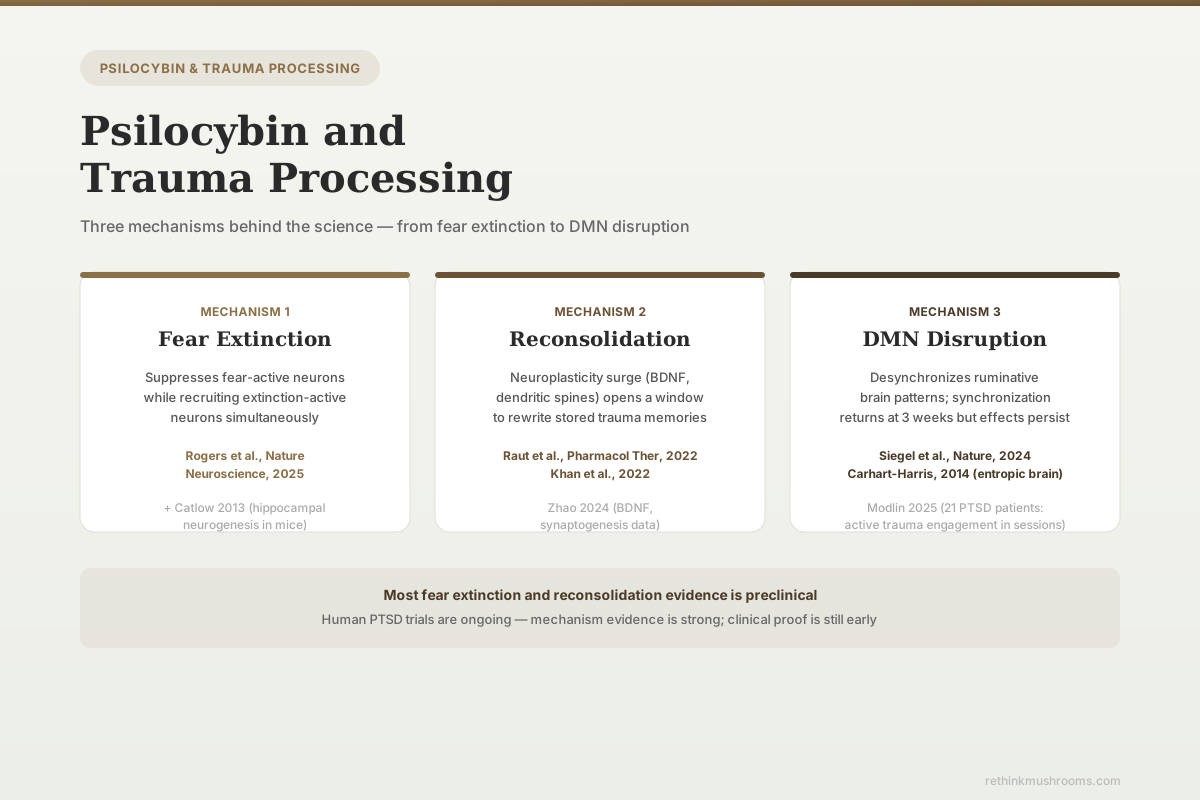
through which psilocybin facilitates trauma processing: fear extinction, reconsolidation, and DMN disruption
21 PTSD patients
in Modlin et al. (2025) qualitative study: participants actively engaged with trauma material during psilocybin sessions
preclinical
evidence base for fear extinction; human PTSD trials applying this mechanism are still underway
Rogers, Heller & Corder, Nature Neuroscience, 2025
 View as image ↗
The question researchers keep asking is simpler than it sounds: why does a few hours of an altered state translate into lasting relief from trauma that years of conventional therapy sometimes cannot touch? Psilocybin trauma processing is not a single thing. It's at least three distinct neurobiological events that tend to happen together, and understanding each of them separately makes the whole picture clearer.
The first is fear extinction: the brain's ability to learn that something previously associated with danger is now safe. Psilocybin appears to enhance this learning process at the cellular level. The second is memory reconsolidation: a brief window, opened when a stored memory is retrieved, during which the emotional charge attached to that memory can be changed before it re-stores. The third is default mode network disruption: the temporary dissolution of the ruminative, self-referential brain patterns that maintain PTSD between sessions. These three mechanisms are distinct in their neuroscience but they can reinforce each other during and after a psilocybin session. This article is part of the evidence base on psilocybin for PTSD: what the clinical trials show.
Key Takeaways
- Rogers, Heller, and Corder (2025, Nature Neuroscience) demonstrated that psilocybin bidirectionally modulated cortical ensembles during fear extinction, suppressing fear-active neurons while recruiting extinction-active neurons simultaneously; the degree of ensemble rebalancing predicted the strength of fear extinction[1]
- Catlow et al. (2013) showed in mice that psilocybin enhanced extinction of a conditioned fear response and increased hippocampal neurogenesis, establishing the preclinical basis for the fear extinction hypothesis[2]
- Raut et al. (2022) analyzed diverse PTSD treatments (MDMA, psilocybin, propranolol, ketamine) and found they all converge on the same mechanism: disruption of consolidated fear memories, either via enhanced extinction or memory reconsolidation interference[4]
- Siegel et al. (2024, Nature) showed psilocybin acutely desynchronizes brain networks, loosening the tightly coupled patterns of the default mode network; synchronization returns at 3 weeks but therapeutic effects persist beyond this[7]
- Modlin et al. (2025, eClinicalMedicine) reported qualitative data from 21 PTSD participants in psilocybin sessions: trauma material was actively engaged, experiential avoidance reduced, and participants emerged with shifted perspectives on their traumatic experiences[8]
- Most fear extinction and reconsolidation evidence comes from animal models; human trials testing psilocybin specifically for PTSD via these mechanisms are still in early phases; mechanistic plausibility is strong but clinical proof is preliminary
Why Traumatic Memories Are So Difficult to Change
PTSD involves a memory system that has gone wrong in a specific way. A traumatic event gets stored not just as a factual record but as a threat-level state: the brain encodes the danger so effectively that exposure to any reminder can re-trigger the full physiological fear response. The memory becomes over-generalized, responding to cues that only resemble the original threat, and over-stabilized, becoming rigid and resistant to the normal processes of fading and updating that keep most memories in proportion.
Standard treatments for PTSD primarily target this memory problem through two routes. Cognitive behavioral therapy attempts to change the meaning attached to traumatic memories through verbal processing. Exposure therapy asks patients to confront fear-triggering cues repeatedly until the anxiety response extinguishes. Both approaches work for many people. Both also have significant limitations: high dropout rates, slow progress, and a substantial minority of patients who don't respond at all.
The question behind psilocybin research for trauma is whether the drug can make the brain more receptive to the kind of memory updating that standard therapy is trying to achieve. Across multiple research programs, the answer appears to be yes, through three distinct neurobiological mechanisms.
Mechanism 1: Fear Extinction: Teaching the Brain That Danger Has Passed
Fear extinction is not the erasure of a fear memory. It is the creation of a new, competing memory. The brain learns that a stimulus previously associated with danger is currently safe. The old fear memory does not disappear, but it becomes inhibited by the new safety memory. In PTSD, this inhibition process is impaired: the fear memory keeps overriding the safety signal, which is why trauma symptoms recur long after the danger has passed.
Catlow and colleagues (2013) ran the foundational animal experiment: mice given psilocybin showed significantly enhanced extinction of a conditioned fear response and increased hippocampal neurogenesis compared to controls.[2] The hippocampus is central to both fear learning and fear extinction. More hippocampal neurons, and more new connections between them, create more capacity for the inhibitory safety learning that extinction requires. This was the first controlled evidence that psilocybin facilitated fear extinction at a structural brain level.
The most precise mechanistic evidence came twelve years later. Rogers, Heller, and Corder (2025) published in Nature Neuroscience a study that followed what happened at the cellular level during fear extinction in mice given psilocybin.[1] They tracked individual neurons in cortical circuits: specifically, which neurons became active during fear recall and which became active during extinction learning.
The finding: psilocybin bidirectionally modulated these cortical ensembles. Fear-active neurons were suppressed. Extinction-active neurons were simultaneously recruited. The drug essentially tilted the balance in the circuit toward safety learning while the animal was undergoing extinction. What made this result particularly significant is that the degree of ensemble rebalancing (how much fear neurons were suppressed and how much extinction neurons were activated) predicted the strength of fear extinction that followed. The mechanism was dose-dependent at a cellular level.
Choi and colleagues (2024) reviewed the detailed pathway through which psilocybin produces these effects in the Journal of Psychopharmacology.[3] The key link is psilocybin's activity at 5-HT2A receptors on GABA interneurons in the amygdala. The amygdala is the brain's primary fear-processing region. GABA interneurons are inhibitory neurons that suppress the output of nearby cells. When 5-HT2A receptors on these interneurons are activated, the amygdala's fear output is dialed down. At the same time, prefrontal cortex activity increases, strengthening the top-down inhibitory control that extinction requires. The result is a brain state more capable of learning safety.
For a deeper look at the neuroscience of fear circuits and how psilocybin alters them, see psilocybin and fear extinction: the neuroscience of trauma release.
Mechanism 2: The Reconsolidation Window: When Stored Memories Become Malleable
Memory reconsolidation is a distinct process from fear extinction. When a stored memory is retrieved and brought back into awareness, it enters a brief period of instability lasting roughly four to six hours before it re-stores. During this window, the memory can be updated: new information, new emotional context, new meaning can alter the stored trace before it consolidates again. For trauma, this means the memory's emotional payload, the automatic fear response attached to it, can theoretically be reduced by what happens during the reconsolidation window.
Raut and colleagues (2022) provided an important connecting insight in Pharmacology and Therapeutics.[4] Analyzing diverse PTSD treatments including MDMA, psilocybin, propranolol, and ketamine, they found that these apparently different therapies converge on the same underlying mechanism: disruption of consolidated fear memories. Either through enhanced extinction learning or through interference with memory reconsolidation, all of these treatments appear to work by making previously fixed fear memories more malleable. This convergence is evidence that memory disruption is not just one strategy among many for PTSD; it may be the core therapeutic target.
How psilocybin specifically opens the reconsolidation window is not yet established in human research. Khan and colleagues (2022) proposed in Current Topics in Behavioral Neuroscience that the combination of mystical experience, emotional processing facilitation, and neuroplasticity creates a therapeutic window genuinely different from what standard therapy provides.[5] When a traumatic memory is retrieved during a psilocybin session, the neuroplasticity surge that psilocybin produces, specifically the increase in brain-derived neurotrophic factor (BDNF) and synaptic growth, may provide the biological substrate for rewriting the memory trace while it is temporarily unstable.
The reconsolidation hypothesis for psilocybin in PTSD has not been directly tested in controlled human research. The evidence is mechanistically strong and theoretically coherent, but the specific contribution of reconsolidation versus fear extinction versus other effects has not been separated in human studies. For a detailed exploration of this distinction, see reconsolidation theory: how psilocybin may rewrite trauma.
Mechanism 3: Dissolving the Ruminative Loop: The Default Mode Network
The default mode network (DMN) is a set of brain regions that activate during self-referential thinking: when you think about yourself, your past, your future, what others think of you. In healthy people, the DMN operates in balance with other brain networks. In PTSD, research consistently shows the DMN is overactive and poorly regulated. The network runs loops: intrusive memories, avoidance, hypervigilance, rumination about the traumatic event and its meaning. The brain cannot stop running the same pattern.
Carhart-Harris (2014) proposed the entropic brain model to explain how psychedelics affect this pattern.[6] In PTSD, the brain's fear-processing patterns have become over-constrained: the neural network is stuck in a rut so deep it cannot easily escape. Psychedelics increase neural entropy, meaning they produce temporarily more disordered, more random-seeming neural firing patterns. This increase in disorder is, paradoxically, therapeutic: it breaks up the over-constrained, rigidly repeating patterns that maintain traumatic symptoms. The brain is temporarily dislodged from its rut.
Ten years later, Siegel and colleagues (2024) published a more precise version of this finding in Nature.[7] Psilocybin acutely desynchronized brain networks in human subjects, reducing the coupling between the regions that normally work together most tightly. The DMN's characteristic tight integration was loosened. At three weeks post-session, brain synchronization had returned to baseline levels. But therapeutic effects had not. This dissociation (the brain's connectivity returns to normal while the psychological benefits persist) suggests that the desynchronization is opening a window for change, not constituting the change itself. Something happens during the desynchronized period that creates lasting differences in how the brain processes trauma.
What Happened During Sessions: Qualitative Data from PTSD Participants
Mechanistic studies use animal models or brain imaging in healthy volunteers. They tell us about what psilocybin does to fear circuits and brain networks. They don't tell us what people with PTSD actually experience during psilocybin sessions, or what that experience is doing for them.
Modlin and colleagues (2025) filled part of this gap with qualitative research in eClinicalMedicine.[8] They interviewed 21 participants with PTSD who had undergone psilocybin-assisted therapy in a phase 2 trial. Four themes emerged consistently: non-pharmacological factors (the quality of the therapeutic relationship and sense of safety in the session) played a significant role; the experience was fundamentally different from standard trauma therapy in ways participants found significant; trauma material was actively engaged during sessions rather than avoided; and experiential avoidance, one of the core maintenance mechanisms of PTSD, was reduced.
The trauma engagement finding is particularly important. One of the defining features of PTSD is avoidance: people go to extraordinary lengths to prevent exposure to trauma reminders, which in turn prevents the extinction learning that could reduce the fear response. In these psilocybin sessions, participants engaged with trauma material they had previously avoided. They didn't simply re-experience it as re-traumatizing; they engaged with it differently. This is consistent with the fear extinction and reconsolidation frameworks: the drug was creating conditions in which trauma material could be processed rather than avoided.
What Makes Psilocybin Different from MDMA for Trauma
MDMA-assisted therapy has received the most attention among psychedelic PTSD treatments. Understanding the distinction between MDMA and psilocybin clarifies what each drug is therapeutically doing.
Bird and colleagues (2021) reviewed both compounds for trauma-related conditions in International Review of Psychiatry.[9] Their framing: MDMA and psilocybin are complementary rather than interchangeable. MDMA works primarily through fear dampening and social trust. It releases oxytocin, increases norepinephrine, and creates a window in which fear response is temporarily suppressed, allowing people to revisit traumatic material with reduced physiological fear activation. It does not primarily work through neuroplasticity or fear extinction in the way psilocybin does.
Psilocybin works through the three mechanisms described above: enhancing fear extinction learning, opening a reconsolidation window via neuroplasticity, and disrupting the over-constrained DMN patterns that maintain PTSD. It is also associated with mystical or peak experiences that participants often describe as meaningfully changing how they relate to their traumatic history. This meaning-making component, the sense that the experience has shifted one's relationship to the past rather than simply making it less frightening, may contribute to outcomes that persist without indefinite treatment.
Neither drug does what the other does. They address different aspects of the trauma memory problem through different pharmacological routes. For a direct comparison of their mechanisms and clinical applications, see psilocybin vs. MDMA for PTSD: different mechanisms, different strengths.
The Neuroplasticity Component: Why Effects Outlast the Drug
One of the persistent puzzles in psilocybin research is the duration of effects. The drug itself has a pharmacological half-life of a few hours. Yet therapeutic effects from a single session can persist for months. Standard psychopharmacology offers no explanation for this: drugs don't normally have effects that outlast their presence in the body by many months.
Zhao and colleagues (2024) investigated this in mice in the Journal of Psychopharmacology.[10] Psilocybin produced a rapid increase in BDNF, the protein that supports neural growth and connection formation. It also drove dendritic spine growth and synaptogenesis, meaning new synaptic connections formed in the hours and days following the drug's clearance from the body. These structural changes provide a substrate for lasting effects: the new connections formed during the period of heightened neuroplasticity can encode the new emotional associations and memory updates that the session produced.
Choi et al. (2024) placed this in the PTSD context: the neuroplasticity surge effectively extends the reconsolidation window and the fear extinction learning period beyond the acute drug effect.[3] New synaptic growth locks in the changes that began during the session. The brain is not simply sedated into relief; it is structurally remodeled in ways that make the new emotional associations more durable.
This is consistent with the Siegel 2024 Nature finding: brain synchronization returns to baseline while therapeutic effects persist. The desynchronized period opened a window for synaptic remodeling. The remodeling persists after the window closes. The drug's therapeutic impact operates through the structural changes it initiates, not through its continued presence.
The Honest Picture: Mechanistic Clarity, Clinical Uncertainty
Across three mechanisms, the mechanistic case for psilocybin in trauma processing is scientifically compelling. The Rogers 2025 Nature Neuroscience cellular data, the Siegel 2024 Nature desynchronization findings, and the Zhao 2024 neuroplasticity data represent some of the most rigorous psychedelic neuroscience published. The picture they paint is coherent: psilocybin opens a neurobiological window during which fear memories become more malleable and safety learning is enhanced, and then closes that window by driving structural brain changes that preserve the new associations.
What the mechanistic literature does not yet provide is controlled clinical proof in PTSD populations. Most fear extinction data comes from animal models. The human evidence for psilocybin in PTSD comes from small phase 2 trials, qualitative studies, and open-label designs. Larger randomized trials are underway. The mechanistic evidence gives researchers a principled hypothesis about why psilocybin should work for trauma. The clinical evidence will tell us whether it does, in how many people, and at what doses and frequencies.
For how psilocybin therapy currently approaches trauma in practice, see how psilocybin therapy approaches trauma differently. For the full clinical trial landscape, see psilocybin for PTSD: current clinical trials and preliminary data.
The Bottom Line
Psilocybin facilitates trauma processing through three converging mechanisms: enhanced fear extinction learning at the cellular level, a reconsolidation window opened by neuroplasticity surges, and acute disruption of the default mode network patterns that maintain PTSD. The 2025 Rogers et al. Nature Neuroscience study provided the most precise cellular evidence yet, showing psilocybin bidirectionally modulates cortical ensembles during fear extinction. The 2025 Modlin et al. qualitative study confirmed that PTSD patients actively engage with trauma material during sessions, consistent with these mechanistic predictions. Most evidence remains preclinical; controlled human trials testing psilocybin specifically for PTSD are ongoing.
Frequently Asked Questions
Sources & References
- 1RTHM-02170·Rogers, Sophie A et al. (2025). “Psilocybin-enhanced fear extinction linked to bidirectional modulation of cortical ensembles..” Nature neuroscience.Study breakdown →PubMed →↩
- 2RTHM-00279·Catlow, Briony J et al. (2013). “Effects of psilocybin on hippocampal neurogenesis and extinction of trace fear conditioning..” Experimental brain research.Study breakdown →PubMed →↩
- 3RTHM-01874·Choi, Charles et al. (2024). “Mechanisms of psilocybin on the treatment of posttraumatic stress disorder..” Journal of psychopharmacology (Oxford.Study breakdown →PubMed →↩
- 4RTHM-01606·Raut, Sanket B et al. (2022). “Diverse therapeutic developments for post-traumatic stress disorder (PTSD) indicate common mechanisms of memory modulation..” Pharmacology & therapeutics.Study breakdown →PubMed →↩
- 5RTHM-00770·Khan, Amanda J et al. (2022). “Psilocybin for Trauma-Related Disorders..” Current topics in behavioral neurosciences.Study breakdown →PubMed →↩
- 6RTHM-00579·Carhart-Harris, Robin L et al. (2014). “The entropic brain: a theory of conscious states informed by neuroimaging research with psychedelic drugs..” Frontiers in human neuroscience.Study breakdown →PubMed →↩
- 7RTHM-00911·Siegel, Joshua S et al. (2024). “Psilocybin desynchronizes the human brain..” Nature.Study breakdown →PubMed →↩
- 8RTHM-02152·Modlin, Nadav Liam et al. (2025). “Investigational psilocybin treatment for post-traumatic stress disorder: a qualitative study of participant experience, trauma engagement, and differences from standard treatment..” EClinicalMedicine.Study breakdown →PubMed →↩
- 9RTHM-01328·Bird, Catherine I V et al. (2021). “Psilocybin and MDMA for the treatment of trauma-related psychopathology..” International review of psychiatry (Abingdon.Study breakdown →PubMed →↩
- 10RTHM-00920·Zhao, Xiangting et al. (2024). “Psilocybin promotes neuroplasticity and induces rapid and sustained antidepressant-like effects in mice..” Journal of psychopharmacology (Oxford.Study breakdown →PubMed →↩