Psychedelic Safety & Integration
r=.50 intensity-to-benefit correlation
In clinical settings with trained therapists, psychedelic experience intensity correlated with therapeutic benefit at r=.50. Without clinical support, that correlation drops to r=.14, according to a 2025 meta-analysis.
Romeo et al., Neuroscience & Biobehavioral Reviews, 2025
4 steps
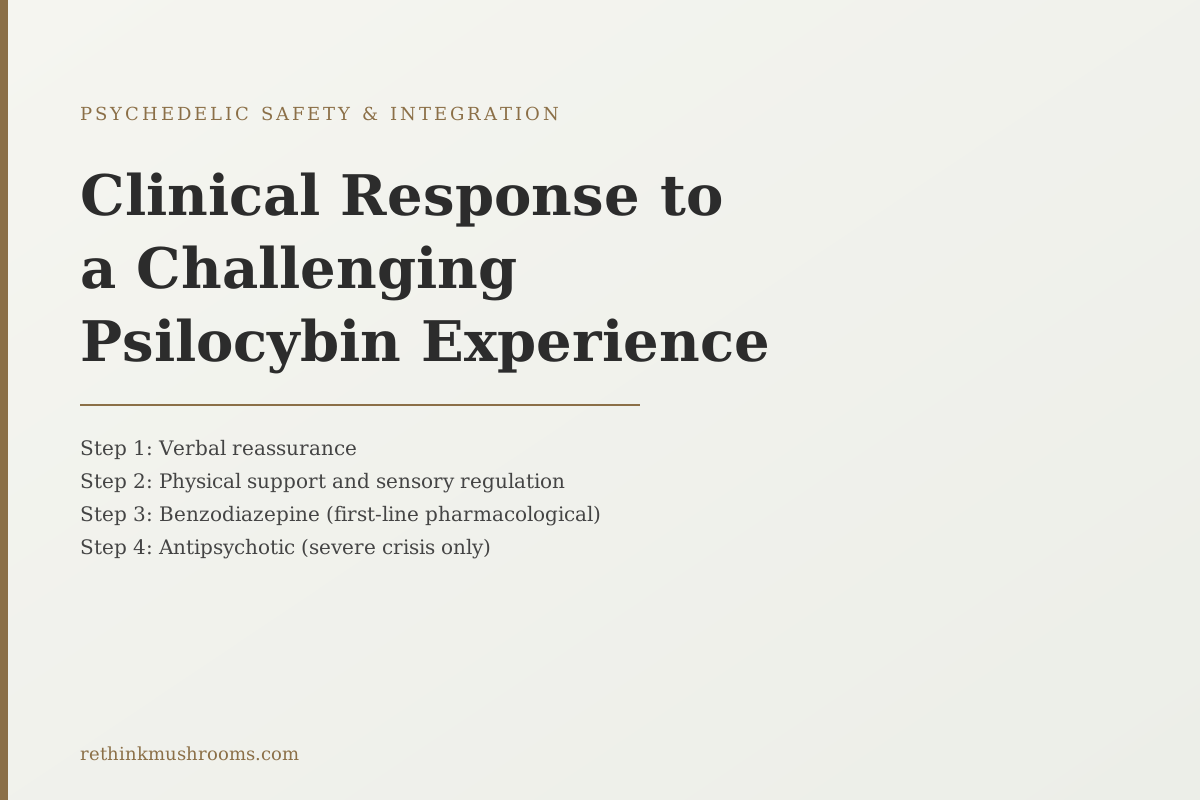
the clinical intervention hierarchy defined by MacCallum 2022
verbal first
reassurance and grounding come before any pharmacological intervention
benzodiazepine
first-line pharmacological option when verbal and physical strategies are insufficient
Romeo et al., Neuroscience & Biobehavioral Reviews, 2025
 View as image ↗
When a psilocybin session becomes difficult, what trained therapists actually do follows a specific evidence-informed hierarchy. That hierarchy matters because the clinical data shows a significant difference in outcomes between supported and unsupported difficult experiences. A 2025 meta-analysis found that the correlation between psychedelic experience intensity and therapeutic benefit was r=.50 in clinical settings with trained therapists, compared to r=.14 in naturalistic use without clinical support.[2] That gap, more than 3x larger in clinical settings, quantifies what skilled oversight adds.
The clinical intervention research for psilocybin challenging experiences is more developed than most people realize. MacCallum and colleagues published a 2022 clinical guidance paper that outlined a specific protocol: verbal reassurance first, physical repositioning second, and pharmacological intervention only when the first two steps are insufficient.[1] This hierarchy, informed by decades of clinical trial experience, is not referenced in any major consumer psychedelic resource.
This article describes what that clinical protocol involves and why each step is structured the way it is, based on the published evidence. It covers the non-pharmacological strategies that trained guides deploy, the threshold for escalating to pharmacological intervention, and the research on what distinguishes a difficult-but-manageable session from a genuine medical emergency. For context on the broader safety research, see How Safe Is Psilocybin? The Complete Safety Research.
Key Takeaways
- MacCallum 2022 established the clinical intervention hierarchy for difficult psilocybin sessions: verbal reassurance, physical support, benzodiazepine if needed, and antipsychotics only in rare crisis situations
- A 2025 meta-analysis (Romeo et al.) found that clinical settings with trained support achieved a therapeutic intensity-to-benefit correlation of r=.50, compared to r=.14 in naturalistic settings without trained guides
- Wood 2024 identified three non-pharmacological strategies trained guides use in session: Acceptance and Reappraisal (most effective for emotional breakthrough), Sensory Regulation, and Social Support/Disclosure
- Kopra 2022 studied cases where psilocybin use led to emergency medical treatment, identifying characteristics that distinguish manageable difficult experiences from situations requiring clinical escalation
- The therapeutic goal per Roseman 2017 is shifting the patient from "dread of ego dissolution" (resistance, associated with negative outcomes) toward "oceanic boundlessness" (acceptance, associated with positive outcomes), and trained verbal guidance directly facilitates this shift
- Benzodiazepines reduce acute anxiety during psilocybin sessions without permanently terminating the experience, making them preferable to antipsychotics in the clinical hierarchy
The Four-Step Clinical Hierarchy When a Psilocybin Session Gets Hard
MacCallum and colleagues published a 2022 clinical guidance paper on therapeutic psilocybin administration that provides the clearest available framework for how trained therapists manage difficult experiences during sessions.[1] The hierarchy is sequential: each step is attempted before moving to the next.
Step 1: Verbal Reassurance
The therapist uses calm, grounding language to help the patient stay oriented. Reminders of context help: this is a therapeutic session, the effects are temporary, the room is safe. The therapist names what the patient appears to be experiencing without amplifying it. This is the first response to any sign of distress, and for most difficult episodes in clinical settings, it is sufficient on its own.
The specific language matters. Effective verbal reassurance doesn't try to talk the patient out of what they're experiencing. It validates the experience while providing temporal grounding ("this will pass") and spatial grounding ("you're here with me, you're safe"). Some clinical protocols use prepared phrases that practitioners rehearse with patients in pre-session preparation.
Step 2: Physical Support and Sensory Regulation
If verbal reassurance doesn't reduce the distress, the therapist can adjust the physical environment: change the music, reduce lighting, offer a blanket or weighted object, or help the patient change position from sitting to lying down. Physical touch (hand on shoulder or hand) may be appropriate depending on the patient's prior consent and the therapeutic relationship, though this is a clinically sensitive area given the vulnerability during these sessions.
The rationale is physiological: changing sensory inputs provides the nervous system with new information that can interrupt the feedback loop between anxious thoughts and physiological arousal. Wood and colleagues' 2024 research on navigation strategies categorized this as "Sensory Regulation and Physical Interaction," finding it effective at reducing acute distress.[3]
Step 3: Benzodiazepine (First-Line Pharmacological Intervention)
When verbal and physical strategies haven't been sufficient to manage acute psychological distress, the clinical protocol moves to pharmacological intervention. The first-line pharmacological option is a benzodiazepine, typically diazepam (Valium). Benzodiazepines work by enhancing activity at GABA receptors, which reduces the nervous system's overall excitability and attenuates the anxiety response.
The key clinical property of benzodiazepines in this context: they reduce acute anxiety and panic without completely terminating the psilocybin experience. At appropriate clinical doses, the patient's distress level decreases substantially while they remain in an altered state. This makes benzodiazepines preferable to antipsychotics for most clinical crisis situations during psilocybin therapy.
Step 4: Antipsychotic (Rare, Severe Crisis Only)
Antipsychotics represent the last resort in the clinical hierarchy. They are appropriate only for situations involving complete loss of contact with reality, extreme agitation that poses a safety risk, or inability to respond to any other intervention. Antipsychotics more reliably terminate the psilocybin state than benzodiazepines, which is why they're reserved for situations where that outcome is acceptable or necessary.
MacCallum 2022 notes that in well-screened clinical populations with proper preparation, reaching steps 3 or 4 of this hierarchy is uncommon. Most difficult sessions are managed at step 1 or 2.
Why Clinical Support Changes the Outcome Data
The Romeo 2025 meta-analysis provides the clearest quantitative evidence for why trained clinical oversight matters.[2] Across all available psychedelic studies, the correlation between mystical experience intensity (which often includes challenging components) and therapeutic benefit was r=.33. Breaking that down by setting reveals the structure of the effect.
In clinical settings with trained therapists: r=.50. In naturalistic settings without trained guides: r=.14. For mood disorders specifically in clinical settings: the correlation reached r=.41. These are substantial differences. An r=.50 correlation means intensity of experience accounts for 25% of the variance in therapeutic outcomes. An r=.14 correlation means it accounts for less than 2%.
What this data suggests: the difficult experiences that occur during psilocybin sessions are not inherently therapeutic or harmful. They become therapeutic when the person experiencing them can engage with the difficult material rather than fight it. Trained therapists are specifically equipped to facilitate that shift. Without that support, the same intensity of experience is much less reliably converted into benefit.
This also explains why the clinical escalation hierarchy matters beyond just safety: it's designed to keep the patient in the therapeutic range of engagement with their experience, rather than allowing distress to escalate to the point of complete psychological shutdown or panic that breaks the processing entirely.
The Non-Pharmacological Toolkit: What Guides Actually Do
Wood and colleagues published a 2024 mixed-methods study on strategies that psilocybin retreat participants use to navigate difficult experiences.[3] Their analysis identified three primary response strategies that trained guides help facilitate, now formalized in the Responses to Challenging Psychedelic Experiences Inventory (ReCiPE).
Acceptance and Reappraisal is the strategy most associated with emotional breakthrough. The guide helps the patient name what they're experiencing: "it sounds like this is bringing up fear" or "this seems like grief." Naming the emotion creates slight psychological distance from it. Reappraisal involves gently reframing the experience: "this content is coming up because it needs attention" or "your mind is showing you something that wants to be seen." This strategy requires the most skill because it involves following the patient's experience rather than redirecting it.
Sensory Regulation and Physical Interaction covers the environmental interventions described in step 2 of the clinical hierarchy: music, lighting, position, physical comfort objects. Wood 2024 found this effective for reducing acute physiological arousal, though it addresses the symptom level rather than the psychological processing level.
Social Support and Disclosure involves the patient verbalizing what they're experiencing to the guide. Wood 2024 found that disclosure itself reduced the intensity of difficult experiences: articulating the experience in language requires moving from the purely experiential layer to the symbolic/linguistic layer, which tends to reduce the raw intensity. The guide's responsive presence, including simple acknowledgments like "I'm here with you" or "I hear you," was documented as effective.
For readers interested in how to navigate a difficult personal experience, see How to Navigate a Difficult Psilocybin Experience, which applies these strategies to the non-clinical context.
When a Difficult Experience Becomes a Medical Emergency
Most difficult psilocybin experiences in clinical settings are manageable with the hierarchy described above. Kopra and colleagues' 2022 study examined cases where psilocybin use led to emergency medical treatment seeking, providing data on what characterizes the most severe adverse events.[4]
Emergency-level events tend to share several characteristics. Accidental or intentional ingestion of very high doses features prominently. Poly-substance use (psilocybin combined with other psychoactive substances) significantly increases emergency risk. Pre-existing psychiatric conditions, particularly those involving psychosis, are major risk factors. Absence of any supportive social environment or guide is nearly universal in the emergency cases.
What distinguishes emergency-level situations from difficult-but-manageable situations clinically: the patient's ability to respond to any form of communication from a therapist or guide. If verbal grounding produces any response, the situation is manageable within the clinical hierarchy. If the patient is entirely unresponsive to communication, shows signs of dissociation so complete that they can't orient to the room, or exhibits physical behavior that poses safety risks, the situation requires medical escalation.
For readers thinking about who should and shouldn't consider psilocybin given these risk patterns, see Who Should Not Take Psilocybin? Contraindications Explained. The risk factors for difficult experiences and the risk factors for emergency-level events overlap substantially with the clinical contraindications to therapeutic psilocybin.
The Mechanism: Shifting From Dread to Oceanic Boundlessness
Roseman and colleagues' 2017 study in patients with treatment-resistant depression provides a mechanistic framework for understanding what trained therapists are trying to facilitate during a difficult session.[5] Two distinct experience dimensions predicted outcomes at five weeks: "oceanic boundlessness" (feelings of unity, awe, transcendence, and surrender to the experience) predicted positive outcomes; "dread of ego dissolution" (fear of losing one's mind, resisting the loss of self) predicted negative outcomes.
The crucial point is that these two dimensions can coexist. The same person in the same session can feel profound fear of losing their ego and simultaneously begin moving toward surrender. The therapist's role during a difficult session is partly to facilitate that movement: from dread (which produces resistance and worsening distress) toward oceanic boundlessness (which produces surrender and eventual processing of the difficult material).
This is why verbal intervention techniques focus so heavily on acceptance language. "You're safe" is less therapeutically potent than "This feeling can be here, you don't have to fight it." The first addresses the symptom; the second addresses the mechanism. Experienced psychedelic therapists describe the therapeutic relationship during a difficult session as creating a container strong enough that the patient doesn't have to hold everything alone, which makes surrender more available.
The neurological basis involves the default mode network (the brain's self-referential system) temporarily losing its normal rigid organization. Resisting this feels like panic. Accepting it is what produces the mystical-type experience associated with therapeutic benefit. Trained clinical support doesn't eliminate the difficult aspects of this dissolution, but it creates the conditions under which acceptance becomes possible.
For how this connects to the post-session integration work that converts difficult in-session material into lasting benefit, see Psychedelic Integration: Making Sense of the Experience. The ethical dimensions of the therapeutic relationship during vulnerable states, including the use of touch and authority, are examined in Ethics in Psychedelic Therapy: Navigating Power and Vulnerability.
The Bottom Line
The clinical literature on managing difficult psilocybin sessions has produced a specific, research-informed hierarchy: verbal reassurance first, sensory regulation second, benzodiazepines for acute panic that doesn't respond to non-pharmacological strategies, and antipsychotics only in rare severe crises. The difference this makes is quantifiable: clinical settings with trained therapists produce therapeutic intensity-to-benefit correlations three times higher than naturalistic use. The non-pharmacological strategies (acceptance/reappraisal, sensory regulation, social support) are the primary toolkit, and most difficult sessions are managed before reaching pharmacological intervention.
Frequently Asked Questions
Sources & References
- 1RTHM-01580·MacCallum, Caroline A et al. (2022). “Therapeutic use of psilocybin: Practical considerations for dosing and administration..” Frontiers in psychiatry.Study breakdown →PubMed →↩
- 2RTHM-02171·Romeo, B et al. (2025). “The intensity of the psychedelic experience is reliably associated with clinical improvements: A systematic review and meta-analysis..” Neuroscience and biobehavioral reviews.Study breakdown →PubMed →↩
- 3RTHM-02019·Wood, Maximillian J et al. (2024). “Strategies for resolving challenging psychedelic experiences: insights from a mixed-methods study..” Scientific reports.Study breakdown →PubMed →↩
- 4RTHM-01554·Kopra, Emma I et al. (2022). “Adverse experiences resulting in emergency medical treatment seeking following the use of magic mushrooms..” Journal of psychopharmacology (Oxford.Study breakdown →PubMed →↩
- 5RTHM-00907·Roseman, Leor et al. (2017). “Quality of Acute Psychedelic Experience Predicts Therapeutic Efficacy of Psilocybin for Treatment-Resistant Depression..” Frontiers in pharmacology.Study breakdown →PubMed →↩