Psychedelic Therapist Ethics & Training
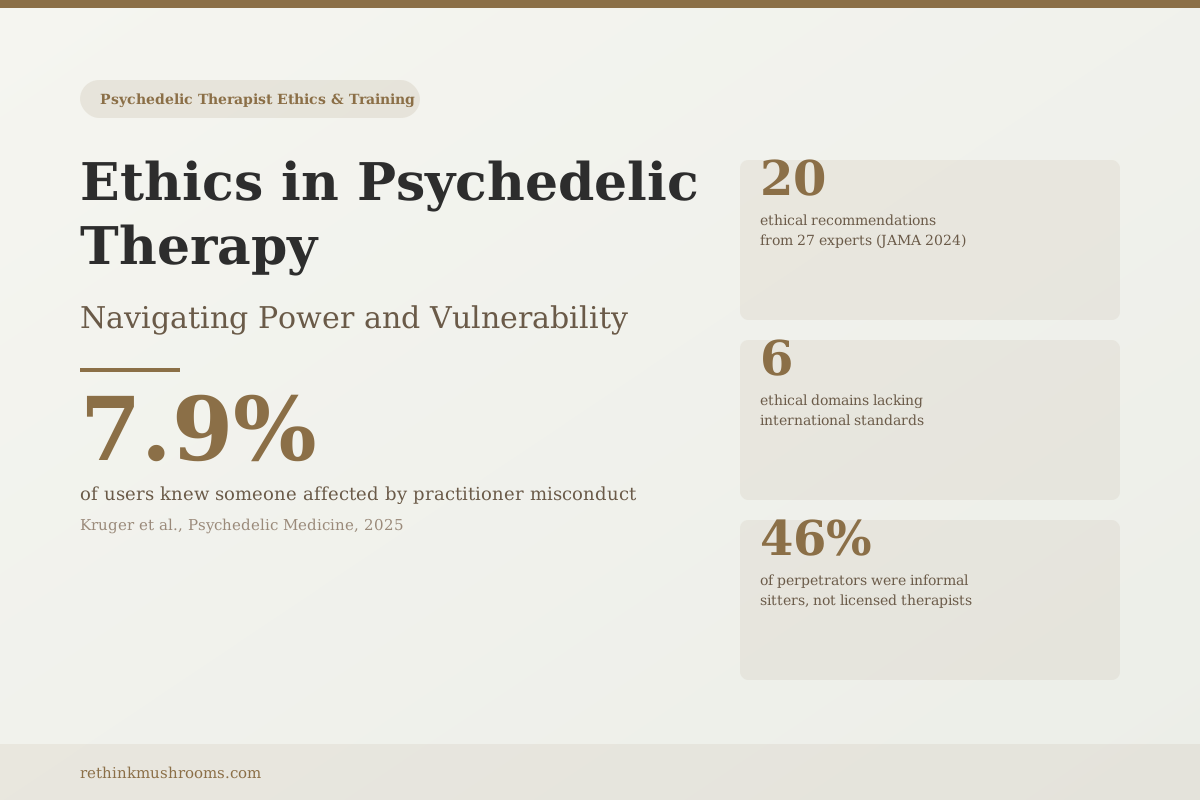
7.9% of users
A 2025 survey by Kruger et al. found that 7.9% of psychedelic users knew someone who experienced inappropriate sexual contact from a practitioner, the first population-level prevalence estimate on record.
Kruger et al., Psychedelic Medicine, 2025
20
ethical recommendations from 27 experts (JAMA 2024)
6
ethical domains lacking international standards
46.3%
of perpetrators were informal sitters, not licensed therapists
Kruger et al., Psychedelic Medicine, 2025
 View as image ↗
Ethics in psychedelic therapy raises a set of problems that standard clinical ethics was not built to solve. In 2025, Kruger and colleagues surveyed a large sample of naturalistic psychedelic users and asked a direct question: do you know anyone who experienced inappropriate sexual contact from a guide or therapist? Nearly 8 percent said yes.[6]
That 7.9 percent figure was the first population-level estimate of abuse in these settings. No prior study had attempted it. In the same year, a systematic review by Caporuscio and colleagues found that six major ethical domains in psychedelic treatment still lack international standards.[2] And one year earlier, 27 experts convened by McGuire and colleagues published a consensus statement in JAMA Network Open with 20 specific ethical recommendations for psychedelic clinical care.[1]
The biological safety of psilocybin is reasonably well characterized from clinical trials. Ethics is a different category of concern. Psychedelic states create a specific cluster of vulnerabilities: impaired judgment, heightened suggestibility, emotional openness, and intense positive feelings toward whoever is present in the room. These features are not marginal side effects. They are central to how psychedelic therapy works. And they make participants unusually susceptible to exploitation.
Key Takeaways
- Kruger et al. (2025) found 7.9% of psychedelic users knew someone who experienced inappropriate sexual contact from a practitioner, with informal sitters responsible for 46.3% of cases
- McGuire et al.'s JAMA 2024 consensus of 27 experts issued 20 recommendations across 5 domains including impaired-state consent, professional boundaries, and equitable access
- Caporuscio et al. (2025) systematic review identified 6 ethical domains requiring international standards, with impaired-state informed consent as the most foundational
- Barber and Dike (2023) cataloged 7 ethical concerns that existing clinical frameworks do not adequately address, including exploitation of transference and absence of mandatory reporting
- Schonholz et al. (2024) identified a legal accountability gap: non-licensed facilitators in states like Oregon face no professional board consequences for misconduct
- Brittain et al. (2026) named mandatory misconduct reporting and competency-based training as the two highest-priority policy changes the field currently needs
What "Ethics in Psychedelic Therapy" Actually Means
Ethics in psychedelic therapy refers to the specific obligations and safeguards required when treating patients in altered states. Psychedelic compounds increase emotional vulnerability and suggestibility, creating power imbalances that exceed those in standard therapy and require dedicated frameworks for consent, touch, boundaries, and misconduct reporting.
That definition matters because the ethical terrain here differs qualitatively from standard outpatient therapy. In a conventional therapy session, a patient can notice when something feels wrong, say so, and leave. Under a psychedelic compound, those capacities are all significantly reduced. The compound actively softens the mental filters that normally allow a person to defend their own psychological space.
The result is a structure in which the therapist or guide holds more concentrated power than in almost any other therapeutic setting. The patient's critical thinking is reduced. Their emotional responsiveness is heightened. They are often experiencing the most intense emotional states of their life. The guide is the one stable presence in the room.
This is not a problem unique to bad actors. Even a well-intentioned guide must navigate the fact that their words, gestures, and touch carry amplified weight during the session. A phrase that would be neutral outside the session may feel profoundly significant inside it. A hand-hold that feels supportive in the moment may seem boundary-violating to the patient once their thinking has cleared.
Ethicists describe this as a structural power imbalance built into the pharmacology itself. It is not resolved by the practitioner's good intentions. It requires pre-specified protocols, external oversight, and clear legal accountability. The research literature over the past two years has produced the most substantial frameworks yet for what those structures should look like.
The Seven Problems Standard Therapy Ethics Can't Solve
In 2023, Barber and Dike published an examination of ethical challenges specific to psychedelic psychiatry in Psychiatric Services.[4] They identified seven core concerns that existing professional ethics frameworks do not adequately address.
The first is informed consent under impaired conditions. Standard informed consent assumes a competent adult who can understand risks, ask questions, and freely agree or refuse. During a psychedelic session, none of those assumptions hold reliably.
The second is exploitation of transference. Psychedelic therapy reliably produces profound positive feelings toward the therapist, feelings that can persist well beyond the session itself. Unethical practitioners have exploited this attachment to extend inappropriate contact.
The third is unclear scope of practice. A guide trained in harm reduction operates in a fundamentally different clinical context than a psychiatrist with prescribing authority. Current legal frameworks in several U.S. states do not require mental health credentials for non-clinical facilitators, leaving scope of practice largely undefined.
The fourth is inadequate training standards. No nationally standardized curriculum exists for psychedelic facilitators. Programs vary from 40 hours to over 200, with widely different content on ethical practice. The training landscape is examined in detail in Psychedelic Therapist Certification and Training Ethics.
The fifth is absence of mandatory reporting. In most jurisdictions, no legal mechanism requires psychedelic practitioners to report colleague misconduct. This differs from standard healthcare, where mandatory reporting requirements exist in most states.
The sixth is equitable access. Who can afford psychedelic therapy, who is included in clinical trials, and whether Indigenous communities receive acknowledgment or compensation for the traditional knowledge that informed modern research all fall within the ethics domain.
The seventh is conflict of interest in advocacy-funded research. Many clinical trials of psychedelic compounds are funded by organizations that also advocate for their therapeutic use. This creates pressure against publishing null results or adverse events.
Barber and Dike's framework predates most of the recent regulatory development in the field. It remains the clearest enumeration of what makes psychedelic therapy ethically distinct from other psychiatric interventions.
The JAMA 2024 Consensus: 27 Experts, 20 Recommendations
In 2024, McGuire and colleagues published the most comprehensive ethics framework for psychedelic clinical care to date in JAMA Network Open.[1] The consensus involved 27 experts across psychiatry, bioethics, law, and Indigenous community representation. It produced 20 actionable recommendations across five domains.
Reparations and reciprocity. The consensus found that modern psychedelic research derived foundational knowledge from Indigenous communities who used these compounds ceremonially for generations. The framework recommends formal benefit-sharing agreements, cultural consultation, and recognition of prior knowledge, obligations that no current regulatory framework has enforced.
Equity and respect. Clinical trials have predominantly enrolled white, college-educated participants. If the compounds demonstrate efficacy in this population, scaling them up without attention to access will replicate existing healthcare disparities at wider scale. The JAMA consensus calls for equity frameworks to be built into any regulatory design rather than added later.
Informed consent and impaired-state limitations. The consensus is explicit: patients cannot give reliable consent for new procedures during an active psychedelic session. All consent for touch, therapeutic interventions, and scope of treatment must be established before drug administration. Any expansion of agreed boundaries during the session is not ethically valid under this framework.
Professional boundaries and physical touch. The consensus does not prohibit therapeutic touch but specifies that its acceptable forms and limits must be defined before the session, documented, and subject to withdrawal at any point via a pre-agreed signal. The touch question is complex enough to warrant its own treatment in The Therapeutic Touch Debate in Psilocybin Sessions.
Personal experience requirements and gatekeeping. The 27 experts did not reach consensus on mandating that facilitators personally have experienced psychedelics, but they identified it as a live ethical question. A practitioner who has never experienced the state they are guiding others through lacks a particular kind of empathic knowledge. The consensus flagged this as an area requiring further professional deliberation.
The JAMA paper's core contribution is specificity. It moves the conversation from "psychedelic therapy raises ethical concerns" to "here are 20 concrete things that should appear in any regulatory framework." No consumer-facing publication had previously cited it as of mid-2025.
Why Consent Mid-Session Is Not the Same as Consent Before
The informed consent problem is the conceptual core of psychedelic therapy ethics. Caporuscio and colleagues' 2025 systematic scoping review, published in Psychological Medicine, identified impaired-state informed consent as one of six domains requiring international standards.[2] It is arguably the most foundational one, because every other ethical protection depends on whether consent can meaningfully be given or modified during the session.
The standard model of informed consent in medicine assumes the person being treated can evaluate information and make free decisions. Psychedelic compounds systematically reduce both of those capacities. Under their influence, a person is more emotionally reactive, more likely to interpret ambiguous signals as significant, and less able to critically evaluate their own responses.
This creates a specific problem: a patient who initially consented to a limited form of touch may, during the session, feel they want to expand that contact. But that mid-session feeling is occurring in the very state that impairs reliable judgment. The person expressing a desire for expanded contact is not in the same cognitive position as the person who set the original terms.
The McGuire consensus and the Caporuscio review reach the same conclusion from different analytical starting points. Valid consent must precede drug administration. If something was not agreed to before the session, it cannot be ethically consented to during it.
This principle has direct implications for risk factors in challenging psilocybin experiences. Patients experiencing extreme distress during sessions are particularly vulnerable to consent violations precisely because their judgment is most compromised at the moments when a guide might be most tempted to improvise outside the established protocol.
The Caporuscio review also identifies a second consent problem: protection of vulnerable populations. Patients with histories of trauma, psychosis risk factors, or acute psychiatric distress require specific pre-session assessment and adapted consent processes. Current protocols vary widely, and the review found no international standard for these adaptations.
The First Real Prevalence Number: 7.9% Knew Someone Abused
Until 2025, no empirical estimate existed for how common therapist misconduct was in psychedelic contexts. The field knew it occurred. Documented cases going back to 1989 confirmed it. But no study had attempted population-level data on the scale of the problem.
Kruger and colleagues changed that with a survey of naturalistic psychedelic users, published in Psychedelic Medicine in 2025.[6] Among respondents, 7.9 percent reported knowing someone who had experienced inappropriate sexual contact from a guide or therapist.
That figure is not a rate of direct victimization. It is a prevalence estimate for knowing someone affected. The actual incidence of incidents is substantially lower than 7.9 percent but not negligible.
What makes the Kruger findings particularly important for policy is the perpetrator breakdown. Underground or informal sitters were responsible for 46.3 percent of reported cases. Formal practitioners in licensed or credentialed settings accounted for 26.2 percent. The remaining cases involved figures in ceremonial or spiritual contexts.
This distribution matters for how regulation is designed. The highest-profile misconduct cases in psychedelic research have involved formally credentialed practitioners operating within registered trials. The Kruger data suggests informal settings carry a higher per-capita risk, but formal credentials do not eliminate it.
The documented cases, spanning from 1989 to the present and crossing underground sessions, registered clinical trials, and licensed retreat centers, are examined in detail in Psychedelic Therapy Abuse: Known Cases and Prevention. The Kruger prevalence figure provides the statistical context that makes those individual cases readable as part of a pattern rather than isolated incidents.
The Legal Accountability Gap: No License, No Consequences
Schonholz and colleagues' 2024 legal analysis, published in the Journal of the American Academy of Psychiatry and the Law, identified a structural problem that most public discussion of psychedelic therapy ethics ignores.[5]
In Oregon and Colorado, a person can legally guide someone through a high-dose psilocybin session without any mental health credentials. Both states created facilitation licenses that require training hours and a background check but not a professional healthcare license.
For licensed mental health professionals who practice psychedelic therapy, accountability is relatively clear. They face malpractice liability for failure to screen contraindications, inadequate informed consent documentation, and breach of professional boundaries. They can lose their license.
For non-licensed facilitators, Schonholz and colleagues found that accountability is largely absent. There is no professional board to file a complaint with. Malpractice insurance is not required. Civil litigation is possible but practically difficult, particularly for cases involving informal sitters who may not have had any formal agreement with their clients.
This creates a specific gap in the legalized market. The populations most at risk of abuse tend to be those seeking lower-cost or informal services. Those same populations have the least legal recourse when something goes wrong.
The integration therapy that follows a session creates an additional exposure window. Integration involves ongoing contact between practitioner and patient, and the emotional vulnerability produced by the session can persist for weeks. The legal accountability gap applies to that period as well.
What 2026 Research Says Must Change
The most current synthesis of ethical recommendations in the psychedelic field is Brittain and colleagues' scoping review, published in the Journal of Bioethical Inquiry in 2026.[3] Drawing on the literature through 2025, the review identifies four policy priorities where the gap between current practice and ethical standards is most acute.
Mandatory misconduct reporting structures. Currently, no jurisdiction requires psychedelic practitioners to report known or suspected colleague misconduct. The Brittain review calls this the most urgent gap. Without mandatory reporting, the aggregate signal of recurring misconduct by specific practitioners remains invisible to regulators. The same situation contributed to delays in identifying serial abusers in other therapeutic contexts.
Competency-based training assessment. The current approach in Oregon, Colorado, and most international contexts counts training hours rather than assessing specific competencies. The review argues that completing a fixed number of hours does not produce a uniformly competent practitioner. Competency assessment covering ethical boundary recognition, crisis response, and consent management should replace or supplement hour counting. The specific training standards comparison is covered in Psychedelic Therapist Training: What Qualifications Are Needed.
Reformed informed consent frameworks. Existing informed consent forms for psychedelic therapy are largely adapted from standard medical or psychological consent documents. They do not adequately address the impaired-state problem, the rights of vulnerable populations, or the specific consent processes needed for touch and expanded therapeutic interventions. Brittain and colleagues call for new consent templates developed specifically for this context.
Equitable access frameworks. Early regulated markets have demonstrated that psychedelic therapy at current cost structures is accessible almost exclusively to affluent patients. If the evidence base shows clinical benefit, access frameworks enabling broader participation become an ethical obligation, not an optional policy add-on. The review frames equity not as a downstream concern but as a precondition for ethically justifiable scaling.
The Brittain review is notable for its realism. It does not frame these as theoretical ideals. It connects them directly to documented harms: the 7.9 percent prevalence figure from Kruger, the accountability gaps identified by Schonholz, and the impaired-consent analysis from McGuire all appear in the same policy landscape that Brittain's four priorities are designed to address.
The Bottom Line
Ethics in psychedelic therapy is defined by structural features of the pharmacology: impaired consent capacity, amplified emotional vulnerability, and concentrated power in the guide's hands. The 2024 JAMA consensus from 27 experts, the 2025 Caporuscio systematic review, and the 2026 Brittain scoping review converge on four urgent needs: mandatory reporting, competency-based training standards, reformed consent frameworks, and equitable access. The Kruger 2025 prevalence data shows that misconduct is not a theoretical risk. It is a documented one.
Frequently Asked Questions
Sources & References
- 1RTHM-01946·McGuire, Amy L et al. (2024). “Developing an Ethics and Policy Framework for Psychedelic Clinical Care: A Consensus Statement..” JAMA network open.Study breakdown →PubMed →↩
- 2. Source details for this reference are not yet available.
- 3. Source details for this reference are not yet available.
- 4RTHM-01660·Barber, Gregory S et al. (2023). “Ethical and Practical Considerations for the Use of Psychedelics in Psychiatry..” Psychiatric services (Washington.Study breakdown →PubMed →↩
- 5RTHM-01983·Schonholz, Stephanie M et al. (2024). “Legal and Ethics Concerns of Psilocybin as Medicine..” The journal of the American Academy of Psychiatry and the Law.Study breakdown →PubMed →↩
- 6RTHM-02114·Kruger, Daniel J et al. (2025). “Psychedelic Therapist Sexual Misconduct and Other Adverse Experiences Among a Sample of Naturalistic Psychedelic Users..” Psychedelic medicine (New Rochelle.Study breakdown →PubMed →↩