Psychedelic Safety & Ethics
8% of surveyed users
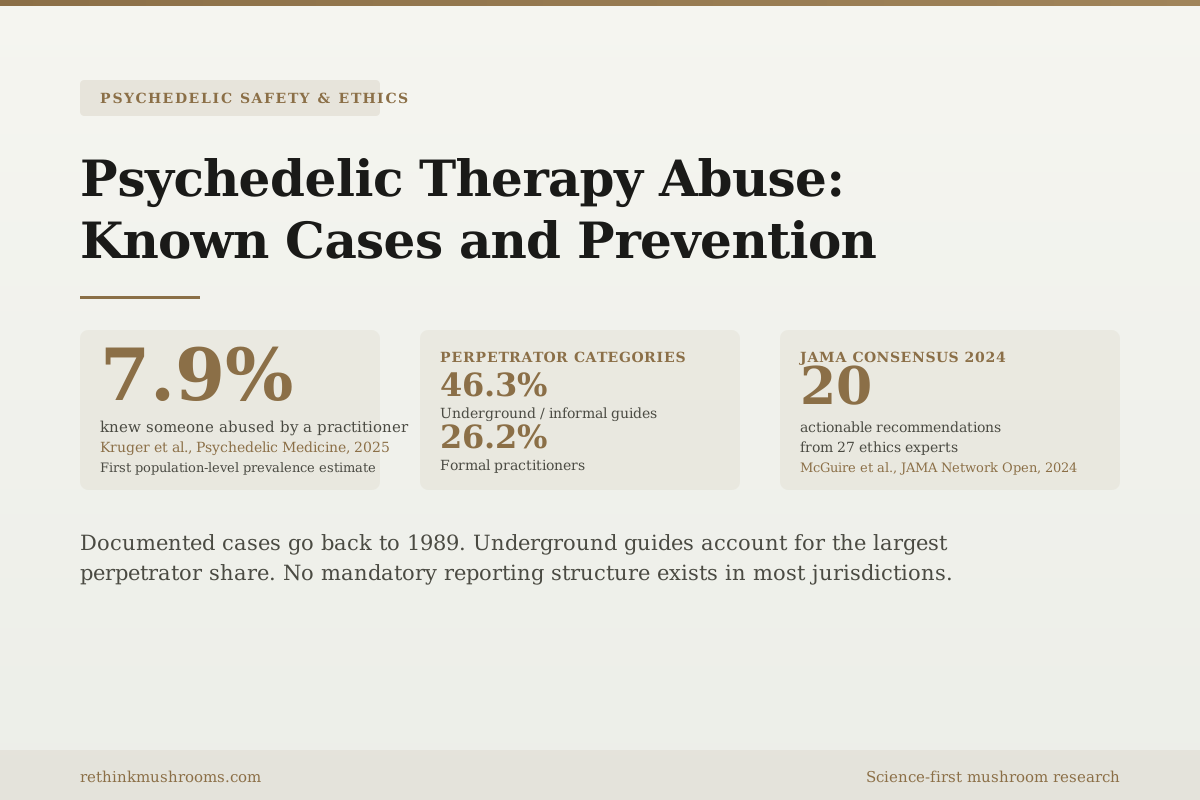
In a survey of 1,221 people who had used psychedelics, 8% said that they or someone they know had been the victim of inappropriate sexual contact by a psychedelic sitter, guide, or practitioner. It is a convenience sample, not a population estimate — and it is the best number the field currently has.
Kruger et al., Psychedelic Medicine, 2025
1,221
participants in the survey that produced the figure
2
cases in this article where a board or court actually acted
20
consensus recommendations from a 27-person expert convening
Kruger et al., Psychedelic Medicine, 2025
 View as image ↗
When someone is in the acute phase of a psilocybin or MDMA session, their judgment is altered, their emotional defenses are lowered, and they are in an unusual state of openness toward whoever is in the room. Responsible practitioners are trained to hold that asymmetry carefully. A small number of practitioners have exploited it, and in at least two cases a licensing body or a court has said so on the record.
This article is deliberately conservative about what it asserts. Where a professional board or a court reached an outcome, that outcome is named. Where a dispute between parties remains unresolved, it is described as unresolved. And where the underlying number is weaker than it is usually reported to be — which is the case for the single statistic most often quoted about this topic — the article says so rather than repeating it. For the foundational safety context, see How Safe Is Psilocybin? The Complete Safety Research.
Key Takeaways
- The most-cited figure comes from Kruger and colleagues (2025): among 1,221 surveyed psychedelic users, 8% reported that they or someone they know experienced inappropriate sexual contact from a sitter, guide, or practitioner
- That survey is a convenience sample, and its authors state plainly that no population-representative study of this question exists — so the figure is an estimate, not a prevalence rate
- A 2026 study in World Psychiatry is the first genuinely population-based US work on violence during psychedelic use, and it identifies housing instability, younger age, student status, and several psychiatric diagnoses as risk factors
- Two cases in this article reached a formal outcome: Richard Ingrasci resigned his Massachusetts medical licence in 1989, and Donna Dryer resigned her British Columbia registration with a reprimand in 2023 following a MAPS-sponsored MDMA trial
- In the MAPS case, both safeguards that should have prevented harm existed on paper: the two-therapist rule was satisfied by a married couple, and session video was recorded but not reviewed for roughly six years
- The common claim that Oregon facilitators answer to no licensing board is false — OHA licenses them, bars sexual contact with clients by rule, and can revoke the licence; the real gap is that the sanction reaches no further than that one credential
The One Real Number, and What It Can and Cannot Support
In 2025, Daniel Kruger and colleagues published a survey in Psychedelic Medicine that produced the most frequently quoted statistic in this area. They asked 1,221 people who reported past psychedelic use about twelve categories of adverse experience, including whether they or someone they knew had been the victim of inappropriate sexual contact by a psychedelic sitter, guide, or practitioner. Eight percent said yes.[1]
That figure is worth taking seriously and worth stating accurately, because it is routinely reported as something it is not.
Kruger, Aday, Fields, Kolbman, Glynos, Barron, Herberholz & Boehnke (2025) · Psychedelic Medicine
- Population
- 1,221 adults reporting past psychedelic use; 84.6% white, mean age 39, predominantly US-based. Recruited via social media, email lists, and a Michigan psychedelic advocacy event.
- Intervention
- Anonymous online survey covering 12 categories of adverse experience during psychedelic use, plus a single item on inappropriate sexual contact by a sitter, guide, or practitioner.
- Finding
- 8% reported that they or someone they know was the victim of inappropriate sexual contact by a psychedelic sitter, guide, or practitioner. Other adverse experiences were far more common: feeling frightened (74.3%), sadness (58.6%), trembling (54.3%), loneliness (51.6%).
narrow-scope A convenience sample cannot produce a population prevalence rate. The authors say so directly, noting that the rates they report are estimates and that no population-representative study of this question exists.
Kruger et al., Psychedelic Medicine, 2025 (RTHM-02114, PMID 40342400)
Two features of that survey item matter for how the number should be read, and both are usually lost in retelling.
The first is that the question combined self and other. It asked whether the respondent or someone they know had experienced inappropriate contact. It is therefore neither a personal-victimisation rate nor a purely second-hand one, and it cannot be decomposed into those two things after the fact. A single widely-known incident can be reported by many respondents who all know the same person.
The second is that the sample was recruited through social media, mailing lists, and a psychedelic advocacy event in Michigan. That is a convenience sample of people already connected to psychedelic communities. It skews heavily white, averages 39 years old, and was never designed to represent the general population of psychedelic users. Kruger and colleagues are explicit that their rates are estimates, and that population-representative research on this question does not yet exist because it is expensive to conduct.[1]
Fact Check
Is 8% a population-level prevalence rate?
The claim
“The Kruger survey produced the first population-level estimate of sexual misconduct in psychedelic therapy, showing that roughly 8% of psychedelic users are affected.”
Secondary coverage compressed a convenience-sample survey item into a prevalence statistic, and the compressed version then circulated on its own.
What research shows
MisleadingThe study is an anonymous online survey of a convenience sample recruited through social media, mailing lists, and an advocacy event. Its authors state that the rates reported are estimates and that no population-representative study of this question currently exists.
This does not mean the finding is unimportant — it is the best available quantification, and the direction it points is consistent with the documented cases. It means the number is a floor-level signal from a self-selected group, not a rate that can be generalised to all psychedelic users.
Kruger et al., Psychedelic Medicine, 2025 (RTHM-02114); author-stated limitations
The genuinely population-based work arrived in 2026, when Chwyl and colleagues published a US population-based study of sexual and physical violence experienced during psychedelic use in World Psychiatry. Rather than a headline prevalence figure, its useful contribution is a risk profile: the factors associated with victimisation during psychedelic use largely mirror the factors associated with violence generally — housing instability, student status, younger age, and belonging to a racially minoritised group. Psychiatric diagnoses raised risk as well, with substance use disorders, eating disorders, and ADHD showing the strongest associations. Notably, socioeconomic status and gender did not emerge as risk factors in that analysis.[2]
The practical implication is uncomfortable but clear: the people most likely to be harmed during psychedelic use are, broadly, the people most likely to be harmed in other settings too. Vulnerability is not created by the drug alone. It is imported into the room and then amplified there.
The Adjudicated Record
Abuse in psychedelic therapy is documented, but "documented" needs a standard. The two cases below are included because a licensing board or a court reached an outcome. Cases resting on allegation alone — of which there are more — are excluded here, which means this record undercounts.
The Adjudicated Record
Two Cases Where a Formal Body Acted
Restricted to cases that reached a licensing board or a court, so that every entry rests on a decision someone actually made rather than on allegation alone. Read the third column first: in both cases a safeguard existed and did not function.
Richard Ingrasci
Private psychiatric practice using MDMA
Conduct late 1980s · action 1989
Multiple former patients alleged sexual abuse in the course of drug-assisted therapy. Ingrasci had testified at the DEA’s 1985 MDMA scheduling hearing.
A sole practitioner working with patients in an altered state, with no contemporaneous record of what happened in the room. Nothing surfaced until patients themselves came forward.
- Resigned medical licence to the Massachusetts Board of Registration in Medicine, 11 July 1989
- Permanently barred from practising psychiatry
Richard Yensen and Donna Dryer
MAPS-sponsored MDMA trial, Vancouver
Sessions 2015 · actions 2019–2023
Trial video shows the participant being pinned down, cuddled, spooned and blindfolded. Yensen has admitted sexual contact after the dosing sessions ended, while the participant was still enrolled.
The two-therapist requirement was met by a married couple, so it supplied no independent observer. Sessions were recorded for protocol adherence, but the sponsor did not review this footage for roughly six years.
- Civil claim settled out of court, June 2019
- Dryer irrevocably resigned her College of Physicians and Surgeons of BC registration, 1 August 2023, with a formal reprimand after admitting unprofessional conduct
- Health Canada opened a review of MDMA trials in 2022
Ingrasci: Massachusetts Board of Registration in Medicine licensure record, 1989, reported by the Boston Globe. Yensen and Dryer: session footage, the College of Physicians and Surgeons of British Columbia disciplinary letter and the 2019 settlement, reported by CBC News. Whether the post-session contact in the second case was consensual is disputed between the parties and is not resolved here. Cases resting on allegation without a licensing or court outcome are excluded from this ledger, which means it undercounts rather than overcounts. Not legal advice.
The 1989 Massachusetts case establishes that the problem is not an artifact of the current research wave. Richard Ingrasci, who had testified at the DEA's 1985 MDMA scheduling hearing, resigned his medical licence to the Massachusetts Board of Registration in Medicine in July 1989 amid allegations from multiple former patients, and was permanently barred from practising psychiatry.
The Vancouver case is the more instructive one, because it happened inside a formally supervised trial. Richard Yensen and Donna Dryer, a married couple serving as sub-investigators on a MAPS-sponsored MDMA trial, were recorded pinning down, cuddling, spooning, and blindfolding a participant during 2015 sessions. Yensen has acknowledged sexual contact with the participant after the dosing sessions concluded but while she was still enrolled in the trial; he characterises it as consensual and she alleges sexual assault, and that disagreement has not been resolved by any tribunal. What was resolved: her civil claim settled out of court in June 2019, and Dryer irrevocably resigned her registration with the College of Physicians and Surgeons of British Columbia on 1 August 2023, receiving a formal reprimand after admitting unprofessional conduct. Health Canada opened a review of MDMA trials in 2022.
The detail that should trouble anyone designing a protocol is that both relevant safeguards were nominally in place. A two-therapist requirement is meant to guarantee an independent witness; here it was satisfied by two people married to each other. Session recording is meant to make conduct reviewable; here the recordings existed and the sponsor did not watch them for roughly six years.
That is not an argument against safeguards. It is an argument that a safeguard which is never exercised is indistinguishable from one that was never adopted.
The participant in that trial went on to co-author a 2023 JAMA Psychiatry Viewpoint with Sarah McNamee and Neşe Devenot, arguing that serious adverse events arising from therapist–participant interactions are systematically under-studied and that the research landscape needs to change to capture them.[3] The most sustained academic treatment of the subject is Harrison and colleagues' 2025 paper in the American Journal of Bioethics, which examines how power dynamics in psychedelic-assisted therapy give rise to sexual abuse and maps out what ethical practice and regulatory frameworks would need to look like to prevent it.[4]
Why the Psychedelic State Is the Mechanism, Not the Backdrop
The 2025 systematic scoping review by Caporuscio and colleagues in Psychological Medicine is the most comprehensive map of the ethics literature to date. Searching MEDLINE, PsycInfo, CINAHL, HeinOnline, and PsycArticles through June 2025, it organises the field into seven themes: safety and patient well-being, therapeutic relationships, informed consent, equity and access, research ethics, special contexts, and societal and cultural implications.[5]
Within the first of those themes, the review identifies patient vulnerability as the central ethical concept. Its formulation is precise: the subjective effects of psychedelics make patients particularly vulnerable to emotional distress, undue influence, inducement, sexual abuse, suggestibility, and various forms of exploitation.[5]
The review's "therapeutic relationships" theme breaks into five subthemes, three of which bear directly on abuse: boundary issues, transference and countertransference, and training. Caporuscio and colleagues note that this context presents heightened risks of relational harm, sexual misconduct, abuse, and exploitation, with particular concern around professional boundaries and therapeutic touch. On transference specifically, they describe the unconscious projection of feelings — including sexualised feelings — as something that must be navigated carefully to protect both parties from relational harm and boundary violations, and they emphasise raising awareness of the power imbalance between patient and therapist. One concrete mitigation the review surfaces from the literature is staffing sessions with two therapists of different genders.[5]
Barber and Dike's 2023 review in Psychiatric Services, written to orient psychiatrists to the field, reaches a compatible conclusion from a different direction. It treats patient vulnerability as one of its core concerns alongside research equipoise, informed consent, equity and access, the distinction between clinical and nonclinical use, and psychedelic self-enhancement — and concludes that the altered states these therapies produce, and the vulnerability those states entail, require careful handling to avoid ethical pitfalls.[6]
For the broader ethics framework these reviews sit inside, see Ethics in Psychedelic Therapy: Navigating Power and Vulnerability.
The Accountability Gap, Stated Precisely
There is a widely repeated claim that psilocybin facilitators in legal-access states answer to no licensing board and face no professional consequence for misconduct. It is false, and repeating it obscures the real problem.
Where a Sanction Actually Lands
The Accountability Gap, Stated Precisely
Oregon facilitators are licensed, and OHA can revoke that licence for sexual contact with a client — the common claim that no board exists is wrong. The gap is in the last column: how far the consequence travels once it is imposed.
Licensed clinician
Psychiatrist, psychologist, clinical social worker
State health-professional board, plus institutional and IRB oversight in research
Professional codes of conduct and the clinical standard of care
- Licence suspension or revocation
- Malpractice and other civil claims — battery, infliction of emotional distress
- Loss of hospital privileges and insurance panels
The sanction follows the person. It is recorded against the clinical licence and is visible to other employers, other states and other professional bodies.
Oregon psilocybin facilitator
Licensed by the Oregon Health Authority — no clinical licence required
Oregon Health Authority, Oregon Psilocybin Services
OAR 333-333-5120 bars romantic or sexual contact with a client during services and for one year after
- OHA may suspend, restrict or revoke the facilitator licence (ORS 475A.477)
- Ordinary civil claims remain available
The sanction stops at the facilitator credential. There is no clinical licence to lose, no cross-professional register that records it, and the administrative rules do not define a standard of care for facilitation.
Underground or informal guide
No licence of any kind
None
No professional conduct code applies
- Criminal law
- Ordinary civil claims
There is no administrative forum at all, and nothing prevents the person from continuing to guide sessions. This is the setting to which most incidents described to Kruger and colleagues were attributed.
Oregon rules: OAR 333-333-5120 (facilitator conduct) and ORS 475A.477 (grounds to suspend, restrict or revoke). Entry requirements are 21 years of age, a high school diploma or equivalent, a background check, and an OHA-approved programme of at least 160 hours — 120 hours of core curriculum plus a 40-hour in-person practicum. Holoyda, JAAPL 2023, notes the core curriculum is roughly a quarter of the 625 hours Oregon requires of massage therapists. Rules described are Oregon’s as of publication and differ in Colorado and other jurisdictions. Not legal advice.
Oregon facilitators are licensed by the Oregon Health Authority. OHA's conduct rule, OAR 333-333-5120, states that a facilitator shall not engage in any romantic relationship, sexual contact, or sexual intimacy with a client during the provision of psilocybin services, and extends that prohibition to clients, their partners, and their immediate family for one year afterward. The same rule imposes a duty to put the client's interests above the facilitator's own. Under ORS 475A.477, OHA may suspend, restrict, or revoke a licence where the licensee has violated the governing statutes or the rules adopted under them — which includes the conduct code. A facilitator who has sexual contact with a client can lose their licence.
The genuine gap is what that sanction reaches. A psychiatrist who abuses a patient loses a clinical licence that travels: it is recorded, it is visible to other employers and other states, and it forecloses a profession. An Oregon facilitator has no clinical licence underneath the facilitator credential, so revoking the credential ends that one authorisation and nothing else. There is no cross-professional register that records it.
Holoyda's 2023 analysis in the Journal of the American Academy of Psychiatry and the Law sets out how thin the entry requirements are that sit on the other side of that gate. Applicants need to be 21 with a high school diploma. The core curriculum runs 120 hours — roughly a quarter of the 625 hours Oregon requires of massage therapists — with a 40-hour practicum on top, for 160 hours total. Oregon simultaneously bars facilitators from diagnosing conditions or exercising a mental health licence while providing services, which produces the awkward position that a facilitator must judge whether a client is suitable while being prohibited from doing the clinical assessment that judgment would normally require. Holoyda's blunter observation is that minimal requirements may attract people motivated to exercise control over clients in highly suggestible states.[7]
Compounding this, Holoyda notes that Oregon's administrative rules do not define a standard of care for psilocybin facilitation. That absence makes civil liability unpredictable in both directions and, as the analysis puts it, leaves lawsuits to establish the standard of care that regulation did not.[7] His companion paper in Psychiatric Services catalogues the civil exposure that does exist: malpractice claims turning on the absence of standards of care, risk of harm, and inappropriate treatment, along with battery and the intentional or negligent infliction of emotional distress.[8]
Schonholz and colleagues' 2024 review, also in the Journal of the American Academy of Psychiatry and the Law, reaches the surrounding legal terrain from the clinical side, examining how psilocybin is currently regulated and working through standard of care, the right to effective treatment, and the respectable minority doctrine, before turning to provider bias, the interpersonal dynamic between provider and patient, informed consent, and equity of access.[9]
One further asymmetry is worth naming. Under OAR 333-333-5120, facilitators who are mandatory reporters under Oregon law must disclose that status to clients at the first preparation session — which means the obligation attaches only to those who already carry it in another professional capacity. A facilitator with no other credential typically carries no such duty.
For the training questions that sit upstream of all of this, see Psychedelic Therapist Training: What Qualifications Are Needed?.
What Prevention Actually Requires
The most authoritative prevention framework is the 2024 consensus statement in JAMA Network Open led by Amy McGuire. Twenty-seven people representing clinicians, researchers, Indigenous groups, industry, philanthropy, veterans, retreat facilitators, training programmes, and bioethicists convened at Cold Spring Harbor's Banbury Center in June 2023 and produced 20 points of consensus across five ethical issues. One of those five is professional boundaries and physical touch — the domain that speaks directly to abuse prevention — alongside reparations and reciprocity, informed consent, personal experience, and gatekeeping. Each recommendation is paired with the actors responsible for implementing it, which is what distinguishes it from a statement of principles.[10]
The most recent synthesis is Brittain and colleagues' 2026 scoping review in the Journal of Bioethical Inquiry, which analysed 51 articles and identified five ethical concerns in the literature: standards of practice, equity, integrity, cultural appropriation, and epistemic justice. Standards of practice — the theme most relevant here — encompasses non-maleficence and beneficence, competence, informed consent, and therapist attributes.[11]
What makes that review unusually useful is that the authors also ran a consultation workshop and reported what the literature had neglected: post-trial care, the absence of consensus on models of care and on practitioner competencies, and the question of how research findings and their ethical problems will translate into practice. Their recommendations follow from those gaps — designing clear competency frameworks, increasing consultation with Indigenous and priority populations, establishing guidelines for Indigenous recognition, managing post-trial care within clinical trials, and adequately governing psychedelic prescribing practices.[11]
Read across the McGuire consensus, the Brittain review, and Caporuscio's mapping, a consistent picture emerges. Competency is the recurring theme, and competency is not hours. Oregon counts hours; the reviews call for frameworks that assess whether a person can actually hold a boundary under pressure. Structural controls matter — two practitioners, recording, supervision — but the Vancouver case shows they matter only insofar as someone independent actually exercises them. And touch, which is where boundary violations characteristically begin, needs explicit advance protocols rather than in-session improvisation.
For what good post-session support looks like, see Integration Best Practices: Evidence-Based Approaches. For the screening questions that precede a session, see Risk Factors for Challenging Psilocybin Experiences.
If This Has Happened to You
CriticalReporting routes exist, and they differ by setting
Concern
Because psychedelic sessions are often unrecorded, take place in informal settings, and involve a period of altered memory, people who have been harmed frequently assume there is nowhere to take a complaint. In legal-access and clinical settings there generally is.
What the research says
In a clinical or research setting, complaints can go to the institution's research ethics board or IRB, to the trial sponsor, and to the practitioner's professional licensing board. In Oregon, conduct complaints about a licensed facilitator go to the Oregon Health Authority, which can suspend, restrict, or revoke the licence under ORS 475A.477. Sexual assault is a criminal matter in every jurisdiction regardless of the setting it occurred in, and civil claims are available whether or not the practitioner held any licence.
Particularly relevant for: Anyone who has experienced boundary violations or sexual contact from a facilitator, guide, therapist, or sitter
What to do
Write down what you remember as soon as you can, including dates and who else was present or aware. If the session was recorded, ask in writing who holds the recording and request that it be preserved. Nothing in this article is legal advice, and a lawyer or a victim advocate can tell you which routes apply to your situation.
OAR 333-333-5120; ORS 475A.477; Holoyda, Psychiatric Services, 2023 (RTHM-02454)
The Bottom Line
The most quoted statistic in this area — 8% of surveyed psychedelic users reporting that they or someone they know experienced inappropriate sexual contact from a practitioner — comes from a convenience-sample survey whose own authors say no population-representative data exists. It is a real signal, not a prevalence rate. The adjudicated record is smaller but firmer: Richard Ingrasci resigned his Massachusetts medical licence in 1989, and Donna Dryer resigned her British Columbia registration with a formal reprimand in 2023 after a MAPS-sponsored MDMA trial in which session video went unreviewed for six years and the two-therapist rule was satisfied by a married couple. The ethics literature converges on why the psychedelic state itself is part of the mechanism: heightened suggestibility, intensified transference, and reduced critical self-appraisal. The accountability gap is narrower than usually claimed — Oregon does license facilitators and can revoke them for sexual contact with clients — but real, because that sanction reaches no further than the single credential. Prevention work from the 2024 JAMA consensus and the 2026 Brittain review points the same direction: competency assessment rather than hour-counting, explicit advance protocols for touch, and safeguards that someone independent actually exercises.
Frequently Asked Questions
Sources & References
- 1RTHM-02114·Kruger, Daniel J et al. (2025). “Psychedelic Therapist Sexual Misconduct and Other Adverse Experiences Among a Sample of Naturalistic Psychedelic Users..” Psychedelic medicine (New Rochelle.Study breakdown →PubMed →↩
- 2RTHM-02456·Chwyl, Christina et al. (2026). “Prevalence and predictors of sexual and physical violence during psychedelic use in a US population-based study..” World psychiatry : official journal of the World Psychiatric Association (WPA).Study breakdown →PubMed →↩
- 3RTHM-02455·McNamee, Sarah et al. (2023). “Studying Harms Is Key to Improving Psychedelic-Assisted Therapy-Participants Call for Changes to Research Landscape..” JAMA psychiatry.Study breakdown →PubMed →↩
- 4RTHM-02452·Harrison, Tahlia R et al. (2025). “Wolves Among Sheep: Sexual Violations in Psychedelic-Assisted Therapy..” The American journal of bioethics : AJOB.Study breakdown →PubMed →↩
- 5RTHM-02065·Caporuscio, Chiara et al. (2025). “Ethical issues with psychedelic-assisted treatments in psychiatry: A systematic scoping review..” Psychological medicine.Study breakdown →PubMed →↩
- 6RTHM-01660·Barber, Gregory S et al. (2023). “Ethical and Practical Considerations for the Use of Psychedelics in Psychiatry..” Psychiatric services (Washington.Study breakdown →PubMed →↩
- 7RTHM-02453·Holoyda, Brian (2023). “The Perilous Policy of Oregon's Psilocybin Services..” The journal of the American Academy of Psychiatry and the Law.Study breakdown →PubMed →↩
- 8RTHM-02454·Holoyda, Brian James (2023). “Malpractice and Other Civil Liability in Psychedelic Psychiatry..” Psychiatric services (Washington.Study breakdown →PubMed →↩
- 9RTHM-01983·Schonholz, Stephanie M et al. (2024). “Legal and Ethics Concerns of Psilocybin as Medicine..” The journal of the American Academy of Psychiatry and the Law.Study breakdown →PubMed →↩
- 10RTHM-01946·McGuire, Amy L et al. (2024). “Developing an Ethics and Policy Framework for Psychedelic Clinical Care: A Consensus Statement..” JAMA network open.Study breakdown →PubMed →↩
- 11RTHM-02224·Brittain, N et al. (2026). “Ethical Issues and Recommendations in Psychedelic Research and Practice: A Scoping Review..” Journal of bioethical inquiry.Study breakdown →PubMed →↩