Microdosing
0 published clinical trials on the combination
The Stamets Stack (psilocybin microdose + lion's mane + niacin) is described in a US patent filed by Paul Stamets in 2019. As of 2026, no peer-reviewed randomized controlled trial has tested this specific combination.
Savides & Outhoff, Journal of Psychopharmacology, 2024; US Patent US20180021326A1, 2019
Patent
US20180021326A1 (Stamets, 2019): the source document for this protocol
5 on, 2 off
dosing schedule specified in the Stack (more frequent than Fadiman's 1-on, 2-off)
5-HT2B
serotonin receptor subtype linked to cardiac valvulopathy with chronic activation (Rouaud 2024)
Savides & Outhoff, Journal of Psychopharmacology, 2024; US Patent US20180021326A1, 2019
 View as image ↗
The Stamets Stack is a combination protocol involving a microdose of psilocybin mushrooms, lion's mane mushroom extract, and niacin (vitamin B3 in its flushing form). The protocol takes its name from mycologist Paul Stamets, who patented the combination in 2019 under US patent number US20180021326A1. It has become one of the most discussed microdosing approaches in the psychedelic community.
Psilocybin is a Schedule I controlled substance in the United States and is illegal in most jurisdictions. This article covers the Stamets Stack as scientific and educational content. It does not constitute medical advice or an endorsement of any illegal activity.
The most important fact about the Stamets Stack is also the least-mentioned by enthusiast sites: as of 2026, no peer-reviewed randomized controlled trial has tested this specific combination. The protocol is based on Paul Stamets' theoretical rationale, which has a coherent scientific logic, but the logic has not been tested in a clinical trial. For an overview of the broader microdosing evidence landscape, see What Is Microdosing Psilocybin? A Complete Guide.
Key Takeaways
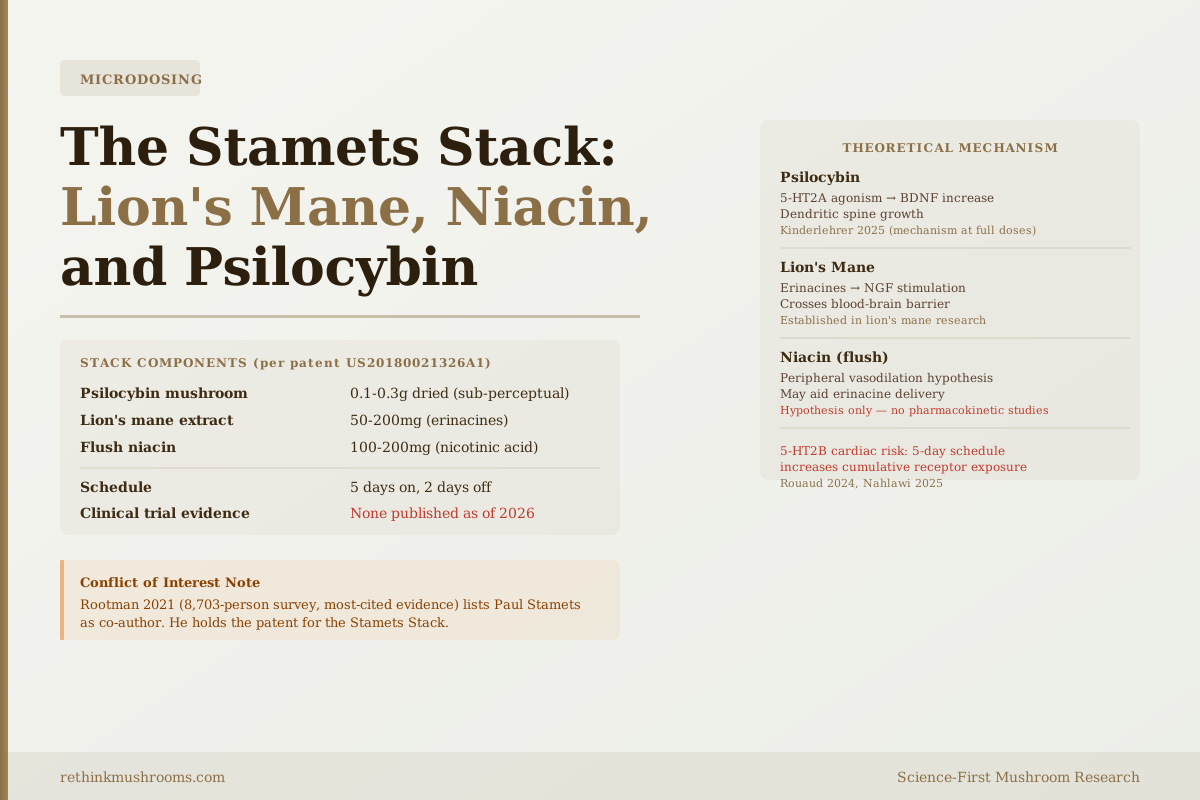
- The Stamets Stack specifies a sub-perceptual dose of psilocybin mushrooms (0.1-0.3g), lion's mane mushroom extract (50-200mg), and flush niacin (100-200mg) on a 5-days-on, 2-days-off schedule
- The protocol originates from US Patent US20180021326A1 filed by Paul Stamets in 2019, not from peer-reviewed clinical research
- No published randomized controlled trial has tested the combination of psilocybin, lion's mane, and niacin; the available human data comes from naturalistic surveys of self-reported experience
- The naturalistic survey most often cited in support of microdosing (Rootman 2021, N=8,703) includes Paul Stamets as a co-author; this conflict of interest is rarely disclosed by sites promoting the protocol
- Each component has independent research support: psilocybin's 5-HT2A mechanism and BDNF effects are well-documented at full doses; lion's mane erinacines/hericenones show NGF effects; niacin's proposed distribution role in the Stack is Stamets' hypothesis and has not been studied in this context
- The 5-day-on schedule is more frequent than Fadiman's 1-on, 2-off protocol, which carries implications for cumulative 5-HT2B serotonin receptor activation, a receptor subtype linked to cardiac valvulopathy with chronic stimulation (Rouaud 2024; Nahlawi 2025)
Three Components, One Patent, and Zero Clinical Trials
The Stamets Stack as a protocol specifies three components taken together:
Psilocybin mushrooms: A sub-perceptual dose, typically 0.1 to 0.3 grams of dried Psilocybe cubensis. Sub-perceptual means below the threshold of psychoactive effects: no visual changes, no perceptual distortion, no obvious mood shift during the dose day.
Lion's mane mushroom (Hericium erinaceus): An extract standardized for erinacines, the compounds produced in lion's mane mycelium that cross the blood-brain barrier and stimulate production of nerve growth factor (NGF). Typical amounts in the Stack range from 50 to 200mg of extract.
Flush niacin (vitamin B3 as nicotinic acid): 100 to 200mg of the flushing form specifically. Flush niacin causes a temporary skin-warming, reddening sensation from peripheral blood vessel dilation. This is distinct from niacinamide (no-flush niacin), which does not produce this effect.
The protocol schedule is 5 days on, 2 days off. On the five active days, all three components are taken together. The two rest days are intended to prevent tolerance buildup and, per the patent's rationale, to allow cellular processes triggered by the combination to complete.
The source document for all of this is not a clinical trial paper. It is US Patent US20180021326A1, filed by Paul Stamets in 2019, titled "Psilocybin mushroom combination for the treatment of inflammatory diseases." The patent describes the theoretical rationale for the combination and specifies the components and schedule. Patents require novelty and a plausible mechanism claim; they do not require clinical trial evidence of efficacy.
This is not a criticism of the Stack as a concept. It is a clarification of what kind of evidence exists. The protocol has a coherent theoretical rationale, which will be examined below. But anyone evaluating it should start from the correct baseline: this is a patented hypothesis, not a clinically validated treatment.
The Science Behind Each Component: What Research Actually Supports
The Stamets Stack's theoretical logic rests on proposed synergies between three separately-supported mechanisms.
Psilocybin acts primarily as an agonist of the 5-HT2A serotonin receptor (a receptor on brain cells that psilocybin activates by mimicking serotonin). At full therapeutic doses, psilocybin produces well-documented effects including increased brain-derived neurotrophic factor (BDNF), which is a protein that supports the growth, survival, and development of nerve cells. A 2025 review by Kinderlehrer, covering psilocybin's effects on neurotransmitters, neuroinflammation, and neuroplasticity, documents the BDNF increase and associated dendritic spine growth (the formation of new connection points between neurons) observed after psilocybin exposure.[1] The key limitation Kinderlehrer identifies is that most of the mechanistic data comes from full or high-dose studies. Whether sub-perceptual microdoses produce the same BDNF and neuroplasticity effects is an open question.
Lion's mane contains two classes of compounds relevant to brain function: hericenones (found in fruiting bodies) and erinacines (found in mycelium). Erinacines are small enough to cross the blood-brain barrier and directly stimulate NGF synthesis in the brain. NGF (nerve growth factor) is a protein that supports the survival and maintenance of certain neuron types. The biological rationale for including lion's mane in the Stack is that erinacines-driven NGF induction could complement psilocybin's BDNF-related neuroplasticity effects through a parallel but distinct mechanism. For a detailed review of the lion's mane bioactive compounds and their neurological research, see Lion's Mane Bioactive Compounds: Hericenones, Erinacines, and Beyond.
Niacin is where the Stack's rationale departs most clearly from established research. Stamets' proposed mechanism is that flush niacin, by dilating peripheral blood vessels, helps deliver lion's mane erinacines to nerve endings throughout the body, potentially amplifying the neurotropic effects of the combination. This is a plausible physiological idea. Flush niacin does cause vasodilation. Vasodilation does increase peripheral circulation. Whether this increases bioavailability of erinacines at nerve terminals in a meaningful way has not been studied in any published research. The niacin mechanism in this context is Stamets' hypothesis, articulated in the patent, and not yet testable from the published literature.
The Conflict of Interest Built Into the Best Evidence
The most frequently cited study supporting microdosing generally, and the Stamets Stack specifically, is a 2021 naturalistic survey by Rootman and colleagues, published in Scientific Reports, with a sample of 8,703 participants.[2] The study found that microdosers reported significantly lower depression and anxiety scores compared to non-microdosers, along with higher wellbeing measures.
What the Rootman 2021 study rarely has disclosed about it: Paul Stamets is a co-author. The holder of the Stamets Stack patent participated in authoring the most-cited naturalistic evidence for microdosing's benefits. This is a significant conflict of interest that should be prominently disclosed whenever this study is cited in the context of the Stamets Stack.
This observation is not an accusation of misconduct. Academic conflict of interest disclosures exist precisely because financial and intellectual stake in a finding can bias research even among well-intentioned researchers, and readers deserve to know about them. Stamets is listed as an author, the conflict is disclosed in the paper's author information, and the study has been published in a reputable journal. The issue is that sites promoting the Stamets Stack routinely cite Rootman 2021 without mentioning the co-authorship.
The study itself has additional interpretive limitations independent of the COI question. It is a naturalistic survey, not a blinded controlled trial. Participants who use a microdosing protocol and feel better are more likely to join a survey than participants who tried it and felt nothing. This self-selection bias means the study population is not representative of all microdosers. The survey design also cannot distinguish whether improvements result from psilocybin pharmacology, expectancy (the placebo effect of believing the protocol will work), lifestyle changes that accompany microdosing practice, or the natural passage of time.
For a thorough treatment of what happens when microdosing is tested under blinded conditions, see Is Microdosing Just Placebo? The Self-Blinding Studies.
5 Days On, 2 Days Off: The Safety Math That Matters
The Stamets Stack's schedule is 5 days on and 2 days off. The Fadiman protocol, the most-studied microdosing schedule in naturalistic surveys, is 1 day on and 2 days off (one dose every three days). This difference has safety implications that the Stack's enthusiast coverage rarely addresses.
The concern involves chronic activation of the 5-HT2B serotonin receptor. While psilocybin's desired effects come primarily through 5-HT2A receptor activation, psilocybin (and its active metabolite psilocin) also activates 5-HT2B at the same binding sites. Chronic 5-HT2B receptor activation in cardiac tissue is associated with cardiac fibrosis and valvulopathy (abnormal thickening and scarring of the heart valves) in other drug contexts. The drug fenfluramine (removed from the market for this reason) and the ergot-derived dopamine agonist cabergoline both produce valvular heart disease through this mechanism.
A 2024 analysis by Rouaud, Calder, and Hasler, published in the Journal of Psychopharmacology, specifically calculated the 5-HT2B receptor occupancy risk from psilocybin at microdosing doses.[3] The analysis found that even at doses 100 times below a recreational threshold, daily psilocybin use produces 5-HT2B activation comparable to levels associated with valvulopathy in other drugs. The critical qualifier is frequency: the risk is modeled for daily use. A 5-day-on, 2-day-off schedule is not daily, but it is substantially more frequent than the Fadiman protocol's every-third-day dosing.
A 2023 review by Wsół, covering cardiovascular safety of psychedelic medicine more broadly, describes the theoretical concern as real but unquantified for microdosing specifically: no confirmed cases of microdosing-related valvulopathy have appeared in the published literature as of this writing, but the absence of evidence is partly because no long-term cardiac monitoring studies of microdosers have been conducted.[4]
In 2025, a review by Nahlawi, Ptaszek, and Ruskin published in Nature Cardiovascular Research, a high-prestige journal, confirmed that chronic 5-HT2B activation is the primary theoretical long-term cardiac concern for anyone using psychedelics in a repeated low-dose pattern.[5] The review recommends cardiac monitoring for individuals using any psychedelic on a frequent, extended schedule.
The implication for the Stamets Stack specifically: the 5-days-on schedule puts more cumulative 5-HT2B receptor activation into any given week than Fadiman's schedule does. This does not mean the Stack is definitively unsafe. It means the higher-frequency schedule carries a higher theoretical cardiac concern, and this should be part of any honest presentation of the protocol. For a comprehensive review of the cardiac concern and what monitoring would be relevant, see Microdosing and Heart Health: The 5-HT2B Valvulopathy Concern.
What Validation Would Look Like: The Research Gap
A 2024 review by Savides and Outhoff in the Journal of Psychopharmacology, titled "Less Is More? A Review of Psilocybin Microdosing," provides a useful framing for where the Stamets Stack sits in the current research landscape.[6] The review found that naturalistic studies of microdosing consistently show positive mood and cognition effects, while controlled studies with better methodology show smaller effects. Protocol-specific data (whether Fadiman's schedule or Stamets' schedule produces different outcomes) does not exist in the controlled literature at all.
Validating the Stamets Stack as a specific combination would require a clinical trial that tests all three components together against placebo, against psilocybin alone, and against psilocybin plus lion's mane without niacin. This is the minimum design that could determine whether the combination produces effects that exceed psilocybin alone, and whether niacin specifically contributes to any synergy.
Such a trial faces several barriers. Psilocybin's Schedule I status in the United States and similar restrictions in most jurisdictions make regulated clinical research costly and logistically complex. The combination includes a patented formulation, which adds intellectual property dimensions to any research program not affiliated with the patent holder. The pharmaceutical regulatory pathway for a combination of controlled substances and dietary supplements is not clearly established.
None of these barriers are unique to the Stamets Stack, and progress has been made on psilocybin research more broadly. Oregon (Measure 110) and Colorado have moved toward regulated therapeutic access, and clinical research programs at major academic institutions have secured DEA Schedule I research licenses. But as of 2026, the specific combination Stamets patented remains untested in peer-reviewed controlled research.
The community interest in this protocol is genuine and widespread. The theoretical rationale is coherent and grounded in real mechanisms. The honest assessment, based on the current evidence, is that the Stamets Stack represents a plausible hypothesis in need of verification, not a validated treatment.
For comparison with the most-studied microdosing protocol, see The Fadiman Protocol: The Original Microdosing Schedule. For a full comparison of all three major scheduling approaches, see Microdosing Protocols Compared: Fadiman vs. Stamets vs. Every Other Day.
The Bottom Line
The Stamets Stack is a patented microdosing protocol combining sub-perceptual psilocybin, lion's mane mushroom extract, and flush niacin on a 5-days-on, 2-days-off schedule. It has a coherent theoretical rationale: psilocybin's BDNF effects, lion's mane erinacines' NGF stimulation, and niacin's proposed peripheral delivery role. What it does not have is any published randomized controlled trial testing the combination. The most-cited naturalistic survey evidence for microdosing includes the patent holder (Stamets) as a co-author, a conflict of interest rarely disclosed by promotional content. The 5-day schedule carries a higher theoretical cardiac (5-HT2B) risk than less-frequent protocols, though no confirmed valvulopathy cases from microdosing have been published.
Frequently Asked Questions
Sources & References
- 1RTHM-00929·Kinderlehrer, Daniel A (2025). “Mushrooms, Microdosing, and Mental Illness: The Effect of Psilocybin on Neurotransmitters, Neuroinflammation, and Neuroplasticity..” Neuropsychiatric disease and treatment.Study breakdown →PubMed →↩
- 2RTHM-00715·Rootman, Joseph M et al. (2021). “Adults who microdose psychedelics report health related motivations and lower levels of anxiety and depression compared to non-microdosers..” Scientific reports.Study breakdown →PubMed →↩
- 3RTHM-00903·Rouaud, Antonin et al. (2024). “Microdosing psychedelics and the risk of cardiac fibrosis and valvulopathy: Comparison to known cardiotoxins..” Journal of psychopharmacology (Oxford.Study breakdown →PubMed →↩
- 4RTHM-01822·Wsół, Agnieszka (2023). “Cardiovascular safety of psychedelic medicine: current status and future directions..” Pharmacological reports : PR.Study breakdown →PubMed →↩
- 5RTHM-02156·Nahlawi, Acile et al. (2025). “Cardiovascular effects and safety of classic psychedelics..” Nature cardiovascular research.Study breakdown →PubMed →↩
- 6RTHM-00905·Savides, Isabella A et al. (2024). “Less is more? A review of psilocybin microdosing..” Journal of psychopharmacology (Oxford.Study breakdown →PubMed →↩