Microdosing
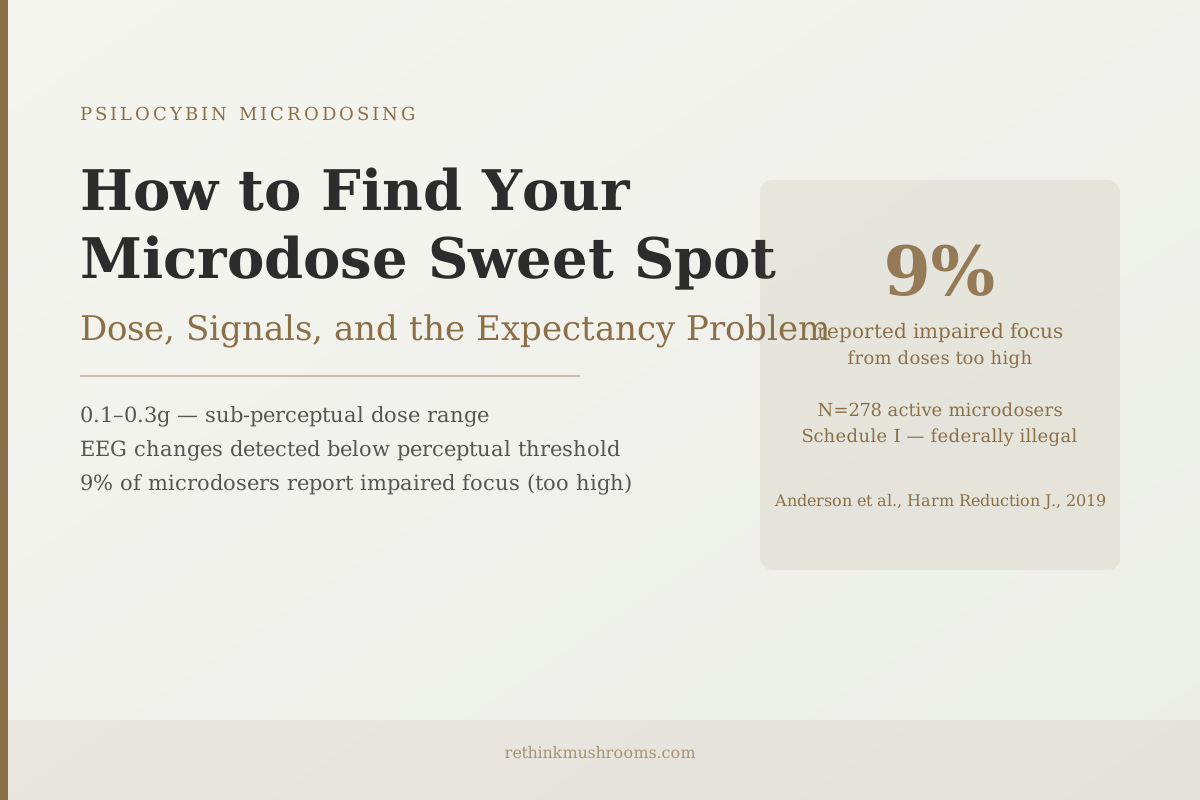
9% reported impaired focus
In Anderson et al.'s survey of 278 microdosers, impaired focus was one of the top reported challenges — a sign that the dose was too high, not too low.
Anderson et al., Harm Reduction Journal, 2019
0.1–0.3g
typical starting range for dried Psilocybe cubensis
EEG changes
detected at sub-perceptual doses in Cavanna 2022 RCT
Schedule I
federal legal status — personal microdosing is illegal in the US
Anderson et al., Harm Reduction Journal, 2019
 View as image ↗
Legal note: Psilocybin mushrooms are classified as Schedule I controlled substances under US federal law. Microdosing is illegal at the federal level, with limited state-level exceptions in Oregon and Colorado. This article reports research findings only and does not constitute medical or legal advice.
The most common mistake in microdosing is taking too much. Not a lot too much — just slightly too much. The dose that produces a mild, barely perceptible shift in perception or mood is not the sweet spot; it is already above it. And according to survey data from Anderson et al. (2019), roughly 9% of active microdosers identify impaired focus as a top challenge — likely from doses that crossed that line.[1]
The concept of a "sweet spot" — a dose low enough to be sub-perceptual but high enough to produce some measurable effect — is central to the practice. Finding it is harder than protocol guides make it seem, partly for pharmacological reasons and partly because the research has complicated the picture considerably. For background on what microdosing is and what the overall evidence shows, see What Is Microdosing Psilocybin? A Complete Guide.
Key Takeaways
- A proper microdose should produce no visual changes, no obvious mood alteration, and no perceptual impairment — if you feel it psychoactively, the dose is above the threshold
- Anderson et al. (2019) found 9% of 278 microdosers reported impaired focus as a top challenge, suggesting a too-high dose is the most common calibration error
- Cavanna et al. (2022) found detectable EEG changes at sub-perceptual doses, confirming biological activity occurs below the perceptual threshold — the sweet spot is neurologically real
- Polito and Liknaitzky (2024) rapid review found expectancy (believing you're taking an active dose) drives much of the benefit reported in open-label settings — psychological framing matters alongside dose
- Rouaud et al. (2024) quantified that daily high-end microdoses produce more 5-HT2B receptor activation than lower doses; this is the primary cardiac risk scenario for chronic use
- Savides and Outhoff (2024) note that dose-specific controlled trial data does not exist — dosing guidance is based on survey reports and theoretical pharmacology, not comparative RCTs
What "Sub-Perceptual" Actually Means — and Why It Matters
A properly calibrated microdose should be invisible. Not barely visible — invisible. The standard framing, from Fadiman and Korb's 2019 published account of the protocol, is that on a dose day you should be able to function normally at work, drive, and interact socially without anyone knowing you have taken anything.[2]
This is a higher bar than many people assume. "Sub-perceptual" does not mean "barely noticeable." It means no psychoactive experience — no visual changes in the periphery, no unusual emotional intensity, no altered sense of time, no elevated sensitivity to sound or color. If any of those are present, the dose is above the threshold.
The typical starting range cited in the community is 0.1–0.3g of dried Psilocybe cubensis, which corresponds to approximately 1–3mg of psilocybin depending on mushroom potency.[2] However, mushroom potency varies significantly between strains, harvests, and storage conditions. The 0.1–0.3g range is a convention, not a pharmacologically standardized dose. Two people taking "0.2g" may receive meaningfully different psilocybin quantities.
The Savides and Outhoff (2024) review in the Journal of Psychopharmacology notes that the absence of standardized dosing is one of the field's core methodological problems — it makes study comparison difficult and individual calibration inherently imprecise.[7]
The Expectancy Problem: Why Finding a Sweet Spot Is Genuinely Difficult
Here is the complication that most protocol guides omit: a large share of the benefit that people attribute to finding their sweet spot may not be dose-dependent at all.
Szigeti et al.'s 2021 self-blinding citizen science study — which enrolled 191 people who microdosed their own supply but used a blinding protocol to test whether effects persisted when they didn't know if they were taking active or placebo — found no statistically significant between-group differences after successful blinding on primary outcomes.[3] People who believed they were taking an active dose reported improvements. People who didn't know showed much smaller effects.
Polito and Liknaitzky's 2024 rapid review in the Journal of Psychopharmacology synthesized the controlled trial literature and reached the same conclusion: expectancy — the belief that you are taking an active substance and that it will help — is a primary driver of the benefits reported in open-label microdosing contexts.[5] The review did not conclude that microdosing has no effect; it concluded that the evidence from controlled studies is substantially weaker than the evidence from self-report surveys, and that expectancy accounts for much of the gap.
What this means practically: when someone adjusts their dose and notices improvement the next dose day, part of that improvement may be a response to having adjusted — a form of active attention and intention — rather than to the specific dose level. Distinguishing pharmacological from expectancy-driven calibration without blinding is genuinely not possible on an individual level.
This is not an argument against the practice. It is an argument for intellectual honesty about what "finding the sweet spot" can and cannot tell you.
The Cavanna 2022 Finding: Brain Changes Do Occur Below the Perceptual Threshold
One of the most important studies for understanding the sweet-spot concept was Cavanna et al.'s 2022 double-blind placebo-controlled RCT, published in Translational Psychiatry.[4]
The study detected neurophysiological changes — measurable differences in brain electrical activity on EEG — between active microdose participants and placebo participants, at doses that participants themselves reported as sub-perceptual. This is significant because it establishes that there IS a biological threshold below conscious perception. The brain registers the compound before the person does.
The catch: Cavanna also found that subjective psychological improvements were small and not clearly differentiated from placebo at the group level. Brains responded; people didn't reliably report different experiences compared to placebo.
This is what makes the sweet-spot concept both credible and contested. There is a neurologically real sub-perceptual zone — Cavanna's EEG evidence confirms it. Whether that neurological activity produces meaningful subjective or functional outcomes that survive blinding is where the research gets murkier.
The Pinhas et al. (2026) meta-analysis in Neuroscience and Biobehavioral Reviews found some evidence of improved cognitive flexibility with microdosing, but no reliable improvement in convergent thinking (the ability to solve problems with single correct answers).[9] Effect sizes were modest overall. The meta-analysis also confirmed no cognitive impairment at sub-perceptual doses — which establishes a safety floor but says less about the ceiling of benefit.
What Survey Data Shows About Dose Ranges and Common Calibration Errors
Anderson et al.'s 2019 survey in Harm Reduction Journal collected data from 278 active microdosers about both benefits and challenges, making it one of the most detailed empirical accounts of real-world calibration experience.[1]
The top reported benefits were improved focus (26%), mood enhancement (25%), and creativity (25%). The top challenges were anxiety (18%) and impaired focus at wrong doses (9%).
The anxiety finding is relevant to calibration: some people experience increased anxiety at sub-perceptual doses, which is a separate issue from taking too much. The impaired focus finding — 9% identifying it as a top challenge — points to doses that crossed into the perceptual range.
Fadiman and Korb's 2019 survey, which established the original protocol framework, included guidance that has since become community standard: start at the lower end of the range (0.1g), complete several dose cycles before adjusting, and adjust by small increments (0.05g) rather than large jumps.[2] The rationale for slow titration is that the threshold between sub-perceptual and perceptual can be narrow, and overshooting it even modestly disrupts the intended experience.
No controlled trial has tested this incremental calibration approach against other strategies. The guidance is pragmatic and internally consistent with the pharmacology, but it is not evidence-based in the trial sense.
For a comparison of different protocol schedules and what the evidence says about each, see Microdosing Protocols Compared: Fadiman vs. Stamets vs. Every Other Day.
The Three-Week Calibration Window: What the Evidence Can and Cannot Support
The common recommendation is to run a microdosing trial for three to four weeks before assessing whether a given dose is working. The logic: effects reported in surveys are often cumulative over weeks, not immediately apparent on the first dose day.
This framing is consistent with the survey data in Anderson 2019 and Fadiman 2019, but it creates a specific calibration problem: a three-week trial at a dose that is actually too high, or actually ineffective, is a three-week investment before the feedback loop closes. The expectancy effects documented in Szigeti 2021 and Polito 2024 mean that during those three weeks, the person knows they are taking something, which itself may produce improvement regardless of dose.
The Savides 2024 review explicitly notes that there is no protocol-specific controlled data — no RCT has compared a two-week calibration window to a four-week one, or tested whether slower titration produces better outcomes than standard starting doses.[7]
The calibration guidance in the community is reasonable given the absence of better data. It is pragmatic, not evidence-based. The three-week window is a convention, not a pharmacologically derived recommendation.
Why Daily High-End Doses Carry the Most Safety Concerns
The cardiac risk question is where dose calibration has direct safety implications.
Rouaud, Calder, and Hasler's 2024 systematic review in the Journal of Psychopharmacology quantified the 5-HT2B receptor activation risk at microdosing levels.[6] The 5-HT2B receptor, when chronically activated, is associated with cardiac valvulopathy — thickening and dysfunction of heart valves — in other drug contexts. Fenfluramine (withdrawn from the market in 1997) and cabergoline (a Parkinson's drug) caused valvulopathy through this mechanism.
Rouaud's analysis found that even at 100x below recreational psilocybin doses, chronic daily microdosing produces 5-HT2B receptor occupancy comparable to drugs known to cause valvulopathy. The key word is "chronic" and "daily." The risk scenario in the review was long-term daily use at the higher end of the microdose range, not occasional use at lower doses.
Nahlawi, Ptaszek, and Ruskin's 2025 review in Nature Cardiovascular Research — a high-prestige journal — reached the same conclusion: current evidence is insufficient to quantify the exact microdosing-specific cardiac risk, but recommends cardiac monitoring for anyone microdosing daily for extended periods.[8]
For context: standard microdosing protocols — Fadiman's 1-on-2-off and Stamets' 5-on-2-off — both include regular rest days, which is relevant to the cumulative receptor activation question. A protocol with daily dosing and no rest days represents a higher theoretical cardiac burden than one with two rest days per week. The dose level matters too: 0.3g daily carries more 5-HT2B activation than 0.1g every third day.
No confirmed microdosing valvulopathy cases appear in the literature as of the 2024-2025 reviews. The concern is theoretical but mechanistically grounded. For a detailed treatment of this risk, see Microdosing and Heart Health: The 5-HT2B Valvulopathy Concern.
The practical implication for calibration: higher doses, used more frequently, carry the most theoretical cardiac risk. This is an independent argument — separate from efficacy — for starting low and for maintaining rest days.
What Tracking Methods Can and Cannot Tell You
Many microdosers use mood journals, productivity ratings, or cognitive tracking apps to assess whether a dose is working. This practice has face validity — systematic self-observation is better than unsystematic self-observation — but it is not a controlled test.
The limitation is the same one Szigeti 2021 identified: people who know they are on a dose day will observe themselves differently than on off days.[3] The act of recording a mood score is itself an intervention. And the expectancy effects documented across multiple studies mean that feeling better after a dose adjustment may reflect the adjustment's psychological meaning as much as its pharmacological effect.
The most useful function of tracking in this context is probably detecting the downside signals — increased anxiety, impaired focus, or disrupted sleep — that indicate the dose is too high. These adverse effects are harder to attribute to expectancy than positive ones. If your focus is measurably worse on dose days compared to off days over multiple cycles, the dose is probably too high.
The upside signals are murkier. A tracking journal that shows consistently better mood on dose days than off days is consistent with pharmacological effect — but also with expectancy, with pattern-matching, and with the fact that many people feel slightly better on days when they are actively doing something intentional for their wellbeing.
For those who want to read more about what the controlled studies specifically show about cognitive effects, see Is Microdosing Just Placebo? The Self-Blinding Studies.
The Bottom Line
Finding a microdose sweet spot means calibrating to a dose that produces sub-perceptual neurological activity without psychoactive effects — a concept validated by Cavanna 2022's EEG evidence but complicated by the strong expectancy effects documented in Szigeti 2021 and Polito 2024. Survey data (Anderson 2019, N=278) points to 0.1–0.3g of dried Psilocybe cubensis as the typical range, with impaired focus (9% of respondents) as the most common signal that a dose is too high. Cardiac safety data from Rouaud 2024 and Nahlawi 2025 argue for lower doses and regular rest days to minimize 5-HT2B receptor activation in chronic use.
Frequently Asked Questions
Sources & References
- 1RTHM-00541·Anderson, Thomas et al. (2019). “Psychedelic microdosing benefits and challenges: an empirical codebook..” Harm reduction journal.Study breakdown →PubMed →↩
- 2RTHM-01054·Fadiman, James et al. (2019). “Might Microdosing Psychedelics Be Safe and Beneficial? An Initial Exploration..” Journal of psychoactive drugs.Study breakdown →PubMed →↩
- 3RTHM-01441·Szigeti, Balázs et al. (2021). “Self-blinding citizen science to explore psychedelic microdosing..” eLife.Study breakdown →PubMed →↩
- 4RTHM-00748·Cavanna, Federico et al. (2022). “Microdosing with psilocybin mushrooms: a double-blind placebo-controlled study..” Translational psychiatry.Study breakdown →PubMed →↩
- 5RTHM-00900·Polito, Vince et al. (2024). “Is microdosing a placebo? A rapid review of low-dose LSD and psilocybin research..” Journal of psychopharmacology (Oxford.Study breakdown →PubMed →↩
- 6RTHM-00903·Rouaud, Antonin et al. (2024). “Microdosing psychedelics and the risk of cardiac fibrosis and valvulopathy: Comparison to known cardiotoxins..” Journal of psychopharmacology (Oxford.Study breakdown →PubMed →↩
- 7RTHM-00905·Savides, Isabella A et al. (2024). “Less is more? A review of psilocybin microdosing..” Journal of psychopharmacology (Oxford.Study breakdown →PubMed →↩
- 8RTHM-02156·Nahlawi, Acile et al. (2025). “Cardiovascular effects and safety of classic psychedelics..” Nature cardiovascular research.Study breakdown →PubMed →↩
- 9RTHM-00961·Pinhas, Netta et al. (2026). “Effects of psychedelic microdosing on cognitive functions: A systematic review and meta-analysis..” Neuroscience and biobehavioral reviews.Study breakdown →PubMed →↩