Microdosing Research
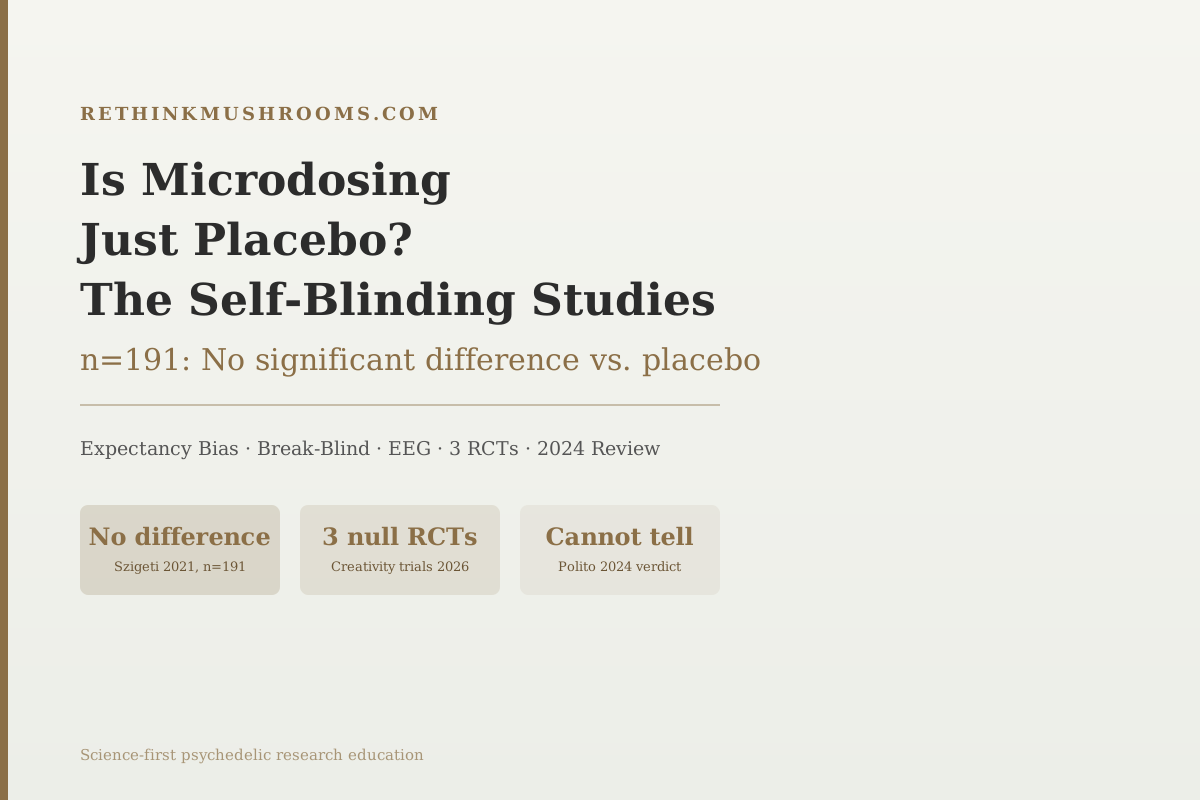
No difference vs. placebo
In the largest placebo-controlled microdosing study (n=191), both psilocybin and placebo groups improved on all psychological measures. No significant between-group differences were found. Small acute effects disappeared when break-blind rate was corrected.
Szigeti et al., eLife, 2021
Cannot determine
the conclusion of a 2024 rapid review of all controlled microdosing trials: 'It is not yet possible to determine whether microdosing is a placebo': the most authoritative current verdict on the question (Polito and Liknaitzky, Journal of Psychopharmacology, 2024)
EEG changed
in a 2022 double-blind placebo-controlled microdosing trial: psilocybin produced measurably altered brain rhythms but failed to improve creativity, cognition, or well-being compared to placebo (Cavanna et al., 2022)
3 RCTs
tested psilocybin's effect on creativity in independent double-blind placebo-controlled trials; no consistent significant effect was found across any of them (Szigeti et al., 2026)
Szigeti et al., eLife, 2021
 View as image ↗
Tens of thousands of people report life-changing benefits from psilocybin microdosing. Surveys show improvements in mood, focus, creativity, and wellbeing. And yet, when researchers have tried to test these benefits under controlled conditions, with real placebos and blind assignments, the benefits have largely disappeared.
The headline answer to "is microdosing just placebo?" is genuinely uncertain. The most rigorous 2024 review of all controlled trials concluded that it is not yet possible to determine the answer. This isn't vagueness or hedge language. It reflects a real and specific epistemological problem: blinding studies of psychoactive substances is extraordinarily difficult, and the attempts to do it have produced results that are hard to interpret clearly.
This article traces the evidence chain from initial observational studies through the self-blinding innovation and the current state of knowledge.
For context on what microdosing is and why it gained popularity, see what is microdosing psilocybin: a complete guide. For a deep dive into the Fadiman protocol that most early studies followed, see the Fadiman protocol: the original microdosing schedule.
Key Takeaways
- The largest placebo-controlled microdosing study (Szigeti et al., eLife, 2021; n=191) found both groups improved over 4 weeks, with no significant differences between psilocybin and placebo on any psychological outcome
- Small acute differences (mood, energy) in the 2021 study disappeared when corrected for participants who correctly guessed they had taken the active substance, indicating those effects were driven by expectancy rather than pharmacology
- A 2024 rapid review concluded "it is not yet possible to determine whether microdosing is a placebo" after reviewing all controlled trials (Polito and Liknaitzky, 2024)
- Microdosing psilocybin produced measurably altered EEG brain rhythms in a 2022 double-blind RCT but failed to improve subjective well-being, creativity, or cognition versus placebo, showing that pharmacological activity does not automatically translate to psychological benefit (Cavanna et al., 2022)
- Three independent double-blind placebo-controlled RCTs found no consistent significant effect of psilocybin microdosing on creativity (Szigeti et al., 2026)
- The core problem: participants can often detect they've taken a psychoactive substance, which activates their positive expectations and inflates outcomes, creating false apparent differences between active and placebo groups
Why Early Microdosing Studies Couldn't Answer the Question
The first wave of microdosing research relied on observational designs. Polito and Stevenson's 2019 study followed 98 self-identified microdosers over 6 weeks, finding improvements in mood, well-being, and reduced mind wandering.[5] The authors themselves explicitly flagged the key limitations: no control group, self-selection of enthusiastic microdosers, and expectancy effects were completely uncontrolled.
Ona and colleagues' 2020 systematic review of early microdosing evidence reached the same conclusion: the benefits suggested by observational studies could not be attributed to pharmacology when expectancy effects remained uncontrolled.[6]
The problem is structural. People who volunteer to participate in a microdosing study have typically already decided they believe microdosing works. They've read forum posts, followed success stories, and made the decision to try it. When these people report improvements over 6 weeks, it is genuinely impossible to know how much came from the psilocybin and how much from their expectation that it would help (the same mechanism that produces the placebo effect in conventional medicine trials).
This is not a criticism of early researchers. It is an inherent challenge in studying any intervention people actively seek out. The solution requires a properly blinded comparison group. And that turns out to be very difficult for psychoactive substances.
Szigeti's Innovation: Doing Blinding Without a Lab
Traditional double-blind drug trials work because neither the participant nor the researcher knows who received the active substance. This works when the drug has no detectable effects at low doses, as is the case with many cardiovascular medications. For psychoactive substances, it often fails: participants can feel something happening, which gives the assignment away.
Benny Szigeti and colleagues at Imperial College London developed an ingenious alternative: citizen science self-blinding.[1] Participants prepared their own capsules at home using a kit that allowed them to create both active (psilocybin) and placebo (inactive) capsules, labeled with unique QR codes whose contents were unknown to the participant until the study ended. The researchers never interacted directly with the substance. Participants assigned themselves into active or placebo conditions based on the code, without knowing which was which.
The design was published in eLife in 2021 and enrolled 191 participants, making it the largest placebo-controlled psychedelic study at the time. It was a genuine methodological advance: moving blinded trials from institutional settings into participants' everyday lives, tracking them over 4 weeks of self-directed dosing.
What 191 Participants Found: Both Groups Improved
The results were striking in their uniformity. Both groups improved significantly over the 4-week study. Mood, well-being, mindfulness, and connectedness all increased. Psychological distress decreased. Participants in both the psilocybin and placebo groups felt better at the end of the study than they had at the start.
The comparison between groups showed no statistically significant differences.[1] The psilocybin group did not improve more than the placebo group on any primary psychological outcome.
There were exceptions: small acute differences in mood, energy, and creativity scores on dosing days. Psilocybin participants reported slightly more of these effects in the immediate post-dose period. But this is where the break-blind problem becomes critical.
Participants were asked throughout the study whether they believed they had taken the active substance or the placebo. A meaningful proportion of psilocybin group participants correctly guessed they had taken the active dose, because they noticed something. When the analysis was restricted to participants who didn't correctly guess their condition (those who genuinely remained blind), the acute differences between groups largely disappeared. The effect was being driven by participants who knew they'd taken psilocybin, and their knowledge was activating their positive expectations.
For the conceptual framework behind this mechanism, see expectancy effects in microdosing: how belief shapes experience.
The Neurological Twist: Real Brain Changes, No Subjective Benefit
A 2022 double-blind placebo-controlled trial in Argentina added a mechanistically interesting data point.[3] Cavanna and colleagues administered microdoses of psilocybin mushrooms under double-blind conditions and measured both subjective psychological outcomes and EEG brain activity.
Psilocybin produced significantly altered EEG rhythms compared to placebo. The brain was doing something measurably different. But the study found no significant improvement in creativity, cognition, or self-reported well-being compared to placebo.
This result has important implications. It demonstrates that microdoses of psilocybin are pharmacologically active; the brain responds in a measurable way. But pharmacological activity and psychological benefit are not the same thing. The neural changes may be real while the subjective benefits remain indistinguishable from placebo.
This is the neurological bridge between the placebo debate and the neuroplasticity evidence. For more on what these sub-perceptual doses do to the brain, see can doses too small to feel still change the brain?.
Creativity Across Three RCTs: No Consistent Effect
Creativity is one of the most commonly cited benefits of microdosing in self-report surveys. Proponents frequently describe enhanced convergent and divergent thinking. Szigeti and colleagues published the most rigorous test of this claim in 2026: a meta-analysis combining results from three independent double-blind placebo-controlled longitudinal trials.[4]
The conclusion: no consistent significant effect of psilocybin on creativity was found across the three trials. The results varied from trial to trial in ways that did not clearly favor the active substance.
This is methodologically meaningful because three independent negative results are more persuasive than one. Each trial had different participants, slightly different protocols, and different measures of creativity. If microdosing consistently enhanced creativity, you would expect at least some consistent signal across three attempts. The absence of a signal across all three is the most direct evidence yet that the creativity benefit, as reported by microdosers, may not hold up under controlled conditions.
For more on the creativity evidence specifically, see microdosing and creativity: what the research shows.
The 2024 Verdict: We Cannot Determine Either Way
Polito and Liknaitzky's 2024 rapid review in the Journal of Psychopharmacology examined all available controlled microdosing trials for psilocybin and LSD.[2] Their conclusion was direct: "It is not yet possible to determine whether microdosing is a placebo."
Several key findings from the review:
Low-dose LSD showed more consistent dose-dependent effects across studies than psilocybin. This suggests the situation may differ by substance.
When the analysis was restricted to double-blind placebo-controlled designs, the positive effects observed in open-label and observational studies largely disappeared.
The field's central problem is methodological: blinding fails for psychoactive substances, and there is currently no fully satisfactory solution to this problem.
This verdict is not "microdosing is placebo." It is "we cannot yet tell." These are importantly different statements. The null result in the Szigeti 2021 study doesn't prove equivalence; it proves the study lacked sufficient evidence to detect a difference, under conditions where blinding was imperfect. A larger, better-controlled trial with a more reliable blinding solution could still find an effect.
The honest answer, after all available controlled evidence, is that the pharmacological benefits of psilocybin microdosing specifically, above and beyond expectancy and placebo, have not been established. This is not what early adopters report. It is what the controlled science has found so far.
The Bottom Line
Controlled microdosing research has consistently found it difficult to demonstrate that psilocybin produces benefits beyond placebo. The largest study (Szigeti et al., 2021; n=191) found both active and placebo groups improved equally, with small acute differences driven by participants correctly guessing they'd received the active dose. Three independent RCTs found no consistent creativity effect (Szigeti et al., 2026). Psilocybin does produce measurably altered EEG activity at microdoses (Cavanna et al., 2022), but brain changes did not translate to subjective benefit. A 2024 review of all controlled trials concluded it is not yet possible to determine whether microdosing effects are pharmacological or placebo (Polito and Liknaitzky, 2024). The core challenge is blinding: participants can often detect when they've taken a psychoactive substance, activating their positive expectations.
Frequently Asked Questions
Sources & References
- 1RTHM-01441·Szigeti, Balázs et al. (2021). “Self-blinding citizen science to explore psychedelic microdosing..” eLife.Study breakdown →PubMed →↩
- 2RTHM-00900·Polito, Vince et al. (2024). “Is microdosing a placebo? A rapid review of low-dose LSD and psilocybin research..” Journal of psychopharmacology (Oxford.Study breakdown →PubMed →↩
- 3RTHM-00748·Cavanna, Federico et al. (2022). “Microdosing with psilocybin mushrooms: a double-blind placebo-controlled study..” Translational psychiatry.Study breakdown →PubMed →↩
- 4. Source details for this reference are not yet available.
- 5RTHM-01113·Polito, Vince et al. (2019). “A systematic study of microdosing psychedelics..” PloS one.Study breakdown →PubMed →↩
- 6RTHM-01271·Ona, Genís et al. (2020). “Potential safety, benefits, and influence of the placebo effect in microdosing psychedelic drugs: A systematic review..” Neuroscience and biobehavioral reviews.Study breakdown →PubMed →↩