Microdosing Research
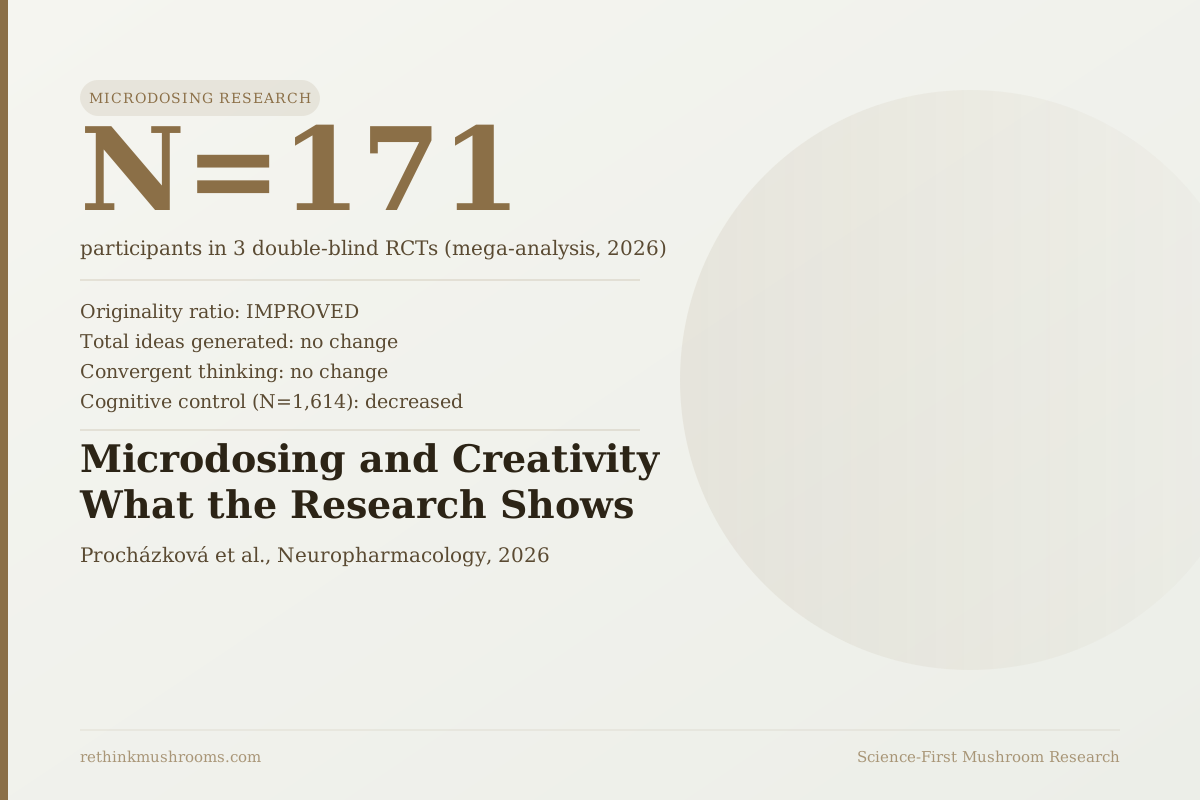
171 participants across 3 double-blind RCTs
The largest controlled investigation of psilocybin microdosing and creativity pooled three double-blind placebo-controlled trials and found one narrow effect: microdosing improved the proportion of original ideas generated, but not the total number of ideas, speed of thinking, or problem-solving ability.
Procházková et al., Neuropharmacology, 2026
1,614
participants in the 2026 cognitive meta-analysis showing cognitive control decrease (Neuroscience & Biobehavioral Reviews)
0
controlled studies finding convergent (problem-solving) thinking improvement with psilocybin microdosing
2021
year Szigeti's self-blinding study showed placebo accounts for most reported microdosing benefits
Procházková et al., Neuropharmacology, 2026
 View as image ↗
The story of microdosing and creativity research has an unusual structure. It starts with a dramatic positive finding, passes through years of mostly null results, and arrives in 2026 with the most rigorous data yet: a real but narrow effect that is much smaller and more specific than anyone in the early days predicted.
The popular version of the story goes like this: Silicon Valley professionals discovered that sub-perceptual doses of psilocybin made them more creative, more focused, and better at solving problems. This narrative spread through podcasts, tech conferences, and a steady stream of self-report surveys showing that microdosers rated their creativity significantly higher than non-microdosers. The evidence for the specific claim that psilocybin microdosing improves creativity looked compelling.
What happened when researchers ran controlled trials? The data got complicated. This article traces the research timeline, explains what "originality-to-fluency ratio" means in plain terms, and gives an accurate account of what microdosing psilocybin research actually shows about creativity. For the broader picture of what psilocybin microdosing is and how protocols work, see the complete guide to microdosing psilocybin.
Key Takeaways
- A 2026 mega-analysis of 3 double-blind RCTs (N=171) found psilocybin microdosing increased the proportion of original ideas relative to total ideas generated, but did not increase the total number of ideas, the speed of idea generation, or performance on convergent (problem-solving) thinking tasks (Procházková et al., Neuropharmacology, 2026)
- A companion 2026 paper from the same research group reported two additional double-blind longitudinal trials showing NO significant cognitive or subjective effects vs. placebo, creating a genuine scientific tension within the same body of work
- The 2026 cognitive meta-analysis (14 studies, N=1,614) found microdosing significantly DECREASED cognitive control, with no detectable improvement in attention, working memory, or other cognitive domains (Neuroscience & Biobehavioral Reviews, 2026)
- A 2021 self-blinding citizen science study found that participants who believed they had taken psilocybin reported benefits regardless of whether they actually had, establishing that expectancy effects account for a large portion of self-reported creativity gains (Szigeti et al., eLife, 2021)
- A 2022 double-blind RCT found zero effects on divergent or convergent thinking, with participants noting subjective effects but showing no behavioral improvement on creativity measures (Szigeti et al., Translational Psychiatry, 2022)
- The honest summary: there is a weak signal for creative idea quality specifically; no controlled evidence for convergent problem-solving improvement; and a potential cost to cognitive control that is directionally opposite to the productivity narrative
How the Creativity Hypothesis Started: The 2018 Open-Label Study
The scientific case for microdosing and creativity begins with a 2018 study by Procházková and colleagues, published in Psychopharmacology (PMID: 30357434). The researchers attended a legal magic truffle ceremony in the Netherlands and measured creativity before and after participants took a microdose.
The results were striking. Both convergent thinking (measured by a picture concept task) and divergent thinking improved after the microdose. Participants generated more ideas, more varied ideas, and more original ideas after microdosing than before, while fluid intelligence was unaffected.
This study was important because it used actual cognitive tests rather than self-report surveys. It was published in a respected journal. And it came from a credible research team who would go on to run rigorous controlled trials on the same question.
But there was a fundamental methodological problem. Everyone in the study knew they had taken magic truffles. There was no placebo group. Everyone expected their thinking to improve. And in psychology research, the expectation that you will think more creatively after taking a substance is itself enough to measurably alter performance on creativity tasks.
The 2018 study launched the hypothesis and inspired a series of controlled investigations. It did not confirm the hypothesis. The distinction matters.
The 2026 Mega-Analysis: What Three Controlled Trials Actually Found
By 2026, the same research group had completed three double-blind placebo-controlled longitudinal trials on psilocybin microdosing and cognition. They pooled these three trials into a mega-analysis of 171 participants, published in Neuropharmacology.[1]
The findings were more nuanced than any prior coverage suggested.
What changed: The originality-to-fluency ratio in divergent thinking improved with active psilocybin microdosing versus placebo. This ratio is the proportion of original ideas relative to the total number of ideas generated.
What did not change: Total idea generation (fluency) did not improve. Speed of idea generation did not improve. Flexibility (variety of idea categories) did not improve. And convergent thinking, which measures the ability to find a single correct solution to a problem, showed no effect at all.
The effect also survived two key statistical controls. It persisted even after controlling for whether participants could correctly guess they had received the active dose rather than placebo. And it persisted after controlling for prior psychedelic experience, which might otherwise inflate the effect in experienced users who expect benefits.
This is the most rigorous controlled creativity evidence available. It shows a real effect. It is also a much smaller and more specific effect than the original 2018 study suggested.
What Originality-to-Fluency Ratio Means in Plain Terms
The key finding requires understanding what "originality-to-fluency ratio" means, because it sounds technical and is genuinely unintuitive.
Imagine you ask someone to list all the uses they can think of for a brick. They generate 20 ideas. Typical ideas: building a wall, propping a door open, breaking a window. One unusual idea: weighing down a kite string in a storm. That unusual idea counts as "original." With 20 total ideas and 1 original, the originality ratio is 1/20 = 5%.
Now imagine the same person on a microdose. They still generate 20 ideas. The typical ideas are still there. But now there are 2 unusual ideas instead of 1. The originality ratio is 2/20 = 10%.
The total number of ideas is identical. The person is not more productive at brainstorming. They are not generating ideas faster. But the proportion that are genuinely novel has increased.
This is what the mega-analysis found. It is a real cognitive shift. But it is a different kind of shift from the "more creative output" narrative popular in microdosing culture. You do not generate more ideas. You generate roughly the same number, with a slightly higher proportion of genuinely original ones.
The Companion Finding: Two More Trials Showed No Cognitive Effects
The same 2026 research paper included a critical piece of context that most coverage missed.
Alongside the mega-analysis, Procházková's group reported results from two additional double-blind longitudinal trials (PMID: 41110634). In these trials, psilocybin microdosing did not produce statistically significant effects on behavioral or subjective measures versus placebo. Some early-week signals appeared in social cognition, mood, and self-reported cognitive flexibility, but these did not survive correction for multiple comparisons across the full trial period.
This creates a genuine scientific puzzle. The same research group, using the same basic protocol, found a creativity originality effect in the mega-analysis but no significant cognitive or subjective effects in two separate longitudinal trials.
What explains this? One possibility: the mega-analysis is powered to detect smaller effects because it pools data from three trials, and the originality ratio change is a small, specific signal that individual trials cannot reliably detect on their own. Another possibility: the originality effect, while real in the pooled data, is too small and variable to be reliably reproduced in any individual study.
Both of these interpretations are consistent with the published data. The honest reading of the 2026 evidence from this group is: there is a small creativity quality signal that requires pooling 171 participants across three controlled trials to detect, and it does not extend to broader cognitive or subjective domains.
The 2022 RCT: Zero Creativity Improvement in Controlled Conditions
A 2022 double-blind placebo-controlled RCT by Szigeti and colleagues, published in Translational Psychiatry, provides additional controlled evidence.[3]
Participants received 0.5 grams of dried psilocybin mushrooms in a double-blind design. The study measured both divergent and convergent thinking. The result: no effects on either cognitive domain.
There was one interesting finding. Participants did notice subjective changes after the active dose. EEG measurements confirmed altered brain activity. Something was happening neurologically. But that neurological change did not translate into measurable improvement on the cognitive tests designed to capture creative thinking.
This is an important pattern that appears repeatedly in controlled microdosing research: the subjective experience of thinking differently is real, but behavioral tests of actual performance do not confirm that the thinking is better. People feel more creative. They do not reliably perform as more creative on standardized tasks.
For a deeper look at what convergent and divergent thinking are and how researchers measure them, see microdosing and problem-solving: convergent and divergent thinking explained.
Why People Feel Creative When Controlled Studies Show Limited Effects
If controlled studies show such limited and specific creativity effects, why do so many people who microdose report feeling significantly more creative?
Two research findings point to the answer.
The first is the 2021 self-blinding citizen science study by Szigeti and colleagues, published in eLife.[5] This study was methodologically creative: 191 participants prepared their own capsules (active or placebo) and blinded themselves so they did not know which they had taken on any given day. The finding: all psychological outcomes improved from baseline, but the placebo group improved just as much, and no significant between-group differences survived once participants who broke blind were accounted for. The authors concluded that the anecdotal benefits of microdosing can largely be explained by the placebo effect.
The second is a 2024 rapid review by Polito and Liknaitzky, published in the Journal of Psychopharmacology, that evaluated how strong the case for a placebo-only explanation actually is.[4] Reviewing 19 placebo-controlled studies, the authors pushed back on the conclusion that microdosing is "just placebo": they noted that microdosing produces measurable changes relative to placebo across neurobiology, physiology, subjective experience, affect, and cognition, that the measured impact of expectancy is small, and that the existing controlled studies are too few and too small to settle the question either way. Their bottom line was that it is not yet possible to determine whether microdosing is a placebo. Holding both papers together is the honest position: expectancy clearly accounts for a large share of the dramatic effects in open-label surveys (the self-blinding data), yet the controlled literature is not strong enough to dismiss a genuine drug effect entirely (the rapid review).
The mechanism: if you believe you are taking a creativity enhancer, you approach creative tasks differently. You push yourself to think in more unusual directions. You tolerate ambiguity in your ideas longer. You dismiss fewer half-formed thoughts. These behavioral shifts are real responses to expectation, and they produce real changes in self-reported experience and possibly in some creative output measures. They are not the direct pharmacological effect of the psilocybin.
For a deeper exploration of how expectancy shapes microdosing experience, see expectancy effects in microdosing: how belief shapes experience. For the detailed study-by-study breakdown of the placebo evidence, see is microdosing just placebo? The self-blinding studies.
The Cognitive Control Finding: The Data Point That Cuts Against the Narrative
The 2026 meta-analysis from Neuroscience and Biobehavioral Reviews adds a finding that almost no coverage has addressed.[2]
This preregistered meta-analysis pooled 14 studies and 1,614 participants, testing a wide range of cognitive domains. The attention, working memory, and fluid intelligence findings were all null, consistent with zero improvement in these areas. The headline finding was unexpected: cognitive control showed a statistically significant decrease with microdosing.
Cognitive control is the mental ability to focus on relevant information, filter out distractions, inhibit impulses, and shift attention flexibly between tasks. It is a foundational component of what most people mean when they say they want better focus, better productivity, or better problem-solving ability. It underlies convergent thinking specifically.
A decrease in cognitive control is directionally opposite to the productivity narrative. The very thing microdosers most want improved may be slightly impaired rather than enhanced in controlled conditions.
This finding is from the most comprehensive cognitive meta-analysis on microdosing published to date. It should be part of any honest account of this research area, and it is absent from virtually all consumer-facing microdosing content.
What This Means: The Honest Research Summary
Controlled-Trial Verdict by Outcome
What Microdosing Actually Changes — and What It Doesn't
Across the most rigorous double-blind data, only one narrow outcome improves. Two of the outcomes people most want enhanced show no effect, and cognitive control points the wrong way.
Idea originality (originality / fluency ratio)
Higher proportion of genuinely novel ideas in divergent-thinking tasks
Mega-analysis of 3 double-blind RCTs, N=171 (Neuropharmacology, 2026)
Idea quantity (fluency)
Total number of ideas generated
Same 2026 mega-analysis — no change vs. placebo
Convergent thinking (problem-solving)
Finding the single correct answer to a problem
Null in every controlled study, incl. Szigeti 2022 RCT (Translational Psychiatry)
Attention & working memory
Sustained focus and short-term memory capacity
Meta-analysis of 14 studies, N=1,614 (Neurosci. & Biobehav. Reviews, 2026)
Cognitive control
Filtering distractions, inhibiting impulses, shifting attention
Same 2026 meta-analysis — statistically significant decrease
Source: Double-blind controlled trials & meta-analyses, 2021–2026
View as image ↗Pulling together the full evidence picture as of 2026:
For creative idea quality (divergent thinking originality): A weak, specific signal exists. The 2026 mega-analysis of 171 participants found that the proportion of original ideas improves. This effect is real, controlled for expectancy, and statistically significant in pooled data. It does not mean more ideas, faster ideas, or better problem-solving.
For total creative output (divergent thinking fluency): Null. No controlled study has found that microdosing increases the number of ideas generated.
For problem-solving ability (convergent thinking): Null across every controlled study.
For focus and cognitive control: The strongest aggregate signal is a decrease, not an increase, in cognitive control as measured by the 2026 meta-analysis.
For self-reported creativity and productivity: Benefits are widely reported by people who microdose. These reports are strongly confounded by expectancy effects, as established by the 2021 self-blinding study. The gap between subjective experience and behavioral performance is a consistent finding across the literature.
The creativity narrative around psilocybin microdosing is not entirely wrong. It is not entirely right. There is a real but narrow signal: psilocybin may improve the quality (originality) of the ideas people generate, without making them generate more ideas or better at solving problems. This is meaningful for some creative applications and irrelevant for others.
The productivity and focus narrative has no controlled empirical support and is undermined by the meta-analytic finding that cognitive control decreases. For that specific question, see microdosing psilocybin for focus and productivity and the comparison with how functional mushrooms affect cognition via a different mechanism in Lion's Mane and cognitive function: what the research shows.
The Bottom Line
The 2026 mega-analysis by Procházková et al. (N=171, 3 double-blind RCTs) found psilocybin microdosing increased the originality-to-fluency ratio in divergent thinking, meaning a higher proportion of ideas were original, without increasing total idea generation or convergent problem-solving. A companion 2026 paper found no significant cognitive or subjective effects in two additional longitudinal trials. The 2022 Szigeti RCT found zero creativity improvement. The 2026 cognitive meta-analysis (14 studies, N=1,614) found cognitive control significantly decreased. The 2021 self-blinding study established that expectancy effects account for most self-reported creativity gains. The honest picture: a real but narrow creativity quality signal, null convergent thinking effects, and possible cognitive control costs.
Frequently Asked Questions
Sources & References
- 1. Source details for this reference are not yet available.
- 2. Source details for this reference are not yet available.
- 3. Source details for this reference are not yet available.
- 4. Source details for this reference are not yet available.
- 5. Source details for this reference are not yet available.