Microdosing & Cognitive Performance
1,614 participants
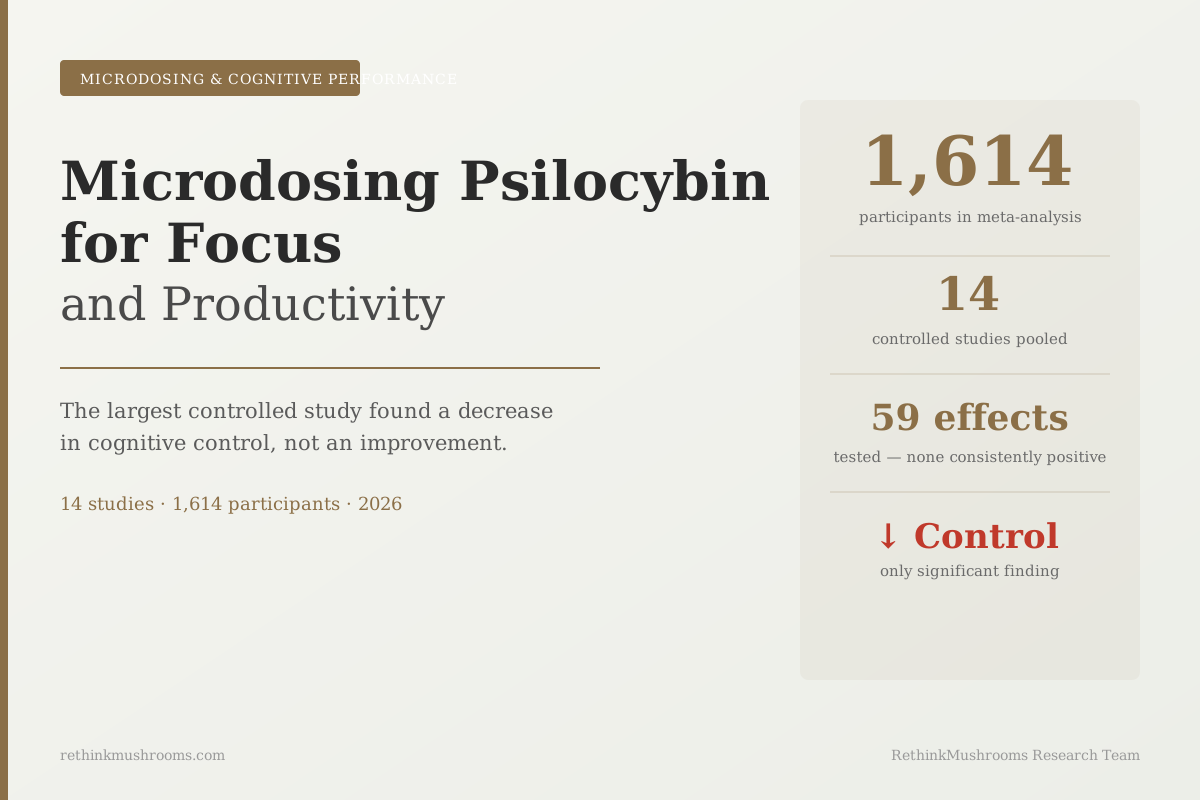
In the largest preregistered meta-analysis of microdosing and cognition (14 controlled studies pooled), the only statistically significant finding was a decrease in cognitive control, not the focus improvement that motivated most microdosers.
Neuroscience & Biobehavioral Reviews, 2026
14 studies
pooled in the 2026 cognitive meta-analysis
59 effects
tested across attention, memory, and executive function; none consistently positive
Focus #1
leading stated motivation for microdosing, yet unconfirmed in controlled trials
Neuroscience & Biobehavioral Reviews, 2026
 View as image ↗
The sales pitch for microdosing psilocybin for focus and productivity is consistent: sharper concentration, deeper work sessions, less mental friction, more output. It circulated through tech circles for years, backed by compelling self-reports from engineers, designers, and executives. The question worth asking is what happens when researchers replace those self-reports with objective tests.
The answer, from the most comprehensive controlled data available, is not what the productivity narrative predicts. The largest meta-analysis of microdosing and cognition, pooling 14 controlled studies and 1,614 participants, found no measurable improvement in attention or working memory. Its single statistically significant finding was a decrease in cognitive control. Cognitive control is the precise mental ability that sustained focused work depends on.
That result does not mean the subjective experience of feeling sharper is invented. People genuinely feel different. What the research clarifies is why.
For a broader overview of what microdosing is and how people use it, see our complete guide to psilocybin microdosing.
Key Takeaways
- Focus and productivity are the leading motivations for microdosing, cited across multiple large surveys of active microdosers
- The 2026 preregistered meta-analysis (14 studies, N=1,614, 59 effect sizes) found a significant decrease in cognitive control with microdosing; no improvements in attention, working memory, or fluid intelligence were detected
- Cognitive control covers inhibition, mental flexibility, and the ability to shift between tasks. These are the same abilities required for sustained productive work
- In Szigeti's self-blinding citizen science study, participants who believed they received psilocybin reported benefits regardless of whether they actually received the active drug or placebo
- A 2024 rapid review concluded that placebo effects are large and pervasive in microdosing research, and that current evidence is insufficient to determine whether drug effects reliably exceed placebo
- A 2024 balanced review found that the most robust evidence for microdosing benefits is in mood and anxiety outcomes, not in cognitive performance measures such as focus or working memory
Why Professionals Turned to Microdosing for Focus, and What They Reported
The adoption of microdosing as a professional productivity tool started with a specific claim: that sub-perceptual doses of psilocybin improved focus without the conspicuous impairment of a full psychedelic experience. This framing resonated particularly with knowledge workers, for whom distraction and cognitive overhead are occupational costs.
Survey data confirms that this motivation is widespread. In a large survey of adults who microdose, focus and productivity ranked among the top stated reasons for starting the practice.[1] Respondents also reported lower self-assessed anxiety and depression compared to non-microdosers. This pattern suggests the population that self-selects into microdosing is seeking a specific psychological profile rather than a purely recreational experience.
The practical appeal was reinforced by the protocols that spread alongside the self-reports. The Fadiman Protocol and its variants were designed explicitly for professional use: dose on day 1, skip two days, dose again. The intention was a cognitive boost on the dosing day without accumulating tolerance or causing perceptual disruption. For a working person, this schedule is functional. It also generated a steady accumulation of favorable self-reports, because people who are paying careful attention to their workday and attributing performance to a drug tend to notice and report the highs more than the lows.
The occupational profile of early adopters matters here too. Computer and office workers represent a large share of self-identified microdosers in survey samples. These are jobs where performance is partly assessed through subjective standards: the quality of ideas, the smoothness of communication, the sense of being in flow, rather than only through objective output metrics. Subjective performance and measured performance are easier to conflate in those roles than in settings with clear, measurable outputs.
For context on those protocols and how they were designed, see our article on the Fadiman Protocol. For the broader cultural history of how microdosing became the professional productivity hack of the 2010s, see our article on microdosing in Silicon Valley: hype vs. evidence.
What 14 Controlled Studies Found When They Actually Measured Performance
The shift from self-reports to controlled measurement changes the picture substantially.
In 2026, a preregistered systematic review and meta-analysis synthesized every controlled study of psychedelic microdosing on cognitive function, identifying 14 studies with a combined 1,614 participants and 59 separate effect sizes across cognitive domains.[2] The inclusion criteria required controlled designs: studies where participants couldn't simply attribute changes to the drug because they knew they were taking it.
The results across those 59 effects were largely null. No statistically significant improvements in attention emerged from the pooled data. Working memory showed no detectable advantage. Fluid intelligence was unchanged. The cognitive domains that matter most for the productivity narrative (the ability to concentrate, hold task-relevant information in mind, and solve novel problems) none registered a measurable benefit.
The single finding that did reach statistical significance was in the opposite direction: cognitive control decreased.
A secondary point worth addressing: the meta-analysis tested 59 effect sizes, which means many different outcomes were measured. Finding one significant result out of 59 is close to what you'd expect from chance at standard significance thresholds. The authors addressed this directly by registering the study in advance. A preregistered study specifies all analyses and outcomes before data collection begins, preventing the post-hoc selection of interesting-looking results. That design choice makes the cognitive control finding more credible, not less. It was a pre-specified outcome that emerged from a pre-specified analysis.
Cognitive Control: The Specific Ability Productive Work Actually Requires
Understanding why the meta-analysis finding matters requires understanding what cognitive control is.
Cognitive control is the umbrella term for a cluster of executive abilities. It covers inhibition: the capacity to suppress distracting thoughts and irrelevant responses while holding focus on the task at hand. When you resist the pull toward social media while working on a report, that is inhibition. When you stay in one cognitive thread while your phone lights up with a notification, that is inhibition.
Cognitive control also covers flexibility: the ability to switch between different tasks or mental frames without losing track of where you are. When you move from analyzing data back to writing without derailing, that is flexibility. It covers the management of interference: keeping one line of reasoning active in memory while evaluating competing information. When you hold three client requirements in mind while evaluating a design decision, that is interference management.
Every meaningful work session draws on all three. The ability to sustain a writing session, to alternate between different work streams, to hold a complex problem in mind while searching for its solution: all of this runs on cognitive control.
When the meta-analysis found that microdosing significantly decreased cognitive control, it was measuring exactly this cluster of abilities in controlled conditions. The finding is not that some abstract function declined. It is that the specific mental machinery required for the work that professional microdosers were trying to do showed a reliable adverse effect.
This is the irony at the center of the focus and productivity narrative: the drug being taken specifically to improve productive focus appears, in the best controlled data, to impair the ability that productive focus most depends on.
Why You Feel Sharper When the Tests Show No Improvement
The most direct evidence that microdosing's focus effects are expectancy-driven comes from Szigeti and colleagues' self-blinding citizen science study.[3] The study used a design where participants prepared their own capsules, some containing psilocybin and some containing placebo, then shuffled and sealed them so they could not distinguish which was which during the trial.
When participants believed they had received psilocybin, regardless of whether they actually had, they reported benefits. The key result is not that the psilocybin group and placebo group performed the same. It is that the belief of having taken psilocybin predicted reported outcomes more reliably than actual drug exposure.
This mechanism has a name: the expectancy effect. If you take a capsule believing it will sharpen your concentration, you notice and amplify every moment of clean focus in your day. Moments of distraction are attributed to external factors. Moments of productivity confirm the drug is working. The result is a persuasive but pharmacologically unreliable experience.
A 2024 rapid review synthesizing the controlled microdosing literature documented how large these expectancy effects are.[4] The review found that placebo effects in microdosing research are pervasive across study designs. It also documented that prior psychedelic experience amplifies expectancy: people who have had meaningful psychedelic experiences believe in their power more strongly and show larger placebo responses when they believe they're taking a psychedelic substance. This creates a compounding problem for research in psychedelic-friendly communities, because the populations most likely to enroll in microdosing studies are also the populations most likely to show large expectancy effects.
The 2024 review's conclusion was careful rather than dismissive: current evidence is insufficient to establish that drug effects reliably exceed placebo effects in healthy adults who microdose. That is not the same as saying the drug does nothing. It means we don't yet have enough controlled evidence to separate the drug from the expectancy, and the expectancy alone is large.
The subjective experience of improved focus is not fabricated. People who feel sharper while microdosing are genuinely experiencing a changed mental state. What the controlled evidence clarifies is that the mechanism is expectancy-mediated, not a direct pharmacological improvement to the cognitive machinery that focus depends on.
For a deeper look at how the expectancy mechanism works and what the controlled studies reveal, see our articles on expectancy effects in microdosing and Is Microdosing Just Placebo? The Self-Blinding Studies.
The Current Evidence: What Is Confirmed and What Is Not
The most complete and balanced view of where the evidence currently sits comes from a 2024 review that examined both the strength of different claimed benefits and the methodological quality of the evidence behind each.[5]
The review's conclusion draws a clear line between two categories of effects. For mood and anxiety outcomes, microdosing shows a more consistent signal: multiple studies, including some with reasonably controlled designs, find reductions in self-reported anxiety and depression. The magnitude of these effects is modest, but the direction is consistent across study types.
For cognitive performance outcomes, including the focus, attention, and productivity claims most widely circulated in professional contexts, the evidence is substantially weaker. The review characterized existing cognitive enhancement data as primarily coming from open-label studies with high expectancy confounds, without adequate controls. The controlled studies, where participants cannot distinguish drug from placebo, fail to replicate the cognitive gains.
This distinction matters for interpreting the self-report surveys. When someone says microdosing improved their work, they may be accurately reporting reduced anxiety, lower baseline mental friction, and a calmer working state. Those are real benefits of better mood. They are different from pharmacological improvements to attention capacity or cognitive control. The controlled evidence does not support the latter.
For readers interested in how the related creativity claims hold up in controlled research, see our article on microdosing and creativity: what the research shows. For the conceptual background on what convergent and divergent thinking are and why researchers test them, see microdosing and problem-solving: convergent and divergent thinking. For a deep look at the specific laboratory measurements behind each study's findings, see microdosing and convergent vs. divergent thinking: what the lab data shows.
If you're exploring cognitive enhancement options with a stronger controlled evidence base, our article on lion's mane and cognitive function covers the functional mushroom with the most consistent controlled findings in that domain.
The Bottom Line
Survey data shows focus and productivity as the leading motivations for microdosing psilocybin, and large self-report samples consistently describe improvements. Controlled research tells a different story: the largest meta-analysis (14 studies, 1,614 participants) found no improvements in attention, working memory, or fluid intelligence, and found a significant decrease in cognitive control, the specific ability that focused productive work depends on. The self-blinding evidence shows that much of the subjective improvement is expectancy-driven. Where microdosing shows the most consistent signal in controlled settings is mood and anxiety reduction, not cognitive performance.
Frequently Asked Questions
Sources & References
- 1. Source details for this reference are not yet available.
- 2. Source details for this reference are not yet available.
- 3. Source details for this reference are not yet available.
- 4. Source details for this reference are not yet available.
- 5. Source details for this reference are not yet available.