Psilocybin Microdosing
38% of microdosers
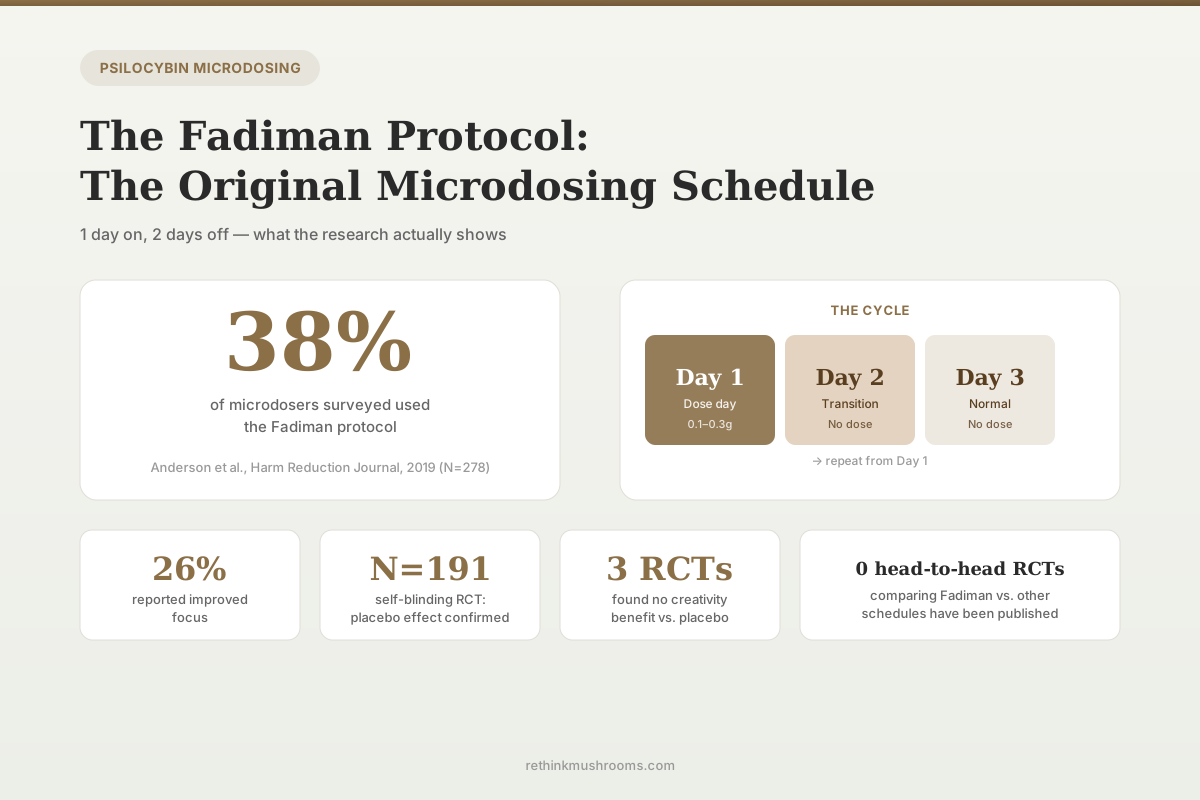
More than a third of the psilocybin microdosers surveyed by Anderson and colleagues used the Fadiman protocol, making it the most common schedule in use by a wide margin.
Anderson et al., Harm Reduction Journal, 2019
278
microdosers surveyed by Anderson (2019)
1-on, 2-off
the Fadiman schedule
2019
year the protocol was first formally published
Anderson et al., Harm Reduction Journal, 2019
 View as image ↗
Before there was a name for it, there was James Fadiman, collecting handwritten reports from people who had decided, on their own, to take small amounts of psilocybin mushrooms and write down what happened. The Fadiman protocol for microdosing came out of that process: a 1-day-on, 2-days-off cycle that became the reference point for nearly every microdosing study that followed. It is not a medical protocol. It is not based on a clinical trial. It is a schedule that emerged from self-reports, written up formally in a 2019 paper by Fadiman and his colleague Sophia Korb, and since adopted by more microdosers than any other approach.[1] For a broader overview of the evidence on microdosing generally, start with our complete guide to microdosing psilocybin.
Legal context: Psilocybin is a Schedule I controlled substance under US federal law and remains illegal for personal use in most US states. Oregon and Colorado have created regulated access programs. Legal status varies widely by country. This article is educational reporting on published research.
Key Takeaways
- The Fadiman protocol is a 3-day repeating cycle: take a sub-perceptual dose on Day 1, rest on Days 2 and 3, then repeat.
- Fadiman and Korb published the protocol formally in the Journal of Psychoactive Drugs in 2019, the first academic description of the schedule, based on citizen science self-reports.
- In a survey of 278 microdosers, 38% used the Fadiman schedule, making it the most common protocol in the community (Anderson et al., 2019).
- The same survey found focus improvement (26%), mood enhancement (25%), and creativity (25%) as the top reported benefits; anxiety (18%) and impaired focus at too-high doses (9%) were the top challenges.
- A 2021 self-blinding RCT (Szigeti et al., N=191) found that improvements reported by microdosers largely disappeared after successful blinding, consistent with a substantial expectancy effect.
- Three separate double-blind RCTs (Prochazkova et al., 2026) found no creativity benefit compared to placebo, directly challenging the most commonly reported benefit of the Fadiman protocol.
Who Is James Fadiman, and How Did This Schedule Get Its Name?
James Fadiman is a psychologist, researcher, and the author of The Psychedelic Explorer's Guide. He was involved in early government-funded psychedelic research in the 1960s before the field was shut down. After the research moratorium, he continued studying psychedelics informally, and in the mid-2000s he began a citizen science project: asking people who were already microdosing on their own to document their experiences systematically.
The process was deliberately low-tech. Fadiman asked participants to keep day-by-day journals, tracking their dose, sleep, mood, focus, social interactions, and anything else they noticed. There was no control group, no blinding, no placebo. Participants knew what they were taking, knew what effects were expected, and self-selected into the project because they were already interested in microdosing.
The 1-on, 2-off schedule was not designed in advance and then tested. It emerged from patterns in the reports. People who dosed daily found effects diminished quickly. People who dosed every other day sometimes noticed carry-over effects on their off days. A 3-day cycle (dose, transition, normal, repeat) was what seemed to work best across the most reports. Fadiman and Korb synthesized this into a formal preliminary publication in 2019.[1]
That paper does not present the Fadiman protocol as validated. It presents it as a starting point: a schedule derived from community experience, worth testing more rigorously. The rigor came later, and the results were more complicated.
The 1-On, 2-Off Cycle: What Each Day Is Actually For
The structure of the Fadiman protocol is simple enough to describe in a table:
| Day | Label | What Happens |
|---|---|---|
| Day 1 | Dose day | Take a sub-perceptual amount, typically 0.1–0.3g dried Psilocybe cubensis |
| Day 2 | Transition day | No dose; effects may linger subtly, perception may still be slightly altered |
| Day 3 | Normal day | No dose; a clean baseline before the next cycle |
| Day 4 | New Day 1 | Repeat |
On a standard 4-week trial, this produces roughly 9 dose days (Days 1, 4, 7, 10, 13, 16, 19, 22, 25) out of 28.
The reasoning behind Days 2 and 3 involves serotonin receptor sensitivity. Psilocybin's primary effect comes from activating a specific type of serotonin receptor (5-HT2A receptors, the ones involved in perception, mood, and cognition) in the brain. When these receptors are activated repeatedly, they become less responsive, a process called downregulation. Dosing on Day 2 would hit receptors that are still somewhat desensitized from Day 1, producing weaker effects. Day 3 exists to give those receptors enough time to return to normal sensitivity before the next dose.
This rationale is coherent with what is known about how psilocybin works at full doses. But a critical point: the specific 3-day cycle has never been tested against a 2-day or 4-day cycle in a controlled study. There are no pharmacokinetic data showing that 48 hours is the exact recovery window needed for receptor resensitization at microdose levels. The 2-day gap reflects what worked for Fadiman's self-reporters, not a measured physiological threshold.
For a side-by-side comparison of how the Fadiman schedule stacks up against the Stamets 5-on-2-off approach and every-other-day dosing, see Microdosing Protocols Compared: Fadiman vs. Stamets vs. Every Other Day.
More Than a Third of Microdosers Use This Schedule. Here's What They Report.
In 2019, Anderson and colleagues published a systematic analysis of self-reported microdosing experiences from 278 community members, organized into a formal codebook of benefits and challenges.[2] The Fadiman protocol was the most common schedule used, at 38% of respondents.
The three most frequently reported benefits were:
- Improved focus: 26% of microdosers
- Mood enhancement: 25%
- Creativity: 25%
The most common challenges:
- Anxiety: 18% of microdosers
- Impaired focus at too-high doses: 9%
The challenge data is worth holding alongside the benefit data. A meaningful minority of people found that microdosing made their anxiety worse, not better. Another group found the experience counterproductive when their dose was slightly too high. Anderson's study is useful precisely because it coded the negative experiences rather than filtering them out.
Two years later, a much larger naturalistic survey added to this picture. Rootman and colleagues surveyed 8,703 adults and found that microdosers reported significantly lower depression and anxiety compared to non-microdosers, with effect sizes that are considered moderate to small: Cohen's d = -0.36 for depression, d = -0.30 for anxiety.[3] Microdosers also reported higher wellbeing overall.
This is the study most frequently cited in support of microdosing. It deserves a disclosure that most sites citing it don't include: Paul Stamets, the patent holder of the Stamets Stack and a prominent commercial figure in the psychedelic supplement industry, is a co-author of Rootman 2021. This does not make the study's findings wrong, but it is a relevant conflict of interest. The study also has a structural limitation: people who microdose and feel better are more likely to join a study about microdosing, and people who tried it and felt worse probably did not enroll. The positive findings are real data, not fabricated; they come from a self-selected sample with a co-author who profits from positive outcomes.
For a deeper look at what the naturalistic mood and anxiety data shows, see Microdosing for Depression and Anxiety: Naturalistic Study Results.
The Placebo Problem: What Happened When Microdosers Couldn't Tell Which Day They Were Dosing
Survey data on the Fadiman protocol (Anderson 2019, Rootman 2021, and Fadiman's own citizen science reports) shares a fundamental limitation: everyone knew which days they were dosing. That knowledge alone can generate the effects people report. This is not a theoretical concern. A 2021 experiment put it to a direct test.
Szigeti and colleagues recruited 191 people who were already planning to microdose, then gave each person a kit to blind themselves.[4] Participants prepared their own capsules (some with their usual mushroom powder, some with placebo) and then had someone else randomize the capsules before sealing them. Participants followed their normal schedule (many used Fadiman-adjacent timing) without knowing whether any given day's capsule was active or placebo. After the trial, researchers checked whether participants could correctly identify their active days above chance; if they could, the blinding had failed.
Before successful blinding was confirmed, the pattern looked like every other survey: people who believed they were taking active doses reported improvements in mood, focus, and wellbeing. After blinding was verified, after the researchers confirmed that people genuinely could not tell their active days from their placebo days, the statistically significant between-group differences were gone. The improvements that seemed real in the open phase were absent in the blinded phase.
A 2024 rapid review by Polito and Liknaitzky examined the controlled trial literature as a whole and found the same pattern.[5] Naturalistic surveys (like Anderson 2019 and Rootman 2021) consistently show positive effects. Blinded controlled studies consistently show smaller effects. Their conclusion: expectancy (the belief that one is taking the drug and that it should help) is a primary driver of the benefits people attribute to microdosing. They do not conclude that microdosing is inert. But they document a consistent and large gap between what unblinded surveys show and what controlled studies show.
This pattern doesn't invalidate the Fadiman protocol as a practice. It does mean that the evidence base for the protocol consists almost entirely of studies that cannot separate pharmacological effects from expectancy. For a deep dive into the blinding evidence specifically, see Is Microdosing Just Placebo? The Self-Blinding Studies.
Creativity Is the Most-Cited Benefit. Three RCTs Found No Effect.
The creativity claim is the most prominent selling point for the Fadiman protocol in community discussions, reported by 25% of Anderson's survey respondents. It is also the claim that has now received the most rigorous testing, and the results are clear.
Prochazkova and colleagues ran three separate double-blind, placebo-controlled longitudinal trials specifically designed to test whether psilocybin microdosing improves creativity.[7] Not one trial. Three.
None found a significant creativity benefit compared to placebo.
Three trials, all pre-registered, all blinded, all longitudinal. Zero significant creativity effects.
The Prochazkova findings sit within a now-consistent pattern across the controlled literature. In unblinded surveys, microdosers report creativity gains. In blinded trials, where participants cannot tell which days they are taking active doses, the creativity gains disappear. The authors' interpretation: the creativity narrative in microdosing is driven by open-label expectancy rather than a pharmacological effect on creative thinking.
For a detailed breakdown of all the creativity RCT data, see Microdosing and Creativity: What the Research Shows.
Is the Fadiman Protocol Actually Better Than the Alternatives?
The most honest answer to the question of whether the Fadiman protocol outperforms other schedules is that no one has tested this. At all.
Savides and Outhoff, in a comprehensive 2024 review of psilocybin microdosing research, explicitly noted the absence of schedule-specific controlled data.[6] The Fadiman 1-on-2-off pattern, the Stamets 5-on-2-off schedule, and every-other-day approaches have all been used by community members and observed in naturalistic surveys. None has been assigned randomly to trial arms and compared directly. The evidence for any protocol's superiority is self-report data, collected by people who knew which schedule they were following.
The Fadiman protocol has one practical advantage over the alternatives: it is the most formally documented. The Fadiman & Korb 2019 paper is a publicly available, citable description of the schedule and its rationale. The 2-day rest period has a coherent theoretical basis, even if that basis hasn't been pharmacokinetically validated at microdose levels. Anderson 2019 shows that 38% of community microdosers use Fadiman-consistent timing, more than any other pattern observed, which means it is the most reported-on approach in the survey literature, even if the reports are unblinded.
What the Fadiman protocol does not have: a controlled trial showing it outperforms a 2-day, 4-day, or daily schedule on any measured outcome. The 3-day cycle is a reasonable starting point with community consensus behind it. It is not a clinically validated optimal schedule.
For anyone interested in calibrating dose within whatever schedule they choose, the adjacent question of how to find the right amount is covered separately: How to Find Your Microdose Sweet Spot. For the full three-protocol comparison, see Microdosing Protocols Compared: Fadiman vs. Stamets vs. Every Other Day.
The Bottom Line
The Fadiman protocol's 1-on, 2-off schedule is the most widely used and best-documented psilocybin microdosing framework, emerging from James Fadiman's citizen science work and formally published in 2019. Survey data consistently shows positive outcomes: improved focus, mood, and creativity reported by a substantial minority of users. But the controlled evidence complicates the picture: a self-blinding RCT found improvements disappeared after successful blinding, a 2024 review concluded expectancy drives most of the reported benefit, and three double-blind RCTs found no creativity effect at all. The Fadiman protocol remains the most natural starting point for people learning about microdosing, but understanding that starting point means holding both the survey data and the controlled trial data in view at the same time.
Frequently Asked Questions
Sources & References
- 1RTHM-01054·Fadiman, James et al. (2019). “Might Microdosing Psychedelics Be Safe and Beneficial? An Initial Exploration..” Journal of psychoactive drugs.Study breakdown →PubMed →↩
- 2RTHM-00541·Anderson, Thomas et al. (2019). “Psychedelic microdosing benefits and challenges: an empirical codebook..” Harm reduction journal.Study breakdown →PubMed →↩
- 3RTHM-00715·Rootman, Joseph M et al. (2021). “Adults who microdose psychedelics report health related motivations and lower levels of anxiety and depression compared to non-microdosers..” Scientific reports.Study breakdown →PubMed →↩
- 4RTHM-01441·Szigeti, Balázs et al. (2021). “Self-blinding citizen science to explore psychedelic microdosing..” eLife.Study breakdown →PubMed →↩
- 5RTHM-00900·Polito, Vince et al. (2024). “Is microdosing a placebo? A rapid review of low-dose LSD and psilocybin research..” Journal of psychopharmacology (Oxford.Study breakdown →PubMed →↩
- 6RTHM-00905·Savides, Isabella A et al. (2024). “Less is more? A review of psilocybin microdosing..” Journal of psychopharmacology (Oxford.Study breakdown →PubMed →↩
- 7RTHM-00962·Prochazkova, Luisa et al. (2026). “Microdosing psilocybin and its effect on creativity: Lessons learned from three double-blind placebo controlled longitudinal trials..” Neuropharmacology.Study breakdown →PubMed →↩