Psilocybin Microdosing for Depression & Anxiety
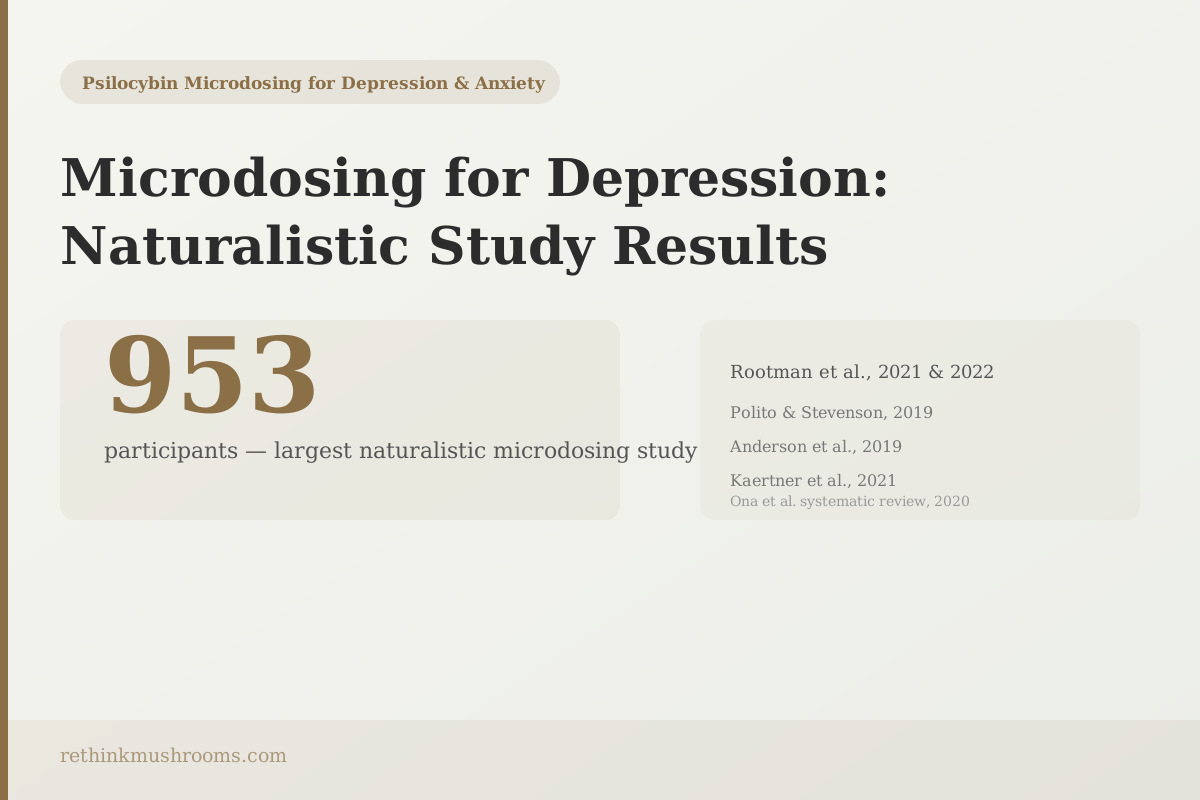
953 microdosers
A prospective naturalistic study tracked 953 psilocybin microdosers and 180 non-microdosing comparators for roughly 30 days and found small-to-medium improvements in mood and mental health. But naturalistic designs cannot separate the drug from belief — which is exactly what this article unpacks.
Rootman et al. (incl. Stamets), Scientific Reports, 2022
8,700+
microdosers and controls in the larger Rootman 2021 cross-sectional study
6 weeks
daily diary tracking in the Polito 2019 study
26.6%
of microdosers reported improved mood (Anderson 2019)
Rootman et al. (incl. Stamets), Scientific Reports, 2022
 View as image ↗
In 2021, a research team that included mycologist Paul Stamets published data on 4,050 people already microdosing psychedelics in their everyday lives.[1] Compared to 4,653 non-microdosers, the microdosers who reported existing mental health concerns showed lower levels of depression and anxiety. It was the largest naturalistic dataset on psilocybin microdosing assembled to that point, and it attracted wide attention. A prospective follow-up the next year tracked a smaller sample — 953 microdosers and 180 comparators — over roughly 30 days and reported small-to-medium improvements in mood and mental health.[2]
What most coverage left out was an explanation of what "naturalistic study" actually means for interpreting those numbers. These participants were not randomly assigned. They were not blinded. They chose to microdose, believed it would help them, and then reported on it. Understanding what that design can and cannot tell you is the only honest way to read the evidence.
This is a cluster article within the complete guide to psilocybin microdosing. For the broader question of how naturalistic results compare to controlled trial evidence, see Microdosing for Depression: Research vs. Anecdote.
Key Takeaways
- Rootman et al. (2021) compared 4,050 microdosers with 4,653 non-microdosers in a cross-sectional survey; among participants who reported mental health concerns, microdosers showed lower levels of depression and anxiety across gender
- Rootman et al. (2022) followed a prospective sample of 953 microdosers and 180 comparators over roughly 30 days; microdosers showed small-to-medium improvements in mood and mental health versus comparators, and combining psilocybin with lion's mane and niacin (the Stamets Stack) did not add to mood benefits beyond psilocybin alone
- Polito and Stevenson (2019) tracked 98 participants in daily diaries over 6 weeks; from baseline to completion, reported depression and stress fell and absorption rose, but neuroticism actually increased over the study period — a mixed result rather than uniform improvement
- Anderson et al. (2019) surveyed self-identifying microdosers and found 26.6% cited improved mood as the primary benefit; 18.0% reported physical discomfort and 6.7% reported increased anxiety as challenging outcomes
- Ona et al.'s 2020 systematic review concluded that most positive microdosing evidence comes from unblinded observational studies, making placebo contribution difficult to rule out
- Kaertner et al. (2021) found that positive baseline expectations significantly predicted mental health improvement, meaning the most optimistic participants consistently reported the best outcomes
Why Microdosing Research Uses Naturalistic Studies Instead of Clinical Trials
In most drug research, a randomized controlled trial is the standard approach to establishing whether a drug works. Participants are randomly assigned to receive either the active compound or a placebo, neither side knows who got which, and any difference in outcomes can be attributed to the drug rather than to expectation or chance.
For psilocybin microdosing, running that kind of trial is genuinely difficult. Psilocybin is a Schedule I substance in the United States and a controlled drug in most countries. Getting regulatory approval to administer it repeatedly over weeks requires significant resources and years of institutional work. Most academic research groups cannot do it.
Naturalistic studies fill that gap. Researchers observe people who are already microdosing in their own lives, measure their psychological state over time, and compare them to people who are not microdosing. This approach offers things that controlled trials usually cannot: real-world conditions, longer observation periods, and sample sizes that single-site laboratory studies rarely reach.
The tradeoff is that naturalistic studies cannot establish whether the drug caused the observed changes. The people being observed chose to microdose. They were not randomly assigned. That single design choice is what limits what the naturalistic literature can tell us, and it is the thread running through every study discussed in this article.
The Rootman 2021 Study: Thousands of Microdosers, Lower Depression, One Critical Design Limit
Rootman and colleagues compared 4,050 adults who reported currently microdosing psychedelics to 4,653 adults who reported not using them, publishing the results in Scientific Reports in 2021.[1] Participants completed validated scales measuring depression, anxiety, and stress. Overall, microdosers looked demographically similar to non-microdosers — but among the subgroup who reported existing mental health concerns, microdosers scored lower on depression and anxiety across gender.
The effect was most pronounced in the subgroup that had come into the study with mental health concerns. Among participants who reported depression or anxiety as a primary motivation for microdosing, the gap between microdosers and comparators was especially wide. This pattern appears in several naturalistic datasets and is consistent with the idea that microdosing affects people who are already struggling differently than it affects people who are baseline-well.
The sample — more than 8,700 people across both groups — stands out in a field where most controlled trials involve 20 to 50 participants. But the design was cross-sectional, meaning everyone was measured once at a single point in time. That approach cannot answer the most important alternative question: maybe people with lower depression are simply more likely to start microdosing. People who feel worse might not get around to it; people who feel better might be more likely to try something new. Cross-sectional comparisons cannot rule this out.
The participants also self-selected into the study. They were interested enough in psilocybin microdosing to participate in research about it. That interest almost certainly carries beliefs about what microdosing will do, and those beliefs shape self-reported outcomes in ways the design could not separate from pharmacological effects.
The Rootman 2022 Follow-Up: Tracking 953 Microdosers Over 30 Days
To address some of these limitations, the same team published a prospective study in 2022 that tracked 953 microdosers and 180 non-microdosing comparators drawn from the same app-based population.[2] Participants were measured at baseline and again about 30 days later. This design is methodologically stronger than a cross-sectional snapshot because it detects within-person change over time, not just differences between groups at a single moment.
The result held. Microdosers showed small-to-medium improvements in mood and mental health over the follow-up period, compared to non-microdosing comparators. The improvements were present across multiple mental health measures and were not fully explained by baseline differences.
One specific finding from this study has relevance to a widely discussed combination: participants using the Stamets Stack, meaning psilocybin combined with lion's mane mushroom and niacin, did not show significantly greater mood improvements than participants microdosing psilocybin alone. The combination formula's popularity is not matched by its performance in the best available naturalistic dataset.
Rootman et al. (incl. Stamets) (2022) · Scientific Reports
- Population
- 953 psilocybin microdosers and 180 non-microdosing comparators from a mobile-app population
- Intervention
- Self-directed psilocybin microdosing, tracked over ~30 days
- Comparator
- Non-microdosing adults measured over the same period
- Finding
- Microdosers showed small-to-medium improvements in mood and mental health, generally consistent across age, gender, and presence of mental health concerns. Combining psilocybin with lion's mane and niacin (the Stamets Stack) did not improve mood beyond psilocybin alone, though it was linked to psychomotor gains in older adults.
positive Prospective and comparator-controlled, which is stronger than a one-time survey — but still unblinded. Participants knew they were microdosing throughout, so expectancy cannot be separated from any pharmacological effect.
Rootman et al., Scientific Reports, 2022
The prospective design still could not remove the blinding problem. Participants knew whether they were microdosing throughout the 30-day period. They carried expectations about what microdosing would do for them. What looks like pharmacological improvement in this data may still partially reflect those expectations. For a closer look at how beliefs about microdosing shape the outcomes people report, see Expectancy Effects in Microdosing: How Belief Shapes Experience.
Polito's 6-Week Diary: The Only Study That Tracked Daily Change Over Time
Polito and Stevenson ran a different kind of naturalistic study in 2019: a 6-week daily diary study with 98 participants who were about to begin microdosing psychedelics.[3]
Daily diary designs are more demanding than cross-sectional surveys. Participants report on their psychological state every day, generating a dense within-person record over time. This approach can answer questions that single-measurement studies cannot: how quickly do changes appear, do they persist, and is the trajectory smooth or does it fluctuate?
Polito's results were genuinely mixed. Daily ratings showed a general lift in psychological functioning on dosing days, but with limited carry-over to the days that followed. Comparing baseline to the end of the six weeks, participants reported lower depression and stress, less distractibility, and greater absorption.
But the same pre-to-post comparison also surfaced something that rarely gets mentioned: neuroticism, the tendency toward emotional instability and negative feeling states, actually increased over the study period rather than decreasing. The improvements in mood and stress did not arrive as a uniform package, and the study's own data recorded a move in the opposite direction on one of the core personality measures.
This matters for how the daily-diary evidence gets summarized. The headline that "depression and stress fell" is accurate but incomplete: the same participants also reported rising neuroticism, and the day-of boosts largely faded by the next day. Polito's design was the only one in the naturalistic literature to measure every day, which is precisely why it could surface this more complicated picture rather than a single tidy before-and-after improvement.
For a full treatment of what the daily diary and self-report research shows about emotional stability over time, see Microdosing for Emotional Regulation: Self-Report Studies.
What the Survey Data Adds: 26.6% Improved, 6.7% Got Worse
Anderson and colleagues published a qualitative codebook of reported microdosing benefits and challenges in 2019, based on surveys of self-identified microdosers across a range of substances including psilocybin.[4]
Improved mood was the most frequently cited benefit: 26.6% of participants named it. Enhanced focus came second at 14.8%. Among psilocybin-specific microdosers, mood improvement was rated as the single most important benefit of the practice.
The challenging outcomes deserve equal attention and receive much less of it. Physical discomfort was reported by 18.0% of participants. Increased anxiety was reported by 6.7%.
That 6.7% figure is not a rounding error. It represents about one in fifteen people in this sample who tried microdosing and found their anxiety got worse, not better. The same dataset that establishes mood improvement as the most commonly reported benefit also contains this adverse signal. Both outcomes are real. The question of who gets which is not answered by the survey data alone.
Safety
ModerateMicrodosing is not an established treatment — and a minority report worse anxiety
Concern
In Anderson et al.'s survey, 6.7% of microdosers reported increased anxiety and 18.0% reported physical discomfort as challenging outcomes. Psilocybin remains a Schedule I substance in the United States, and placebo-controlled trials have not shown a benefit over placebo for depression or anxiety.
What the research says
The naturalistic findings describe what people who choose to microdose experience; they do not establish that microdosing is safe or effective as a treatment. People with depression or anxiety have evidence-based options that microdosing has not been shown to match.
Particularly relevant for: Anyone considering microdosing for a mental health condition
What to do
This is educational information, not medical advice. Talk to a qualified clinician before starting or stopping any treatment for depression or anxiety.
Anderson et al., Harm Reduction Journal, 2019; Cavanna et al., Translational Psychiatry, 2022
For a detailed look at the two-directional anxiety findings across the microdosing research, including the populations that appear more likely to report adverse responses, see Microdosing Psilocybin for Anxiety: What We Know.
The Self-Selection Problem: Why Naturalistic Samples Skew Positive From the Start
Every naturalistic microdosing study shares the same foundational limitation: the people who microdose and then participate in research about it are not typical.
Kaertner and colleagues examined this problem directly in 2021.[5] The team, which included Robin Carhart-Harris, measured participants' expectations about microdosing before they began, then tracked mental health outcomes over time. Positive expectations at baseline significantly predicted mental health improvement. The stronger someone's belief that microdosing would help, the better their outcomes looked.
This explains a lot about the gap between naturalistic results and controlled trial results. In a naturalistic study, participants have made an active choice to microdose. Many have read about its benefits, believe in its potential, and are paying close attention to how they feel. A controlled trial participant is randomly assigned and may or may not expect anything. These are structurally different populations, and the difference matters when you are trying to separate pharmacological effects from belief effects.
Ona and colleagues reached the same conclusion through systematic review in 2020.[6] Their review was the first formal meta-level assessment of the microdosing literature. The central finding was that the most positive evidence for microdosing comes from unblinded observational studies, not controlled designs. Placebo contribution to the reported benefits cannot be quantified from this literature, but the reviewers concluded it was likely.
Neither the Kaertner finding nor the Ona review means that the naturalistic results are fabricated. They mean the results reflect a combination of pharmacological effects, expectancy effects, and self-selection effects that the existing designs cannot disentangle.
Fact Check
Does the research prove microdosing treats depression?
The claim
“The research proves that psilocybin microdosing treats depression and anxiety.”
Media coverage of large naturalistic datasets such as Rootman 2021, which reported lower depression and anxiety among microdosers.
What research shows
OverstatedEvery large positive dataset is naturalistic: participants chose to microdose, knew they were doing it, and expected a benefit. When placebo-controlled trials (Szigeti 2021, Cavanna 2022) added a real comparison, the advantage over placebo largely disappeared.
Naturalistic studies reliably show what committed microdosers report. They cannot show that psilocybin, rather than expectancy, caused it — and Kaertner 2021 found that baseline expectations predicted who improved most.
Rootman 2021 & 2022; Szigeti 2021; Cavanna 2022; Kaertner 2021; Ona 2020
What Naturalistic Studies Can Establish, and Where Only Controlled Trials Can Go
Naturalistic microdosing research answers one question with consistency: among people who choose to microdose psilocybin in their daily lives, what do they report?
The answer, reproduced across multiple independent research groups and thousands of participants, is meaningful improvement in depression, anxiety, stress, and mood over weeks to months. The Rootman 2021 cohort showed this cross-sectionally across more than 8,000 people. The 2022 study showed it prospectively in 953 microdosers over 30 days. Polito's daily diary showed it within individuals across 6 weeks. Anderson's codebook identified mood improvement as the most commonly cited experience. This is a consistent signal, not noise.
What naturalistic studies cannot establish is that psilocybin caused those improvements. The missing element is a credible comparison condition: a group of people who believed they were microdosing, followed the same protocols, and reported on themselves with the same level of attention, but were actually taking a placebo. Without that, the pharmacological signal and the expectancy signal cannot be separated.
Controlled trials that have applied that comparison have produced different results. Cavanna and colleagues ran a double-blind, placebo-controlled study in 34 people beginning to microdose psilocybin mushrooms and found no improvement in well-being, creativity, or cognitive function beyond placebo.[7] Szigeti and colleagues' self-blinding citizen-science trial — at 191 participants, the largest placebo-controlled microdosing study to date — found that every outcome improved from baseline, but the placebo group improved just as much, with the small remaining differences attributable to participants breaking blind.[8] For what those controlled trials actually found, see Is Microdosing Just Placebo? The Self-Blinding Studies.
Evidence by Study Design
The Microdosing Paradox: The Biggest Studies Say Yes, the Most Rigorous Say No
The large, consistent positive findings all come from unblinded naturalistic studies. When placebo control is added, the benefit largely disappears. Longer bars indicate larger samples.
Naturalistic (unblinded)
Observes people who already chose to microdose. Large samples, real-world conditions — but expectancy and self-selection cannot be ruled out.
Rootman 2021
n = 4,050 vs 4,653Cross-sectional survey (unblinded)
Lower depression & anxiety among microdosers with mental health concerns
Rootman 2022
n = 953 vs 180Prospective, ~30 days (unblinded)
Small-to-medium improvements in mood & mental health
Polito 2019
n = 986-week daily diary (unblinded)
Depression & stress fell; neuroticism rose over the study
Anderson 2019
n = 278Qualitative survey codebook (unblinded)
26.6% reported improved mood; 6.7% reported worse anxiety
Placebo-controlled (blinded)
Compares microdosing against an identical placebo. Smaller and harder to run — but the only design that isolates the drug from belief.
Szigeti 2021
n = 191Self-blinding, placebo-controlled
Improvements matched placebo once blind-breaking was accounted for
Cavanna 2022
n = 34Double-blind, placebo-controlled
No benefit beyond placebo on well-being, creativity, or cognition
Source: Rootman 2021 & 2022, Polito 2019, Anderson 2019 (naturalistic); Szigeti 2021, Cavanna 2022 (controlled)
There is a version of the naturalistic data that remains meaningful even after acknowledging this. Controlled microdosing trials typically test a single dose or a short protocol under clinical conditions. Naturalistic studies capture repeated real-world microdosing over weeks and months, with real social stressors, real relationships, and the full range of daily life. It is possible that something about sustained real-world microdosing in natural conditions produces effects that a brief clinical protocol is not designed to detect. That is a hypothesis, not an established finding, but it is why the naturalistic literature remains worth reading carefully rather than simply setting aside.
For a full comparison of how survey data, naturalistic observational data, and clinical trial data compare on the mood question, see Microdosing and Mood Improvement: Clinical and Survey Data. For readers interested in mushroom-based mood support without the psychedelic complexity, see Functional Mushrooms for Depression: Non-Psychedelic Options.
The Bottom Line
Naturalistic studies are the largest and most consistent evidence base for psilocybin microdosing effects on depression and anxiety, with the Rootman team's work providing the most rigorous real-world data — a cross-sectional comparison of more than 8,000 people (2021) and a prospective 30-day follow-up of 953 microdosers (2022). The finding that committed microdosers report meaningful improvements in mood, depression, anxiety, and stress is reproducible across independent research groups. The core interpretive limit is that these designs cannot establish causation: self-selection, unblinded conditions, and the expectancy effects documented by Kaertner et al. (2021) mean the pharmacological signal is real but not yet separable from belief effects. When placebo-controlled trials removed that ambiguity, the advantage over placebo largely disappeared.
Frequently Asked Questions
Sources & References
- 1RTHM-00715·Rootman, Joseph M et al. (2021). “Adults who microdose psychedelics report health related motivations and lower levels of anxiety and depression compared to non-microdosers..” Scientific reports.Study breakdown →PubMed →↩
- 2RTHM-01611·Rootman, Joseph M et al. (2022). “Psilocybin microdosers demonstrate greater observed improvements in mood and mental health at one month relative to non-microdosing controls..” Scientific reports.Study breakdown →PubMed →↩
- 3RTHM-01113·Polito, Vince et al. (2019). “A systematic study of microdosing psychedelics..” PloS one.Study breakdown →PubMed →↩
- 4RTHM-00541·Anderson, Thomas et al. (2019). “Psychedelic microdosing benefits and challenges: an empirical codebook..” Harm reduction journal.Study breakdown →PubMed →↩
- 5RTHM-01371·Kaertner, L S et al. (2021). “Positive expectations predict improved mental-health outcomes linked to psychedelic microdosing..” Scientific reports.Study breakdown →PubMed →↩
- 6RTHM-01271·Ona, Genís et al. (2020). “Potential safety, benefits, and influence of the placebo effect in microdosing psychedelic drugs: A systematic review..” Neuroscience and biobehavioral reviews.Study breakdown →PubMed →↩
- 7RTHM-00748·Cavanna, Federico et al. (2022). “Microdosing with psilocybin mushrooms: a double-blind placebo-controlled study..” Translational psychiatry.Study breakdown →PubMed →↩
- 8RTHM-01441·Szigeti, Balázs et al. (2021). “Self-blinding citizen science to explore psychedelic microdosing..” eLife.Study breakdown →PubMed →↩