Microdosing for Depression & Anxiety
6 weeks
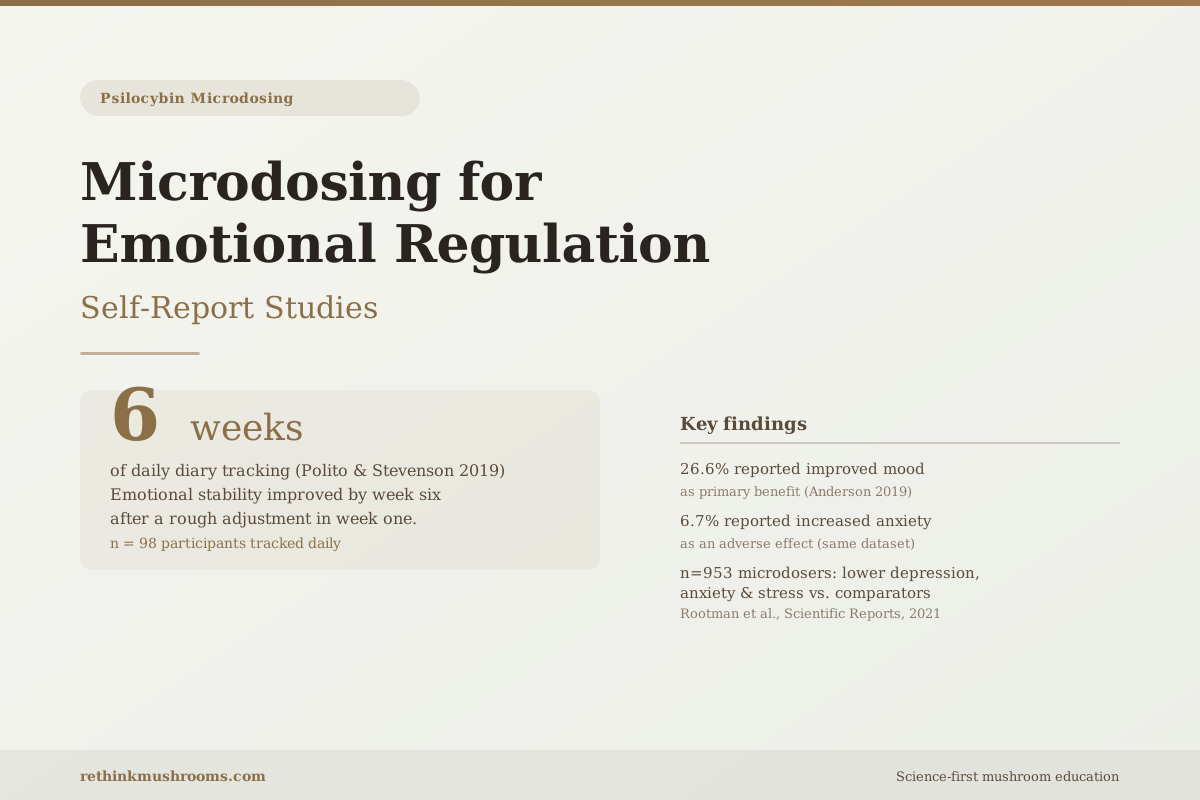
Polito and Stevenson tracked 98 people through six weeks of daily microdosing. Emotional stability improved significantly by week six, but emotional reactivity increased slightly in week one before declining.
Polito & Stevenson, PLOS ONE, 2019
98 people
tracked daily for 6 weeks in the only diary-based microdosing study on emotional stability
26.6%
of surveyed microdosers identified improved mood as a key benefit (Anderson et al. 2019)
Week 1
often shows a temporary increase in emotional reactivity before stability improves by week 6
Polito & Stevenson, PLOS ONE, 2019
 View as image ↗
Emotional regulation is the ability to modulate emotional responses, to feel something without being overwhelmed by it. Self-report studies consistently find that people who microdose psilocybin over four to six weeks report improvements in emotional stability, though a meaningful subset, particularly in the first week, experience heightened reactivity before that stability arrives.
The most detailed picture of how this unfolds over time comes from a 2019 study by Polito and Stevenson at Macquarie University. They tracked 98 people through six consecutive weeks of daily microdosing, asking each participant to fill out questionnaires every day. What they found, a first-week increase in emotional reactivity followed by meaningful improvement by week six, is the most practically important finding in the self-report literature on microdosing and emotional regulation. It is also almost entirely absent from consumer health content.
For an overview of what microdosing is and how it's practiced, the complete guide to psilocybin microdosing covers the basics. This article focuses on what self-report research specifically reveals about emotional regulation: the daily diary data, the large-scale surveys, the neurobiological hypothesis, and the fundamental question these studies cannot answer.
Key Takeaways
- Polito and Stevenson's 2019 daily diary study (98 participants over 6 weeks) found emotional stability improved by week six, preceded by a temporary increase in emotional reactivity in week one
- Anderson et al.'s 2019 codebook found improved mood was the most commonly reported benefit of microdosing (26.6%), while 6.7% of the same respondents reported increased anxiety as a side effect
- Hutten et al.'s 2019 survey found mood improvement was the top motivation for taking up microdosing, alongside performance enhancement and general health goals
- Rootman et al.'s 2021 cross-sectional study found 953 microdosers scored significantly lower on depression, anxiety, and stress compared to 180 non-microdosing comparators across validated scales
- Kaertner et al. (2021) found that positive expectations measured before starting microdosing predicted mental health improvements more strongly than dose, substance, or frequency
- Raval et al. (2021) found psilocybin increases synaptic density in the brain, providing a neurobiological mechanism through which emotional regulation circuits could theoretically strengthen
Six Weeks in a Diary: Emotional Stability Improved, But Not Right Away
The most granular window into microdosing and emotional regulation comes from a 2019 study by Vince Polito and Richard Stevenson at Macquarie University in Australia. They recruited 98 people who were already microdosing psychedelics, most using psilocybin or LSD on self-chosen schedules, and asked each person to complete daily questionnaires for six weeks.[1]
Among the outcomes tracked was a personality dimension called neuroticism. Neuroticism measures emotional instability and moodiness, the tendency to experience negative emotions more intensely and more persistently than average. It sits close to the center of what emotional regulation means in daily life: people who score high on neuroticism find it harder to modulate their emotional responses when something difficult happens.
Two things emerged from the six weeks of data. First, the positive finding: depression and stress scores fell meaningfully across the full study period. Participants felt less depressed and less stressed by week six than when they started.
Second, the temporal finding: neuroticism increased slightly in week one before declining.[1]
The emotional system became more reactive, or at least more apparent, in the first seven days of microdosing. Then, over the following five weeks, it settled below where it had started. By week six, emotional stability was meaningfully improved from baseline.
Polito and Stevenson described this as a possible adjustment period. Whether the first-week increase in neuroticism is pharmacological, meaning psilocybin temporarily sensitizes emotional responses, or psychological, meaning people pay closer attention to their inner states when starting a deliberate mental health practice, cannot be determined from diary data alone. What the data establishes is the trajectory.
A person who starts microdosing for emotional regulation and finds themselves slightly more emotionally reactive in the first week is not necessarily having a bad response. The pattern observed by Polito and Stevenson suggests week one may often be the hardest part.
This daily tracking design is meaningfully different from the surveys and snapshot comparisons that dominate the rest of the microdosing literature. By measuring the same individuals each day across six weeks, Polito and Stevenson captured within-person change over time rather than comparing groups of different people at a single moment. That design makes the results harder to explain away as a selection effect, since each participant serves as their own comparison point.
The limitation the design cannot overcome is the absence of a blinded control condition. Participants knew they were microdosing. They were also tracking their own mood daily, which itself can shift how people experience and report their emotional states. The observed improvements are consistent with psilocybin's pharmacology, with the attention effect of daily mood monitoring, or with the natural emotional arc of committing to a new practice with positive expectations.
What the Surveys Found: 26.6% Better Mood, 6.7% Worse Anxiety
Beyond the diary study, two large surveys from 2019 capture the breadth of emotional experiences that people who microdose actually report.
Anderson et al. conducted a systematic qualitative analysis of microdosing reports, creating what they called an empirical codebook, a structured account of both benefits and challenging experiences drawn from community reports.[2] The most commonly reported benefit was improved mood, cited by 26.6% of respondents. Among psilocybin-specific users, mood improvement was rated as the most important benefit. Focus and energy improvements followed.
The same codebook captured the adverse side of the picture. Among challenging experiences, physiological discomfort appeared in 18.0% of reports. Increased anxiety appeared in 6.7% of reports.[2]
Both numbers are from the same dataset, describing the same practice in the same population. The 26.6% and the 6.7% are not contradictory. They describe real variation in how microdosing affects different people's emotional lives. Some people who microdose for emotional regulation report better emotional regulation. Some report worse anxiety. The honest account of the survey literature includes both.
Hutten et al. published a complementary survey the same year, examining the motivations and side effects of people who microdose.[3] Mood improvement appeared as the most commonly cited motivation, alongside enhanced cognitive performance and general health goals. On the adverse side, anxiety, concentration difficulties, and physiological discomfort appeared frequently enough to be systematically catalogued.
The surveys align with each other across the 2019 literature: emotional improvement is the dominant experience reported by microdosers, mood enhancement is the primary motivation, and a meaningful minority experience emotional effects they did not intend.
Survey data has a structural ceiling on what it can tell us. The samples are self-selected communities of people who are already microdosing, typically recruited from online forums and tracking platforms. People who had uniformly negative experiences may not persist in microdosing communities long enough to be surveyed. The result is a population skewed toward continued use, which is likely also skewed toward positive experience.
For what the anxiety side of this picture looks like in detail, see Microdosing Psilocybin for Anxiety: What We Know.
The Largest Comparison: 953 Microdosers Against 180 Non-Microdosers
For a broader picture of emotional outcomes in microdosers versus non-microdosers, the Rootman studies provide the most substantial observational data available.
In 2021, Rootman et al. compared 953 people who reported current microdosing against 180 non-microdosing comparators across several validated mental health measures.[4] The study was conducted through a global microdosing tracking app, drawing a sample of people already motivated to monitor their own mental health.
Microdosers scored significantly lower on depression, anxiety, and stress across multiple psychometric scales. The differences were consistent across measures. Among the subgroup who reported pre-existing mental health concerns, the differences between microdosers and comparators were most pronounced.
The design was cross-sectional: a single snapshot in time, not a before-and-after measure. Cross-sectional comparisons cannot determine whether microdosers have lower emotional distress because they microdose, or whether people with naturally lower emotional distress are more likely to sustain a microdosing practice. Both explanations fit the data equally.
The 2022 follow-up added the longitudinal dimension the first study lacked. The same 953 microdosers and 180 comparators were assessed 30 days after baseline.[5] Microdosers showed greater improvements in mood and mental health at one month compared to the non-microdosing group. Effect sizes were small to medium: real and consistent, but not large.
One finding from Rootman 2022 is worth noting for readers interested in specific protocols. Participants using the Stamets Stack, a combination of psilocybin mushrooms, lion's mane mushroom, and niacin promoted as a synergistic regimen, did not show significantly better emotional outcomes than those using psilocybin alone. The combination protocol offered no measurable emotional advantage in this analysis.
For the methodological detail on what naturalistic observational studies can and cannot establish, see Microdosing for Depression and Anxiety: Naturalistic Study Results.
The Brain-Level Theory: Why Emotional Regulation Might Actually Improve
Every finding discussed above comes from what people report about their inner experience. None of it measures what is happening in the brain directly. But animal research provides a biological hypothesis for why emotional regulation could genuinely improve with psilocybin exposure.
Raval et al. administered a single dose of psilocybin to pigs and measured structural changes in the brain using PET imaging.[7] Psilocybin increased synaptic density: the number of connection points between neurons grew after a single dose. The density of 5-HT2A receptors, which are the primary sites through which psilocybin produces its effects, decreased.
Why does this matter for emotional regulation?
The brain manages emotions partly through a circuit between the region that generates emotional reactions and the region that evaluates and moderates them. Think of it as the emotional-response system and the thinking-override system. The override system works by sending signals through synaptic connections. More connections mean more capacity for modulation.
If psilocybin produces a similar increase in synaptic density in humans, it could theoretically provide the brain with greater infrastructure for top-down emotional regulation. More connections to work with when the thinking part of the brain tries to turn down an emotional response.
The decrease in 5-HT2A receptor density is also relevant here. These receptors are involved in emotional reactivity. Raval's finding suggests that psilocybin both adds synaptic resources for regulation and reduces the receptor density that mediates the intensity of raw emotional responses. The net effect, more top-down connections plus lower emotional sensitivity at the receptor level, would point toward improved regulation capacity.
This remains a biological hypothesis, not a confirmed mechanism in microdosing humans. Pig brains are not human brains. Raval's study used a single dose, not a repeated microdosing regimen. The chain from "psilocybin increases synaptic density in pigs" to "humans regulate their emotions better after six weeks of microdosing" crosses several gaps that current research has not bridged.
What the animal data provides is biological plausibility. The diary and survey improvements documented in this article could be explained by expectancy and ritual. They could also be explained by a genuine pharmacological effect on the brain's regulatory architecture. The Raval finding keeps the second explanation viable.
The Question the Data Cannot Resolve: Psilocybin or Belief?
All of the self-report evidence reviewed in this article shares a structural limitation: participants knew they were taking a psychedelic substance. They had expectations about what that would do to their emotional life.
Kaertner et al., working with collaborators including Robin Carhart-Harris at Imperial College London, measured participants' positive expectations about microdosing before their first dose, then tracked mental health outcomes over time.[6]
The result: positive expectations at baseline were a significant predictor of the mental health improvements that followed. The expectancy score explained a substantial portion of the variance in who improved and by how much. Participants who entered the study expecting their emotional life to improve were substantially more likely to report that it had.
This is not a verdict that the improvements are illusory. Expectancy effects are real neurobiological phenomena. A person who believes microdosing will help their emotional regulation may approach difficult situations differently, interpret their own reactions differently, and have genuinely different emotional experiences as a result. The change is real even if psilocybin's pharmacology is not the primary driver.
What Kaertner's finding means for interpreting the diary data, surveys, and naturalistic comparisons in this article is this: they capture a combination of pharmacological effect and belief-driven effect. Currently there is no method within unblinded self-report studies to separate those contributions.
The controlled trials that try to isolate the pharmacological effect by blinding participants to whether they received active psilocybin or placebo have generally found smaller emotional benefits, or none. The expectancy effects in microdosing article examines this mechanism in depth.
For the full picture of what clinical and survey data show on mood specifically, see Microdosing and Mood Improvement: Clinical and Survey Data. For the depression-specific evidence, see Microdosing for Depression: Research vs. Anecdote. For what the research shows on risks and adverse effects, see Microdosing Safety: What the Research Shows.
The Bottom Line
The self-report literature on microdosing and emotional regulation points consistently toward improvement, with important caveats. Polito and Stevenson's 2019 daily diary study is the most granular piece of evidence: 98 participants tracked over six weeks showed emotional stability improving by week six, preceded by a temporary first-week increase in neuroticism. Survey data from Anderson 2019 finds 26.6% of microdosers report mood improvement as their primary benefit, while 6.7% report increased anxiety. Rootman 2021 and 2022 show lower depression, anxiety, and stress in 953 microdosers versus comparators, with small-to-medium improvements at 30 days. Raval 2021 provides a neurobiological hypothesis in animal tissue: increased synaptic density and reduced 5-HT2A receptor density could theoretically strengthen the brain's emotional regulation circuits. The central limitation across all this data is that Kaertner 2021 found positive expectations at baseline predicted outcomes more strongly than dose or substance, meaning that in unblinded self-report studies, the pharmacological and expectancy contributions to emotional improvement cannot currently be separated.
Frequently Asked Questions
Sources & References
- 1. Source details for this reference are not yet available.
- 2. Source details for this reference are not yet available.
- 3. Source details for this reference are not yet available.
- 4. Source details for this reference are not yet available.
- 5. Source details for this reference are not yet available.
- 6. Source details for this reference are not yet available.
- 7. Source details for this reference are not yet available.