Microdosing
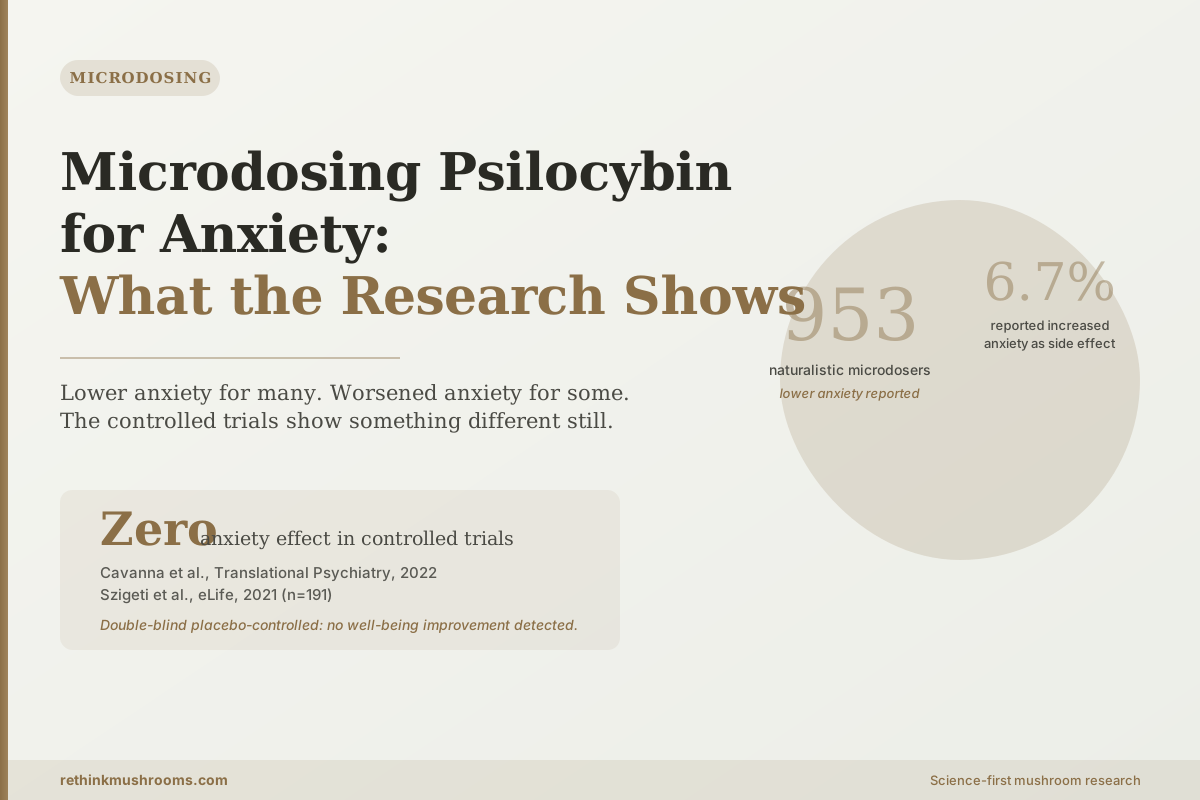
953 naturalistic microdosers
A 30-day prospective study of 953 microdosers found small-to-medium improvements in anxiety versus a comparison group, but the same body of survey research shows 6.7% of users report increased anxiety as a side effect.
Rootman et al., Scientific Reports, 2022
6.7%
of users report increased anxiety as a challenging side effect
Week 1
shows increased neuroticism before anxiety improves by week 6
Zero
anxiety effect detected in double-blind placebo-controlled trials
Rootman et al., Scientific Reports, 2022
 View as image ↗
The 2019 survey that found improved mood in 26.6% of microdosers also found that 6.7% reported increased anxiety as a challenging outcome. These are not contradictory findings. They are from the same dataset, describing the same drug in the same population.
Microdosing psilocybin for anxiety is a two-way bet. Naturalistic studies of thousands of people show that microdosers, on average, report lower anxiety scores than non-microdosers. But when researchers add a placebo group and neither side knows what was taken, the anxiety benefit disappears. And a meaningful minority of people who microdose report their anxiety gets worse, not better.
Understanding these results requires looking at multiple types of evidence: surveys, naturalistic observational studies, daily diary research, and placebo-controlled trials. Understanding what each type can and cannot tell you changes how you interpret the findings. Our complete guide to microdosing psilocybin covers the broader picture; this article focuses specifically on the anxiety evidence.
Key Takeaways
- Naturalistic studies of 953 microdosers found significantly lower self-reported anxiety and depression compared to non-microdosers, but these studies had no placebo group and participants knew they were microdosing (Rootman et al., 2021)
- A 30-day prospective follow-up of the same cohort found small-to-medium improvements in anxiety and mental health versus comparators (Rootman et al., 2022)
- 6.7% of microdosers in survey research reported increased anxiety as a side effect, and a subset reported it was significantly disruptive (Anderson et al., 2019)
- A 6-week daily diary study of 98 participants found anxiety and stress decreased by week 6, but the first week brought a measurable increase in neuroticism (Polito & Stevenson, 2019)
- Positive expectations at baseline were the strongest predictor of improved mental health outcomes, explaining much of the gap between observational and controlled results (Kaertner et al., 2021)
- Double-blind placebo-controlled trials found no well-being improvements over placebo; effects observed in naturalistic studies do not replicate when expectancy is controlled (Cavanna et al., 2022; Szigeti et al., 2021)
The Paradox at the Center: Same Research, Two Opposite Effects
Start with what the survey literature actually shows about anxiety, and you immediately hit the paradox.
Hutten and colleagues surveyed people who microdose psychedelics and asked about their primary motivations and side effects.[3] Mood improvement was the top reported motivation. But among the challenging effects, anxiety appeared as a significant category: concentration difficulties and physiological discomfort appeared alongside anxiety-related responses.
Anderson and colleagues published a complementary study the same year, creating a qualitative codebook from microdosing user reports.[9] Improved mood appeared in 26.6% of reports as a positive experience. Increased anxiety appeared in 6.7% of reports as a challenging experience. Both numbers come from the same research community, the same drug, and largely the same population.
This is not a data problem. It is the honest picture of a drug that affects people differently.
The reason this matters for anxiety specifically: anxiety is bidirectional in a way that depression typically is not. Psychedelic compounds activate the brain's serotonin 2A receptors, which regulate emotional arousal. For some people, this activation reduces the chronic low-level activation that underlies anxiety. For others, it increases arousal in a way that produces or intensifies anxiety symptoms. Both outcomes are pharmacologically plausible.
No competitor article covers this paradox directly. Most either cite the positive naturalistic data and stop, or dismiss all evidence as "anecdotal." Neither is accurate.
What 953 Naturalistic Microdosers Reported at One Month
The largest naturalistic dataset on microdosing and anxiety comes from Rootman and colleagues, in a pair of studies published in Scientific Reports.
The first study, published in 2021, compared 953 microdosers to 180 non-microdosing comparators using validated mental health scales.[1] Microdosers reported significantly lower depression, anxiety, and stress across multiple measures. The effect was especially pronounced in the subgroup who microdosed specifically because of mental health concerns.
This is real data from real people using psilocybin in their actual lives. But it has a critical limitation: it is cross-sectional and self-selected. The people who choose to microdose and who agree to participate in research about microdosing are not a random sample of the population. They tend to be people who believe microdosing will help them, which introduces expectancy effects that are powerful enough to produce measurable mental health changes on their own.
The second Rootman study followed the same cohort prospectively over 30 days.[2] Within-person changes over a month showed small-to-medium improvements in mood and mental health scores versus the comparator group. Participants who used the Stamets Stack (psilocybin combined with lion's mane and niacin) showed similar mood outcomes to psilocybin alone, suggesting the combination did not add benefit for anxiety specifically.
For a deeper look at the methodology of these naturalistic studies and what they can and cannot establish about causation, see the naturalistic microdosing study data article.
What these studies do tell us: the people who microdose and who participate in research about it consistently report lower anxiety than comparable non-microdosers. This is a real observation. The scientific question is what causes it.
Six Weeks of Daily Diaries: The First-Week Problem
The most granular longitudinal data on microdosing and anxiety comes from Polito and Stevenson, who tracked 98 participants using daily diary measures over six weeks.[4]
The headline result: depression and stress decreased significantly over the six weeks. By week 6, emotional stability had improved meaningfully from baseline.
But the week-by-week pattern matters.
In the first week of microdosing, participants showed a measurable increase in neuroticism, a personality trait closely associated with anxiety and emotional reactivity.[4] For people starting microdosing specifically because of anxiety, this first-week adjustment period is practically important information. The drug that may reduce anxiety over weeks appears to first intensify certain anxiety-adjacent emotional responses before the picture improves.
This daily diary design, which tracked within-person change repeatedly over time rather than comparing groups at a single point, provides a kind of evidence that neither cross-sectional surveys nor single-session RCTs can capture. It suggests that the relationship between microdosing and anxiety is dynamic: it changes as dosing continues, and early experiences may not predict later outcomes.
The Polito 2019 study had no placebo group, which limits causal interpretation. But the temporal pattern it documents is unique in this literature. For readers interested in how emotional regulation changes during sustained microdosing, the microdosing for emotional regulation article covers this in more depth.
The 6.7% Who Get Worse: What the Side Effect Data Shows
The minority who experience increased anxiety from microdosing is small in percentage terms but large in absolute terms, given how many people microdose.
Anderson and colleagues documented this specifically in their codebook of challenging microdosing experiences.[9] Increased anxiety appeared as one of the more common challenging outcomes, representing 6.7% of the challenging experience reports. Physiological discomfort, which can manifest as racing heart, restlessness, or heightened physical arousal, appeared alongside anxiety as a distinct category.
Hutten and colleagues found a similar pattern in their survey on motives and side effects: anxiety and concentration difficulties were among the reported adverse experiences alongside the more commonly reported positive effects.[3]
Several factors appear to correlate with adverse anxiety responses in microdosers, though the data is observational rather than controlled:
People with pre-existing anxiety disorders may be at higher risk, particularly in early dosing cycles before the proposed adaptive effects develop. The first-week neuroticism finding from Polito's diary study supports this possibility.
Dose matters. What counts as a microdose varies widely among self-reported users, and doses at the higher end of the "micro" range are more likely to produce psychedelic-adjacent experiences, including heightened arousal and anxiety.
Set and setting influence acute responses to psychedelics even at low doses. Taking psilocybin during a stressful period or in an uncertain environment may increase the probability of an anxiogenic response.
For a comprehensive look at the full side effect profile across the microdosing literature, the microdosing side effects article covers what survey data shows about adverse experiences.
Why Expectations Predict Outcomes: The Kaertner Finding
If naturalistic microdosing studies consistently show anxiety benefits while controlled trials consistently show none, there must be something different between the two types of studies that explains the gap. Kaertner and colleagues identified what that something is.
Their 2021 study, published in Scientific Reports and co-authored by Carhart-Harris, measured participants' expectations about microdosing before they started and then tracked mental health outcomes over time.[5]
The result: positive expectations at baseline were significantly predictive of mental health improvements. Participants who expected microdosing to help their anxiety were substantially more likely to report that it did. The expectancy score explained a large portion of the variance in outcomes.
This is the mechanistic bridge between the observational data and the controlled null results. People who choose to microdose for anxiety relief hold strong positive expectations. Those expectations, measured before any substance is taken, predict a large fraction of the benefit they subsequently report. When a placebo control removes the drug-specific effect while leaving the expectancy effect intact, participants in the placebo group also improve, making the psilocybin effect undetectable in the between-group comparison.
Expectancy effects are not fake. They are real psychological processes that produce measurable changes in mood and anxiety. But they are not the same as the pharmacological action of psilocybin. Understanding which is which requires controlled trials.
What Happens When Researchers Add a Placebo Group
Two well-designed controlled studies have tested microdosing effects on anxiety and well-being with placebo groups.
Cavanna and colleagues conducted a double-blind, placebo-controlled trial of 34 participants, published in Translational Psychiatry in 2022.[6] Participants received either 0.5 grams of Psilocybe cubensis or a placebo. Neither participants nor researchers evaluating outcomes knew who received which.
The result: no improvements in well-being, creativity, or cognitive function with the active psilocybin dose compared to placebo. Participants who correctly identified that they had received psilocybin reported more intense acute effects, but those acute effects did not translate into psychological benefits. Feeling different did not mean getting better.
Szigeti and colleagues published a self-blinding citizen science study in eLife in 2021 with 191 participants. At the time, this was the largest placebo-controlled study of psychedelic microdosing ever conducted.[7] Participants created their own blinded doses and tracked outcomes in a structured app over time. Initial improvements in well-being, mindfulness, and thinking appeared across both active and placebo conditions. When researchers statistically modeled expectancy and blinding quality, the apparent drug-specific effects disappeared. No reliable differences from placebo remained.
The Szigeti self-blinding study is examined in depth in the article on whether microdosing is just placebo.
Together, these controlled results do not prove that microdosing has no anxiety effect. They prove that the effects are small enough that placebo-controlled trials with current sample sizes cannot detect them. There could be a real drug-specific anxiety benefit that is simply smaller than expectancy effects, and therefore invisible in comparisons that cannot remove expectancy from both groups equally.
A 2025 medical review by Kinderlehrer, examining mushrooms, microdosing, and mental illness outcomes, provides a current clinical perspective on where this evidence stands: the naturalistic data is encouraging but controlled evidence remains insufficient to establish efficacy for anxiety as a clinical target.[8]
State Anxiety vs. Trait Anxiety: Why the Distinction Matters
Not all anxiety is the same, and the microdosing literature does not always distinguish between types.
State anxiety is the acute, situational kind that most people experience in response to a specific stressor: a test, a difficult conversation, or a medical procedure. It rises and falls with circumstances and is generally self-limiting. Full-dose psychedelics have been tested for state anxiety in end-of-life contexts with strong results; this is a different evidence base from the microdosing literature.
Trait anxiety is the chronic, dispositional kind that colors everyday experience regardless of specific circumstances. People with high trait anxiety experience more anxiety more often, across a wider range of situations. This is the type most relevant to anxiety disorders and to the people most likely to microdose specifically for anxiety relief.
Most microdosing studies measure general anxiety scores that capture a blend of both types. The Rootman studies used validated depression, anxiety, and stress scales that reflect trait-level tendencies over time; these are the most relevant measures for chronic anxiety sufferers. The Polito diary study tracked within-person variation in a way that could capture both types, and found that the within-person trajectory mattered as much as the average score.
One practical implication from the data: the people in the Rootman studies with pre-existing mental health concerns showed the most pronounced improvements.[1] This suggests the highest-baseline-anxiety participants may have the most room to improve, though whether the improvement comes from the drug, from expectancy, or from the structured self-monitoring involved in naturalistic study participation cannot be separated.
For readers exploring anxiety support through functional mushrooms, the broader functional mushroom literature offers comparison points, particularly lion's mane and cognitive function research and mood research for non-psychedelic options.
What the Evidence Leaves Unanswered
The honest summary of where the anxiety evidence stands:
Naturalistic data consistently shows that microdosers self-report lower anxiety than non-microdosers. This effect appears across multiple studies, with the Rootman 2021 cohort (n=953) providing the largest and most carefully characterized dataset.[1]
Controlled trials cannot detect this benefit. Cavanna 2022 (n=34) and the Szigeti 2021 self-blinding study (n=191) both found no superiority over placebo for well-being outcomes.[6][7]
Expectancy explains a substantial portion of the gap between observational benefits and controlled null results.[5]
A meaningful minority, approximately 6.7%, report worsened anxiety.[9] This effect appears real and is not explained by placebo, since the people getting worse are not doing so because they expected to.
The first week may be harder than subsequent weeks, with neuroticism increasing before emotional stability improves.[4]
This is not "the evidence is mixed and we need more research." This is a coherent picture with specific, quantifiable observations. The uncertainty is about mechanism and magnitude, not about whether the effects exist.
For the full picture on how these anxiety findings connect to the depression evidence, including why the two conditions sometimes show different response patterns, see the microdosing for depression article.
The Bottom Line
Naturalistic studies consistently link psilocybin microdosing to lower self-reported anxiety, with the largest dataset (953 participants, Rootman et al., 2021 and 2022) showing small-to-medium improvements at one month. However, placebo-controlled trials by Cavanna (2022) and Szigeti (2021) found no well-being benefit over placebo, and Kaertner et al. (2021) showed that positive expectations at baseline explain a substantial portion of the naturalistic improvement. A meaningful minority, approximately 6.7%, report increased anxiety as a side effect. The current evidence cannot establish whether psilocybin directly reduces anxiety or whether the improvements observed in naturalistic settings are primarily driven by expectancy and self-selection effects.
Frequently Asked Questions
Sources & References
- 1. Source details for this reference are not yet available.
- 2. Source details for this reference are not yet available.
- 3. Source details for this reference are not yet available.
- 4. Source details for this reference are not yet available.
- 5. Source details for this reference are not yet available.
- 6. Source details for this reference are not yet available.
- 7. Source details for this reference are not yet available.
- 8. Source details for this reference are not yet available.
- 9. Source details for this reference are not yet available.