Microdosing
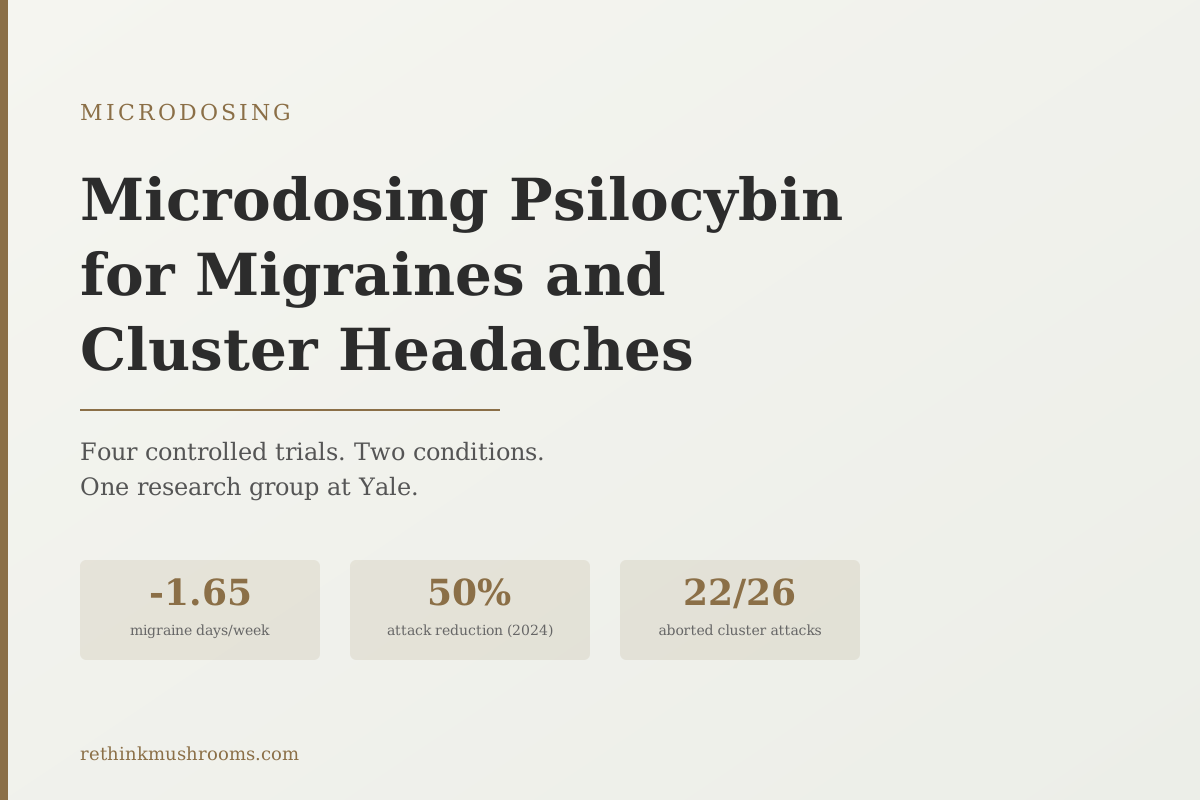
22/26 cluster patients aborted attacks
22 of 26 psilocybin users reported aborting cluster headache attacks in a clinical review. Controlled trials show even stronger migraine data: 1.65 fewer days per week vs placebo.
Henderson et al., Current Pain and Headache Reports, 2025
-1.65 days
migraine reduction per week vs placebo in Yale RCT (Schindler 2021)
50%
reduction in cluster headache attacks in blinded extension (Schindler 2024)
4 trials
from the Yale headache lab testing psilocybin for migraine or cluster headache (2021 to 2026)
Henderson et al., Current Pain and Headache Reports, 2025
 View as image ↗
The clearest data we have on microdosing psilocybin for migraines and cluster headaches comes from one research group at Yale, running one trial series over five years. What makes that series worth following isn't just the numbers. It's the finding buried inside the first trial: when researchers measured how intense participants' psychedelic experiences were during the psilocybin session, the intensity had no relationship to how much their migraines improved. The patients who barely felt anything got the same benefit as those who had vivid experiences.[1]
That single observation changed the research question. If the trip isn't what works, the mechanism is pharmacological, not psychological. And if the mechanism is pharmacological, it might engage at sub-perceptual doses. That premise is what links this headache research to microdosing psilocybin as a broader field.
Four controlled trials now define what we actually know. All four come from Emmanuelle Schindler's lab at Yale. The progression across 2021, 2022, 2024, and 2026 tells a story about two different conditions (migraine and cluster headache) with two different evidence tracks and two different levels of certainty.
Key Takeaways
- Psilocybin reduced weekly migraine days by 1.65 compared to 0.15 for placebo in a double-blind crossover trial, and this benefit was independent of how intense the psychedelic experience was (Schindler et al., Neurotherapeutics, 2021)
- The first cluster headache RCT technically missed its primary endpoint (p=0.251) because it was underpowered, not because the effect was absent; in chronic cluster headache specifically, the effect size was large (d=1.25) (Schindler et al., Headache, 2022)
- A blinded extension of the cluster headache trial found the psilocybin pulse regimen reduced attacks from 18.4 to 9.8 per week over eight weeks in chronic cluster patients, roughly 50% (Schindler et al., Journal of Neurological Sciences, 2024)
- A 2026 exploratory RCT from Yale is the first to directly compare single-dose versus repeat-dose psilocybin against active placebo for migraine prevention (Schindler et al., Headache, 2026)
- 22 of 26 psilocybin users reported aborting cluster headache attacks, and 25 of 48 reported terminating a full cluster period, in a clinical review of community-use data (Henderson et al., Current Pain and Headache Reports, 2025)
- In a survey of 250 chronic pain patients, migraine patients showed particularly strong responses to microdosing; across all conditions, microdosers averaged 6.51/10 pain relief versus 5.32/10 for conventional medications including opioids (Bonnelle et al., British Journal of Pain, 2022)
The 2021 Breakthrough: Psilocybin Cut Migraine Days 11x More Than Placebo
The Schindler lab's 2021 migraine trial was the first randomized controlled study of psilocybin specifically for migraine prevention.[1] It used a crossover design, meaning every participant received both psilocybin and placebo in separate sessions two weeks apart, with neither the participants nor the researchers knowing which was which at the time of treatment.
The dose was 0.143 mg/kg of psilocybin, approximately 10mg for a 70kg person. This is at the lower boundary of what produces perceptible effects: some participants reported mild experiences, others felt nothing. It is much lower than a standard recreational dose but not a classical microdose.
The primary result was clear. Over the two weeks following the psilocybin session, participants had 1.65 fewer migraine days per week compared to placebo's 0.15-day reduction. That's an eleven-fold difference.
| Outcome | Psilocybin | Placebo |
|---|---|---|
| Migraine day reduction per week | 1.65 | 0.15 |
| Pain severity | Reduced | No change |
| Abortive medication use | Reduced | No change |
Secondary measures moved in the same direction: fewer attacks, reduced pain severity, lower functional impairment, and fewer days needing emergency medications. The effects persisted for two full weeks after a single session, far longer than psilocybin remains in the body.
That duration points toward a lasting change in how pain circuits are organized, not just temporary relief while the drug is present. What kind of change is explored in detail in the mechanisms article for this cluster; see can sub-perceptual psilocybin reduce pain?.
The secondary analysis on psychedelic intensity is what makes this trial particularly relevant to the microdosing question. Patients who reported the most vivid experiences did not show better migraine outcomes than those who reported minimal effects. The correlation between experience intensity and migraine relief was essentially zero. This is a meaningful constraint on what theories of mechanism are plausible: the benefit is not coming from psychological processing of the experience itself.
How the First Cluster Headache RCT "Failed," and What the Data Actually Showed
Cluster headache has been called "suicide headache" by clinicians and patients alike. The name reflects the severity: attacks can last 15 to 180 minutes, occur up to 8 times daily during cluster periods, and are described by patients as worse than childbirth or kidney stones. The chronic form, where fewer than 3 months per year are headache-free, leaves people in sustained cycles that available treatments often fail to interrupt.
Patient communities had been reporting that psilocybin could terminate cluster periods since the early 2000s. The first randomized, double-blind, placebo-controlled trial to test this claim was published by Schindler's team in 2022.[2]
The trial tested a pulse dosing protocol modeled directly on what patients in these communities described: several low doses of psilocybin spaced days apart during a cluster period. This was a patient-informed design, incorporating real-world use patterns into a rigorous trial structure.
The result at three weeks: the primary endpoint missed significance (p=0.251).
Reading this as a "negative trial" requires understanding what p-values do and don't measure. A p-value tells you how likely the observed difference would be if there were no real effect. At p=0.251, the result is ambiguous: not strongly positive, not clearly negative. The trial was underpowered, meaning it had too few participants to detect a real effect with confidence even if one existed.
The effect sizes tell a different story. In chronic cluster headache patients, the effect size was d=1.25, which is large by conventional standards. In episodic cluster headache (where attacks come in seasonal cycles), the effect size was d=0.35, which is small. The trial was pointing clearly in one direction for the chronic subtype while finding less signal in the episodic subtype.
A trial can fail to prove something statistically while still generating a signal worth pursuing. That is what happened in 2022.
The Extension Confirms What the Effect Size Predicted: 50% Fewer Attacks
Two years later, Schindler's team published the blinded extension phase of the same cluster headache trial.[3] Ten patients with chronic cluster headache received the psilocybin pulse regimen: three doses of 10mg/70kg, spaced five days apart.
Attack frequency dropped from 18.4 per week to 9.8 per week. The reduction held over eight weeks of follow-up.
Eighteen attacks per week means roughly 2 to 3 attacks every day. The 50% reduction in the extension is not a cure, and 10 patients is a small sample. But in a condition where standard preventive options regularly fail and where 10 attacks per day is a realistic scenario in severe cases, halving that burden is clinically significant.
The 2024 extension confirmed exactly what the 2022 effect size had predicted. The chronic cluster subtype responds to the pulse regimen in a way the episodic subtype does not. This distinction is now consistent across two datasets from the same lab and should inform future trial design.
What the extension cannot resolve on its own: whether this holds in a larger sample, whether episodic cluster responds to a different protocol, and how long the benefit lasts beyond eight weeks. Those questions require trials that haven't been run yet.
Single Dose vs Repeat Dosing: The 2026 Yale Migraine Trial
The most practical question migraine patients ask about psilocybin research is straightforward: do you need to dose once or multiple times? That question had never been directly tested until 2026, when Schindler's lab published an exploratory randomized controlled trial comparing a single psilocybin dose against a repeat-dose protocol, both against an active placebo control, for migraine prevention.[4]
The 2021 trial used a single dose. The 2022 cluster headache trial used three doses spread over two weeks. Neither trial was designed to compare the two approaches directly. The 2026 trial is the first to ask the question head-on.
This is marked as an exploratory RCT, which means it is designed to generate hypotheses and inform larger trials rather than deliver a definitive clinical answer. It is the most recent published data from the lab that has produced all of the headache evidence so far, and it closes the most immediate gap in what the earlier trials could tell us about dosing.
For anyone tracking the Schindler series, 2026 is where the direct dose-protocol comparison begins.
What 22 of 26 Cluster Headache Patients Actually Reported
Controlled trial evidence tells part of the story. Community data, collected years before clinical trials were possible, tells another part; the two are worth reading together.
Henderson and colleagues reviewed the published clinical evidence and real-world patterns of psychedelic use in headache disorders in 2025.[5] Among psilocybin users documented in the reviewed literature, 22 of 26 reported aborting individual cluster headache attacks. 25 of 48 reported terminating a full cluster period, meaning the weeks-long cycle of daily attacks ended earlier than it typically would.
These numbers come from patient surveys and case reports, not controlled trials. The people who responded to surveys are not representative of all people with cluster headache. Positive experiences are more likely to be reported than negative ones. The figures cannot be treated as prevalence estimates.
What they can offer is a directional signal. The community was observing something before trials could test it, and the direction of the community-use data is consistent with what the controlled trials later found. Henderson's review also confirmed that many patients reported effects at low doses, doses low enough to produce no perceptible psychoactive effect in some users. This community observation preceded the Schindler 2021 finding about psychedelic intensity being irrelevant to benefit by years.
The Migraine and Cluster Headache Evidence Are Not the Same
These two conditions frequently get grouped in discussions of psilocybin because both are severe, both respond poorly to standard medicine in many patients, and both have long histories of community use. The evidence base for each is structurally different.
For migraine, there are two completed RCTs with statistically significant results favoring psilocybin over placebo. Schindler 2021 showed clear reduction in migraine frequency with a benefit that was independent of psychedelic experience intensity. Schindler 2026 extended this with the first direct dosing comparison. Two controlled trials pointing the same direction is meaningful evidence, even if both are exploratory rather than phase 3.
For cluster headache, there is one completed RCT with a negative primary endpoint in an underpowered sample, a blinded extension showing 50% attack reduction in the chronic subtype specifically, and consistent community-use reports predating the trials. The direction is positive, but the controlled evidence is weaker, and the episodic versus chronic distinction matters: the chronic subtype shows the stronger signal.
Anyone interpreting psilocybin headache research as a single story is reading too fast. The migraine evidence is ahead of the cluster headache evidence. Within cluster headache, chronic is ahead of episodic. These distinctions are not minor; they are where the current state of the science actually lives.
For a data-dense look at all four trials with specific p-values, effect sizes, and a direct comparison of chronic versus episodic cluster outcomes, see microdosing psilocybin for chronic pain: cluster headache and migraine data. For how the broader chronic pain evidence sits alongside the headache-specific data, see microdosing psilocybin for chronic pain: emerging research.
Where Migraine Patients Land in Microdosing Survey Data
The Schindler trials test doses at or near the threshold of perceptibility, not classical microdoses. The connection to microdosing research specifically comes from a different source.
In 2022, researchers from the Beckley Foundation and Maastricht University surveyed 250 chronic pain patients who had used psychedelics.[6] Participants rated how much relief they received from macrodoses, microdoses, and conventional treatments including opioids, on a 10-point scale.
Across the full sample: macrodoses averaged 8.25/10, microdoses 6.51/10, conventional medications 5.32/10. Both psychedelic approaches outperformed standard treatments. The analgesic effect held even after controlling for mood, meaning the pain reduction was not simply a byproduct of feeling better emotionally.
Among the conditions represented, migraine patients showed particularly strong responses to microdosing, above the average across all pain types.
This is survey data with all the limitations that implies. Respondents were self-selected people who had already used psychedelics and chose to report. People with positive experiences are more likely to participate than people with no effect. The figures represent the experience of motivated psychedelic users, not a random sample of migraine patients.
What makes the finding worth noting alongside the controlled trial data: two independent observations point in the same direction. The Schindler 2021 trial found that migraine benefit was independent of how intense the psychedelic experience was. The Bonnelle 2022 survey found that migraine patients showed particularly strong relief from sub-perceptual doses specifically. Neither observation proves that true microdoses work for migraine. Together, they suggest the mechanism that generates migraine benefit from psilocybin may be accessible at lower doses than it is for other pain conditions.
Whether genuinely sub-perceptual doses produce clinically meaningful migraine suppression has not been tested in a controlled trial. It is the most practically important unanswered question in this field.
For a comparison of microdosing and full-dose approaches across all pain conditions, see microdosing vs. full-dose psilocybin for pain management. For what chronic microdosing means for long-term safety, see long-term microdosing risks: what we don't know yet and microdosing safety: what the research shows.
The Bottom Line
Four controlled trials from Yale have tested psilocybin for migraine and cluster headache, with a consistent pattern: the migraine evidence is stronger, the chronic cluster headache evidence is promising but based on small samples, and the episodic cluster signal is weakest of all. The most important finding across these trials is that migraine benefit appeared independent of psychedelic experience intensity, pointing toward a pharmacological mechanism that may operate at lower doses. Survey data from 250 pain patients adds a consistent observation: migraine patients specifically showed strong responses to microdosing. Whether truly sub-perceptual doses can suppress migraines is still untested.
Frequently Asked Questions
Sources & References
- 1RTHM-00716·Schindler, Emmanuelle A D et al. (2021). “Exploratory Controlled Study of the Migraine-Suppressing Effects of Psilocybin..” Neurotherapeutics : the journal of the American Society for Experimental NeuroTherapeutics.Study breakdown →PubMed →↩
- 2RTHM-00794·Schindler, Emmanuelle A D et al. (2022). “Exploratory investigation of a patient-informed low-dose psilocybin pulse regimen in the suppression of cluster headache: Results from a randomized, double-blind, placebo-controlled trial..” Headache.Study breakdown →PubMed →↩
- 3RTHM-01982·Schindler, Emmanuelle A D et al. (2024). “Psilocybin pulse regimen reduces cluster headache attack frequency in the blinded extension phase of a randomized controlled trial..” Journal of the neurological sciences.Study breakdown →PubMed →↩
- 4RTHM-00963·Schindler, Emmanuelle A D et al. (2026). “Comparing single- and repeat-dose psilocybin with active placebo for migraine prevention in an exploratory randomized controlled clinical trial..” Headache.Study breakdown →PubMed →↩
- 5RTHM-00927·Henderson, Isabella et al. (2025). “Exploring the Potential of Psychedelics in the Treatment of Headache Disorders: Clinical Considerations and Exploratory Insights..” Current pain and headache reports.Study breakdown →PubMed →↩
- 6RTHM-01489·Bonnelle, Valerie et al. (2022). “Analgesic potential of macrodoses and microdoses of classical psychedelics in chronic pain sufferers: a population survey..” British journal of pain.Study breakdown →PubMed →↩