Microdosing
8.25/10 (full dose)
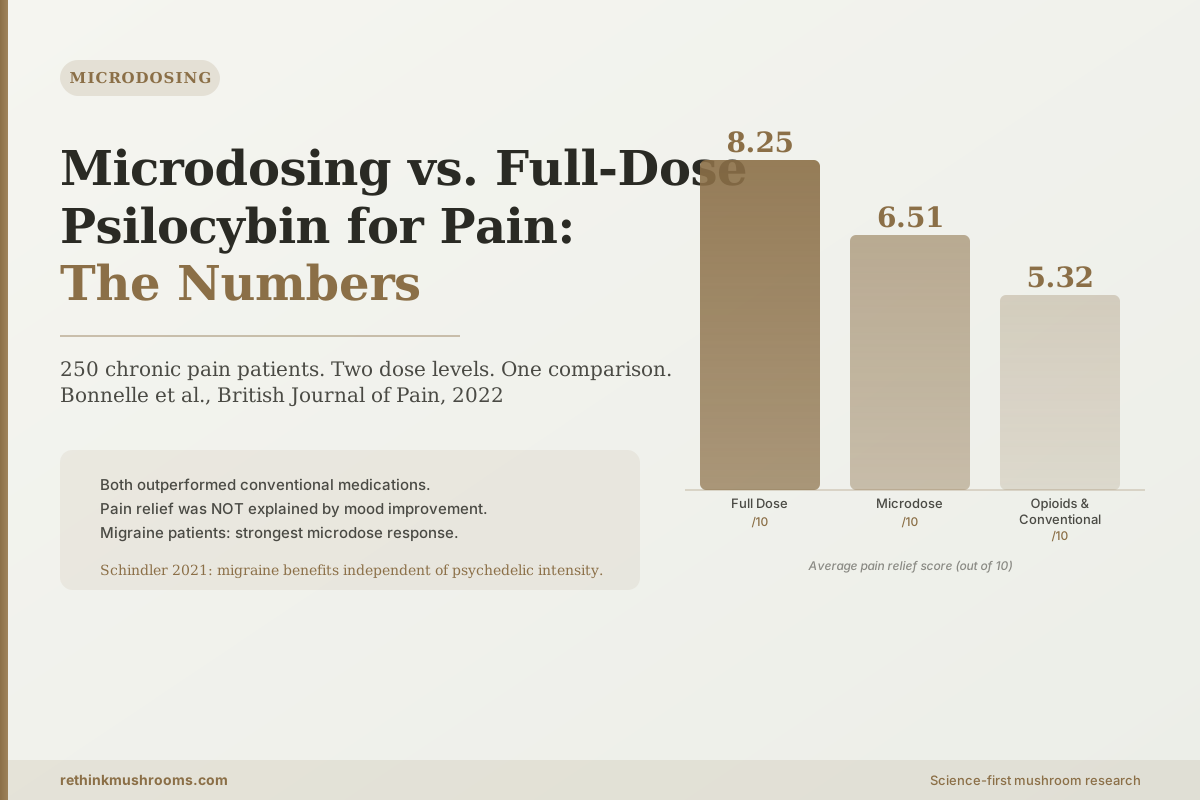
In a 250-patient survey of chronic pain sufferers with psychedelic experience, full-dose psilocybin averaged 8.25/10 for pain relief, microdosing averaged 6.51/10, and conventional medications including opioids averaged 5.32/10.
Bonnelle et al., British Journal of Pain, 2022
6.51/10
average pain relief from psilocybin microdosing vs. 5.32/10 for opioids
Independent
migraine benefits were independent of psychedelic experience intensity (Schindler, 2021)
80-100%
pain relief in 3 neuropathic pain patients who used sub-perceptual microdoses (Lyes, 2023)
Bonnelle et al., British Journal of Pain, 2022
 View as image ↗
In a controlled migraine trial at Yale, psilocybin reduced headache frequency by 1.65 days per week compared to 0.15 days for placebo. That is a large and clinically meaningful difference. The twist: this benefit had nothing to do with how intense the psychedelic experience was. Participants who barely noticed the drug felt the same migraine reduction as those who had profound hallucinatory experiences.
This independence between psychedelic intensity and pain relief is one of the most interesting findings in psilocybin research. It suggests that the mechanism reducing pain is distinct from the mechanism producing the altered state, which has direct implications for the microdosing vs. full-dose question. If pain relief does not require a psychedelic experience, a dose too small to produce one might still work.
The evidence on that question now includes quantitative comparisons, case series with specific pain scores, and animal studies that directly contradict each other. This article assembles the full picture. For broader context, our complete guide to microdosing psilocybin covers the landscape.
Key Takeaways
- A 250-patient survey found full-dose psilocybin averaged 8.25/10 for pain relief, microdosing averaged 6.51/10, and conventional medications (including opioids) averaged 5.32/10; both psychedelic approaches outperformed conventional medicine (Bonnelle et al., 2022)
- Three patients with severe chronic neuropathic pain achieved 80-100% pain relief through microdoses (250-1000mg dried mushrooms) without any psychedelic experience and reduced or eliminated opioid use (Lyes et al., 2023)
- Psilocybin's migraine benefits in a controlled RCT were statistically independent of how intense the psychedelic experience was, suggesting pain relief does not require a full perceptual dose (Schindler et al., 2021)
- A 2025 Nature Neuroscience study found a single psilocybin dose rapidly reversed chronic pain behaviors in mice by calming an overactive pain-alarm brain region; a 2026 Stanford study in Nature Communications found no such effect across three different mouse pain models. This is a live scientific contradiction.
- Migraine patients in the Bonnelle 2022 survey showed a particularly strong microdose response, the best among the chronic pain subtypes studied
- The analgesic effect of both macro and microdosing in the Bonnelle survey was not explained by mood improvement; pain relief appeared to be a direct effect rather than secondary to antidepressant action
The Numbers: What 250 Chronic Pain Patients Reported When Asked to Compare
Bonnelle and colleagues at the Beckley Foundation and Maastricht University surveyed 250 people with chronic pain who had prior psychedelic experience and had used both macro and microdoses.[1]
The core finding: on a 10-point pain relief scale, full-dose psilocybin averaged 8.25, microdosing averaged 6.51, and conventional medications (which included opioids for many participants) averaged 5.32.[1]
Full dose outperformed microdosing by about 1.74 points. Both outperformed conventional medications by more than a full point on the scale.
The pain relief effect, Bonnelle found, was not mediated by improvements in mood. Analyses controlling for the antidepressant and anxiolytic effects of psychedelics found the analgesic benefit remained significant. This suggests psilocybin's pain-reduction mechanism is at least partly direct rather than operating entirely through mood improvement.
Migraine patients within the survey showed a particularly strong response to microdoses, outperforming all other pain subtypes at the lower dose range.
This is survey data with important limitations: participants self-selected into the survey, knew they had taken psychedelics, and rated their experiences retrospectively. The Bonnelle study cannot establish causation. But it provides the most quantitative comparison between the two approaches available in any published dataset, and the numbers are specific enough to be practically informative.
For a deeper look at the chronic pain side of this evidence, see the article on microdosing psilocybin for chronic pain emerging research.
The Paradox That Changes the Dose Question: Pain Relief Without the Trip
The framing of "microdosing vs. full dose" implies that a stronger psychedelic experience might be necessary for clinical benefit. The Schindler 2021 migraine RCT from Yale directly tested this assumption.
Schindler and colleagues found that psilocybin reduced migraine frequency by 1.65 headache days per week over the two weeks following treatment, compared to 0.15 days for placebo in a crossover design.[3] The drug also reduced pain severity, functional impairment, and abortive medication use.
Then they tested whether the magnitude of the acute psychedelic experience predicted how much migraine benefit participants received. It did not. Participants who barely noticed the drug's effects got the same headache reduction as those who had intense perceptual experiences. Statistically, the therapeutic effect was independent of the acute subjective experience.[3]
This finding cuts against the assumption that you need a full, immersive psychedelic experience to get the clinical benefit. If the pain mechanism operates separately from the perceptual mechanism, a dose calibrated to fall below the perceptual threshold might still engage the pain-relevant pathway.
The 2026 Schindler RCT from Yale tested this more directly, comparing a single-dose psilocybin protocol against a repeat-dose (pulse) protocol and an active placebo for migraine prevention.[7] This exploratory trial represents the first direct head-to-head comparison of dosing protocols in a controlled setting for headache, and its findings inform whether the repeat-dose approach that patients anecdotally report gives better results actually holds in controlled conditions.
What Sub-Perceptual Doses Achieved in Real Pain Patients
The most direct evidence for microdosing specifically comes from a 2023 case series published in PAIN journal by Lyes and colleagues, which followed three patients with severe chronic neuropathic pain.[2]
The three patients had diagnoses including spinal cord injury, complex regional pain syndrome (CRPS), and lumbar radiculopathy. These are conditions known for being difficult to treat and for often failing to respond adequately to standard medications.
Each patient used microdoses in the range of 250 to 1000 milligrams of dried psilocybin mushrooms, amounts that fall well below the threshold for psychedelic effects. All three achieved 80 to 100% pain relief. All three reduced or eliminated opioid use. The duration of relief ranged from three hours to two weeks per dose.
This is a case series of three patients, which is near the bottom of the evidence hierarchy. But the specific outcomes, the complete absence of psychedelic effects at pain-relieving doses, and the dramatic opioid reduction are notable. These patients got results that did not require a psychedelic experience.
The broader survey by Fadiman and Korb, published in the Journal of Psychoactive Drugs in 2019, included 418 self-reported microdosers and documented positive outcomes including reduced pain, alongside mood and focus improvements, with uncommon adverse effects at sub-perceptual doses.[8] This foundational survey established that a wide range of people were already reporting pain relief from sub-threshold doses before formal research began.
Why Sub-Perceptual Pain Relief Makes Mechanistic Sense
If microdosing can relieve pain without producing psychedelic effects, there needs to be a mechanism that explains how. A 2024 review in the British Journal of Pharmacology by Askey and colleagues identified three converging pathways.[6]
The first is direct receptor action at the spine and brainstem. Psilocybin activates a class of serotonin receptors called 5-HT2A receptors. These receptors are present not just in the brain's perception centers but also at the level of the spinal cord, where pain signals are processed before they reach conscious awareness. Activating these receptors at the spinal level can reduce pain signal transmission without producing any perceptual effects. The psychedelic experience requires activation of the same receptors in the cortex, but the spinal action is a distinct process.
The second pathway is neuroplasticity. Psilocybin promotes a process in which brain cells create new connections, governed by a growth signal called BDNF. This growth process strengthens the functional connections in brain regions that normally regulate and suppress pain. Over time, stronger regulation capacity means the brain's pain-control circuitry works more effectively.
The third pathway is anti-inflammatory. Chronic pain is partly sustained by ongoing inflammation in the nervous system. Psilocybin appears to have anti-inflammatory properties that can reduce this neuroinflammatory driver.
Critically, the first pathway, the direct spinal receptor action, does not require a full dose or a psychedelic experience. Sub-perceptual doses that reach the spinal serotonin receptors can engage this mechanism. This is the mechanistic basis for why Lyes 2023's patients achieved pain relief without any perceptual effects, and why Schindler 2021's migraine benefits were independent of psychedelic intensity.
For a deeper look at how the sub-perceptual dose mechanism works, see the article on sub-perceptual psilocybin and pain mechanisms.
The Preclinical Debate: Two Animal Studies, Two Opposite Results
The most active current scientific debate in psilocybin pain research is playing out in the preclinical literature, where two high-profile studies reached directly contradictory conclusions.
Hammo and colleagues, publishing in Nature Neuroscience in 2025, found that a single psilocybin dose rapidly and sustainably reversed chronic pain behaviors in mice.[4] Specifically, they worked with mice that had developed allodynia, meaning they felt pain from light touches that would not normally hurt. The psilocybin dose calmed hyperactive neurons in the brain's pain-alarm region (an area called the anterior cingulate cortex) by acting on the same receptors that serotonin targets. The pain reduction was rapid and lasted beyond the drug's direct pharmacological action window.
Gregory and colleagues at Stanford, publishing in Nature Communications in 2026, tested psilocybin across three different mouse pain models using doses of 0.3, 2, and 10 milligrams per kilogram of body weight.[5] The three models covered different types of chronic pain: inflammatory pain from a chemical injury, neuropathic pain from a nerve injury, and musculoskeletal pain. Across all three models, psilocybin showed minimal effects on pain measures: the sensory dimension (how much something hurts) and the emotional dimension (how distressing the pain is) were both unchanged. The Stanford team could not replicate the pain-reversal effects that Hammo had reported.
Both are rigorous, peer-reviewed studies from respected institutions. Both are animal research, which limits direct translation to humans. The discrepancy between them is not yet resolved and reflects genuine uncertainty at the mechanistic level.
The Hammo finding, if it extends to humans, would support the case that even single low doses can engage a durable pain-relief mechanism through brain-region normalization. The Gregory finding suggests the effect may be model-specific or may depend on variables not yet identified. This scientific disagreement is honest and unresolved.
The Practical Differences That Often Drive the Choice
When people with chronic pain who know about both options choose microdosing over full-dose psilocybin, their reasons typically reflect practical factors rather than evidence-based efficacy comparisons.
The Bonnelle data shows full dose outperforms microdosing on average. But "on average" masks meaningful variation. Migraine patients specifically showed strong microdose responses in the Bonnelle survey, with pain relief ratings that were among the strongest in the dataset for lower dose ranges.
The reasons chronic pain patients favor microdosing often include:
Daily function. Full-dose psilocybin requires a dedicated session of several hours, during which normal activities are not possible. Microdosing allows for daily or alternate-day use without interruption to work, childcare, or other responsibilities.
Access. Full-dose guided psilocybin therapy, where legal, often costs thousands of dollars per session. Dried mushrooms for microdosing are substantially cheaper per dose.
Side effect profile. Full-dose experiences can include challenging emotional content, nausea, and disorientation. Sub-perceptual microdoses typically produce none of these acute effects, though the Lyes case series documented some adverse effects at the higher end of the microdose range.
Reversibility. A microdose that produces unwanted effects can be discontinued immediately. A full-dose session that goes poorly cannot be shortened.
Anyone considering either approach for chronic pain management as an ongoing strategy should review the evidence on long-term microdosing risks and the cardiovascular safety context on microdosing and heart health, as repeated serotonin receptor activation carries considerations that single-session use does not.
What the Evidence Cannot Yet Tell Us
The research on psilocybin and pain is several critical studies away from answering the head-to-head comparison definitively.
The Bonnelle survey is the only published data that directly compares dose levels on a common pain relief scale. It is survey data, not a randomized comparison. The Schindler clinical trials are the most rigorous evidence but test specific pain types (migraine, cluster headache) rather than chronic pain broadly. The Lyes case series is three patients.
What the evidence does establish:
Both approaches outperform conventional medications including opioids in the Bonnelle survey, across a 10-point scale (full dose 8.25, microdose 6.51, conventional 5.32).
Pain relief from full-dose psilocybin does not require an intense psychedelic experience in at least the migraine context.
Sub-perceptual doses achieved complete or near-complete pain relief in neuropathic pain patients who were unresponsive to standard care.
The animal-level mechanism is debated by two high-quality studies with directly contradictory results.
For a complete picture of headache-specific research, including the progression of Schindler's cluster headache and migraine trials across 2021, 2022, 2024, and 2026, see the cluster headache and migraine psilocybin data article. For the broader emerging research on microdosing and chronic neuropathic pain, see microdosing psilocybin for chronic pain.
The Bottom Line
The best quantitative comparison available comes from a 250-patient survey (Bonnelle et al., 2022): full-dose psilocybin averaged 8.25/10 for pain relief, microdosing averaged 6.51/10, and conventional medications including opioids averaged 5.32/10. Both psychedelic approaches outperformed conventional medicine, and the analgesic effect was not explained by mood improvement. The paradox identified by Schindler (2021), that migraine benefits were independent of psychedelic experience intensity, provides a mechanistic rationale for why sub-perceptual doses can work. The choice between approaches involves practical considerations alongside the evidence gap: daily function, access, side effects, and reversibility all favor microdosing, while overall efficacy in survey data favors full dose.
Frequently Asked Questions
Sources & References
- 1RTHM-01489·Bonnelle, Valerie et al. (2022). “Analgesic potential of macrodoses and microdoses of classical psychedelics in chronic pain sufferers: a population survey..” British journal of pain.Study breakdown →PubMed →↩
- 2RTHM-01742·Lyes, Matthew et al. (2023). “Microdosing psilocybin for chronic pain: a case series..” Pain.Study breakdown →PubMed →↩
- 3RTHM-00716·Schindler, Emmanuelle A D et al. (2021). “Exploratory Controlled Study of the Migraine-Suppressing Effects of Psilocybin..” Neurotherapeutics : the journal of the American Society for Experimental NeuroTherapeutics.Study breakdown →PubMed →↩
- 4RTHM-02091·Hammo, Ahmad et al. (2025). “Single-dose psilocybin rapidly and sustainably relieves allodynia and anxiodepressive-like behaviors in mouse models of chronic pain..” Nature neuroscience.Study breakdown →PubMed →↩
- 5RTHM-02229·Gregory, Nicholas S et al. (2026). “No evidence of immediate or persistent analgesic effect from a single dose of psilocybin in three mouse models of pain..” Nature communications.Study breakdown →PubMed →↩
- 6RTHM-00864·Askey, Tate et al. (2024). “Psilocybin as a novel treatment for chronic pain..” British journal of pharmacology.Study breakdown →PubMed →↩
- 7RTHM-00963·Schindler, Emmanuelle A D et al. (2026). “Comparing single- and repeat-dose psilocybin with active placebo for migraine prevention in an exploratory randomized controlled clinical trial..” Headache.Study breakdown →PubMed →↩
- 8RTHM-01054·Fadiman, James et al. (2019). “Might Microdosing Psychedelics Be Safe and Beneficial? An Initial Exploration..” Journal of psychoactive drugs.Study breakdown →PubMed →↩