Pain
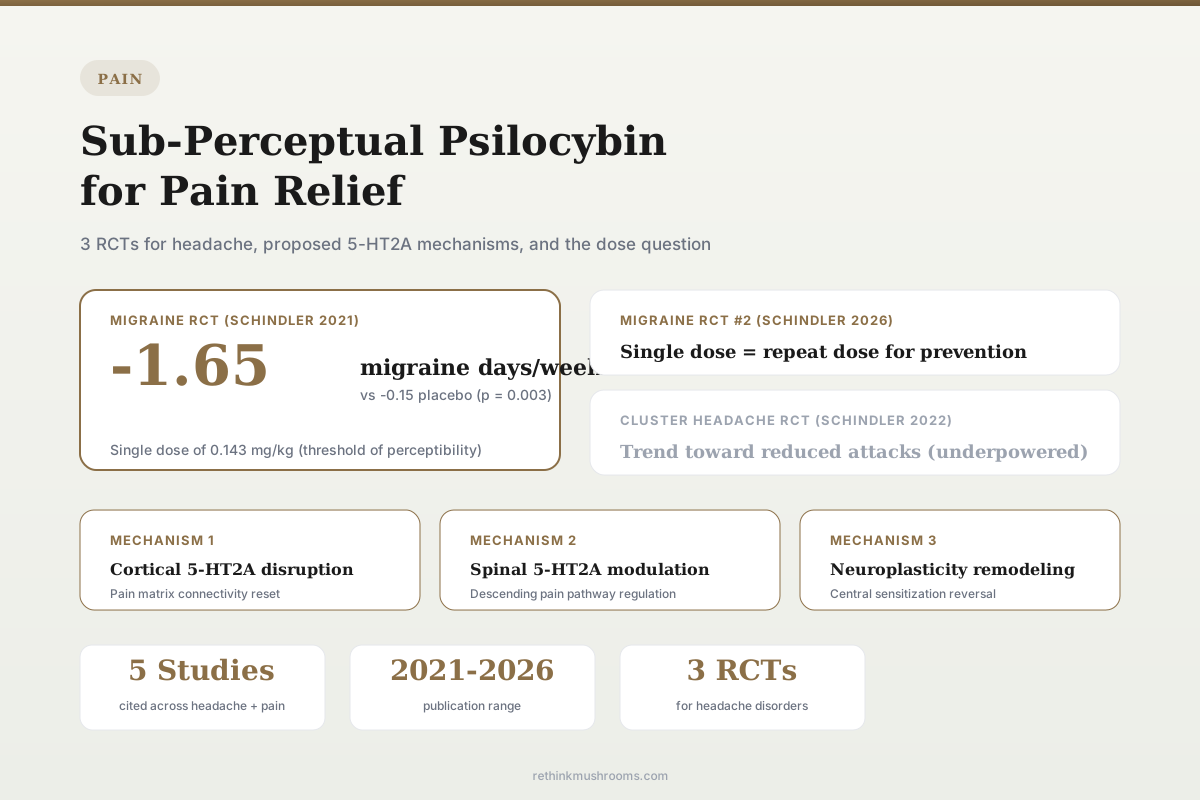
-1.65 migraine days/week
A single low oral dose of psilocybin (0.143 mg/kg) reduced weekly migraine days by 1.65 compared to 0.15 for placebo in a double-blind crossover trial.
Schindler et al., Neurotherapeutics, 2021
p = 0.003
separation from placebo for migraine day reduction
5-HT2A
receptor activation in both cortex and spinal cord implicated in analgesic mechanism
3 RCTs
now published testing psilocybin for headache disorders specifically
Schindler et al., Neurotherapeutics, 2021
 View as image ↗
The idea that sub-perceptual psilocybin can reduce pain draws on two converging evidence streams: controlled trials testing low-dose psilocybin for headache disorders, and mechanistic research identifying 5-HT2A receptor pathways in pain processing circuits. The headache data is the strongest. Three randomized controlled trials have now tested psilocybin for migraine or cluster headache, two using doses at or near the sub-perceptual range. The broader chronic pain evidence is almost entirely preclinical or anecdotal. The gap between what psilocybin does in pain models and what sub-perceptual doses do in human pain conditions is wider than most popular accounts suggest.
This article separates the three tiers of evidence: what RCTs have demonstrated in headache disorders, what the proposed analgesic mechanisms are, and where the chronic pain claims stand against actual data. For the specific headache evidence in more detail, see microdosing for migraines and cluster headaches.
Key Takeaways
- A double-blind placebo-controlled crossover trial found that a single low dose of psilocybin (0.143 mg/kg) reduced weekly migraine days by 1.65 compared to 0.15 for placebo (p = 0.003), with reductions in pain severity and abortive medication use (Schindler et al., 2021)
- A follow-up RCT comparing single versus repeat-dose psilocybin for migraine prevention found that both dosing schedules produced migraine suppression superior to active placebo, suggesting duration of effect may not require repeated dosing (Schindler et al., 2026)
- A randomized double-blind placebo-controlled trial of low-dose psilocybin pulse regimen for cluster headache found trends toward reduced attack frequency, but the primary endpoint did not reach significance, with an underpowered sample size (Schindler et al., 2022)
- The 5-HT2A receptor is expressed in pain-processing regions including the prefrontal cortex, anterior cingulate cortex, and dorsal horn of the spinal cord, providing a mechanistic basis for analgesic effects at both central and peripheral levels (Askey et al., 2024)
- Animal models show psilocybin dose-dependently reverses mechanical and cold hypersensitivity in chemotherapy-induced neuropathy and thermal hypersensitivity in chronic inflammatory pain, mediated through 5-HT2A activation (Askey et al., 2024)
- Clinical case reports of psilocybin microdosing for CRPS (complex regional pain syndrome) and neuropathic pain have reported pain reduction, but no controlled trial has tested sub-perceptual psilocybin for any chronic pain condition outside of headache disorders (Henderson et al., 2025)
The Migraine RCTs
Schindler et al. (2021) published the first controlled trial of psilocybin for migraine. In a double-blind, placebo-controlled crossover study, participants with migraine received a single low oral dose of psilocybin (0.143 mg/kg, approximately 10 mg for a 70 kg person) in two sessions separated by two weeks. The dose was selected to be at the lower end of the psychoactive range, near the threshold where some participants experience mild perceptual effects and others do not.[1]
The primary outcome was definitive: psilocybin reduced weekly migraine days by 1.65 compared to 0.15 for placebo (p = 0.003). Secondary measures confirmed the finding with reductions in migraine attack frequency, pain severity, functional impairment, and days requiring abortive medication. The effect persisted beyond the pharmacological duration of the drug, consistent with serotonergic modulation of migraine circuits rather than acute pain relief.
The 0.143 mg/kg dose is at the boundary between sub-perceptual and perceptual. Some participants reported mild subjective effects; others did not. This matters for the "microdosing for pain" narrative: the dose that worked in the only definitive migraine RCT is not clearly sub-perceptual. It is low-dose, but "low-dose" and "sub-perceptual" are not synonyms. Whether truly sub-perceptual doses (0.05 to 0.1 mg/kg) would produce the same migraine suppression is untested.
Schindler et al. (2026) extended this work with a follow-up RCT comparing single-dose versus repeat-dose psilocybin for migraine prevention, with an active placebo. Both dosing schedules produced migraine suppression superior to placebo. The finding that a single dose was as effective as repeated dosing is mechanistically important: it suggests the analgesic effect operates through a sustained neuroplastic or neuromodulatory change rather than requiring continuous receptor activation, which distinguishes psilocybin from conventional acute analgesics.[2]
The Cluster Headache Trial
Schindler et al. (2022) tested a patient-informed low-dose psilocybin pulse regimen for cluster headache in a randomized, double-blind, placebo-controlled trial. The pulse dosing protocol was based on the practice reported by cluster headache patient communities, who self-administer psilocybin at intervals during cluster periods to abort or shorten headache bouts.[3]
The trial found trends toward reduced attack frequency in the psilocybin group, but the primary endpoint did not reach statistical significance. The sample size was small and the trial was underpowered for the primary outcome. The authors noted that the effect size was clinically meaningful despite not reaching the p < 0.05 threshold, and that the pulse regimen was well-tolerated with no serious adverse events.
Cluster headache is one of the most severe pain conditions in medicine, sometimes called "suicide headache" because of the intensity of attacks, which can occur multiple times daily during cluster periods lasting weeks to months. Standard preventive treatments (verapamil, lithium, corticosteroids) have limited efficacy, substantial side effects, and failure rates that leave many patients in a therapeutic dead end. About 10 to 20% of cluster headache patients have the chronic form, meaning they have fewer than three months of remission per year.
The observational evidence that psilocybin suppresses cluster headache periods has been reported since at least 2006 in patient surveys conducted by Clusterbusters, a patient advocacy organization. These surveys documented that a majority of respondents who used psilocybin reported cluster period termination or significant reduction in attack frequency. The controlled evidence has been slower to materialize because of the regulatory and logistical difficulties of running psychedelic trials in a rare disease population. The Schindler cluster headache trial is the first and only completed RCT, and its underpowered result reflects the challenge of recruiting sufficient patients rather than a pharmacological failure. For more detail on the cluster headache and migraine evidence together, see microdosing psilocybin for chronic pain: cluster headache and migraine data.
The Proposed Analgesic Mechanisms
Askey et al. (2024) published a comprehensive review of psilocybin as a novel treatment for chronic pain in the British Journal of Pharmacology. The review identifies three mechanistic pathways through which psilocybin could produce analgesia.[4]
Central serotonergic modulation. The 5-HT2A receptor is highly expressed in the prefrontal cortex and anterior cingulate cortex, both key nodes in the pain neuromatrix. Chronic pain involves maladaptive connectivity between these regions and limbic structures that amplify the emotional component of pain (catastrophizing, rumination, fear-avoidance). Psilocybin's disruption of default mode network activity and enhancement of prefrontal-limbic connectivity could reduce the affective dimension of pain without altering the sensory signal itself.
Spinal 5-HT2A activation. The 5-HT2A receptor is also expressed in the dorsal horn of the spinal cord, where descending serotonergic pathways modulate pain transmission. In preclinical models, psilocybin dose-dependently reversed mechanical and cold hypersensitivity in chemotherapy-induced peripheral neuropathy and thermal hypersensitivity in chronic inflammatory pain. These effects were blocked by 5-HT2A antagonists, confirming receptor specificity. The spinal mechanism is distinct from the cortical one and could contribute to direct analgesic effects independent of changes in mood or cognition.
Neuroplasticity-mediated circuit remodeling. The observation that single psilocybin doses produce lasting migraine suppression (weeks beyond pharmacological clearance) suggests structural or functional brain changes. Psilocybin promotes dendritic spine growth, BDNF expression, and synaptic plasticity in frontal cortex. If chronic pain involves maladaptive neural circuits (central sensitization), psilocybin-induced neuroplasticity could partially reset these circuits.
This neuroplasticity hypothesis is the most speculative of the three mechanisms but the most consequential if true. Central sensitization, the amplification of pain signals through changes in spinal and cortical neural circuits, is a hallmark of chronic pain conditions including fibromyalgia, chronic migraine, and neuropathic pain. If psilocybin can reverse central sensitization through the same neuroplastic mechanisms that appear to underlie its antidepressant effects, then the drug's utility in pain could extend far beyond headache disorders. The hypothesis is attractive but unproven in human pain populations, and the dose required for neuroplastic effects may exceed the sub-perceptual range. For how neuroplasticity relates to psilocybin's effects more broadly, see can doses too small to feel still change the brain?.
Beyond Headache: The Chronic Pain Evidence Gap
Henderson et al. (2025) reviewed the clinical evidence and exploratory insights for psychedelics in headache and pain disorders. Outside of the three headache RCTs, the chronic pain evidence for psilocybin is limited to case reports and case series.[5]
Published cases include psilocybin microdosing for complex regional pain syndrome (CRPS), where three patients reported substantial pain reduction and reduced opioid use over 7 to 10 days of daily microdosing (approximately 500 mg of dried Psilocybe cubensis). A separate case report documented pain relief in a patient with refractory CRPS treated with psilocybin. Neuropathic pain case reports describe analgesic effects at sub-psychedelic doses.
These are encouraging signals but represent the lowest tier of clinical evidence. Case reports are inherently subject to publication bias (positive outcomes get published, negative ones do not), placebo effects, expectancy, and confounding variables. The three CRPS patients were on concurrent medications, the pain measurements were self-reported, and there was no placebo control. Whether psilocybin produces genuine analgesic effects for chronic pain conditions beyond headache is an open question that requires controlled trials to answer. For how microdosing and full-dose approaches compare for pain, see microdosing vs. full-dose psilocybin for pain management.
- Cell & Lab Studiescompleted
5-HT2A receptor mapping in the prefrontal cortex, anterior cingulate cortex, and dorsal horn — the mechanistic basis for both central and spinal analgesia (Askey et al., 2024)
- Animal Studiescompleted
Dose-dependent reversal of mechanical/cold hypersensitivity in chemotherapy-induced neuropathy and thermal hypersensitivity in inflammatory pain, blocked by 5-HT2A antagonists (Askey et al., 2024)
- Case Reports & Early Seriescompleted
CRPS and neuropathic pain cases report reduced pain and opioid use with psilocybin microdosing — uncontrolled, self-reported, confounded by concurrent medications (Henderson et al., 2025)
- Small Human Trialscurrent
Migraine crossover RCT clearly beat placebo (Schindler 2021); a follow-up confirmed single- and repeat-dose suppression (Schindler 2026); the cluster headache RCT trended but was underpowered (Schindler 2022). All in headache — none for other chronic pain
- Large Randomized Trialsmissing
No adequately powered trial for any pain indication
- Meta-Analyses & Systematic Reviewsmissing
Too few controlled trials to synthesize
For headache disorders, the evidence has climbed to small controlled trials with a clear positive migraine result. For every other chronic pain condition, it stops at animal models and case reports — no controlled trial has tested psilocybin outside headache.
Schindler 2021; Schindler 2022; Schindler 2026; Askey 2024; Henderson 2025
The Sub-Perceptual Question Specifically
The evidence base does not cleanly address whether truly sub-perceptual doses (those producing no detectable subjective effect) can reduce pain. The migraine RCT used 0.143 mg/kg, which is at the threshold of perceptibility. The cluster headache trial used a "low-dose pulse" that was informed by patient community practice, not formally calibrated to be sub-perceptual. The case reports used approximately 500 mg of dried mushrooms, which is at the upper end of what the microdosing community considers a microdose and is perceptible to many users.
Psilocybin dose scale for pain
The proven dose sits above the sub-perceptual band
Sub-perceptual band
0.05–0.10 mg/kgThe doses "microdosing for pain" implies (~3.5–7 mg). No controlled pain trial has ever tested this band.
Migraine-RCT effective dose
0.143 mg/kgThe only dose proven to cut migraine days (≈10 mg for 70 kg). Trialists place it at the lower edge of the psychoactive range — the perceptibility threshold.
“Low-dose” and “sub-perceptual” are not synonyms. The dose-response curve for psilocybin analgesia in humans has never been mapped, and the preclinical effects were dose-dependent — lower doses produced weaker results. Whether a genuinely sub-perceptual dose (0.05–0.10 mg/kg) could reproduce the migraine result is untested.
Dose and effect from Schindler et al., Neurotherapeutics, 2021 (single oral 0.143 mg/kg; −1.65 vs −0.15 weekly migraine days, p = 0.003). Sub-perceptual band per the article’s dosing discussion. Illustrative dose scale, not a clinical dosing guide.
The mechanistic literature suggests that 5-HT2A activation, the pathway implicated in analgesic effects, requires meaningful receptor occupancy. At genuinely sub-perceptual doses, receptor occupancy may be too low to engage the cortical and spinal circuits that drive pain modulation. The dose that works for migraine is low but not clearly sub-perceptual, and the preclinical analgesic effects were dose-dependent: lower doses produced weaker effects. The "microdosing for pain" claim may be built on evidence from doses that are not, in pharmacological terms, microdoses.
This distinction has practical implications. If the analgesic threshold requires 0.143 mg/kg (the migraine RCT dose), then a person who microdoses at 0.05 mg/kg may be below the therapeutic threshold for pain while experiencing the time cost, legal risk, and cognitive side effects of regular psychedelic use. Conversely, if the dose required to suppress migraines also produces perceptible effects, then the appeal of sub-perceptual dosing as a pain strategy may rest on a misreading of the evidence. The dose-response curve for psilocybin analgesia in humans has not been mapped, and mapping it is the single most important next step for this field. For the broader chronic pain research landscape, see microdosing psilocybin for chronic pain: emerging research.
Safety
ModeratePsilocybin is a Schedule I drug, and self-treating pain with it carries real risk
Concern
Outside of a small number of authorized clinical trials and a few state-regulated programs, possessing or using psilocybin is illegal under U.S. federal law. Self-sourced mushrooms vary widely in potency, so a dose intended to be sub-perceptual can be several times stronger than expected, and the analgesic dose that worked for migraine (0.143 mg/kg) is at the threshold where perceptual effects begin.
What the research says
The evidence for psilocybin in pain is preliminary and confined almost entirely to headache disorders. There is no validated protocol, no established safe dose for pain, and no controlled evidence for chronic pain conditions beyond headache.
Particularly relevant for: People considering psilocybin for migraine, cluster headache, or chronic pain
What to do
This is not medical advice. Do not stop or replace prescribed pain or preventive treatment with psilocybin, and discuss any interest in psychedelic-assisted therapy — including eligibility for a clinical trial — with a qualified clinician.
Schindler et al., Neurotherapeutics, 2021; Askey et al., British Journal of Pharmacology, 2024
The Bottom Line
Three randomized controlled trials have tested low-dose psilocybin for headache disorders, with the migraine data showing clear superiority over placebo for weekly migraine day reduction. The cluster headache trial showed trends but did not reach significance. Proposed mechanisms include cortical 5-HT2A-mediated pain matrix disruption, spinal serotonergic modulation, and neuroplasticity-driven circuit remodeling. Outside headache, chronic pain evidence is limited to case reports. Whether truly sub-perceptual doses produce analgesia is undemonstrated; the effective migraine dose is at the perceptibility threshold.
Frequently Asked Questions
Sources & References
- 1RTHM-00716·Schindler, Emmanuelle A D et al. (2021). “Exploratory Controlled Study of the Migraine-Suppressing Effects of Psilocybin..” Neurotherapeutics : the journal of the American Society for Experimental NeuroTherapeutics.Study breakdown →PubMed →↩
- 2RTHM-00963·Schindler, Emmanuelle A D et al. (2026). “Comparing single- and repeat-dose psilocybin with active placebo for migraine prevention in an exploratory randomized controlled clinical trial..” Headache.Study breakdown →PubMed →↩
- 3RTHM-00794·Schindler, Emmanuelle A D et al. (2022). “Exploratory investigation of a patient-informed low-dose psilocybin pulse regimen in the suppression of cluster headache: Results from a randomized, double-blind, placebo-controlled trial..” Headache.Study breakdown →PubMed →↩
- 4RTHM-00864·Askey, Tate et al. (2024). “Psilocybin as a novel treatment for chronic pain..” British journal of pharmacology.Study breakdown →PubMed →↩
- 5RTHM-00927·Henderson, Isabella et al. (2025). “Exploring the Potential of Psychedelics in the Treatment of Headache Disorders: Clinical Considerations and Exploratory Insights..” Current pain and headache reports.Study breakdown →PubMed →↩