Microdosing
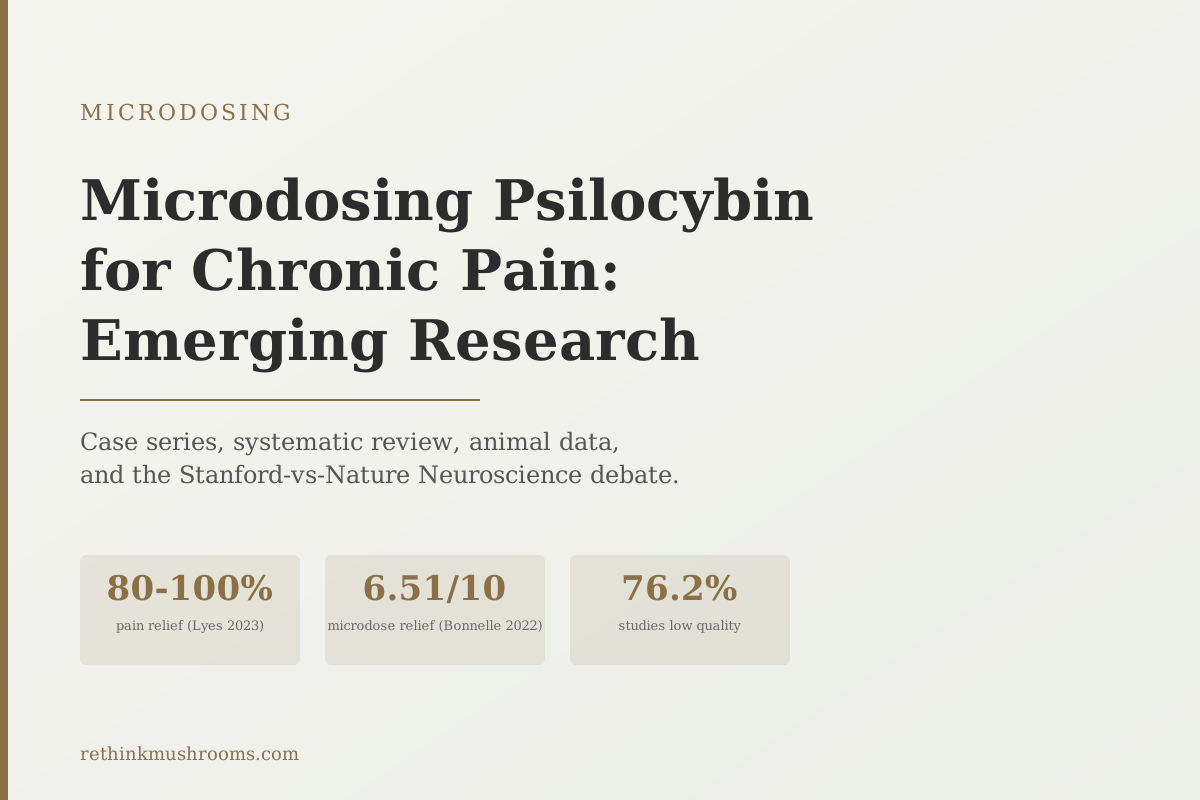
80-100% pain relief
Three patients with chronic neuropathic pain achieved 80-100% relief using sub-perceptual psilocybin doses, without any psychedelic experience, and reduced or eliminated opioid use.
Lyes et al., PAIN, 2023
3/3
patients reduced or eliminated opioid use after microdosing psilocybin (Lyes 2023)
76.2%
of studies in a systematic review were low or very low quality; an honest picture of where the field stands (Jevotovsky 2025)
6.51/10
pain relief reported by microdosers vs 5.32/10 for conventional medications including opioids (Bonnelle 2022)
Lyes et al., PAIN, 2023
 View as image ↗
Microdosing psilocybin for chronic pain means taking sub-perceptual doses, too small to cause hallucinations, on a regular schedule. The only published case series testing this in chronic pain patients found 80-100% pain relief in all three participants, all of whom had neuropathic pain that had failed conventional treatment, and all of whom reduced or eliminated opioid use during the protocol.[1]
That's one case series with three patients. It is the entire clinical evidence base for microdosing psilocybin specifically for chronic pain.
What surrounds it is a field in early construction: a systematic review showing that most of the broader psilocybin-and-pain literature is low quality, a mechanistic paper in Nature Neuroscience showing dramatic pain reversal in mice, and a direct replication from Stanford that found no effect at all. Understanding what microdosing psilocybin might do for chronic pain requires holding all of that at once, including the parts that contradict each other.
For the broader picture of what microdosing psilocybin research covers, the pillar article provides the full context. This article focuses specifically on the pain evidence.
Key Takeaways
- The only microdosing-specific case series in chronic pain (n=3) found 80-100% relief in patients with spinal cord injury pain, CRPS, and lumbar radiculopathy, all of whom reduced or eliminated opioids (Lyes et al., PAIN, 2023)
- A 2025 systematic review of 28 psilocybin pain studies found 76.2% were low or very low quality, which is important context for interpreting positive anecdotal and case-report findings (Jevotovsky et al., 2025)
- Three convergent mechanisms have been proposed: 5-HT2A receptor activation in spinal and cortical pain circuits, neuroplasticity via BDNF-TrkB signaling, and anti-inflammatory effects on neuroinflammation (Askey et al., British Journal of Pharmacology, 2024)
- A Nature Neuroscience study found a single psilocybin dose rapidly and lastingly reversed mechanical hypersensitivity in mouse chronic pain models by normalizing overactive neurons in the anterior cingulate cortex, a brain region involved in pain perception (Hammo et al., 2025)
- Stanford published a direct response: at three dose levels and in three pain models, psilocybin showed minimal analgesic effect in mice, directly contradicting the Nature Neuroscience findings (Gregory et al., Nature Communications, 2026)
- In a 250-patient survey, chronic pain patients who microdosed psychedelics reported 6.51/10 pain relief on average, compared to 5.32/10 for conventional medications including opioids; the analgesic effect was not mediated by mood improvement (Bonnelle et al., 2022)
The Only Microdosing-Specific Case Series: Three Patients, 80-100% Relief
Lyes and colleagues published a case series in the journal PAIN in 2023 describing three patients with chronic neuropathic pain who used psilocybin microdosing outside of a clinical trial setting and agreed to have their experiences documented.[1]
The three patients had different underlying conditions. One had pain from a spinal cord injury. One had complex regional pain syndrome (CRPS), a condition characterized by intense burning pain, often following an injury, that outlasts the original trauma by years or decades. One had lumbar radiculopathy, a nerve pain condition originating in the lower spine. All three had failed or were dissatisfied with conventional pain treatments. All three were using opioids.
Their self-administered doses ranged from 250mg to 1000mg of dried mushrooms. These are sub-perceptual quantities: doses at which most people experience nothing, or at most a slight brightening of perception. None of the three reported a psychedelic experience during their microdosing protocols.
All three achieved 80-100% pain relief during the protocol periods. All three reduced or eliminated opioid use. The effects lasted from 3 hours to 2 weeks depending on the patient and the dosing schedule.
These are remarkable numbers. The question any careful reader asks is: why should we believe them?
The honest answer is that case reports are the least reliable form of clinical evidence. There is no control condition, no randomization, no blinding. Patients who chose to try microdosing and then chose to report their experience are not a random sample of chronic pain patients. The placebo response in pain studies is strong and real. Each of these three patients had reasons to want the treatment to work, reasons to notice improvements, and no way to know whether their relief came from psilocybin specifically or from some combination of attention, expectation, and the natural fluctuation of chronic pain.
What the case series does provide: a documented signal that sub-perceptual doses are tolerated without adverse effects, that the absence of psychedelic effects doesn't appear to eliminate the analgesic effect, and that opioid reduction was a consistent secondary finding. These observations are worth pursuing in controlled trials. They are not evidence the treatment works.
Why This Field Is Young: 28 Studies, 76% Low Quality
Jevotovsky and colleagues published a systematic review of psilocybin for chronic neuropathic pain in 2025, pulling together all available evidence on the question.[2]
The review identified 28 studies. It found that 76.2% were low or very low quality by standard evidence-quality criteria. Despite the methodological limitations across the body of literature, findings consistently suggested promise for psilocybin in chronic neuropathic pain relief.
That combination of widespread methodological weakness alongside consistent directional findings is exactly what characterizes a research field in early development. The signal appears consistent enough that serious researchers keep investigating. The evidence is not yet strong enough to draw conclusions about whether psilocybin works, what doses work, or which patient populations are most likely to respond.
The systematic review is important for calibrating how to read the case series and animal data that follow. The consistency of positive findings across low-quality studies is meaningful: it suggests the effect, if real, is robust enough to show up even in poorly designed research. But consistency across weak studies does not prove anything on its own. The next step is well-designed randomized controlled trials, which this field largely lacks for chronic pain conditions outside headache disorders.
For the headache-specific controlled trial evidence, which represents the highest-quality data currently available, see microdosing for migraines and cluster headaches.
Three Ways Psilocybin Might Reduce Pain
Askey and colleagues published a comprehensive review of psilocybin as a potential treatment for chronic pain in the British Journal of Pharmacology in 2024.[3] The review identified three mechanistic pathways that could explain analgesic effects.
5-HT2A receptor activation. Psilocybin's main active metabolite, psilocin, binds primarily to serotonin receptors, specifically the 5-HT2A type. These receptors are found throughout the brain's pain-processing regions, including the prefrontal cortex and anterior cingulate cortex, but also in the spinal cord's dorsal horn, where pain signals are relayed from body to brain. Activation at the spinal level could reduce how strongly pain signals are transmitted upward, producing analgesic effects that don't require any change in brain-level processing. This mechanism works whether or not the dose is perceptible; the receptor responds to the molecule regardless of whether the dose is large enough to produce conscious effects.
Neuroplasticity via BDNF signaling. Psilocybin promotes the growth of new dendritic spines on neurons and stimulates BDNF (brain-derived neurotrophic factor), a protein that supports the formation and strengthening of neural connections. Chronic pain involves maladaptive changes to neural circuits, where pain pathways become sensitized and amplified over time. If psilocybin can reverse these structural changes (essentially rebuilding healthier circuit patterns), the effect could persist long after the drug has cleared. This would explain the "one dose, lasting weeks of relief" pattern documented in the Schindler migraine trials and suggested in the Lyes case series.
Anti-inflammatory effects. Neuroinflammation, the activation of immune-like cells in the nervous system, plays a documented role in driving and maintaining chronic pain. Psilocybin shows anti-inflammatory effects in cell and animal models. Reducing neuroinflammation could reduce the underlying driver of certain chronic pain conditions independent of either the receptor-level or neuroplasticity mechanisms.
These three pathways are not competing theories. They can all operate simultaneously. The relative contribution of each probably varies by pain condition, dose, and patient. Sub-perceptual doses might engage the spinal 5-HT2A mechanism with minimal contribution from the neuroplasticity pathway, while higher doses might trigger all three. This dose-response relationship for analgesia specifically has not been mapped in humans.
A Nature Neuroscience Finding: One Dose Reversed Chronic Pain in Mice
Hammo and colleagues published a study in Nature Neuroscience in 2025 testing single-dose psilocybin in mouse models of chronic pain.[4]
The results were striking. A single psilocybin dose rapidly and lastingly reversed mechanical hypersensitivity (a form of pain where light touch causes intense pain responses) and anxiety-like behaviors in the mice. The animals returned to normal pain thresholds and stayed there.
The mechanism the researchers identified was specific: psilocybin normalized abnormally overactive neurons in the anterior cingulate cortex, the brain region that processes the distressing, evaluative dimension of pain. In chronic pain, these neurons become hyperactive in a pattern that amplifies how threatening and severe pain feels. Psilocybin, via 5-HT2A and 5-HT1A receptor activity, brought this overactivity back down to normal. When the researchers blocked the relevant receptors pharmacologically, the analgesic effect disappeared, confirming the mechanism.
The publication in Nature Neuroscience gave this finding significant scientific credibility. The mechanistic specificity went beyond "psilocybin reduced pain scores." The researchers identified a specific brain circuit, a specific cellular mechanism, and a specific receptor pathway. That level of detail makes the finding harder to dismiss as noise.
Stanford's Response: No Effect in Three Mouse Models
Gregory and colleagues at Stanford University published a direct response in Nature Communications in 2026.[5]
They tested psilocybin at three doses (0.3, 2, and 10 mg/kg) in three separate mouse models of chronic pain: a CFA inflammatory pain model, a spared nerve injury neuropathic pain model, and an acid-induced muscle pain model. They measured sensory, affective, and functional pain measures. The result: minimal effects across all combinations. Psilocybin did not produce clinically meaningful analgesia in any of the three models at any of the three doses.
This directly contradicts the Hammo 2025 findings. Two well-powered, methodologically rigorous studies in top journals, both in mice, coming to opposite conclusions.
When this happens in science, the immediate question is: what was different? The specific mouse strains, the specific pain models, the specific doses, the exact timing of measurements, the route of administration: any of these could produce divergent results. Neither study is obviously flawed. Both are from respected labs publishing in high-quality journals.
The honest takeaway is that the animal mechanistic data is less settled than either paper alone would suggest. Psilocybin does not have a clean track record of producing reliable analgesia in mouse models. This should temper enthusiasm based on the mechanistic story, without dismissing it entirely. The two studies together indicate that the effect, if real, is sensitive to conditions that are not yet fully understood.
For a detailed comparison of how animal model data relates to the human clinical evidence, see can sub-perceptual psilocybin reduce pain?.
What Chronic Pain Patients Self-Report: 6.51/10 vs 5.32/10 for Opioids
Survey data and animal models are both weak in different ways. Survey data is subject to selection bias and expectation effects. Animal models may not translate to human pain conditions. A 2022 survey from the Beckley Foundation and Maastricht University represents the largest real-world dataset currently available for psychedelics and chronic pain specifically.[6]
Bonnelle and colleagues surveyed 250 people with chronic pain conditions who had prior experience with psychedelics. Participants rated their pain relief from three categories of treatment on a 10-point scale: macrodoses of psychedelics, microdoses, and conventional medications including opioids.
Macrodoses averaged 8.25/10. Microdoses averaged 6.51/10. Conventional medications averaged 5.32/10.
Both psychedelic approaches outperformed conventional medications in this sample. Critically, the analgesic effect held after controlling for mood, meaning the improvement wasn't explained by people feeling emotionally better and rating their pain differently as a result. Something about the pharmacological interaction with pain circuits showed up in the ratings independent of mood state.
The selection bias in this sample is substantial. People who had already tried psychedelics for pain and chose to respond to a survey are not representative of chronic pain patients as a whole. The survey cannot determine whether psilocybin caused the pain reduction or whether natural variation in pain coincided with psychedelic use. These limitations don't make the data worthless. They make it hypothesis-generating rather than hypothesis-confirming.
Fadiman and Korb's 2019 survey of 418 self-reported microdosers found pain improvement among the reported positive outcomes, alongside mood improvement and increased focus.[7] This broader survey did not focus on chronic pain patients specifically and does not provide quantitative pain relief data. It adds to the picture that people who microdose report pain benefits, but says nothing about the size or reliability of those benefits.
What the Evidence Is and Isn't Saying
Put together, this is what the evidence for microdosing psilocybin in chronic pain actually shows:
A case series of three patients found dramatic results. A systematic review of 28 studies found most evidence is low quality but consistently directional. A sophisticated mechanism has been proposed and partially validated in animal models. But that mechanism produced opposite results in two mouse studies from different labs. And a large survey of pain patients found real-world outcomes that beat conventional medications.
This is not a picture of a proven treatment. It is a picture of a promising signal in a poorly studied area with methodological weaknesses at every level of evidence.
What the evidence does not support: claims that microdosing reliably reduces chronic pain, that it is safe for long-term use, or that it outperforms conventional medications in ways that would hold up in a controlled trial. The Bonnelle survey shows that people who use psychedelics for pain report better relief than they got from conventional medicines. It doesn't show that psilocybin causes better outcomes in a random sample of chronic pain patients.
What the evidence does support: the hypothesis is worth investigating. The direction of findings across multiple levels of evidence (case reports, surveys, animal models, and indirect human data from the headache trials) is consistent enough to justify investment in properly designed randomized controlled trials.
For safety considerations relevant to anyone thinking about chronic microdosing, see microdosing safety: what the research shows and the Fadiman protocol: the original microdosing schedule. For how microdoses compare to full-dose approaches for pain specifically, see microdosing vs. full-dose psilocybin for pain management.
The Bottom Line
The clinical evidence for microdosing psilocybin for chronic pain consists of a three-patient case series showing 80-100% neuropathic pain relief and opioid reduction. A 2025 systematic review confirmed the broader field is promising but methodologically weak. Animal models point to an ACC-mediated mechanism via 5-HT2A receptors, but a Nature Neuroscience finding and a Stanford replication came to opposite conclusions. Survey data from 250 chronic pain patients shows microdosers report better outcomes than conventional medications, though selection bias limits what this proves. The honest summary: a consistent signal across low-quality evidence, with no controlled trial specifically testing sub-perceptual doses.
Frequently Asked Questions
Sources & References
- 1RTHM-01742·Lyes, Matthew et al. (2023). “Microdosing psilocybin for chronic pain: a case series..” Pain.Study breakdown →PubMed →↩
- 2RTHM-02100·Jevotovsky, David S et al. (2025). “Psilocybin and chronic neuropathic pain: a systematic review..” Regional anesthesia and pain medicine.Study breakdown →PubMed →↩
- 3. Source details for this reference are not yet available.
- 4RTHM-02091·Hammo, Ahmad et al. (2025). “Single-dose psilocybin rapidly and sustainably relieves allodynia and anxiodepressive-like behaviors in mouse models of chronic pain..” Nature neuroscience.Study breakdown →PubMed →↩
- 5RTHM-02229·Gregory, Nicholas S et al. (2026). “No evidence of immediate or persistent analgesic effect from a single dose of psilocybin in three mouse models of pain..” Nature communications.Study breakdown →PubMed →↩
- 6RTHM-01489·Bonnelle, Valerie et al. (2022). “Analgesic potential of macrodoses and microdoses of classical psychedelics in chronic pain sufferers: a population survey..” British journal of pain.Study breakdown →PubMed →↩
- 7RTHM-01054·Fadiman, James et al. (2019). “Might Microdosing Psychedelics Be Safe and Beneficial? An Initial Exploration..” Journal of psychoactive drugs.Study breakdown →PubMed →↩