Microdosing
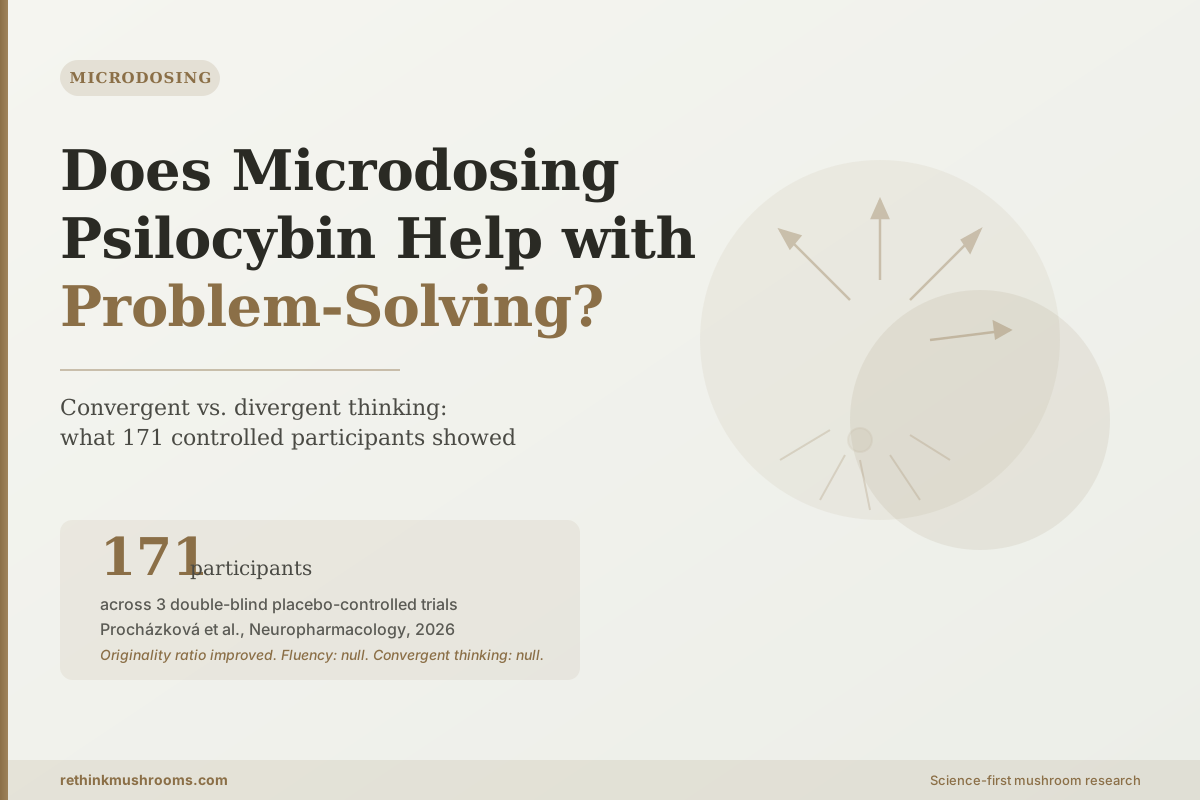
171 participants
Pooling 3 double-blind trials, researchers found psilocybin microdosing produced more original ideas per total ideas generated, but did not increase idea quantity or improve problem-solving accuracy.
Procházková et al., Neuropharmacology, 2026
3 RCTs pooled
all double-blind placebo-controlled
Zero
effects on convergent (problem-solving) thinking
1,614
participants in the 2026 cognitive meta-analysis
Procházková et al., Neuropharmacology, 2026
 View as image ↗
In 2018, a Dutch research group brought participants to a ceremony where they took small amounts of psilocybin-containing magic truffles. Before and after, researchers tested two things: how many creative ideas participants could generate, and how well they could solve problems with a single correct answer. Both improved. The headlines wrote themselves.
The same research group then ran controlled trials, adding something the 2018 study lacked: a placebo group. When participants did not know whether they had taken psilocybin or a dummy pill, the effects were dramatically different. This pattern defines the current state of microdosing psilocybin research on thinking and problem-solving: open-label studies show benefits; controlled studies show something much smaller.
Understanding what that research actually measured requires two concepts: divergent thinking and convergent thinking. Researchers test them separately because they capture fundamentally different cognitive abilities, and microdosing appears to affect them differently. Our complete guide to microdosing psilocybin covers the broader landscape; this article focuses on what controlled research shows about these two specific types of thinking.
Key Takeaways
- Divergent thinking (brainstorming many ideas) and convergent thinking (finding one correct answer) are distinct cognitive abilities that research measures separately
- The strongest controlled evidence, a 2026 mega-analysis of 3 double-blind trials with 171 participants, found psilocybin microdosing increased the ratio of original ideas to total ideas in divergent tasks, but did not increase the total number of ideas
- Total idea generation (fluency), thinking speed, and all convergent problem-solving measures showed zero effect in the mega-analysis
- A 2022 double-blind RCT by Cavanna and colleagues found no effects on either divergent or convergent thinking, despite participants noticing subjective changes and measurable EEG differences
- A 2026 meta-analysis of 14 studies with 1,614 participants found cognitive control, the executive function underlying both types of thinking, significantly decreased with microdosing
- The 2018 naturalistic study that appeared to show dramatic improvements in both types of thinking had no placebo group; every participant knew they had taken psilocybin in a ceremonial setting
What "Divergent" and "Convergent" Thinking Actually Mean
These two terms describe the most basic split researchers use when studying creative and analytical thinking.
Divergent thinking is the ability to generate many possible answers when a question has no single correct response. A classic test: "List as many uses as you can think of for a brick." Researchers score the answers for fluency (total number of ideas), flexibility (how many different categories the ideas span), and originality (how unusual each idea is compared to what most people say).
Convergent thinking is the opposite: finding the one correct answer when one exists. A classic test: "What single word connects 'cream,' 'skate,' and 'water'?" (The answer is "ice.") This type of thinking requires logical analysis, rule-following, and filtering out wrong answers.
Both abilities matter in everyday life. Creative work often requires divergent thinking first to generate options, then convergent thinking to evaluate which option is correct or useful. Psychedelic research measures both types because high-dose psychedelics appeared to enhance both, making creativity a logical place to look for effects at lower doses.
Why Researchers Expected Microdosing to Affect Both
The hypothesis came from what was already known about full-dose psychedelic experiences.
High doses of psilocybin reliably alter activity in a brain network called the default mode network. This is a set of regions that tends to dominate mental activity when people are thinking about themselves, replaying memories, or mentally drifting. Its high baseline activity appears to constrain creative thinking by reinforcing familiar mental patterns.
Full-dose psilocybin quiets this self-referential circuit temporarily, which allows brain regions that do not normally communicate to exchange signals. The result is more unusual, associative thinking. Controlled research documented genuine improvements in divergent idea generation and convergent problem-solving after full-dose psychedelic sessions.
The microdosing hypothesis followed logically: if very small amounts of psilocybin produced the same brain-network changes in a milder form, they should produce milder but real improvements in both types of thinking. Sub-threshold doses were expected to deliver a creativity benefit without the perceptual intensity of a full experience.
That expectation turned out to be partly right and mostly wrong.
The 2018 Study That Seemed to Confirm the Hypothesis
Procházková and colleagues published a naturalistic study in Psychopharmacology in 2018.[4] The setting was a psilocybin-truffle ceremony in the Netherlands, where consuming psilocybin-containing truffles was legal. Participants took a low dose in the microdosing range, and researchers tested their thinking before and after.
The results looked impressive. Convergent thinking scores improved on the Picture Concept Task, and divergent thinking improved on the Alternative Uses Task.[4] Both types of thinking, measured in a single session, moved in the right direction.
But the study had a critical design feature: there was no placebo group. Every participant knew they had taken psilocybin truffles. They were in a ceremony specifically organized around that experience.
When people believe they have taken a substance that will enhance their thinking, their thinking often improves. This is the expectancy effect, and it is especially powerful for psychedelics. Participants who are enthusiastic about microdosing and who take a substance they believe will make them think better are not a clean test of whether the substance itself causes the improvement.
The 2018 study launched the creativity hypothesis and generated genuine scientific interest. But it could not separate psilocybin's pharmacological effects from participants' expectations. That separation required a different study design.
What Happened When Placebo Controls Were Added
Cavanna and colleagues designed exactly that: a double-blind, placebo-controlled trial published in Translational Psychiatry in 2022.[2]
Participants received either 0.5 grams of dried psilocybin mushrooms or an identical-looking placebo. Neither the participants nor the researchers scoring the cognitive tests knew who received which. The study tested both divergent and convergent thinking.
The results: neither improved.[2]
This was despite the fact that participants noticed the psilocybin. EEG recordings showed measurable changes in brain rhythms. Participants reported feeling different subjectively. The dose was pharmacologically active at a perceptual level.
But feeling different and performing differently on cognitive tests are not the same thing. On the specific tasks measuring divergent idea generation and convergent problem-solving, psilocybin and placebo produced identical results.
This study joined a growing body of placebo-controlled evidence suggesting that the improvements seen in open-label research are at least partly driven by expectancy. When participants know they took psilocybin and believe it will improve their thinking, it subjectively does. When they do not know, the effect on measured task performance disappears. This dynamic is explored in depth in the research on whether microdosing is just placebo.
The 2026 Mega-Analysis: One Narrow Finding Survived Three Controlled Trials
Procházková and colleagues continued working in this area, eventually accumulating data from three double-blind, placebo-controlled longitudinal trials. In 2026, they published a mega-analysis in Neuropharmacology that pooled all three into a single dataset of 171 participants.[1]
With 171 participants across three rigorously controlled trials, this is the most statistically powerful controlled evidence on psilocybin microdosing and creative thinking.
The finding: psilocybin microdosing increased the originality-to-fluency ratio in divergent thinking.[1]
Total idea generation (fluency) did not improve. Thinking speed did not improve. The variety of idea categories (flexibility) did not improve. Convergent thinking showed no effect whatsoever.
The one thing that shifted: of all the ideas participants generated, a higher proportion were rated as original. The ratio of original ideas to total ideas went up.
The same research group also published a companion paper reporting results from two additional longitudinal trials.[5] Those trials found no significant effects on behavioral or subjective measures compared to placebo. The creativity finding lives specifically in the originality ratio; the broader cognitive and subjective picture across this group's research is otherwise null.
What the "Originality Ratio" Finding Actually Means in Practice
This is the part that most reporting gets wrong: the finding is about the composition of ideas, not the volume of ideas.
Imagine asking someone to list uses for a brick and they generate 10 ideas. In normal conditions, one of those 10 might be rated as original, meaning an unusual idea that most people do not think of. That is a 10% originality rate.
The 2026 mega-analysis finding means that with psilocybin microdosing, that same person might generate 10 ideas and have 2 rated as original.[1] The originality rate shifts upward. But the total idea count stays at 10.
This is a real effect. It is also narrow. It does not mean "more ideas." It means "a slightly higher proportion of ideas are unusual."
The study authors were careful to describe this precisely. The effect survived controls for whether participants could guess they had received psilocybin, and it survived controls for prior psychedelic experience. It represents a genuine, small pharmacological signal in a specific subdomain of divergent thinking quality.
For a close look at the actual numbers across each individual study in this literature, including how researchers measured the originality ratio and why the companion trials came out differently despite using the same drug and research group, see the lab data article on convergent and divergent thinking research.
Convergent Thinking: Every Controlled Study Finds Nothing
Across all controlled research on psilocybin microdosing, convergent thinking has consistently shown zero effect.
The 2022 RCT by Cavanna and colleagues found no improvement in convergent thinking with 0.5 grams of psilocybin mushrooms.[2] The Procházková mega-analysis, which found the narrow divergent originality effect, found zero effect on convergent thinking.[1] The companion longitudinal trials found no significant cognitive or behavioral effects either.[5]
This matters because "problem-solving" in everyday usage typically refers to convergent thinking. You have a specific challenge with a limited set of correct solutions, and you need to find one. Engineering problems, mathematical questions, strategic decisions with defined constraints, debugging code: all of these rely heavily on convergent thinking.
The research does not support the idea that microdosing psilocybin helps with this type of thinking. The null results are consistent, they come from well-designed controlled trials, and they hold across different doses and protocols.
The divergent thinking effect, narrow as it is (the originality ratio only), might apply in brainstorming contexts where unusual ideas are the explicit goal. For convergent thinking contexts, where finding the correct answer is the point, controlled evidence shows no signal.
The Cognitive Control Finding That Points the Other Way
A 2026 systematic review and meta-analysis in Neuroscience and Biobehavioral Reviews analyzed 14 microdosing studies involving 1,614 participants across 59 effect sizes.[3]
The headline finding: cognitive control significantly decreased with microdosing. No detectable improvements appeared in attention, working memory, or fluid intelligence.
Cognitive control refers to the set of mental skills that regulate how the brain pursues goals. This includes the ability to stay focused on a task, to inhibit irrelevant thoughts, and to shift attention between tasks efficiently. These regulatory skills underlie both divergent and convergent thinking. Generating useful creative ideas requires the control to stay on task and not drift into unproductive territory. Solving a convergent problem requires the control to resist wrong answers and keep working toward the one that is correct.
The meta-analysis finding suggests that microdosing, across a large and varied sample, produces a reliable reduction in this regulatory capacity.[3] This finding comes from different studies and different outcome measures than the creativity mega-analysis, but it represents the strongest cognitive signal from the entire controlled research literature, and it cuts against the idea that microdosing sharpens thinking across the board.
This connects to broader questions about microdosing psilocybin for focus and productivity, where the same meta-analysis found no support for the focus-enhancement claims that drove the Silicon Valley microdosing trend.
For readers interested in functional mushrooms with a different cognitive evidence profile, the research on lion's mane and cognitive function provides a useful comparison point from a distinct evidence base.
How to Read the Apparent Contradictions
The evidence base for microdosing and thinking contains real tensions. The 2018 open-label study showed improvements in both types of thinking. The 2022 controlled RCT showed zero effects on either. The 2026 mega-analysis found a narrow divergent thinking quality signal. The 2026 meta-analysis found cognitive control decreases. How do these fit together?
The most useful frame is measurement specificity combined with expectancy effects.
The 2018 study measured participants who knew they had taken psilocybin, in a context specifically designed to feel meaningful and transformative. Expectancy effects reliably produce improvements on cognitive tests when people believe a substance will help them think. This does not mean the 2018 results were wrong as observations; it means they measured a blend of drug effects, expectancy effects, and ceremonial context that cannot be separated.
The controlled trials separated the drug from the expectancy. What remained was small and specific. In divergent thinking, the quality ratio improved slightly. In convergent thinking, nothing remained. In cognitive control, the signal was negative.
These results are not fully contradictory. They describe a pharmacological effect that is narrower, weaker, and more mixed than the open-label data suggested. The drug does something specific: it shifts the composition of divergent thinking toward more original outputs. But it does not do most of what enthusiasts and early research implied.
What the Evidence Shows Across Different Thinking Contexts
The controlled research points to three different conclusions depending on the thinking context.
Controlled-Trial Evidence by Thinking Type
Divergent vs. Convergent: What Survives Placebo Control
Of every measure controlled trials tracked, exactly one moves in a favorable direction — and only narrowly. Idea volume, problem-solving, and the control system beneath both do not follow.
Divergent thinking (generating ideas)
Measured with the Alternative Uses Task — listing possible uses for a common object.
Originality ratio (original / total ideas)
The proportion of generated ideas rated as genuinely novel
Mega-analysis of 3 double-blind RCTs, N=171 (Neuropharmacology, 2026)
Idea quantity (fluency)
Total number of ideas generated
Same 2026 mega-analysis — no change vs. placebo
Category flexibility
How many different kinds of ideas are produced
Same 2026 mega-analysis — no change vs. placebo
Generation speed
How quickly ideas are produced
Same 2026 mega-analysis — no change vs. placebo
Convergent thinking (problem-solving)
Finding the one correct answer, as in the Remote Associates or Picture Concept tasks.
Problem-solving accuracy
Finding the single correct answer to a defined problem
Null in every controlled trial (Cavanna 2022 RCT; 2026 mega-analysis, N=171)
Underlying capacity
Cognitive control
The regulatory capacity underlying both thinking types — filtering distractions, inhibiting impulses
Meta-analysis of 14 studies, N=1,614, 59 effect sizes (Neurosci. & Biobehav. Reviews, 2026)
Source: Procházková et al. 2026 mega-analysis (N=171); Cavanna et al. 2022 RCT; Pinhas et al. 2026 meta-analysis (N=1,614)
For generating unusual ideas (divergent thinking, specifically the originality dimension): the 2026 mega-analysis found a weak positive signal.[1] A slightly higher proportion of generated ideas were rated as original. This is the most specific and most robust finding in the creative thinking literature.
For generating more ideas (divergent thinking, fluency): no effect in any controlled study. The total number of ideas does not increase.
For finding correct answers to defined problems (convergent thinking): consistently null across every controlled trial.
For sustained, goal-directed thinking that requires filtering distractions (cognitive control): the largest meta-analysis found a significant decrease across 1,614 participants.[3]
For a broader view of how these findings connect to the creativity research on microdosing psilocybin, including what the evidence means for popular claims about microdosing and creative work, that article covers the full creativity picture beyond the thinking-type framework.
The Bottom Line
Controlled research finds that psilocybin microdosing produces a narrow, specific effect on creative thinking: the proportion of original ideas in a brainstorming task increases slightly, according to a 2026 mega-analysis of 171 participants across three double-blind trials. The total number of ideas generated, the speed of generation, and convergent problem-solving accuracy all show no effect. The largest cognitive meta-analysis (14 studies, 1,614 participants) found cognitive control significantly decreased. These results represent a much smaller and more specific pharmacological signal than the open-label and naturalistic research suggested.
Frequently Asked Questions
Sources & References
- 1RTHM-00962·Prochazkova, Luisa et al. (2026). “Microdosing psilocybin and its effect on creativity: Lessons learned from three double-blind placebo controlled longitudinal trials..” Neuropharmacology.Study breakdown →PubMed →↩
- 2RTHM-00748·Cavanna, Federico et al. (2022). “Microdosing with psilocybin mushrooms: a double-blind placebo-controlled study..” Translational psychiatry.Study breakdown →PubMed →↩
- 3RTHM-00961·Pinhas, Netta et al. (2026). “Effects of psychedelic microdosing on cognitive functions: A systematic review and meta-analysis..” Neuroscience and biobehavioral reviews.Study breakdown →PubMed →↩
- 4RTHM-00993·Prochazkova, Luisa et al. (2018). “Exploring the effect of microdosing psychedelics on creativity in an open-label natural setting..” Psychopharmacology.Study breakdown →PubMed →↩
- 5RTHM-02243·Prochazkova, Luisa et al. (2026). “Cognitive and subjective effects of psilocybin microdosing: Results from two double-blind placebo-controlled longitudinal trials..” Neuropharmacology.Study breakdown →PubMed →↩