Microdosing
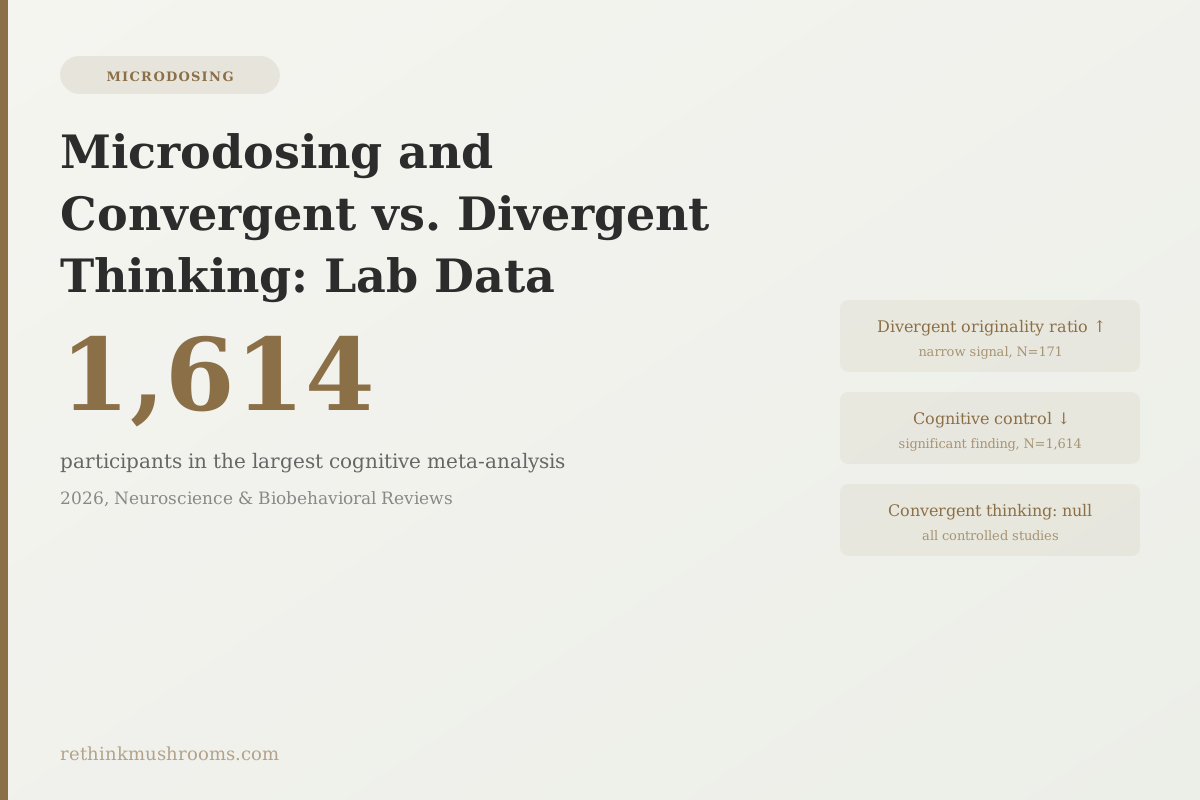
1,614 participants in the largest cognitive meta-analysis
The largest preregistered meta-analysis on microdosing and cognition found no improvements in attention or working memory, and a significant decrease in cognitive control, across 14 studies and 59 effect sizes.
2026, Neuroscience & Biobehavioral Reviews
N=171
pooled from 3 double-blind RCTs; only originality ratio improved, not fluency or convergent thinking
Cognitive control ↓
the meta-analysis headline finding runs opposite to the productivity narrative
0 gains
in convergent problem-solving across all controlled studies reviewed
2026, Neuroscience & Biobehavioral Reviews
 View as image ↗
The lab research on microdosing and convergent and divergent thinking has produced a story that doesn't fit neatly into either the hype or the dismissal. Controlled studies show one narrow positive signal: a higher proportion of original ideas in divergent thinking tasks, documented in a 2026 mega-analysis that pooled 171 participants across three double-blind trials.[1] The same evidence base shows zero effects on convergent thinking (problem-solving with a single right answer), no improvement in idea quantity, and a significant decrease in cognitive control documented across 14 studies and 1,614 participants.[2] This article walks through each key study, explains what the apparent contradictions actually mean, and presents the most accurate picture of where the evidence currently stands.
For the conceptual framework explaining what convergent and divergent thinking are, the problem-solving and microdosing explainer provides the definitional grounding. The broader microdosing research guide places this cognitive research in the full context of psilocybin microdosing.
Key Takeaways
- A 2026 mega-analysis pooling 3 double-blind RCTs (N=171) found that psilocybin microdosing improved the ratio of original ideas to total ideas generated (meaning quality of divergent thinking improved modestly) but did not increase the total number of ideas, speed, or any measure of convergent problem-solving (Procházková et al., 2026)
- A companion 2026 paper by the same research group found no significant cognitive or subjective effects across two separate double-blind longitudinal trials (Procházková et al., Neuropharmacology, 2026; PMID:41110634)
- The largest preregistered meta-analysis on microdosing and cognition (14 studies, N=1,614) found a significant decrease in cognitive control and no detectable improvements in attention, working memory, or fluid intelligence (2026, Neuroscience & Biobehavioral Reviews)
- The creativity improvements seen in the 2018 Procházková naturalistic ceremony study (PMID:30357434) were not controlled for expectancy; the self-blinding citizen science study established that most reported benefits in unblinded settings are placebo-driven
- The cognitive control decrease and the narrow originality ratio improvement are not contradictory: they measure different constructs, tested in different ways, and both can be simultaneously true
- Microdosing shows a weak, specific signal for idea originality in divergent thinking; it shows no benefit and a probable cost for convergent (analytical) problem-solving and focused cognitive work
The Study That Launched the Hypothesis: What the 2018 Ceremony Data Showed
In 2018, Procházková and colleagues published a naturalistic observational study that sent the microdosing-and-creativity hypothesis viral in scientific circles. Participants at a legal psilocybin truffle ceremony in the Netherlands completed creativity tests before and after consuming the truffles (Procházková et al., Psychopharmacology, 2018; PMID:30357434). The results looked extraordinary: both convergent and divergent thinking improved substantially. Convergent thinking scores on the picture concept test moved from 6.6 to 7.6. Divergent thinking scores rose on multiple dimensions.
The problem was the design. There was no placebo group. Every participant knew they were consuming psilocybin truffles at a ceremony specifically designed around their use. They were at an event where improvement was expected, surrounded by others expecting improvement, measured by researchers they knew were interested in demonstrating improvement. The expectancy conditions could not have been more favorable.
The 2018 study is genuinely important research: it was the first careful measurement of creativity at a psilocybin event and it generated the specific hypotheses that later controlled studies tested. But its findings cannot be separated from the expectancy context in which they were produced. That distinction is why the controlled research that followed told a different story.
The Methodological Breakthrough: Self-Blinding Proved Expectancy Effects Are Large
In 2021, Szigeti and colleagues published what became one of the most important methodological papers in microdosing research: the self-blinding citizen science study, published in eLife.[3]
The study recruited naturalistic microdosers and had them prepare their own capsules, with some capsules randomly replaced by placebo. Participants did not know on any given day whether they had taken their substance or a sugar pill. They reported their experiences over several weeks.
The key finding: participants who believed they had taken psilocybin on a given day reported benefits (better mood, greater focus, enhanced creativity) regardless of whether they actually had. When the self-reported benefits were corrected for the placebo capsule days, the drug-specific effects were substantially smaller and less consistent than the open-label self-report data from uncontrolled studies.
This study established what controlled researchers had suspected: the large benefits reported in naturalistic microdosing surveys and the 2018 ceremony study are mostly expectancy effects. People who take a substance they believe improves cognition will report improved cognition. The pharmacological effect, if any, is a smaller signal riding on top of a large psychological one.
For a full treatment of how expectancy shapes microdosing experiences, see the article on expectancy effects in microdosing and the is microdosing just placebo? analysis.
The 2022 Double-Blind RCT: Zero Effects When Expectancy Is Controlled
With the methodological stakes clarified, Szigeti and colleagues published a full double-blind placebo-controlled randomized trial in Translational Psychiatry in 2022.[4] Participants received 0.5g of dried psilocybin mushrooms or placebo under double-blind conditions, and completed standardized tests of both divergent and convergent thinking.
The results: no effects on divergent thinking by any measure. No effects on convergent thinking. Zero.
Participants did report noticeable subjective effects from the active condition, and EEG recordings confirmed altered brain rhythms. So the dose was pharmacologically active; people felt it. They just didn't perform better on cognitive tasks. This is the dissociation that appears repeatedly in controlled microdosing research: subjective enhancement and objective performance enhancement are different things that do not reliably travel together.
The Szigeti 2022 trial is a single study with a specific dose and population, and cannot generalize to all microdosing protocols. But it established that the dose most naturalistic microdosers use (roughly 0.5g dried mushrooms) produced no measurable cognitive benefit in a controlled test.
The 2026 Mega-Analysis: The Most Positive Controlled Finding in This Literature
The most rigorous attempt to find a genuine cognitive effect came from Procházková and colleagues' 2026 mega-analysis in Neuropharmacology, which pooled individual participant data from three separate double-blind placebo-controlled longitudinal trials for a total of 171 participants.[1]
The headline finding was specific and modest: psilocybin microdosing increased the originality-to-fluency ratio in divergent thinking. Not fluency itself (the total number of ideas generated). Not flexibility (the variety of idea categories). Not speed. Only the ratio of original ideas to total ideas.
To understand what this means in practice: imagine someone normally generates 10 ideas in a brainstorming task, with 2 of them rated as highly original. A microdose, per this finding, might shift that to 3 out of 10 ideas being highly original while the total number stays at 10. The person generates the same number of ideas in the same time but a higher proportion of them are novel.
This is a real finding that survived controlling for dose-guess (whether participants could detect they were in the active condition), prior psychedelic experience, and other potential confounders. It is not large and it is not broad. Convergent thinking showed no improvement. Fluency showed no improvement. But originality ratio showed a statistically significant and replicable effect across three trials.
This is the most specific positive claim the controlled evidence supports.
The Companion Trials: Same Group, Different Outcome Measures
Alongside the mega-analysis, the same research group published results from two separate double-blind longitudinal trials in Neuropharmacology (Procházková et al., 2026; PMID:41110634). These trials measured a broader range of outcomes: behavioral cognitive measures, subjective reports of cognitive flexibility, mood, and social cognition.
The result of these two trials: no statistically significant effects on behavioral or subjective measures after correcting for multiple comparisons.
This seems to contradict the mega-analysis finding from the same team. Both papers are from 2026, published together, based on overlapping data. How can they simultaneously find a creativity improvement and no cognitive effects?
The answer is measurement specificity. The mega-analysis used a focused analysis of a particular metric (originality-to-fluency ratio) specifically designed to detect the subtle quality-versus-quantity distinction in divergent thinking. The companion trials measured a broader array of outcomes, applied multiple comparison corrections for the larger number of tests, and found no surviving effects.
The originality ratio finding survives because it is the right tool for the specific signal. The broader outcome battery finds nothing because the signal is too narrow to show up as a general cognitive benefit. Both results are accurate descriptions of the data.
What Controlled Microdosing Lab Research Shows for Convergent and Divergent Thinking
| Study | Design | Divergent Thinking | Convergent Thinking | N |
|---|---|---|---|---|
| Procházková et al. 2018 (PMID:30357434) | Naturalistic, no placebo | Fluency ↑, quality ↑ | ↑ | Not specified |
| Szigeti et al. 2021 (self-blinding, eLife) | Self-blinding citizen RCT | Placebo ≈ active | Placebo ≈ active | Not specified |
| Szigeti et al. 2022 (Transl. Psychiatry) | Double-blind RCT | No effect | No effect | Not specified |
| Procházková et al. 2026 (mega-analysis) | 3 pooled double-blind RCTs | Originality ratio ↑; fluency null | No effect | 171 |
| Procházková et al. 2026 (longitudinal trials, PMID:41110634) | 2 double-blind longitudinal RCTs | No significant effects | No significant effects | Not specified |
| 2026 preregistered meta-analysis | 14 studies, 59 effect sizes | Cognitive control ↓ | No effect | 1,614 |
The Biggest Dataset: What 1,614 Participants Tell Us About Cognitive Control
The 2026 preregistered meta-analysis in Neuroscience & Biobehavioral Reviews pooled 14 studies with 1,614 participants and 59 effect sizes.[2] This is the largest systematic analysis of microdosing and cognitive performance, and its headline finding contradicts the popular narrative entirely.
Cognitive control significantly decreased with microdosing. No improvements were detected in attention, working memory, or fluid intelligence.
Cognitive control is the set of executive functions that allows someone to inhibit irrelevant information, maintain focus on a task, switch appropriately between task demands, and update working memory with relevant new information. These are the exact capacities required for productive focused work. The finding that microdosing decreases cognitive control, across 14 studies and 59 effect sizes, is the most robust quantitative conclusion in this entire field, and it runs directly against the productivity claims.
The 2025 systematic review of microdosing side effects, published in the Journal of Psychopharmacology, provides corroboration: attentional impairment was among the documented adverse effects in several microdosing protocols.[5] The cognitive control decrease in the meta-analysis is biologically consistent with acute adverse effects on executive function that the side effects review documented.
How the Creativity Finding and the Cognitive Control Finding Can Both Be True
The originality ratio improvement and the cognitive control decrease are not contradictory. They describe different psychological constructs measured by different tests.
Divergent thinking originality is a measure of idea novelty relative to the pool. It reflects the capacity to generate unusual associations. Cognitive control is the capacity to focus, inhibit, and direct attention efficiently. These abilities are partially independent. A state that loosens associative thinking (producing more novel ideas per idea generated) can simultaneously impair the executive function required to focus on one task for sustained periods.
This is actually consistent with what full-dose psychedelics do: they increase entropy in neural activity, which loosens the default mode network's grip on habitual thought patterns, generating more unusual associations, while temporarily reducing the kind of directed, focused attention that executive function underlies. The microdosing data suggests a sub-threshold version of the same pattern: a small push toward associative looseness (originality ratio up) and a small impairment of executive control (cognitive control down).
Both of these are pharmacological effects. Neither is placebo. Both matter for anyone evaluating whether microdosing is appropriate for specific cognitive goals. For a cross-pillar perspective on functional mushrooms that show cognitive benefits through different mechanisms, the lion's mane and cognitive function article covers a compound with a stronger controlled evidence base for neuroplasticity-related outcomes.
What These Findings Mean for Productivity Claims
The productivity narrative around microdosing (sharp focus, sustained concentration, better problem-solving) is not supported by any controlled study. The 2026 meta-analysis finding of decreased cognitive control is the data most relevant to this claim, and it points in the opposite direction. The microdosing for focus and productivity article covers this gap between the cultural narrative and the controlled evidence in full.
The microdosing and creativity article puts the originality ratio finding in practical context: what it means to generate more original ideas per idea generated, and whether that constitutes the creative enhancement the popular literature describes. The answer is more specific and more limited than the popular literature suggests.
The Bottom Line
The controlled lab evidence on microdosing and convergent vs. divergent thinking has converged on a narrow, specific picture. The most positive finding, from a 2026 mega-analysis of 171 participants, is that originality per idea in divergent thinking improves modestly. Fluency, flexibility, and all convergent thinking measures remain null across controlled studies. The most consequential finding from the largest meta-analysis (N=1,614) is a significant decrease in cognitive control with no gains in attention or working memory. The 2018 naturalistic data showing dramatic creativity improvements is not replicable under controlled conditions once expectancy is removed.
Frequently Asked Questions
Sources & References
- 1. Source details for this reference are not yet available.
- 2. Source details for this reference are not yet available.
- 3. Source details for this reference are not yet available.
- 4. Source details for this reference are not yet available.
- 5. Source details for this reference are not yet available.