Microdosing Safety
31 studies reviewed for adverse effects (Modzelewski, 2025)
The first systematic review of microdosing side effects found adverse effects are typically dose-dependent, mild, and transient; adverse event reporting across the field is so inconsistent that true rates remain uncertain.
Modzelewski et al., Neuropharmacology, 2025
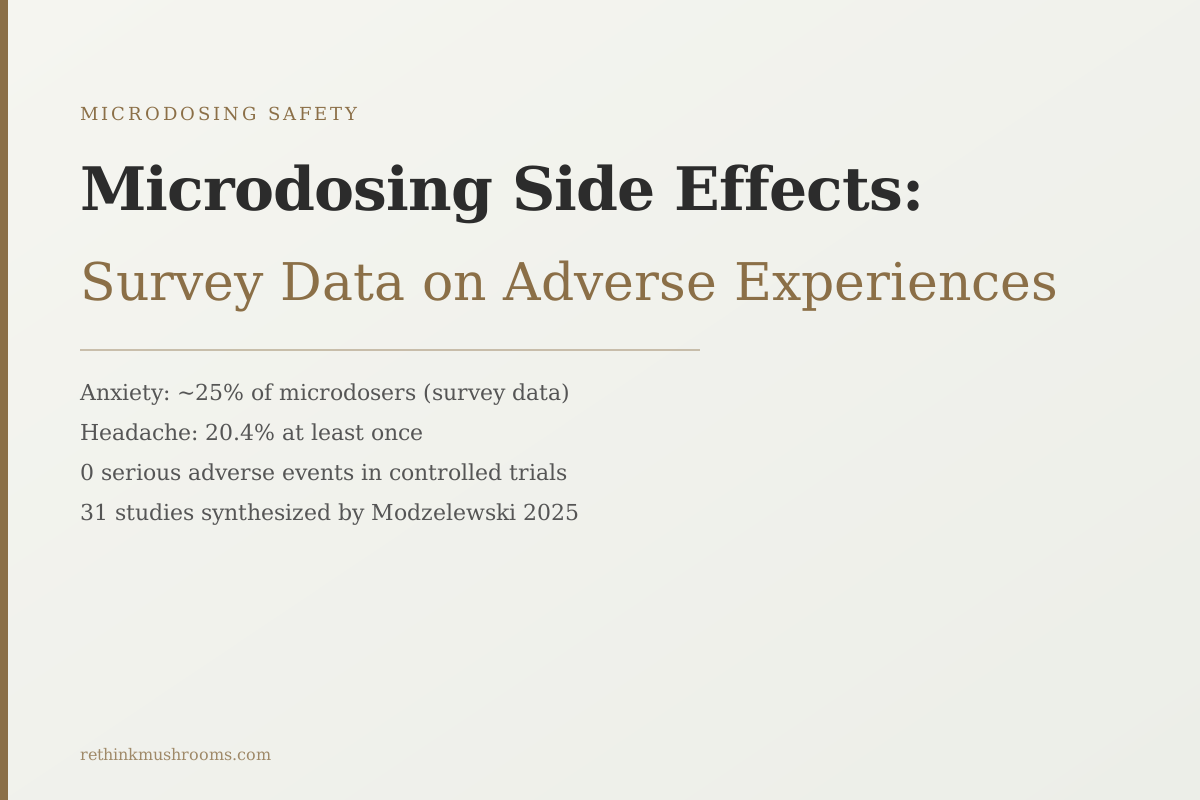
20.4%
of surveyed microdosers reported headache at least once (Hutten 2019)
0
serious adverse events reported in any controlled microdosing trial to date
15 high-quality
lab studies vs 14 lower-quality studies in the Modzelewski 2025 synthesis; cognitive impairments and anxiety were most common findings
Modzelewski et al., Neuropharmacology, 2025
 View as image ↗
Twenty percent of surveyed microdosers reported headaches. In the same research context, approximately 25% reported some degree of anxiety. These numbers come from surveys of people who self-identify as current or former microdosers.
Controlled clinical trials of the same practice tell a different story: no serious adverse events in any study published to date. The most common side effects in trials are acute and mild. Most resolve within hours.
The gap between those two sets of numbers is the core issue in microdosing psilocybin side effects research, and understanding it is more useful than any single statistic. Both data sources are real. Both are incomplete. Survey data captures more people but skews toward enthusiasts and is confounded by unregulated supply. Controlled trial data uses clean conditions but small samples and short follow-ups that cannot detect rare or long-term effects.
This article works through what each source of evidence actually shows, where the numbers come from, and what the most comprehensive synthesis to date found when researchers tried to pool everything together. For the broader scientific picture, the complete guide to psilocybin microdosing covers the full landscape.
Key Takeaways
- In Hutten's 2019 survey of active microdosers, anxiety was the most commonly reported adverse effect; approximately 25% reported mild anxiety and 4.6% reported severe anxiety; headache occurred in 20.4% of respondents at some point; most effects were acute and dose-dependent
- Anderson's 2019 empirical codebook of 278 microdosers found impaired focus, physical discomfort, and anxiety as the most frequently coded adverse experiences; most challenges were tied to dose days, not off-days
- No serious adverse events were reported in any controlled clinical trial of microdosing (Cavanna 2022 RCT; Szigeti 2021 self-blinding study of 191 participants)
- Modzelewski and colleagues' 2025 systematic review of 31 studies found adverse effects were typically dose-dependent, mild, and transient; the most commonly identified were increased blood pressure, anxiety, and cognitive impairment
- Rootman's 2021 naturalistic cohort (n=953) found no serious adverse events and lower self-reported anxiety and depression in microdosers versus controls, though selection bias limits interpretation
- Pinhas and colleagues' 2026 meta-analysis found that microdosing can impair convergent thinking, a specific cognitive adverse effect that survey studies would not detect, because surveys ask about subjective experience rather than objective performance
Why Survey Data and Controlled Trial Data Disagree on Side Effect Rates
The difference between a survey and a clinical trial matters as much as any individual finding.
Survey studies recruit people who are already microdosing by choice. That creates selection bias in both directions: enthusiastic users are overrepresented (people who had serious problems likely stopped and are less likely to respond to surveys about active microdosers), and adverse effect reporting may be inflated by how questions are framed. In a survey that asks "have you ever experienced headache while microdosing?", someone who had a headache on a dose day that might have been unrelated will still answer yes. The denominator and the numerator are both fuzzy.
Controlled trials recruit carefully screened participants, control for confounders, use standardized measures, and compare effects directly against a placebo condition. This produces cleaner signal about what the drug actually does. But trials for microdosing tend to have small sample sizes, short durations (weeks, not months), and selection criteria that exclude the populations most likely to have adverse reactions, including people with personal or family histories of psychosis, cardiac conditions, or mental health disorders. They are designed to detect short-term pharmacological effects, not rare events.
A 2025 systematic review by Modzelewski and colleagues pooled data from 31 studies and tried to categorize what those studies actually found.[7] Their sample broke down into 15 high-quality laboratory studies, 14 lower-quality observational studies, and 2 case reports. The adverse event reporting across these studies was heterogeneous enough that the researchers flagged inconsistency in how studies even defined and measured adverse effects as a major limitation of the field.
The honest takeaway: the numbers you see in any given headline about microdosing side effects depend heavily on where those numbers came from.
The Adverse Effects Survey Data Actually Found: A Ranked List
The most detailed quantified survey of microdosing adverse effects comes from Hutten and colleagues' 2019 study of active microdosers.[1] The study asked participants to report side effects they had experienced while following a microdosing protocol. The most commonly reported adverse effects, in descending order, were:
- Anxiety: reported by approximately 25% at some level; of those, roughly 4.6% described severity as significant
- Headache: reported at least once by 20.4% of participants
- Nausea and gastrointestinal discomfort: reported by a meaningful fraction, concentrated on dose days
- Insomnia: reported primarily when doses were taken late in the day
- Impaired focus: reported on dose days, particularly at higher doses within the sub-threshold range
The pattern across all these effects: they were concentrated on dose days, they were typically mild, and they resolved without intervention. No participants in the survey reported seeking medical care for any microdosing-related adverse effect. Most effects appeared dose-dependent, meaning they were more common at higher doses within what participants considered their sub-threshold range.
Anderson and colleagues' 2019 empirical codebook of 278 microdosers complemented the Hutten data with qualitative categories.[2] The researchers coded participant reports and found that "challenges" fell into two main clusters: physiological discomfort on dose days (the headache, nausea, and GI effects) and social difficulties from being subtly altered during interactions with others. Impaired focus appeared as a distinct category, described by participants as the opposite of what they sought from microdosing but which occurred at some doses.
Anxiety: The Most Common Adverse Effect, and Why the Numbers Are Hard to Interpret
Anxiety deserves its own section because it illustrates the complexity of interpreting adverse effect reports from this population.
The Hutten study found anxiety in roughly 25% of microdosers at mild levels and 4.6% at significant levels.[1] That sounds substantial. But consider what this sample looks like: self-selecting microdosers who responded to an online survey, many of whom were microdosing specifically to address pre-existing anxiety and depression. In that population, anxiety may be the baseline condition, and the 25% figure may include people whose anxiety fluctuated for reasons unrelated to their microdosing protocol.
The comparison: Rootman and colleagues' 2021 naturalistic cohort of 953 microdosers found that microdosers reported significantly lower anxiety compared to non-microdosing controls.[3] This doesn't mean psilocybin can't cause anxiety. It means the overall trajectory for this population skewed toward less anxiety, not more, even in a large sample. The observation is consistent with anxiety being dose-day-specific and transient, rather than a persistent adverse effect.
Kaertner's expectancy research adds another layer: positive expectations predict positive reported outcomes, and by extension, negative expectations may inflate reported adverse effects. A participant who expects to feel anxious on a dose day may interpret normal arousal as anxiety. This is not a reason to dismiss the data; it is a reason to hold it loosely. For a full treatment of how expectation shapes microdosing experience, Expectancy Effects in Microdosing: How Belief Shapes Experience covers the mechanism.
What Controlled Trials Found: Fewer Adverse Effects, More Reliable Counting
The most methodologically rigorous adverse effect data in microdosing research comes from two controlled studies.
Cavanna and colleagues published a double-blind placebo-controlled trial of psilocybin microdosing in 2022.[4] The trial found no serious adverse events in either arm. Acute anxiety was more frequent in the active psilocybin arm than in the placebo arm, but it was mild and transient. The study also found improvements in some cognitive measures in the psilocybin group, though that was not the adverse effects focus.
Szigeti and colleagues' 2021 self-blinding citizen science study enrolled 191 participants who microdosed their own LSD or psilocybin against self-prepared placebo capsules.[5] No serious adverse events were recorded. Wellbeing measures improved in both the microdose and placebo groups, and the adverse effect profile was comparable across conditions. The most important safety finding from this study was actually methodological: substantial expectancy effects in the microdose group mean that adverse effects in uncontrolled settings may be partly driven by anticipation rather than pharmacology.
Rootman's 2022 observational study tracked 953 psilocybin microdosers against matched controls over one month.[6] No serious adverse events were reported. Microdosers showed greater improvements in mood and mental health outcomes compared to controls. This is a large naturalistic dataset with the expected limitation of selection bias; people who continue microdosing for a month are unlikely to be the people for whom it caused significant problems.
The consistent message from controlled and prospective data: the most severe adverse effect profile reported is mild, transient anxiety, concentrated on dose days, with no evidence of serious acute harm in screened populations.
Modzelewski 2025: The First Systematic Review of Microdosing Side Effects
The Modzelewski 2025 systematic review is the most comprehensive attempt to synthesize what the field knows about microdosing adverse effects.[7]
The 31 studies in the review divided into three quality tiers. The 15 high-quality laboratory studies used standardized measures and controlled conditions. The 14 lower-quality studies relied primarily on self-report without controls or objective measurement. Two were case reports. This quality distribution maps directly onto the pattern described above: the more rigorous the study design, the fewer and milder the adverse effects found.
The most commonly identified adverse effects across the high-quality studies were increased blood pressure, anxiety, and cognitive impairment. All three were dose-dependent. All three were typically transient. The blood pressure finding is particularly well-documented: psilocybin, even at sub-perceptual doses, causes mild, transient increases in heart rate and blood pressure that are not clinically significant in healthy individuals but may require monitoring in those with pre-existing cardiovascular conditions. For a full analysis of the cardiac dimensions specifically, Microdosing and Heart Health: The 5-HT2B Valvulopathy Concern covers both the acute cardiovascular effects and the chronic valvulopathy risk.
The systematic review also flagged a data quality problem that limits any conclusions from the field: studies reported adverse events inconsistently, with different definitions, measurement tools, and follow-up windows. The Modzelewski team called for standardized adverse event reporting in future studies as a foundational need.
The Cognitive Adverse Effect Nobody Surveys For
The most underreported finding in microdosing side effects research comes from a meta-analysis, not a survey.
Pinhas and colleagues' 2026 meta-analysis of controlled studies found that microdosing produced a small positive effect on divergent thinking (the generative, idea-generating side of creativity) but no effect or a slight impairment in convergent thinking (the analytical, single-answer problem-solving side).[8]
Convergent thinking impairment is a specific cognitive adverse effect that survey studies would not detect. When you ask someone "did microdosing improve your thinking?", they report their subjective experience, which typically feels positive. When you put them in a controlled cognitive test and measure their performance on problems with a correct answer, the data may tell a different story.
This finding matters because it contradicts a common rationale for professional microdosing: the idea that a morning dose sharpens analytical thinking and problem-solving. The controlled evidence, including the only meta-analysis of the data, does not support impairment in the high-anxiety-driven subjective experience; it also does not support improvement in analytical cognitive performance. It finds a signal pointing toward impairment in that domain.
This is the kind of adverse effect that only shows up when you test for it objectively. Survey studies, by definition, ask what people experience, not what their performance measures show.
Who Is Most Likely to Experience Adverse Effects
Across studies, certain patterns emerge about who reports more adverse effects.
Dose magnitude matters most. Effects described as adverse in the Hutten survey were concentrated among people who had exceeded their intended sub-threshold dose, either accidentally or deliberately. The sub-perceptual threshold is not precisely defined and varies between individuals; a dose that produces no noticeable effect in one person may produce mild perceptual changes in another.
Timing on dose days also matters. Insomnia was reported primarily when doses were taken in the afternoon or evening, consistent with psilocybin's mild stimulatory properties. Most adverse effects on the list (anxiety, impaired focus, headache) were acute to the dose day.
Mental health history is a significant moderating factor not captured well in general surveys. Clinical reviews, including Kinderlehrer's 2025 analysis, consistently flag personal or family history of psychosis as a contraindication: psilocybin's serotonergic mechanism can precipitate manic or psychotic episodes in predisposed individuals, and no dose is reliably sub-threshold for that risk. Family History of Psychosis and Psilocybin: Risk Assessment covers the specific psychiatric risk factors in depth.
What the Survey Data Cannot Tell You
Two categories of risk are genuinely absent from the current evidence base.
Long-term chronic effects have not been studied. The Modzelewski systematic review, like every systematic review in this field, covers studies with short follow-up windows. Nobody has tracked microdosers for two or three years with objective measures of cardiac function, cognitive performance, or psychiatric outcomes. Survey data from self-reported long-term microdosers exists but cannot be validated against objective measures or control for selection bias.
For sibling articles covering what remains unknown about long-term effects: Long-Term Microdosing Risks: What We Don't Know Yet maps out the specific research gaps, and Microdosing Safety: What the Research Shows provides the full safety evidence landscape. For those specifically concerned about cardiac risk from long-term use, Microdosing Long-Term Risks: Cardiac Valvulopathy Concerns and 5-HT2B covers the mechanism and what the animal data shows.
Drug interactions are not covered by any existing study in adequate depth. Psilocybin's interaction with SSRIs is the most clinically relevant gap: most people who might consider microdosing for mental health are already taking serotonergic medications, and the pharmacological consequences of that combination are not well characterized.
The Bottom Line
Survey studies, controlled trials, and systematic reviews all point toward the same general picture for microdosing psilocybin side effects: adverse effects are typically mild, transient, and concentrated on dose days, with anxiety and headache as the most commonly reported. No serious adverse events have appeared in any controlled trial. The most important nuances are methodological: survey data overrepresents motivated users and misses rare or long-term effects; controlled trials use screened populations and short follow-ups. Modzelewski's 2025 systematic review of 31 studies provides the most comprehensive current synthesis, finding dose-dependent, mostly transient effects. Pinhas's 2026 meta-analysis adds a finding surveys cannot detect: convergent thinking may be mildly impaired. Long-term safety data is essentially absent.
Frequently Asked Questions
Sources & References
- 1RTHM-01067·Hutten, Nadia R P W et al. (2019). “Motives and Side-Effects of Microdosing With Psychedelics Among Users..” The international journal of neuropsychopharmacology.Study breakdown →PubMed →↩
- 2RTHM-00541·Anderson, Thomas et al. (2019). “Psychedelic microdosing benefits and challenges: an empirical codebook..” Harm reduction journal.Study breakdown →PubMed →↩
- 3RTHM-00715·Rootman, Joseph M et al. (2021). “Adults who microdose psychedelics report health related motivations and lower levels of anxiety and depression compared to non-microdosers..” Scientific reports.Study breakdown →PubMed →↩
- 4RTHM-00748·Cavanna, Federico et al. (2022). “Microdosing with psilocybin mushrooms: a double-blind placebo-controlled study..” Translational psychiatry.Study breakdown →PubMed →↩
- 5RTHM-01441·Szigeti, Balázs et al. (2021). “Self-blinding citizen science to explore psychedelic microdosing..” eLife.Study breakdown →PubMed →↩
- 6RTHM-01611·Rootman, Joseph M et al. (2022). “Psilocybin microdosers demonstrate greater observed improvements in mood and mental health at one month relative to non-microdosing controls..” Scientific reports.Study breakdown →PubMed →↩
- 7RTHM-02153·Modzelewski, Stefan et al. (2025). “Side effects of microdosing lysergic acid diethylamide and psilocybin: A systematic review of potential physiological and psychiatric outcomes..” Neuropharmacology.Study breakdown →PubMed →↩
- 8RTHM-00961·Pinhas, Netta et al. (2026). “Effects of psychedelic microdosing on cognitive functions: A systematic review and meta-analysis..” Neuroscience and biobehavioral reviews.Study breakdown →PubMed →↩