Microdosing Safety & Risks
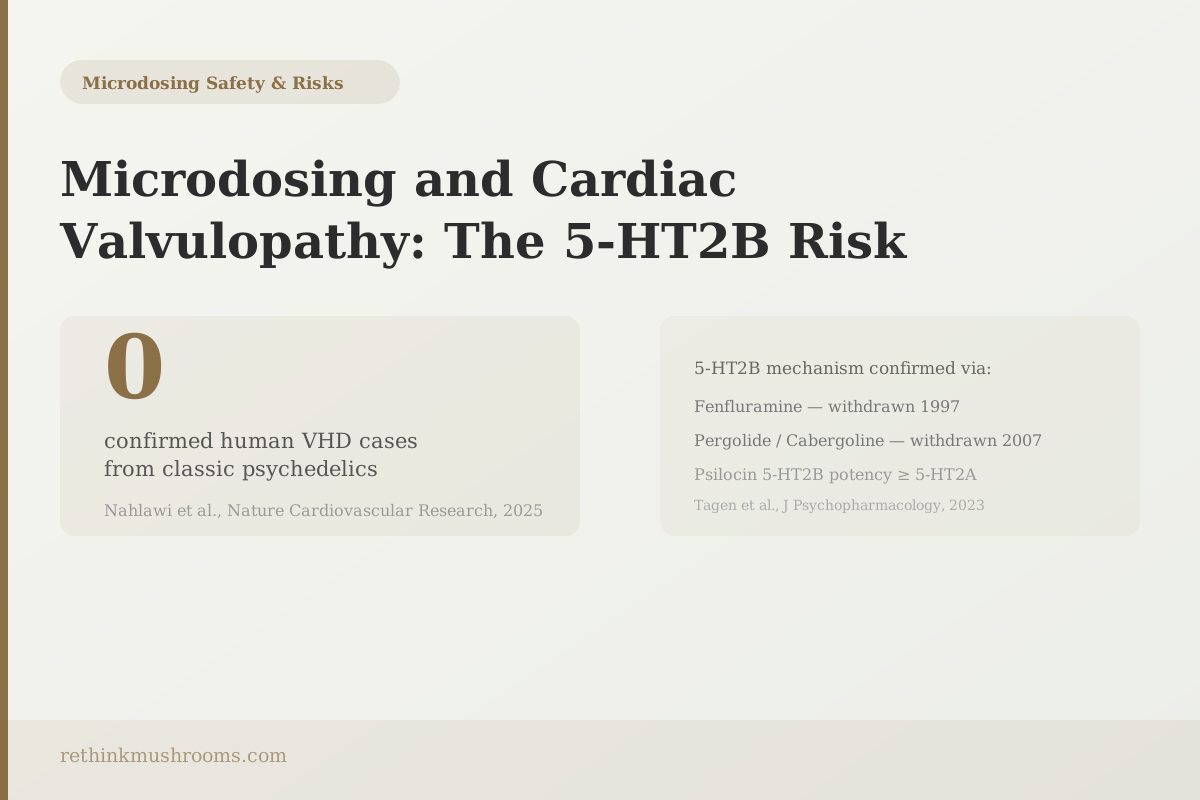
0 confirmed human VHD cases from psychedelics
A 2025 review in Nature Cardiovascular Research found no confirmed cases of drug-induced heart valve disease from psychedelics — but it also concluded that the theoretical risk from chronic 5-HT2B receptor activation is real and warrants monitoring.
Nahlawi, Ptaszek & Ruskin, Nature Cardiovascular Research, 2025
5 of 5
classic psychedelics bind 5-HT2B with potency ≥ 5-HT2A (Tagen 2023)
4 weeks
time for fenfluramine to cause aortic regurgitation in mice (Rouaud 2024)
1997
year fenfluramine withdrawn after ~25% of long-term users developed VHD
Nahlawi, Ptaszek & Ruskin, Nature Cardiovascular Research, 2025
 View as image ↗
In 1997, the FDA removed fenfluramine from the US market after echocardiography studies found that roughly one in four patients who had taken the drug long-term had developed abnormal heart valves.[1] Fenfluramine was a diet drug, not a cardiac drug. It had been prescribed to millions of people. The valve damage was unexpected, and the mechanism behind it would eventually be traced to a specific receptor that psilocybin also activates.
That receptor is 5-HT2B. It sits on the surface of heart valve cells. When it is repeatedly activated over months, it sets off a signaling chain that ends in too much collagen, thickened valve leaflets, and valves that no longer close properly. In 2007, two Parkinson's medications, pergolide and cabergoline, were withdrawn from the European market for the same reason: long-term 5-HT2B agonism, confirmed valvulopathy.
Now comes the question that makes researchers who follow psilocybin microdosing pay attention. Tagen and colleagues, reviewing receptor binding data in 2023, found that all five classic psychedelics tested bind 5-HT2B with potency at least equal to their binding at 5-HT2A, the receptor responsible for psychedelic effects.[2] Psilocin is on that list. So is LSD, mescaline, DMT, and MDMA.
This article is the mechanism deep-dive for the cardiac concern. For a broader overview of heart-health effects including acute blood pressure and heart rate changes, see Microdosing and Heart Health: The 5-HT2B Valvulopathy Concern. This article is part of the complete guide to psilocybin microdosing.
Key Takeaways
- Drug-induced cardiac valvulopathy develops when a drug repeatedly activates 5-HT2B receptors on heart valve cells, triggering a growth signal (TGF-β) that causes fibroblasts to overproduce collagen, thickening and stiffening the valve leaflets
- Fenfluramine (withdrawn 1997) and two Parkinson's drugs, pergolide and cabergoline (withdrawn 2007), caused measurable valvulopathy in human patients through exactly this mechanism
- Tagen et al. (2023) found that LSD, psilocybin, mescaline, DMT, and MDMA all bind 5-HT2B with potency equal to or greater than their binding at 5-HT2A, making the theoretical concern biochemically credible
- Rouaud et al. (2024) tested serotonin, fenfluramine, and LSD in mice; serotonin and fenfluramine caused measurable valve changes within 4 weeks, while LSD produced no significant cardiac morphology changes
- Nahlawi et al. (2025) in Nature Cardiovascular Research found no confirmed human cases of valvulopathy from classic psychedelics — but no prospective cardiac monitoring studies in long-term microdosers have been conducted
- The safety margin for psilocin at typical microdose plasma concentrations is estimated to be wider than for fenfluramine at therapeutic doses, but this is a modeling estimate, not human trial data
What Drug-Induced Heart Valve Disease Actually Is
Drug-induced cardiac valvulopathy is the thickening and stiffening of heart valve leaflets caused by a drug's chemical effects on the cells that make up those valves. The valves normally open and close with each heartbeat to keep blood moving in one direction. When the leaflets become too thick or rigid, they cannot seal properly. Blood leaks backward through the valve — a condition called regurgitation — and the heart has to work harder to compensate.
The cellular process that causes this is specific and well-characterized. Heart valve cells carry a type of serotonin receptor on their surface, called 5-HT2B. When a drug repeatedly activates this receptor over months, those cells receive a signal to grow. The signal is a protein called TGF-β, or transforming growth factor beta. TGF-β is a growth messenger: its job is to instruct nearby connective tissue cells, called fibroblasts, to multiply and lay down collagen.
In valve cells, this process produces the wrong outcome. The fibroblasts respond and deposit collagen, but no new valve is being formed. The existing valve simply accumulates more and more structural material. Over time, the leaflets thicken, stiffen, and lose the flexibility they need to open and close completely with each heartbeat.
The key point is repetition. A single dose, or occasional doses, of a drug that activates 5-HT2B does not trigger this cascade. The damage is cumulative and requires sustained activation over months to years. A daily or near-daily microdosing regimen provides exactly that kind of sustained receptor exposure. This is what makes the theoretical concern specific to microdosing rather than to occasional psychedelic use.
For a look at how the Fadiman protocol's built-in off-days might relate to receptor exposure and potential recovery, see The Fadiman Protocol: The Original Microdosing Schedule.
Fenfluramine, Pergolide, and How 5-HT2B Became a Known Cardiac Risk
Fenfluramine was approved for weight loss in the United States in the 1970s and remained in use for decades. When it was combined with phentermine in the 1990s, the "Fen-Phen" combination became one of the most prescribed weight-loss regimens in the country. The cardiac risk was not identified until echocardiography studies began systematically examining the hearts of long-term users.
Rouaud and colleagues, reviewing the comparative cardiotoxicity data in 2024, documented how the evidence developed.[1] The rate of valvular abnormalities in fenfluramine users was approximately 25% — one in four long-term users. The abnormalities were most common in the mitral and aortic valves and were consistent with the thickening and regurgitation pattern that 5-HT2B activation predicts.
The causal mechanism was confirmed by the second wave of withdrawals. Pergolide and cabergoline are medications used to treat Parkinson's disease. They also activate 5-HT2B receptors as part of their pharmacological action. After decades of use, the pattern emerged: patients on these drugs developed the same valve changes as fenfluramine users. Both drugs were withdrawn from the European market in 2007. The European Medicines Agency cited 5-HT2B agonism as the confirmed mechanism.
This established a clear principle in drug safety: sustained 5-HT2B activation, over months in humans, produces measurable structural damage to heart valves. The principle is not theoretical. It is supported by mechanistic data, animal experiments, and the withdrawal records of three drugs from major markets. Any new compound that activates 5-HT2B at meaningful levels carries this history as a background concern.
Does Psilocybin Have the Right Profile for This Risk? The Binding Data
Tagen and colleagues published a systematic receptor binding analysis in 2023 specifically addressing the question of whether classic psychedelics and MDMA have the pharmacological profile that could produce valvulopathy in long-term microdosers.[2]
The answer was yes, for all five compounds tested. LSD, psilocybin, mescaline, DMT, and MDMA all bind 5-HT2B receptors with potency at least equal to their binding at 5-HT2A, the primary receptor through which psychedelics produce their perceptual and psychological effects. In some cases, the 5-HT2B binding was stronger.
For psilocin specifically, the active compound that psilocybin is converted to in the body, Rouaud's 2024 analysis found a 5-HT2B potency comparable to methylergonovine, a medication used to control postpartum hemorrhage that has itself been associated with valvulopathy in long-term or high-dose use.[1] This comparison puts psilocin in a different category than caffeine or most common supplements — it shares a binding profile with compounds that have a documented track record of valve effects.
The critical nuance Tagen's analysis introduced is the safety margin calculation. The amount of 5-HT2B stimulation a compound produces per dose depends not only on how potently it binds the receptor but on plasma concentrations reached after dosing. At typical microdose levels, psilocin plasma concentrations are far lower than the concentrations produced by fenfluramine at therapeutic doses. Tagen's team calculated that the safety margins for psychedelics are greater than for the confirmed valvulopathogens, while explicitly noting that no animal or clinical trials have been designed to directly test whether psychedelics cause VHD.
The phrase "greater safety margin than fenfluramine" is not a clearance. Fenfluramine caused valvulopathy in roughly one in four users at therapeutic doses. Having a wider margin than a drug that caused that level of harm is a floor, not a ceiling.
What Mouse Studies Showed About Serotonin, Fenfluramine, and LSD
To test whether the theoretical risk translates to measurable valve changes in living tissue, Rouaud and colleagues ran a 4-week mouse model study comparing several compounds side by side.[1]
Serotonin produced ventricular wall thickening and early valve changes. This was expected — serotonin is the endogenous molecule that activates 5-HT2B, and excess serotonin has long been associated with valvulopathy in clinical conditions like carcinoid syndrome, where tumors produce abnormally high serotonin levels.
Fenfluramine produced aortic regurgitation within 4 weeks. This confirmed the animal model was working as expected: the known human valvulopathogen caused the expected valve changes in mice on the expected timeline.
LSD produced no significant changes in cardiac morphology at 4 weeks.
This last finding is the most practically interesting. LSD binds 5-HT2B in the receptor binding assays. By pharmacological logic, it should carry some valvulopathy risk. But at the doses tested, no valve changes were visible. This could mean the safety margin for LSD is genuinely wide enough that typical doses do not reach the threshold needed to trigger the TGF-β cascade in valves. It could also mean that 4 weeks is too short a window to see changes from a compound with a wider safety margin than fenfluramine.
Psilocin was not tested in this specific mouse model. That is a gap in the animal literature. Psilocin and LSD have different binding profiles and different pharmacokinetics, and LSD's negative result in mice cannot be directly extrapolated to psilocin. The animal data provides a somewhat reassuring signal for LSD, but no corresponding data exists for psilocin specifically.
The Current Human Tally: Zero Confirmed Cases, Zero Monitoring Studies
Nahlawi, Ptaszek, and Ruskin published a comprehensive cardiovascular safety review of classic psychedelics in Nature Cardiovascular Research in 2025, representing the most authoritative and highest-profile academic summary of this specific question.[3]
Their conclusion on valvulopathy: no confirmed human cases of drug-induced valve disease from classic psychedelics, including psilocybin. This is the reassuring side of the current picture. Despite decades of psychedelic use and, more recently, the growth of intentional microdosing, no case series or monitoring studies have documented the kind of valve pathology seen with fenfluramine or cabergoline.
The Nahlawi team was careful about what this absence of evidence means. No prospective cardiac monitoring studies in long-term microdosers have been conducted. The echocardiographic follow-up that would be needed to detect early valve changes in a population of regular microdosers does not exist. Case reports of psychedelic-related cardiac events have been published, but they reflect acute cardiovascular effects, not structural valve disease from chronic use.
On the acute effects: psilocybin causes dose-dependent, transient increases in heart rate and blood pressure. These typically peak within the first hour or two and resolve without intervention. They are real but not the same category of risk as valvulopathy. They reflect psilocybin's activity at other receptors, including 5-HT2A and adrenergic pathways, rather than the slow structural damage of the fibrosis pathway.
Nahlawi's recommendation was practical: cardiac screening for individuals with pre-existing cardiovascular conditions before using psychedelics, and echocardiographic monitoring warranted for people using psilocybin in prolonged regimens. No such protocol currently exists in any jurisdiction's regulatory guidance, because the regulatory landscape for microdosing has not developed to the point of issuing monitoring recommendations.
Who Should Take This Uncertainty Most Seriously
The absence of confirmed human VHD cases from psychedelics is a genuinely reassuring data point. But the absence reflects the absence of monitoring as much as it reflects the absence of harm. Nobody has gone looking systematically, and the studies needed to answer the question have not been funded or conducted.
The people for whom this uncertainty carries the most weight are those who combine multiple risk factors: existing cardiac conditions, especially valvular abnormalities; very long-term microdosing at frequent intervals; use of other serotonergic compounds alongside psilocybin; and age-related increases in baseline cardiac vulnerability.
For people with a history of heart valve problems, the combination of theoretical 5-HT2B risk and pre-existing structural vulnerability is a concern that the current literature cannot dismiss with confidence. Nahlawi's group specifically flags this population for cardiac screening before psychedelic use.
For the general population of healthy adults doing occasional microdosing cycles, the theoretical concern sits at a meaningful but unquantified level. The safety margin for psilocin at microdose concentrations is estimated wider than for the drugs that caused confirmed harm. The LSD animal data is somewhat reassuring. No human cases have appeared. But none of this is the same as a long-term monitoring study that checked and found nothing.
For a broader view of what is known and unknown about long-term microdosing safety beyond the cardiac question, see Long-Term Microdosing Risks: What We Don't Know Yet. For those with specific cardiac histories, see Heart Conditions and Psilocybin: Who Should Be Cautious?. For broader microdosing adverse effects data, see Microdosing Safety: What the Research Shows and Microdosing Side Effects: Survey Data on Adverse Experiences. For contraindications involving psychiatric history, see Family History of Psychosis and Psilocybin: Risk Assessment.
The Bottom Line
The theoretical cardiac risk from psilocybin microdosing is biochemically real: psilocin binds 5-HT2B receptors with potency comparable to drugs that caused confirmed valvulopathy in humans. The animal data is partially reassuring for LSD but provides no direct data for psilocin. The human record shows zero confirmed VHD cases from psychedelics, but no prospective cardiac monitoring studies in microdosers have ever been conducted. The current honest summary: theoretical concern exists, safety margins are estimated to be wider than for the drugs that caused known harm, and the absence of reported cases is not the same as confirmed safety.
Frequently Asked Questions
Sources & References
- 1RTHM-00903·Rouaud, Antonin et al. (2024). “Microdosing psychedelics and the risk of cardiac fibrosis and valvulopathy: Comparison to known cardiotoxins..” Journal of psychopharmacology (Oxford.Study breakdown →PubMed →↩
- 2RTHM-01799·Tagen, Michael et al. (2023). “The risk of chronic psychedelic and MDMA microdosing for valvular heart disease..” Journal of psychopharmacology (Oxford.Study breakdown →PubMed →↩
- 3RTHM-02156·Nahlawi, Acile et al. (2025). “Cardiovascular effects and safety of classic psychedelics..” Nature cardiovascular research.Study breakdown →PubMed →↩