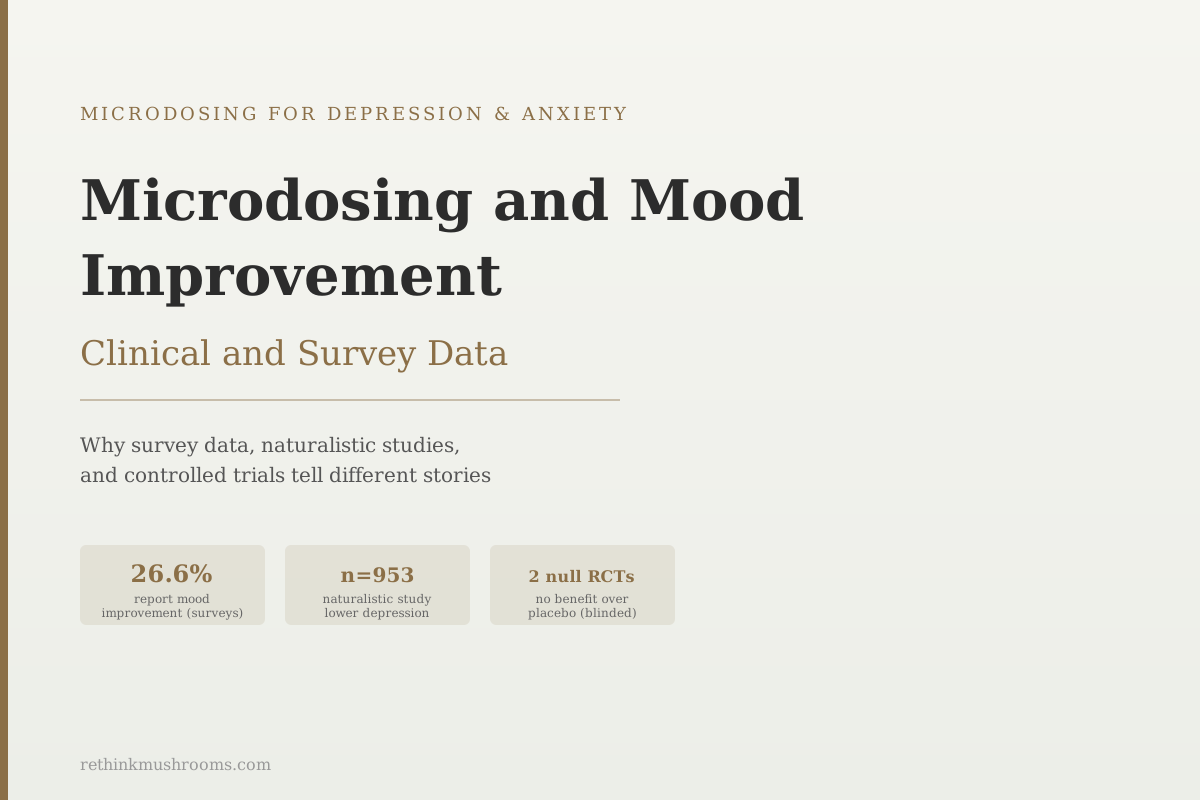
Microdosing for Depression & Anxiety
26.6% of users
In a qualitative analysis of microdosing reports, improved mood was the most commonly reported benefit. But double-blind controlled trials have found no reliable mood improvement compared to placebo.
Anderson et al., Harm Reduction Journal, 2019
n=953
participants in the largest naturalistic microdosing study, showing lower depression vs. comparators
2 null RCTs
double-blind trials found no significant mood benefit over placebo
Expectancy
baseline expectations predicted mood outcomes more strongly than dose, substance, or frequency
Anderson et al., Harm Reduction Journal, 2019
 View as image ↗
The mood improvement question is one of the most divisive in microdosing research, and the answer is genuinely different depending on which type of study you look at.
Surveys: people report improved mood. Naturalistic studies: microdosers score lower on depression and anxiety than non-microdosers. Clinical trials: no difference from placebo when expectancy is controlled. All three statements are true, and they are not actually contradictory. The reasons why they diverge are both interesting and important.
For an overview of microdosing practices and protocols, see what is microdosing psilocybin.
Key Takeaways
- In a survey of microdosing users, 26.6% identified improved mood as a key benefit, making it the most commonly reported positive outcome
- In the largest naturalistic study (Rootman 2021, n=953), microdosers scored significantly lower on validated depression and anxiety scales compared to non-microdosing comparators
- A 30-day prospective naturalistic follow-up found small-to-medium improvements in mood and mental health scores in microdosers relative to controls
- A 6-week daily diary study (Polito 2019) showed decreased depression and stress over time, with an initial first-week increase in neuroticism before emotional stability improved
- Two double-blind controlled trials (Szigeti 2021 and Cavanna 2022) found no reliable mood improvement compared to placebo once expectancy and blinding quality were accounted for
- Kaertner 2021 identified positive baseline expectations as the dominant predictor of mood outcomes, explaining why observational data and controlled trials diverge
Three Types of Data That Tell Three Different Stories
Here is the comparison that no single article on microdosing and mood currently presents clearly:
Survey data (self-selected users, no control group): Anderson et al. surveyed 278 microdosers and found 26.6% rated improved mood as a key benefit, making it the most frequently mentioned positive outcome.[1]
Naturalistic observational data (real-world users with a comparison group, no randomization or blinding): Rootman et al. studied 953 microdosers vs. 180 non-microdosing comparators and found significantly lower depression and anxiety scores in the microdosing group on multiple validated scales.[3]
Controlled trial data (randomized, placebo-controlled): Cavanna et al. ran a double-blind RCT and found no improvements in well-being, creativity, or psychological function in participants who received psilocybin microdoses compared to those who received placebo.[7]
The gap between these findings is not random noise. It reflects a systematic difference in what each study design captures. Understanding why the gap exists is more useful than simply picking the study that confirms what you want to believe.
What 26.6% Means: The Survey Evidence
Anderson et al. published a qualitative codebook of microdosing experiences in 2019, synthesizing the reports of 278 participants who had microdosed.[1] Improved mood (26.6%) was the most commonly reported benefit, ahead of improved focus (14.8%) and increased creativity. Among psilocybin-specific users, mood improvement was rated as the most important benefit.
Hutten et al., in a separate 2019 survey, found that mood improvement was the top motivating reason for microdosing, cited by 26.6% of participants alongside enhanced performance (22.8%) and general health improvement (13.9%).[2]
The consistency between these surveys on the 26.6% figure is notable. What the survey data cannot tell us is why that mood improvement happened: whether psilocybin's pharmacology caused it, whether the ritual and intention of microdosing caused it, whether the expectation of benefit drove it, or whether people who naturally experience mood improvement over time were the most likely to continue and report microdosing. Survey data reflects what people experience and report; it cannot distinguish between mechanisms.
The Naturalistic Studies: Rootman 2021 and 2022
The most substantial naturalistic evidence comes from Rootman et al.'s two studies using participants from a global microdosing tracking app.
In the 2021 cross-sectional analysis, 953 people who reported microdosing were compared against 180 who did not.[3] Microdosers scored significantly lower on depression (OR=0.54), anxiety (OR=0.66), and stress on validated psychometric scales. The mental health concern subgroup, people who reported using microdosing specifically for mood disorders, showed the most pronounced differences.
The 2022 follow-up added a prospective dimension: the same participants were assessed 30 days later.[4] Microdosers showed greater observed improvements in mood and mental health at one month compared to non-microdosing controls. Effect sizes were small to medium. Older adults also showed improved psychomotor performance.
Rootman et al. explicitly acknowledged the core limitation: participants were not randomized and were not blinded. People who choose to microdose may differ from non-microdosers in ways that predict better mental health independently of the psilocybin. The comparison group is not equivalent to a placebo group. These are real improvements observed in real people, and they may well reflect a genuine psilocybin effect, but the design cannot confirm causality.
For the deeper methodological analysis of naturalistic study design, see Microdosing for Depression and Anxiety: Naturalistic Study Results.
What Six Weeks of Daily Diaries Show: Polito 2019
Polito and Stevenson's 2019 study used a design that is more granular than either surveys or cross-sectional comparisons: 98 participants kept daily diaries across a 6-week microdosing period, and the researchers measured within-person change over time rather than comparing microdosers to non-microdosers.[5]
The results showed decreased depression and stress over the 6 weeks. But the temporal pattern matters: neuroticism (a measure of emotional reactivity and instability) initially increased in the first week before declining. By week 6, emotional stability had improved from baseline. The early increase in neuroticism may explain why some people report that microdosing feels worse before it feels better in the first few days.
This within-person daily diary approach is more rigorous in some ways than cross-sectional comparisons, because it tracks the same individuals changing over time rather than comparing different groups. What it cannot do is separate the psilocybin effect from the effect of starting a deliberate mental health practice, tracking mood daily, and expecting improvement over the course of six weeks. All of these factors could independently produce the observed changes.
What Controlled Trials Find: The Null Results
When researchers added a blinded placebo condition, the mood improvement findings changed substantially.
Szigeti et al. ran what they called a "self-blinding citizen science" study, where 191 participants designed their own blinding procedure using pre-sealed doses of either psilocybin mushrooms or inactive lookalike capsules.[6] Initial analysis showed improvements in wellbeing, mindfulness, and cognitive performance in the microdose group. When the researchers statistically modeled expectancy (how much improvement participants expected before starting) and blinding quality (how well participants were actually blinded to whether they received active or placebo), the microdosing improvements disappeared. No reliable differences from placebo remained.
Cavanna et al. ran a more conventionally designed double-blind RCT with 34 participants receiving 0.5 grams of dried psilocybin mushrooms or placebo.[7] No improvements in well-being, mood, creativity, or cognitive function were found in the psilocybin group compared to placebo. Participants who correctly guessed they had received the active dose reported more intense acute effects, but these did not translate into lasting psychological benefits.
These null results do not prove that psilocybin has no mood effects. They establish that under blinded conditions, with expectancy controlled, reliable mood benefits have not been detected in the trials conducted so far.
For a deeper analysis of the Szigeti study design, see Is Microdosing Just Placebo? The Self-Blinding Studies.
The Expectancy Bridge: Why Observational and Controlled Data Diverge
Kaertner et al. published the study that most directly explains the gap between observational and controlled findings.[8]
In a controlled study of 191 participants, baseline expectations measured before any dose was taken predicted the magnitude of mental health improvements more strongly than dose, dose frequency, or substance type. Positive expectations explained a substantial share of the variance in who benefited and by how much.
This is the mechanism that bridges the three evidence tiers. In surveys, participants are self-selected enthusiasts with high baseline expectations. In naturalistic studies, people who choose to microdose have positive intentions and often positive initial experiences that reinforce their practice. In controlled trials, roughly half the participants receive placebo and the expectancy effect is equally distributed across both groups, eliminating the advantage the active group would have in an unblinded design.
An important clarification: expectancy-driven effects are not fake. They involve real changes in neurochemistry, attention allocation, and behavioral patterns. A person who expects microdosing to help their mood may genuinely behave differently and experience real mood changes as a result. What expectancy-driven effects cannot tell us is whether the psilocybin itself is pharmacologically responsible for those changes.
For a detailed examination of this mechanism, see Expectancy Effects in Microdosing: How Belief Shapes Experience.
What Systematic Reviews Conclude
Two scholarly syntheses provide the broadest view.
Ona et al.'s 2020 systematic review examined the existing microdosing literature and concluded that the positive evidence base consists primarily of unblinded observational studies, and that the claimed mood benefits are likely partially driven by placebo and expectancy effects.[9] The review called for rigorous RCTs as the field's most urgent methodological need.
Pinhas et al.'s 2026 systematic review and meta-analysis synthesized the controlled evidence available, providing the most quantitatively rigorous assessment to date.[10] The meta-analysis found small effects on divergent thinking in controlled studies, but no reliable effects on mood or depression specifically versus placebo across the studies reviewed.
Neither review dismisses the observational and self-report data. Both frame the current state honestly: real improvements are observed in people who microdose; the pharmacological contribution of psilocybin versus expectancy and ritual has not been established in controlled settings.
The Honest Verdict: Real Benefits, Uncertain Mechanism
The weight of all available evidence points toward a consistent picture:
Mood improvement is genuinely common among people who microdose psilocybin. The 26.6% survey figure, the Rootman naturalistic data, and the Polito diary studies all point in the same direction. This is not a fringe finding or wishful thinking. Tens of thousands of people report better mood, and the research captures that.
Whether psilocybin's pharmacology is responsible is genuinely uncertain. The controlled trials that have tested this under blinded conditions have not found reliable pharmacological effects on mood. Expectancy is a powerful predictor of outcomes. The honest conclusion is not "it doesn't work" but rather "we cannot yet determine whether psilocybin causes the mood improvement or whether the expectation and ritual of microdosing is sufficient to produce real changes."
For readers interested in the depression-specific evidence, see Microdosing for Depression: Research vs. Anecdote. For the anxiety angle, see Microdosing Psilocybin for Anxiety: What We Know. For non-psychedelic mushroom alternatives that also have mood research, see Functional Mushrooms for Depression: Non-Psychedelic Options.
The Bottom Line
Three types of evidence on microdosing and mood point in different directions. Survey data shows 26.6% of microdosers identify mood improvement as a primary benefit. Naturalistic studies (Rootman 2021, n=953; Rootman 2022, 30-day follow-up) show lower depression and anxiety scores in microdosers vs. comparators, with small-to-medium effect sizes. Controlled trials (Szigeti 2021, n=191; Cavanna 2022, n=34) find no reliable mood benefit over placebo once expectancy is controlled. Kaertner 2021 identified positive baseline expectations as the dominant predictor of mood outcomes, providing the bridge between why observational and controlled findings diverge. The honest synthesis: mood benefits are real in the experience of many microdosers; whether psilocybin pharmacology drives them or expectancy does is genuinely unresolved.
Frequently Asked Questions
Sources & References
- 1. Source details for this reference are not yet available.
- 2. Source details for this reference are not yet available.
- 3. Source details for this reference are not yet available.
- 4. Source details for this reference are not yet available.
- 5. Source details for this reference are not yet available.
- 6. Source details for this reference are not yet available.
- 7. Source details for this reference are not yet available.
- 8. Source details for this reference are not yet available.
- 9. Source details for this reference are not yet available.
- 10. Source details for this reference are not yet available.