Psilocybin Drug Interactions
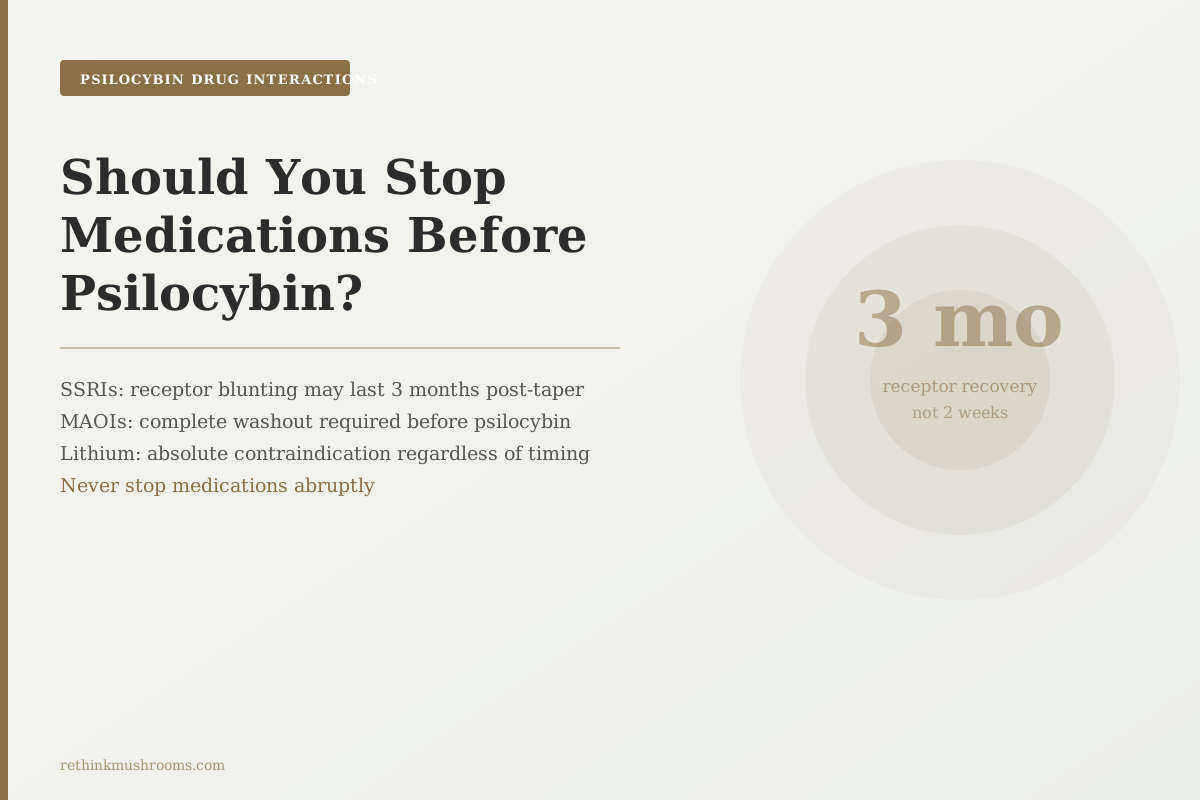
3 months potential residual blunting after stopping SSRIs
A 2023 retrospective survey found SSRI-related blunting of psilocybin effects may persist up to 3 months after stopping antidepressants, well beyond the 2-week washout period most sources cite.
Gukasyan et al., Journal of Psychopharmacology, 2023
Attenuated
but still therapeutic: a small open-label trial found psilocybin worked for TRD in patients on concurrent SSRIs (Goodwin et al., 2023)
6+ weeks
typical minimum washout in clinical psilocybin trial protocols
52 studies
covered in Halman 2024 systematic review of psychedelic drug interactions
Gukasyan et al., Journal of Psychopharmacology, 2023
 View as image ↗
The question "do I need to stop my medications before psilocybin?" has no single answer. It depends entirely on what medication, why it was prescribed, and what outcome is being optimized for. The answer differs for someone on an SSRI for depression, someone on lithium for bipolar disorder, someone on an MAOI for treatment-resistant depression, and someone on a beta-blocker for blood pressure. The answers differ further depending on whether the context is supervised clinical therapy or anything else.
What the research does show is that the commonly cited 2-week washout recommendation for SSRIs is probably too short. A 2023 retrospective survey found that SSRI-related blunting of psilocybin's effects may persist for up to 3 months after stopping antidepressants.[1] That finding has significant implications for anyone planning a psilocybin experience after tapering SSRIs. This article covers what the clinical evidence shows and how research protocols actually handle the medication question. For the safety guide to psilocybin overall, see how safe is psilocybin.
Key Takeaways
- SSRI-related blunting of psilocybin may persist up to 3 months after stopping, not just 2 weeks, because 5-HT2A receptor density takes longer to recover than the drug takes to clear
- A 2023 clinical trial found psilocybin was still therapeutically effective for treatment-resistant depression in patients who stayed on their SSRIs throughout, though effects were attenuated
- Clinical psilocybin trials typically require washout periods of 6 weeks or more before enrollment; some exclude participants who have used SSRIs in the past 3 months
- MAOIs are the drug class most requiring complete washout: irreversible MAO-A inhibitors (phenelzine, tranylcypromine) require at least 2 weeks after the last dose before psilocybin is considered safe
- Abrupt discontinuation of SSRIs or SNRIs causes discontinuation syndrome (flu-like symptoms, brain zaps, emotional instability) and should not be self-managed
- Lithium is an absolute contraindication regardless of timing; this is not a washout question but a fundamental contraindication
The 3-Month Finding That Changes the Standard Guidance
The most commonly cited recommendation for SSRIs before psilocybin is a 2-week washout. This is approximately how long most SSRIs take to clear the body: fluoxetine (Prozac) clears more slowly than others due to its long half-life, but most SSRIs reach negligible plasma levels within 1-4 weeks of stopping.
The problem is that receptor recovery lags behind drug clearance.
A 2023 retrospective survey by Gukasyan and colleagues, published in the Journal of Psychopharmacology, asked people who had taken psilocybin mushrooms while on an SSRI/SNRI (or within two years of stopping one) how strong the effects were relative to their expectations.[1] SSRI/SNRIs appeared to weaken psilocybin's effects relative to a non-serotonergic antidepressant. Critically, the dampening was not limited to people currently taking the drug: the authors concluded it "may last as long as 3 months following antidepressant discontinuation."
A plausible mechanism explains why. Chronic SSRI use is associated with 5-HT2A receptor downregulation: the brain, chronically exposed to elevated serotonin, reduces the number and sensitivity of the receptors that psilocybin primarily activates. This adaptation develops over weeks to months of SSRI use. Reversing it, once the drug clears, plausibly takes longer than the drug's half-life because receptor density recovery is a biological remodeling process, not a pharmacokinetic one. (Note that Gukasyan and colleagues measured self-reported effect strength, not receptor density directly — the receptor account is the leading explanation, not something the survey itself proved.)
A person who has been on an SSRI for two years and stops for two weeks has a drug-free body, but their 5-HT2A receptor landscape may still reflect months of downregulation. Psilocybin encounters reduced receptor availability, and the experience is weaker or qualitatively different from what it would be with full receptor density.
This is the finding that distinguishes the Gukasyan 2023 data from the standard "wait two weeks" guidance. The drug may be gone in two weeks. The receptor system may not have recovered for three months.
What Clinical Psilocybin Trials Actually Require
Clinical psilocybin trials address the medication question through screening protocols rather than treatment guidelines: their job is to define eligibility, not prescribe tapering.
The 2021 New England Journal of Medicine trial comparing psilocybin to escitalopram required a washout period for psychoactive medications before enrollment.[5] Most phase 2 psilocybin trials have used washout windows of 6 weeks or longer. Some trials exclude participants who have used SSRIs within the past 3 months, aligning with the Gukasyan 2023 finding.
A 2023 clinical trial by Goodwin and colleagues, published in Neuropsychopharmacology, took the opposite approach: it kept patients on their concurrent SSRIs throughout the psilocybin therapy for treatment-resistant depression.[2] The rationale was that for patients with severe treatment-resistant depression, stopping SSRIs to access psilocybin therapy carries its own psychiatric risk, and the trial tested whether psilocybin (a single 25 mg dose of the synthetic form COMP360) could work despite the interaction.
The result: in this small, open-label study of 19 participants, depression scores improved substantially, with a mean drop of 14.9 points on the MADRS depression scale at three weeks and both response and remission reached by roughly 42% of participants. There were no serious adverse events from the combination. Because the study had no comparison arm and was not blinded, it cannot prove that effects were "attenuated" relative to psilocybin without an SSRI — but the response rate sits below what the same COMP360 25 mg dose has produced in patients not taking antidepressants, consistent with a real but tolerable dampening.
Goodwin et al. (2023) · Neuropsychopharmacology
- Population
- 19 adults with treatment-resistant depression, all continuing a stable SSRI
- Intervention
- Single 25 mg dose of synthetic psilocybin (COMP360) plus psychological support
- Finding
- MADRS depression score fell a mean of 14.9 points by week 3; ~42% reached response and remission; no serious adverse events.
preliminary Open-label, no control group, n=19 — encouraging but not definitive. Response sat below the SSRI-free COMP360 benchmark, consistent with mild dampening rather than a blocked effect.
Goodwin GM et al., Neuropsychopharmacology, 2023 (PMID 37443386)
This trial gives clinical context to the medication question: sometimes the right answer is not "stop SSRIs before psilocybin" but "proceed with psilocybin despite SSRIs, accepting somewhat attenuated effects." For people in clinical programs with severe depression, that may be the appropriate path. For people seeking full psilocybin responsiveness, a longer washout is the better option.
A 2024 systematic review by Halman and colleagues identified 52 studies on classic psychedelic drug interactions in humans, of which 10 examined psilocybin.[3] Across the combinations reviewed, effects ranged from attenuated to potentiated, and — apart from a few case reports — no serious adverse drug events were reported. This is among the broadest safety overviews available on the concurrent medication question.
A Practical Framework by Medication Class
The medication decision framework differs substantially by drug class.
Medication Decision, by Drug Class
What the Answer Actually Is, Medication by Medication
“Do I stop my medication?” has no single answer. The class determines whether the issue is a washout, a blunted effect, or a hard contraindication. None of this replaces a conversation with the prescribing physician.
SSRIs / SNRIs
Reduces effectSupervised taper
Timing: Up to ~3 months for full response (trials use ≥6 weeks)
Why
Blunt psilocybin effects; receptor recovery lags drug clearance(Gukasyan 2023)
MAOIs
Avoid until washoutComplete washout
Timing: ~2 weeks (irreversible MAO-A enzyme regeneration)
Why
Block psilocin breakdown → elevated psilocin and serotonin loading(Halman 2024)
Lithium
ContraindicatedDo not combine
Timing: No washout scenario — absolute contraindication
Why
Seizures in 47% of 62 online lithium + psychedelic reports(Nayak 2021)
Antipsychotics
Reduces effectPsychiatric decision
Timing: Not a pharmacokinetic question
Why
Block 5-HT2A — the receptor psilocybin acts on — reducing or erasing effects(Halman 2024)
Cardiovascular (e.g. beta-blockers)
Usually continuedUsually continue
Timing: Evaluate individual cardiac status, not the drug alone
Why
May blunt cardiovascular response; drug-interaction data limited(Wsół 2023)
Benzodiazepines
Usually continuedUsually continue
Timing: Kept available in sessions for acute distress
Why
Low safety risk; regular use may reduce experience intensity(Halman 2024)
Sources: Gukasyan et al. (2023); Halman et al. (2024); Nayak et al. (2021); Wsół (2023). Guidance reflects supervised clinical settings; not medical advice.
SSRIs and SNRIs: The evidence supports tapering, not abrupt stopping. If the goal is full psilocybin responsiveness, the Gukasyan 2023 data suggests a washout of up to 3 months may be needed for the receptor system to recover, substantially longer than the commonly cited 2 weeks. Clinical trials use 6-week minimums. Any tapering should be supervised by a prescribing physician and carried out gradually to avoid discontinuation syndrome.
If stopping SSRIs is not possible (due to psychiatric risk), the Goodwin 2023 trial suggests psilocybin therapy can still be effective with concurrent SSRIs, at the cost of somewhat attenuated effects. This is a clinical decision, not one to make unilaterally.
MAOIs: This is not a washout timing question in the same way. MAOIs block the enzyme that breaks down psilocin (the active metabolite of psilocybin), creating a pharmacokinetic interaction that elevates psilocin levels and serotonin loading. This combination must be avoided. For irreversible MAO-A inhibitors (phenelzine, tranylcypromine, isocarboxazid), the enzyme takes approximately 2 weeks to regenerate after the last dose; washout periods of at least 14 days are standard for other MAOI interactions, and psilocybin should not be combined until well after that point.
Lithium: This is not a washout scenario. Lithium is an absolute contraindication for psilocybin regardless of timing. In a 2021 analysis of online psychedelic-experience reports, seizures occurred in 47% of 62 reports of lithium taken with a classic psychedelic, while none of 34 lamotrigine reports involved seizures.[6] These are self-reported cases from forums rather than controlled clinical data, so the exact rate should be read with caution — but the signal is strong and consistent enough that it places lithium in a fundamentally different category from drugs that merely blunt effects. For people on lithium who are interested in psilocybin therapy, the clinical discussion is about whether transitioning to a different mood stabilizer (such as lamotrigine) is medically appropriate, not about how long to wait after stopping. That conversation requires a psychiatrist.
Absolute Contraindication
CriticalLithium plus psilocybin: seizure risk
Concern
In an analysis of 62 online reports of lithium combined with a classic psychedelic, 47% involved seizures and 39% involved a visit for medical attention. No lamotrigine reports involved seizures.
What the research says
Do not combine lithium with psilocybin. This is not a timing or washout question. If psilocybin therapy is being considered, the only appropriate path is a psychiatrist-led discussion about the underlying condition and whether a different mood stabilizer is suitable.
Particularly relevant for: Anyone taking lithium, including for bipolar disorder
What to do
Never combine; consult the prescribing psychiatrist before making any change.
Nayak et al., Pharmacopsychiatry, 2021 (PMID 34348413)
Antipsychotics: Antipsychotics block 5-HT2A receptors, the primary mechanism through which psilocybin acts. Concurrent antipsychotic use is likely to significantly reduce or eliminate psilocybin's effects. The question of stopping antipsychotics before psilocybin therapy is a psychiatry question, not a pharmacokinetics question: antipsychotics are typically prescribed for serious psychiatric conditions where discontinuation carries substantial risk.
Cardiovascular medications: A 2023 review of psychedelic cardiovascular safety by Wsół concluded that psychedelic-assisted therapy appears relatively cardiovascularly safe in "healthy" volunteers in clinical trials, while noting that data are still insufficient for people who already have cardiovascular disease, and that serotonergic effects (including proarrhythmic potential and 5-HT2B-related concerns with repeated exposure) warrant caution.[4] Direct evidence on interactions with specific cardiovascular drugs is limited rather than reassuringly complete. In practice, beta-blockers may blunt the cardiovascular response to psilocybin without necessarily diminishing the psychological effects, and people on stable cardiovascular medications are generally evaluated on individual cardiac status rather than medication alone. Stopping cardiovascular medications for psilocybin is typically not indicated.
Benzodiazepines: Benzodiazepines taken regularly may reduce psilocybin's intensity. They are low-risk safety-wise but can diminish the experience. Clinically, benzodiazepines are kept available in psilocybin sessions as an intervention for severe distress, not avoided entirely.
The Abrupt Discontinuation Problem
One of the most practically important points about medication management before psilocybin is what not to do: stop antidepressants abruptly.
SSRI and SNRI discontinuation syndrome is a recognized clinical entity. Abrupt withdrawal causes a predictable set of symptoms: flu-like malaise, sleep disruption, irritability, difficulty concentrating, and in many people, a neurological experience commonly described as "brain zaps" (brief electrical-like sensations in the head). These symptoms can be severe and may last weeks.
Beyond discontinuation syndrome, abrupt SSRI withdrawal carries the risk of rapid depressive symptom return, which for some patients represents a clinically serious setback. For people on SSRIs for severe depression, this is not a minor inconvenience.
The pharmacokinetic argument (the drug leaves in two weeks anyway) is insufficient justification for an unmanaged taper. Gradual tapering under physician guidance is standard practice and substantially reduces discontinuation symptoms. For longer-term SSRI users, tapering schedules of several weeks to a few months are common.
The 3-month recovery window from Gukasyan 2023 reinforces this practically: even after a slow, medically supervised taper, there may be an additional waiting period of weeks to months before the receptor system recovers and psilocybin produces its full effects. Planning this timeline as part of a structured clinical process is the appropriate approach.
Do Not Self-Manage
ModerateNever stop antidepressants abruptly to chase a stronger trip
Concern
Abrupt SSRI/SNRI discontinuation causes withdrawal (flu-like malaise, brain zaps, insomnia, irritability) and can trigger a rapid return of depression — a real clinical setback, not a minor inconvenience.
What the research says
Any taper must be gradual and supervised by the prescribing physician. The fact that the drug clears in about two weeks is not a reason to stop it in two weeks.
Particularly relevant for: Anyone on an SSRI or SNRI, especially long-term users
What to do
Plan any medication change with your prescriber as part of a structured timeline.
Gukasyan et al., Journal of Psychopharmacology, 2023; standard clinical guidance on antidepressant discontinuation
What Psilocybin Therapy Protocols Actually Do
For people who are in or considering clinical psilocybin therapy programs, medication management is handled as part of the clinical preparation process, not as something the patient navigates independently.
Clinical protocols typically include: a comprehensive medication review at intake, a supervised tapering plan developed with the participant's prescribing physician, and a waiting period after completion of the taper before the psilocybin session. In some protocols, the psilocybin facilitator and prescribing physician communicate directly during the tapering period.
The Goodwin 2023 trial represents one model where tapering is not required: the therapy proceeded with concurrent SSRIs, accepting somewhat attenuated effects in exchange for psychiatric stability and the reduced risk of discontinuation. This model may be appropriate for some patients and inappropriate for others.
For people pursuing psilocybin outside of clinical settings, the medication question is harder to navigate safely. The evidence supports understanding the interaction by drug class, accepting that SSRIs will reduce effects, not combining with MAOIs or lithium under any circumstances, and not abruptly stopping any medication without medical supervision.
What the Research Picture Shows
The medication question before psilocybin is not a single answer. For SSRIs, the evidence now points to a 3-month receptor recovery window, substantially longer than the standard 2-week guidance. For MAOIs, complete washout is essential before psilocybin is safe. For lithium, there is no washout scenario that makes the combination acceptable. For antipsychotics and cardiovascular medications, the question is more nuanced and situation-specific.
The consistent thread across this evidence is that medication changes in the context of psilocybin therapy are medical decisions. The clinical literature does not support self-managed abrupt discontinuation as a path to better psilocybin experiences. The pharmacology is too variable by drug class, and the psychiatric risks of unmanaged discontinuation are too real.
For detail on the SSRIs specifically, see Psilocybin and SSRIs: Will Antidepressants Block the Effect?. For the complete drug interaction overview by risk tier, see Psilocybin Drug Interactions: A Complete Guide. For the lithium contraindication specifically, see Psilocybin and Lithium: The Dangerous Interaction.
The Bottom Line
SSRI-related blunting of psilocybin's effects may persist up to 3 months after stopping antidepressants, not just the 2 weeks required for drug clearance. Clinical trials use washout periods of 6 weeks or more. A 2023 clinical trial found psilocybin still worked therapeutically with concurrent SSRIs, suggesting that stopping medications is not always the right clinical decision. MAOIs and lithium require different handling: MAOIs need complete washout, and lithium is an absolute contraindication regardless of timing. All medication changes before psilocybin therapy should involve the prescribing physician.
Frequently Asked Questions
Sources & References
- 1RTHM-00827·Gukasyan, Natalie et al. (2023). “Attenuation of psilocybin mushroom effects during and after SSRI/SNRI antidepressant use..” Journal of psychopharmacology (Oxford.Study breakdown →PubMed →↩
- 2RTHM-01698·Goodwin, Guy M et al. (2023). “Psilocybin for treatment resistant depression in patients taking a concomitant SSRI medication..” Neuropsychopharmacology : official publication of the American College of Neuropsychopharmacology.Study breakdown →PubMed →↩
- 3RTHM-01899·Halman, Andreas et al. (2024). “Drug-drug interactions involving classic psychedelics: A systematic review..” Journal of psychopharmacology (Oxford.Study breakdown →PubMed →↩
- 4RTHM-01822·Wsół, Agnieszka (2023). “Cardiovascular safety of psychedelic medicine: current status and future directions..” Pharmacological reports : PR.Study breakdown →PubMed →↩
- 5RTHM-00675·Carhart-Harris, Robin et al. (2021). “Trial of Psilocybin versus Escitalopram for Depression..” The New England journal of medicine.Study breakdown →PubMed →↩
- 6RTHM-01412·Nayak, Sandeep M et al. (2021). “Classic Psychedelic Coadministration with Lithium, but Not Lamotrigine, is Associated with Seizures: An Analysis of Online Psychedelic Experience Reports..” Pharmacopsychiatry.Study breakdown →PubMed →↩