Chaga Antioxidants
2012 FDA delisted ORAC
The USDA removed its ORAC database from public release in 2012 because chemical antioxidant capacity values were being widely misused to imply human health effects that had not been demonstrated. Chaga's high ORAC numbers persist in marketing despite the methodological retreat.
USDA Nutrient Data Laboratory, 2012
ORAC = Test-Tube Chemistry
not in vivo or clinical activity
Removed by USDA
due to systematic marketing misuse
Chaga Still Markets Off It
the supplement industry kept the number
USDA Nutrient Data Laboratory, 2012
 View as image ↗
The single most repeated chaga statistic in supplement marketing is its ORAC score. Numbers in the tens of thousands per gram appear on packaging, blog posts, and product pages, almost always with an implication that high ORAC means strong protection against aging, disease, or cellular damage. The implication is, at best, an extrapolation that the underlying methodology does not support. The USDA removed its ORAC database from public release in 2012 specifically because manufacturers were systematically misusing chemical antioxidant assay values to imply human health effects that had not been demonstrated. Chaga has real, well-documented in-vitro antioxidant activity. The ORAC number is not a meaningful predictor of what that activity does in a person, and the supplement industry has not generally caught up with the science on this point.[1]
For the broader cluster context, see chaga and antioxidants: the highest ORAC score in the mushroom kingdom. For the chemistry behind the activity, see chaga melanin: the unique antioxidant you won't find elsewhere.
Key Takeaways
- The USDA Nutrient Data Laboratory withdrew its ORAC database from public release in 2012, citing widespread marketing misuse of chemical antioxidant assay values to imply unproven health effects
- ORAC measures the capacity of a sample to neutralize a specific synthetic radical (peroxyl) in a test tube buffer, which has uncertain relationship to in-vivo antioxidant activity in human cells
- Chaga's ORAC values are genuinely high in the comparative chemistry, driven primarily by its polyphenol-melanin complex (Glamoclija et al., 2015; Lee et al., 2007)
- Cellular antioxidant evidence for chaga is more meaningful: Park et al. (2004) showed over 40% reduction in oxidative DNA damage in human lymphocytes at 10–500 microg/mL
- Tissue-protection evidence in oxidative liver injury extends the chaga antioxidant signal beyond chemical assays (Hong et al., 2015)
- No human clinical trial has measured systemic oxidative stress biomarkers, lipid peroxidation, or chronic disease endpoints in people consuming chaga (Szychowski et al., 2021)
What ORAC Actually Measures
The Oxygen Radical Absorbance Capacity assay (ORAC) measures one specific thing: how much fluorescein degradation by AAPH-generated peroxyl radicals can be inhibited by a sample, in a buffered aqueous solution at 37°C, over a defined time window. The output is a Trolox-equivalent value per gram or per serving.
This is a chemistry measurement. It tells you something about the radical-scavenging capacity of the molecules in the sample under the specific conditions of the assay. It does not tell you:
- Whether those molecules survive digestion
- Whether they are absorbed into circulation
- Whether they reach target tissues at active concentrations
- Whether they affect cellular oxidative stress at physiological exposures
- Whether any of the above translates to a measurable health outcome
Each of those gaps is large. The chain from "high ORAC in a beaker" to "improved health in a person" requires evidence at every step, and for most foods and supplements, including chaga, most of those steps have not been measured.
Why the USDA Pulled the Database
In 2012 the USDA Nutrient Data Laboratory removed its ORAC database from public release. The agency's stated reason was that "ORAC values are routinely misused by food and dietary supplement manufacturing companies to promote their products and by consumers to guide their food and dietary supplement choices." The USDA further noted that "there is no evidence that the beneficial effects of polyphenol-rich foods can be attributed to the antioxidant properties of these foods."
This was an unusual move. Government databases rarely get withdrawn for misuse. The withdrawal reflected a substantial shift in the scientific consensus around dietary antioxidants. The simple "more antioxidants = better" framing that dominated supplement marketing in the 1990s and 2000s did not survive contact with the controlled trial evidence in the 2000s and 2010s, which repeatedly failed to show benefit (and sometimes showed harm) from high-dose antioxidant supplementation.
The scientific community had moved from "antioxidants neutralize free radicals so more is better" to a more nuanced view in which the relationship between dietary phenolics and health involves cell signaling, hormesis, gut microbiome interactions, and pathway-specific effects rather than bulk radical scavenging. ORAC, as a single number, did not capture any of this.
Chaga's ORAC Numbers in This Context
Chaga consistently appears at or near the top of antioxidant rankings among edible fungi when measured by ORAC. The numbers are real, reproducible, and chemically meaningful in the limited sense that the assay is meaningful at all.
Glamoclija et al. (2015) characterized the chaga polyphenol-melanin fraction in detail and demonstrated that the chemistry behind the high antioxidant assay values is genuinely concentrated and structurally interesting.[2] Lee et al. (2007) isolated three new antioxidant polyphenols with radical-scavenging activity exceeding several reference antioxidants at equivalent concentrations.[3]
What this means: chaga has chemically rich antioxidant content. What it does not mean: chaga consumption produces a proportional benefit in humans.
Why High ORAC Does Not Equal Health Benefit
The reasons high in-vitro antioxidant capacity often fails to translate are well-mapped in the polyphenol pharmacology literature.
Bioavailability is low and variable. Most plant and fungal polyphenols are absorbed at low percentages of the ingested dose, with substantial first-pass metabolism in the liver. The high-molecular-weight melanin polymer in chaga is essentially not absorbed intact.
Metabolites have different activity. When polyphenols are absorbed, they are conjugated by liver enzymes into glucuronides, sulfates, and methylated forms. These conjugates often have substantially different antioxidant properties than the parent compound: sometimes higher, sometimes lower, often very different in tissue distribution.
Plasma antioxidant capacity does not predict cellular oxidative stress. Multiple studies have measured plasma ORAC values after antioxidant-rich food consumption and found measurable increases that do not translate to changes in cellular oxidative stress biomarkers like F2-isoprostanes or 8-OHdG.
Hormesis dominates many polyphenol effects. The most likely mechanism by which chronic dietary polyphenols affect health involves low-dose stimulation of endogenous antioxidant defenses (Nrf2 activation, glutathione synthesis) rather than direct radical scavenging. The relevant dose range for hormetic activation is much lower than the implied "more is better" of ORAC marketing.
Single endpoints miss the picture. Health outcomes are determined by cell signaling, inflammatory tone, microbiome composition, mitochondrial function, and dozens of other variables that no single chemical assay captures.
The implication for chaga specifically: a high ORAC number is consistent with chaga's interesting chemistry and may be one input into a broader antioxidant evaluation. It is not a meaningful standalone health predictor.
What the Better Evidence Looks Like
Cellular and tissue-level evidence is closer to a meaningful health prediction than chemical-assay activity. For chaga, two studies illustrate the difference.
Park et al. (2004) used the comet assay to measure DNA fragmentation in human lymphocytes after exposure to hydrogen peroxide.[4] Chaga aqueous extract reduced oxidative DNA fragmentation by over 40% at 10–500 microg/mL. This is meaningful in a way ORAC is not, because comet assay damage correlates with cancer risk in long-term human cohorts. The endpoint maps to a clinically validated biological process.
Hong et al. (2015) tested chaga water extract against tert-butyl hydroperoxide-induced oxidative liver injury in primary rat hepatocytes and demonstrated dose-dependent protection.[5] This is closer to a tissue-level endpoint and demonstrates that the antioxidant chemistry is biologically active in a relevant cell type, not just in a test tube.
Debnath et al. (2013) tested I. obliquus extracts in parallel for antioxidant and anti-inflammatory activity and found the two activities tracked together, consistent with a unified phenolic chemistry driving both.[6]
Even with these higher-quality endpoints, the inferential chain from cell culture to human clinical benefit is incomplete. What is missing is human pharmacokinetic data, controlled human trials measuring oxidative stress biomarkers, and trials measuring relevant chronic disease endpoints.
A Useful Framework for Reading Antioxidant Claims
Anyone trying to evaluate a chaga (or any) antioxidant claim can apply a simple hierarchy of evidence quality.
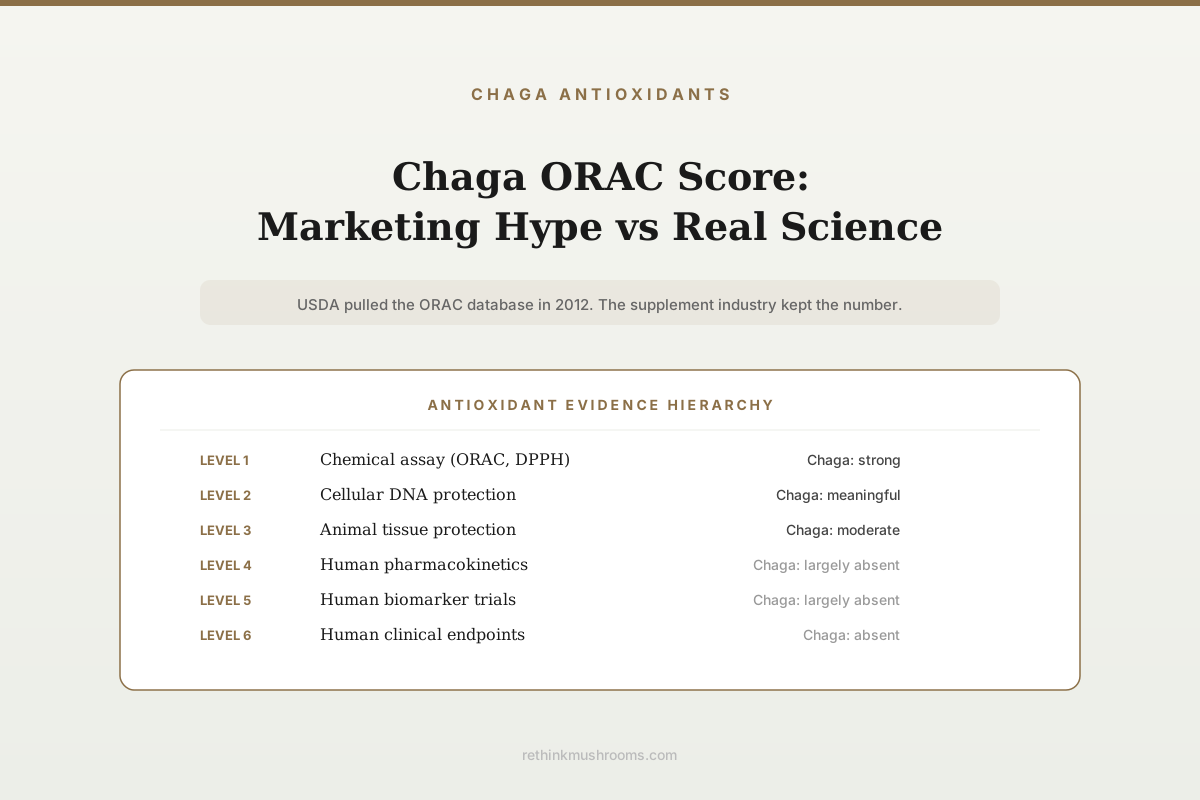
Level 1: Chemical assay activity. ORAC, DPPH, ABTS, FRAP. Useful for compound characterization; weak for predicting clinical effect. Chaga is well-supported here.
Level 2: Cellular antioxidant or DNA-protective activity. Comet assay, GSH/GSSG ratio in cell culture, ROS imaging in live cells. Closer to biological relevance. Chaga has limited but meaningful evidence here.
Level 3: In-vivo tissue protection in animal models. Demonstrated reduction in oxidative damage markers in target tissues after a defined intervention. Chaga has moderate evidence here, mostly in liver and kidney models.
Level 4: Human pharmacokinetics. Absorption, distribution, metabolism of the active compound class. Largely missing for chaga.
Level 5: Human controlled trials measuring oxidative stress biomarkers. Plasma F2-isoprostanes, urinary 8-OHdG, lipid peroxidation markers. Largely missing for chaga.
Level 6: Human controlled trials measuring clinical endpoints. Chronic disease incidence, all-cause mortality, validated functional measures. Entirely missing for chaga.
A claim built on Level 1 evidence alone (which is what ORAC marketing typically is) does not justify Level 6 implications. This is the substance of the USDA's 2012 concern.
Evidence Hierarchy
Chaga's Antioxidant Evidence — Solid at the Bottom, Absent at the Top
A claim is only as strong as the highest evidence tier that supports it. Chaga is well-supported at Level 1 (the chemical assays ORAC belongs to) and the evidence thins to nothing at the human clinical endpoint. ORAC marketing sells a Level-1 fact as if it proved a Level-6 outcome. Bar width reflects how much direct chaga evidence exists at each tier.
Level 1Chemical assay activity
evidenceGlamoclija 2015 · Lee 2007
ORAC, DPPH, ABTS, FRAP in a test tube. Useful for characterizing compounds; weak for predicting clinical effect. This is the layer ORAC marketing is built on.
Level 2Cellular / DNA-protective activity
evidencePark 2004
Comet assay in human lymphocytes: chaga extract cut oxidative DNA fragmentation by over 40% at 10-500 microg/mL. Limited but biologically meaningful.
Level 3In-vivo / tissue protection
evidenceHong 2015 · Debnath 2013
Dose-dependent protection against oxidative liver injury in primary rat hepatocytes; antioxidant and anti-inflammatory activity track together. Moderate, mostly liver and kidney models.
Level 4Human pharmacokinetics
gapDoes not yet exist
Absorption, distribution, and metabolism of the active compound class in people. Largely missing for chaga.
Level 5Human oxidative-stress-biomarker trial
gapDoes not yet exist
Controlled trials measuring plasma F2-isoprostanes, urinary 8-OHdG, or lipid peroxidation after chaga intake. Largely missing.
Level 6Human clinical-endpoint trial
gapDoes not yet exist
Chronic disease incidence, mortality, or validated functional outcomes. Entirely missing — yet this is the level ORAC marketing implies.
How to read it: the bottom three tiers are real and repeatable — chaga has genuine chemistry, cellular DNA protection, and tissue-level activity. The top three tiers, where a claim about human health actually lives, have not been measured. A number drawn from Level 1 does not justify a Level-6 promise, which is exactly the gap the USDA flagged in 2012.
Sources: Lee 2007 [1]; Glamoclija 2015 [2]; Park 2004 [4]; Hong 2015 [5]; Debnath 2013 [6]. Absence of human data framed by Szychowski 2021 [7], Fordjour 2023 [8], Ern 2024 [9]. Bar widths are illustrative of evidence depth per tier, not quantitative effect sizes.
Why the Supplement Industry Kept Using ORAC Anyway
The USDA's 2012 retreat from ORAC did not move the supplement industry. ORAC numbers continue to appear on chaga packaging, in product descriptions, and in marketing materials more than a decade after the database was withdrawn. The reason is straightforward: a single large number is easier to market than a multi-step explanation of cellular antioxidant evidence and its limitations. "65,000 ORAC per gram" is a more compelling label statement than "documented in-vitro polyphenol-melanin chemistry with limited human pharmacokinetic data."
This is not a chaga-specific problem. It applies to every dietary antioxidant marketed off ORAC values, from acai berries to dark chocolate to green tea. What is specific to chaga is that the underlying chemistry is genuinely interesting and the higher-quality preclinical evidence (Park 2004, Hong 2015, Debnath 2013) does support the broad claim that chaga's antioxidant activity is real. The problem is the leap from "real activity" to specific clinical implications, not the existence of the activity itself.
What Honest Antioxidant Reporting Looks Like for Chaga
A precise statement about chaga's antioxidant evidence:
- The chemical antioxidant capacity is genuinely high among edible fungi, driven by a polyphenol-melanin complex with structurally novel components
- Cellular antioxidant and DNA-protective activity has been demonstrated in human cells and primary rat hepatocytes
- Tissue protection has been demonstrated in oxidative liver injury models
- Human pharmacokinetic and clinical trial evidence is absent
- Marketing claims framing chaga as a definitive anti-aging or longevity intervention are not supported by the published clinical literature
Szychowski et al. (2021) framed this gap explicitly in their review tracing chaga from folk medicine to clinical use, identifying the absence of well-powered human trials as the key constraint on translating the rich preclinical chemistry to demonstrated clinical benefit.[7] Fordjour et al. (2023) used the phrase "untapped potential" for the same observation: the chemistry is interesting; the clinical demonstration has not been done.[8]
For the broader compound chemistry that drives chaga's antioxidant identity, see chaga bioactive compounds: betulinic acid, melanin, and polysaccharides. For the polyphenol mechanism in detail, see chaga polyphenols and free radical scavenging: how they work. Ern et al. (2024), in the comprehensive therapeutic review, listed antioxidant activity among chaga's best-supported pharmacological properties while noting the limited clinical coverage.[9]
The Bottom Line
Chaga's high ORAC value is real chemistry but a weak health predictor. The USDA pulled the ORAC database in 2012 because the metric was being systematically misused to imply unproven health benefits. Better-quality chaga antioxidant evidence exists at the cellular and tissue level, but human pharmacokinetic and clinical trial data is absent. The honest interpretation is that chaga has interesting antioxidant chemistry and unproven clinical antioxidant benefit.
Frequently Asked Questions
Sources & References
- 1RTHM-00118·Lee, In-Kyoung et al. (2007). “New antioxidant polyphenols from the medicinal mushroom Inonotus obliquus..” Bioorganic & medicinal chemistry letters.Study breakdown →PubMed →↩
- 2RTHM-00373·Glamočlija, Jasmina et al. (2015). “Chemical characterization and biological activity of Chaga (Inonotus obliquus), a medicinal "mushroom"..” Journal of ethnopharmacology.Study breakdown →PubMed →↩
- 3RTHM-00118·Lee, In-Kyoung et al. (2007). “New antioxidant polyphenols from the medicinal mushroom Inonotus obliquus..” Bioorganic & medicinal chemistry letters.Study breakdown →PubMed →↩
- 4RTHM-00076·Park, Yoo Kyoung et al. (2004). “Chaga mushroom extract inhibits oxidative DNA damage in human lymphocytes as assessed by comet assay..” BioFactors (Oxford.Study breakdown →PubMed →↩
- 5RTHM-00374·Hong, Ki Bae et al. (2015). “Hepatoprotective Activity of Water Extracts from Chaga Medicinal Mushroom, Inonotus obliquus (Higher Basidiomycetes) Against Tert-Butyl Hydroperoxide-Induced Oxidative Liver Injury in Primary Cultured Rat Hepatocytes..” International journal of medicinal mushrooms.Study breakdown →PubMed →↩
- 6RTHM-00283·Debnath, Trishna et al. (2013). “Anti-oxidant and anti-inflammatory activities of Inonotus obliquus and germinated brown rice extracts..” Molecules (Basel.Study breakdown →PubMed →↩
- 7RTHM-00722·Szychowski, Konrad A et al. (2021). “Inonotus obliquus - from folk medicine to clinical use..” Journal of traditional and complementary medicine.Study breakdown →PubMed →↩
- 8RTHM-01694·Fordjour, Eric et al. (2023). “Chaga mushroom: a super-fungus with countless facets and untapped potential..” Frontiers in pharmacology.Study breakdown →PubMed →↩
- 9RTHM-01886·Ern, Phoebe Tee Yon et al. (2024). “Chaga Therapeutic Properties: What This 2024 Review Actually Shows.” Mycology.Study breakdown →PubMed →↩