Chaga Antioxidants
Highest ORAC in fungi
Chaga's polyphenol-melanin complex consistently sits at the top of antioxidant rankings among edible fungi, driven by a heteropolymer pigment chemistry distinct from plant flavonoids, vitamin E, and standard dietary antioxidants.
Glamoclija et al., J Ethnopharmacology, 2015
Heteropolymer Pigment
not a single small molecule
Phenolic Radical Stability
the source of long-acting activity
Distinct Biosynthesis
different from plant polyphenols
Glamoclija et al., J Ethnopharmacology, 2015
 View as image ↗
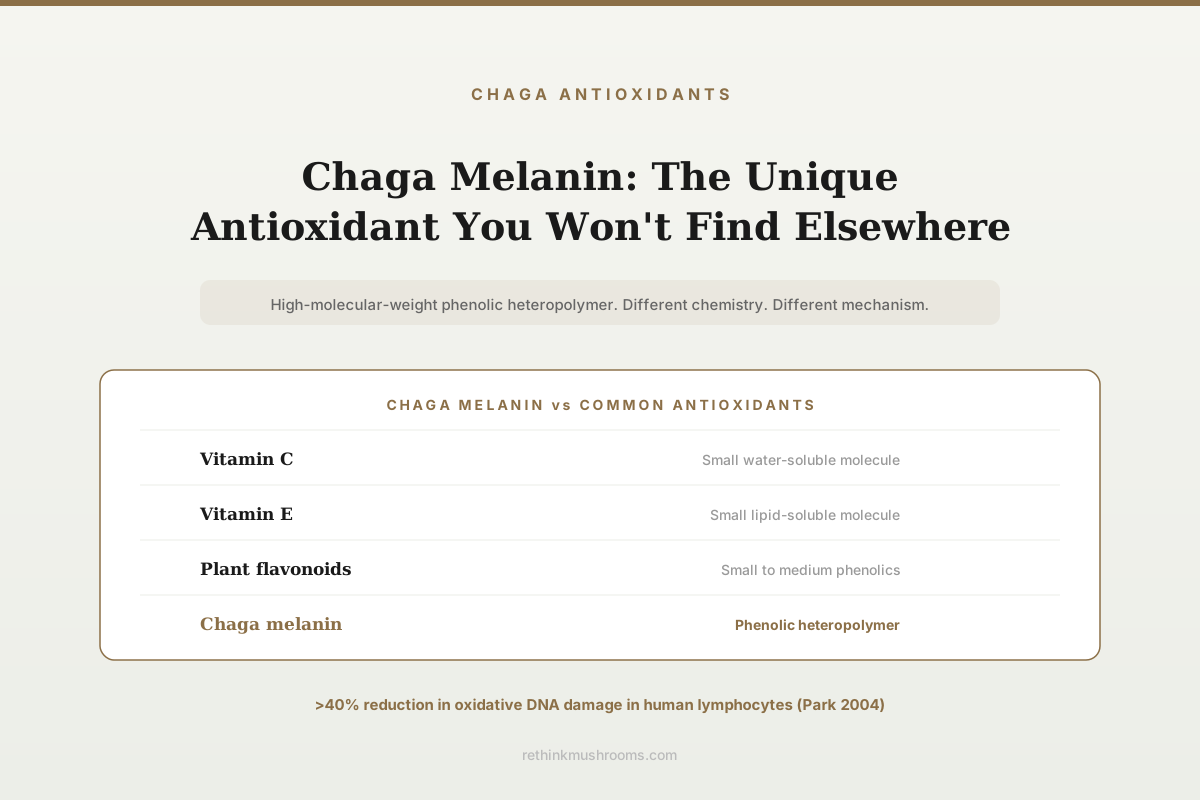
The supplement market is full of antioxidants, and it is reasonable to ask why chaga melanin should be treated as anything other than another phenolic radical scavenger in a long list. The answer is in the chemistry. Chaga melanin is not a small molecule like vitamin C or quercetin. It is a high-molecular-weight phenolic heteropolymer with broad-spectrum UV-visible absorbance, paramagnetic radical stability, and a biosynthetic origin distinct from anything found in plant-derived antioxidants. The compound class is well-represented across fungi as a defense pigment, but chaga produces a particularly concentrated and chemically rich version of it, accumulated over the decade-plus the fungus spends growing on a birch host. Glamoclija et al. (2015) characterized the European wild chaga's polyphenolic-melanin profile in detail and tied it to the antioxidant activity of the whole extract.[1]
For the broader cluster context, see chaga and antioxidants: the highest ORAC score in the mushroom kingdom. For the marketing-versus-science framing of ORAC, see chaga ORAC score: separating marketing hype from actual antioxidant science.
Key Takeaways
- Chaga melanin is a high-molecular-weight phenolic heteropolymer, structurally and biosynthetically distinct from small-molecule antioxidants like vitamin C, vitamin E, and plant flavonoids (Glamoclija et al., 2015)
- Lee et al. (2007) isolated three structurally novel antioxidant polyphenols from I. obliquus with radical-scavenging activity exceeding several reference antioxidants at equivalent concentrations
- Chaga aqueous extract reduced oxidative DNA fragmentation in human lymphocytes by over 40% at 10–500 microg/mL in the comet assay (Park et al., 2004)
- The closest comparable mushroom melanin, from Auricularia auricula, has been more extensively structurally characterized and shows similar antioxidant and tissue-protective bioactivity (Sun et al., 2016; Hou et al., 2019; Ma et al., 2022)
- Chaga water extract protected primary rat hepatocytes from oxidative liver injury induced by tert-butyl hydroperoxide (Hong et al., 2015), demonstrating tissue-level antioxidant effect beyond chemical-assay activity
- The unique combined antioxidant and anti-inflammatory profile of chaga's polyphenol-melanin fraction is one of three pillars of the broader chaga pharmacological identity (Debnath et al., 2013; Ern et al., 2024)
What "Unique" Actually Means in Antioxidant Chemistry
The word "unique" appears constantly in supplement marketing, usually with no chemical content behind it. For chaga melanin, the word has a specific meaning: the compound class is genuinely different from the antioxidants most consumers are familiar with.
Vitamin C (ascorbic acid) is a small water-soluble molecule that scavenges radicals in aqueous compartments and recycles other antioxidants like vitamin E. It is rapidly oxidized and excreted, with a short biological half-life.
Vitamin E (alpha-tocopherol) is a lipid-soluble small molecule that protects membrane lipids from peroxidation. It is recycled by ascorbate and ubiquinol and works in the lipid phase of cells.
Plant flavonoids like quercetin, anthocyanins, and catechins are small to medium-sized molecules with phenolic hydroxyl groups that donate electrons to neutralize radicals. They are extensively metabolized by gut bacteria and liver enzymes.
Chaga melanin is none of these. It is a high-molecular-weight polymer built from phenolic and indolic subunits. It is not absorbed intact through the gut and likely acts mainly through the metabolites of its breakdown plus the smaller polyphenols associated with the polymer. Its radical-scavenging activity per gram is comparable to or higher than the reference antioxidants in chemical assays, but its biological behavior is fundamentally different from a small-molecule antioxidant.
This is what "unique" means in this context. Not "better." Not "the only one of its kind." Different. Different chemistry, different biosynthesis, different absorption, different mechanism of action. Whether the difference matters clinically is a separate question.
The Polyphenolic Backbone
Glamoclija et al. (2015) ran a complete chemical characterization of European wild chaga, quantifying total phenolics, flavonoids, and the melanin pigment, alongside antibacterial and antioxidant testing.[1] Their finding was that the polyphenolic and melanin fractions tracked closely with the antioxidant activity of the whole extract. The two are not separate. Chaga's "melanin" is operationally a melanin-polyphenol complex with components on a continuum from small free phenolics to the high-molecular-weight pigment polymer.
Lee et al. (2007) isolated three structurally novel antioxidant polyphenols from I. obliquus that contribute to the smaller-molecular-weight end of this continuum.[2] These compounds are structurally distinct from common plant polyphenols and were not previously characterized in any other organism.
Debnath et al. (2013) tested I. obliquus extracts in parallel for antioxidant and anti-inflammatory activity and found the two activities tracked together, consistent with a unified phenolic-pigment chemistry driving both.[3]
For the broader compound landscape, see chaga bioactive compounds: betulinic acid, melanin, and polysaccharides.
What the Cellular Evidence Shows
The most translationally relevant chaga antioxidant evidence is the comet assay work of Park et al. (2004).[4] This study tested chaga aqueous extract against hydrogen peroxide-induced DNA damage in human lymphocytes and documented over 40% reduction in oxidative DNA fragmentation at concentrations of 10–500 microg/mL.
This matters because comet assay damage is a validated correlate of cancer risk in long-term human cohorts. A compound that reduces oxidative DNA damage in human cells at achievable concentrations is biologically more interesting than one that only scavenges radicals in a beaker.
Hong et al. (2015) extended the antioxidant evidence to actual tissue protection. Chaga water extract protected primary rat hepatocytes from oxidative liver injury induced by tert-butyl hydroperoxide.[5] The effect was dose-dependent and tracked with biomarkers of mitochondrial integrity and lipid peroxidation. This is closer to a clinically relevant antioxidant endpoint than chemical radical-scavenging activity in a buffer.
The combination of cellular DNA protection and tissue-level oxidative damage prevention puts chaga's antioxidant chemistry in a different evidence category from many supplement antioxidants whose only data is chemical-assay activity.
Comparison to Other Fungal Melanins
The most useful comparative reference for chaga melanin is Auricularia auricula, the wood ear mushroom, which produces a structurally similar fungal melanin and has been studied more thoroughly in dedicated mechanism papers.
Sun et al. (2016) produced and characterized the molecular structure of A. auricula melanin in detail.[6] Hou et al. (2019) tested the same melanin in vivo and demonstrated hepatoprotective effects against acute alcohol-induced liver injury in mice, a clinically meaningful tissue protection endpoint.[7] Ma et al. (2022) mapped the biosynthetic pathway, providing one of the more complete blueprints for an edible fungal melanin synthesis to date.[8]
The cross-species evidence supports the general bioactivity of edible fungal melanins as a class. Chaga is part of this broader picture but stands out for the concentration of the pigment in its sclerotium and for the polyphenolic richness of the surrounding fraction. The closest analog in chemistry (A. auricula) is the closest analog in mapped bioactivity, which makes the cross-species inference reasonable even where chaga-specific structural data is less complete.
Why "You Won't Find It Elsewhere" Is Roughly True
The article's title makes a strong claim that deserves examination. Is chaga melanin actually unavailable from other sources?
The full polymer with chaga's exact polyphenol composition: yes, it is essentially unique to I. obliquus growing on birch. The biosynthetic chemistry is fungal-specific, the polyphenol composition reflects the birch substrate, and the pigment maturation reflects the long sclerotium growth cycle. No plant antioxidant matches this profile.
The general class of fungal melanin antioxidants: no, chaga is not unique here. A. auricula and other pigmented fungi produce structurally related polymers with similar biophysical properties. A consumer choosing between fungal melanin sources has more than one option in principle, though chaga is the most concentrated and most studied in the supplement market.
The honest reframing of "you won't find it elsewhere" is "the specific polyphenol-melanin complex of chaga is distinct from other dietary antioxidants and from the more extensively studied Auricularia melanin, but it belongs to a broader class of fungal pigment antioxidants with shared biophysical properties."
A Note on Absorption and Half-Life
The behavioral difference between chaga melanin and a small-molecule antioxidant matters for any practical interpretation of "antioxidant intake." Vitamin C peaks in plasma within an hour or two of ingestion and clears within a day. Plant polyphenols are extensively metabolized in the gut and liver and reach plasma as conjugated metabolites with their own pharmacokinetic profile. A high-molecular-weight pigment polymer like chaga melanin behaves differently from either model. The polymer itself is not absorbed intact. Smaller polyphenols associated with the melanin fraction can be absorbed and metabolized, with kinetics that follow the broader rules of plant polyphenol absorption. Insoluble pigment fragments can also act locally in the gut lumen, which may contribute to the antioxidant and anti-inflammatory activity observed in colitis models even without systemic absorption. The implication is that the question "how much chaga antioxidant did I absorb" is not a meaningful single-number answer; it is several different questions about several different molecular species in the chaga extract, each with its own pharmacokinetics.
What the Antioxidant Evidence Actually Justifies
A complete and honest summary of what chaga melanin's antioxidant chemistry supports as of 2026:
- The chemistry is genuinely distinct from small-molecule antioxidants and from plant polyphenols
- The in-vitro radical-scavenging activity is among the highest measured in any edible fungus
- The cellular DNA protection evidence (Park 2004) is closer to a clinically relevant endpoint than most supplement antioxidant data
- The tissue protection evidence in oxidative liver injury (Hong 2015) extends the bioactivity beyond cell culture
- The cross-species evidence from Auricularia melanin supports the broader bioactivity of fungal melanin antioxidants
What the evidence does not support:
- A specific human clinical effect on aging, longevity, oxidative stress markers, or any chronic disease endpoint
- A demonstrated bioavailability profile from oral chaga consumption
- A defined dose, formulation, or duration of use for any human antioxidant indication
- Substitution for established antioxidant interventions with proven clinical benefit
Szychowski et al. (2021) and Fordjour et al. (2023) both characterized the broader chaga clinical-translation gap, and the antioxidant indication is one where the gap is particularly wide given the strength of the in-vitro evidence.[9][10]
For the polyphenol mechanism in detail, see chaga polyphenols and free radical scavenging: how they work. For the comparative landscape, see chaga vs. other superfoods for antioxidant power: a comparison.
Why Sourcing Matters Here Specifically
The polyphenol-melanin antioxidant complex develops over the decade-long growth of the wild sclerotium on birch. Cultivated mycelium grown in submerged liquid fermentation does not develop the same pigment profile. For most chaga indications, water-soluble polysaccharides drive the activity, and these are present in both wild and cultivated material. For the antioxidant indication specifically, the active fraction is the polyphenol-melanin complex that is largely a feature of mature wild sclerotium.
This puts the antioxidant claim in a different category from the immune or metabolic claims. A consumer choosing chaga for antioxidant or skin-related reasons has more reason to care about wild-versus-cultivated sourcing than a consumer choosing chaga for general immune support. Ern et al. (2024) discussed sourcing implications across multiple indication categories in their comprehensive therapeutic review.[11]
The Bottom Line
Chaga melanin is a high-molecular-weight phenolic heteropolymer with chemistry, biosynthesis, and bioactivity distinct from small-molecule antioxidants and plant polyphenols. Cell-based and tissue-protection evidence supports its activity beyond simple chemical radical scavenging. The clinical translation to human antioxidant or anti-aging endpoints has not been demonstrated in controlled trials. The compound class is genuinely unique among dietary antioxidants; the clinical proof of unique benefit is not yet on the table.
Frequently Asked Questions
Sources & References
- 1RTHM-00373·Glamočlija, Jasmina et al. (2015). “Chemical characterization and biological activity of Chaga (Inonotus obliquus), a medicinal "mushroom"..” Journal of ethnopharmacology.Study breakdown →PubMed →↩
- 2RTHM-00118·Lee, In-Kyoung et al. (2007). “New antioxidant polyphenols from the medicinal mushroom Inonotus obliquus..” Bioorganic & medicinal chemistry letters.Study breakdown →PubMed →↩
- 3RTHM-00283·Debnath, Trishna et al. (2013). “Anti-oxidant and anti-inflammatory activities of Inonotus obliquus and germinated brown rice extracts..” Molecules (Basel.Study breakdown →PubMed →↩
- 4RTHM-00076·Park, Yoo Kyoung et al. (2004). “Chaga mushroom extract inhibits oxidative DNA damage in human lymphocytes as assessed by comet assay..” BioFactors (Oxford.Study breakdown →PubMed →↩
- 5RTHM-00374·Hong, Ki Bae et al. (2015). “Hepatoprotective Activity of Water Extracts from Chaga Medicinal Mushroom, Inonotus obliquus (Higher Basidiomycetes) Against Tert-Butyl Hydroperoxide-Induced Oxidative Liver Injury in Primary Cultured Rat Hepatocytes..” International journal of medicinal mushrooms.Study breakdown →PubMed →↩
- 6RTHM-00449·Sun, Shujing et al. (2016). “Production of natural melanin by Auricularia auricula and study on its molecular structure..” Food chemistry.Study breakdown →PubMed →↩
- 7RTHM-00559·Hou, Ruolin et al. (2019). “Characterization of natural melanin from Auricularia auricula and its hepatoprotective effect on acute alcohol liver injury in mice..” Food & function.Study breakdown →PubMed →↩
- 8RTHM-00784·Ma, Zihui et al. (2022). “Studies on the biosynthetic pathways of melanin in Auricularia auricula..” Journal of basic microbiology.Study breakdown →PubMed →↩
- 9RTHM-00722·Szychowski, Konrad A et al. (2021). “Inonotus obliquus - from folk medicine to clinical use..” Journal of traditional and complementary medicine.Study breakdown →PubMed →↩
- 10RTHM-01694·Fordjour, Eric et al. (2023). “Chaga mushroom: a super-fungus with countless facets and untapped potential..” Frontiers in pharmacology.Study breakdown →PubMed →↩
- 11RTHM-01886·Ern, Phoebe Tee Yon et al. (2024). “Chaga Therapeutic Properties: What This 2024 Review Actually Shows.” Mycology.Study breakdown →PubMed →↩