Chaga & Antioxidant Activity
2012
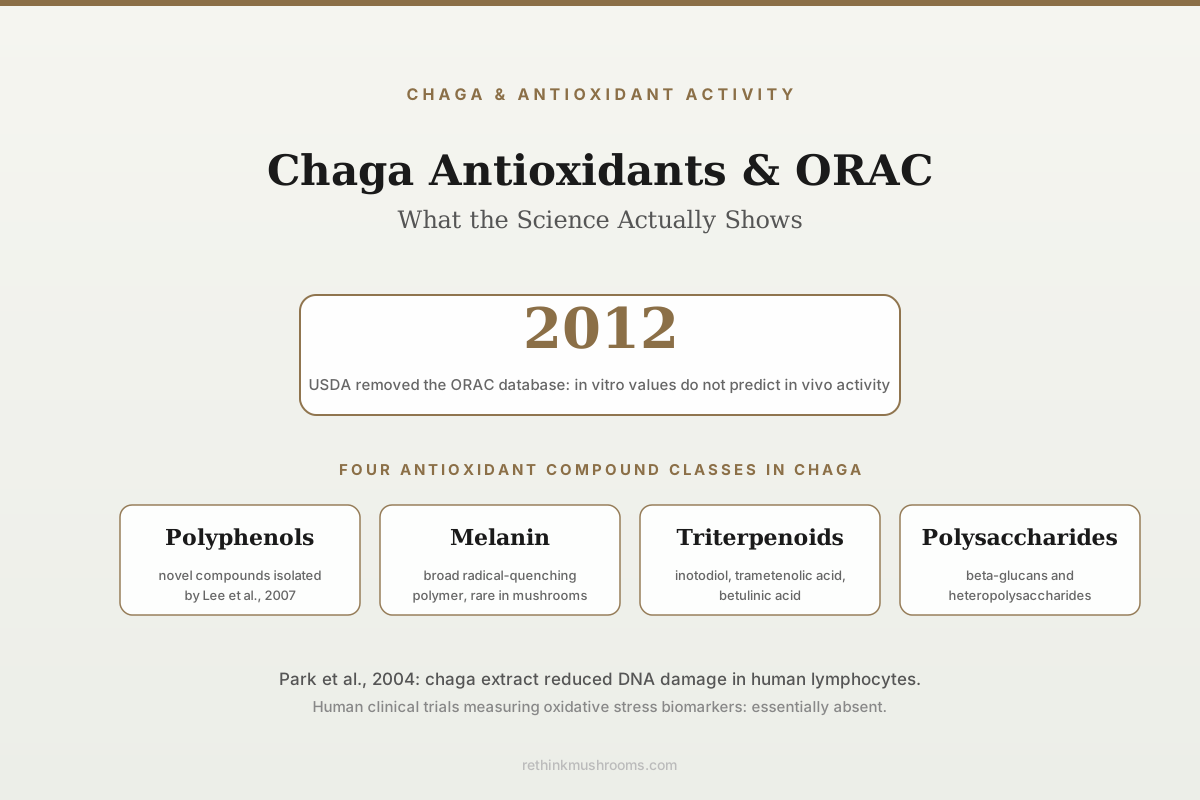
The year USDA removed its ORAC database because the value failed to predict antioxidant activity in vivo. Marketing kept the number; the science moved on.
US Department of Agriculture, Nutrient Data Laboratory, 2012
Novel Polyphenols
identified in chaga by Lee et al., 2007
Direct DNA Protection
shown in human lymphocytes
Melanin Pigment
rare mushroom-derived antioxidant
US Department of Agriculture, Nutrient Data Laboratory, 2012
 View as image ↗
Chaga (Inonotus obliquus) is routinely marketed as having the highest ORAC score in the mushroom kingdom, with numbers ranging from 36,000 to over 146,000 micromoles of Trolox equivalents per 100 grams cited across the supplement industry. Those numbers are real in the sense that someone measured them in a test tube. What they are not is a reliable predictor of how chaga actually performs as an antioxidant in a human body. The US Department of Agriculture recognized this limitation in 2012 and removed its ORAC database entirely, stating that the values had "no relevance to the effects of specific bioactive compounds, including polyphenols on human health."
The real antioxidant story for chaga is more interesting than a single test-tube score. Chaga contains multiple structurally distinct classes of antioxidant compounds (polyphenols, melanin, triterpenoids, polysaccharides, and ergosterol) that act through different mechanisms, and at least one published human-cell study has shown chaga extracts directly reduce oxidative DNA damage in lymphocytes. This article breaks down what the antioxidant chemistry actually does, where the marketing claims get disconnected from the biology, and what the evidence supports. For the foundational chaga chemistry, see betulinic acid content: wild harvest vs. lab-grown chaga.
Key Takeaways
- Lee et al. (2007) isolated new antioxidant polyphenols from Inonotus obliquus including 3,4-dihydroxybenzalacetone and other phenolic compounds with measurable radical scavenging activity
- Park et al. (2004) showed chaga mushroom extract reduced oxidative DNA damage in human lymphocytes exposed to hydrogen peroxide, measured by comet assay in a human-cell model
- Chaga sclerotia contain high levels of melanin pigment, a unique antioxidant polymer absent from most other medicinal mushrooms and implicated in chaga's dark color and radical quenching capacity
- Fordjour et al. (2023) catalogued chaga's antioxidant constituents across polyphenols, triterpenoids, polysaccharides, melanin, and ergosterol, and noted that the combined activity exceeds what any single compound class explains
- Windsor et al. (2025) found wildcrafted chaga canker contained triterpenoids and polyphenols absent from mycelium-on-grain products, meaning ORAC values from authentic chaga do not transfer to grain-based substitutes
- USDA removed its ORAC database in 2012 because ORAC values measured in vitro do not predict antioxidant activity in vivo, making single ORAC numbers unreliable as consumer guidance
Why ORAC Became a Marketing Number
Oxygen Radical Absorbance Capacity (ORAC) was developed in the 1990s as a laboratory method to measure a food's capacity to neutralize peroxyl radicals in a test tube. The assay pits a sample against a fluorescent probe and a radical generator, then measures how long the sample delays fluorescence loss. The result gets reported as micromoles of Trolox equivalents per 100 grams (µmol TE/100 g), where Trolox is a water-soluble vitamin E analog used as a standard reference.
ORAC values proliferated through the 2000s as the supplement and functional food industries adopted them as shorthand for "how antioxidant" a product was. The USDA published an ORAC database of common foods. Chaga joined the chart with values that placed it above blueberries, acai, goji, and essentially every popular antioxidant food.
In 2012, USDA's Nutrient Data Laboratory withdrew the ORAC database from its website. The published reason, available through the USDA archive, explained that "ORAC values are routinely misused by food and dietary supplement manufacturing companies to promote their products and by consumers to guide their food and dietary supplement choices. There is no evidence that the beneficial effects of polyphenol-rich foods can be attributed to the antioxidant properties of these foods." The agency cited mounting evidence that ORAC does not translate to in vivo antioxidant activity in human tissues.
The critique was not that ORAC numbers are fake. It is that the number measures one narrow type of radical quenching under artificial conditions, does not account for absorption, does not reflect tissue-level activity, and cannot distinguish between a compound that reaches the bloodstream and one that is metabolized before it ever leaves the gut.
For chaga, this matters because the ORAC claim does a lot of work in marketing. The chemistry behind chaga's antioxidant profile is genuinely interesting and well-supported in the lab literature. The single number obscures that the real story requires looking at compound classes, mechanisms, and what actually happens in living systems.
What Chaga Actually Contains
Fordjour et al. (2023) published a comprehensive pharmacology review of chaga and catalogued the bioactive profile across compound classes. The review identified chaga as chemically rich in polyphenols, triterpenoids, polysaccharides, melanin, and ergosterol, with each class contributing differently to antioxidant and other biological activities.[1] Ern et al. (2024) reached similar conclusions in a parallel review, noting that chaga's therapeutic profile is "multi-compound and multi-mechanism" rather than attributable to any single molecule.[2]
The four compound classes most relevant to antioxidant activity are:
Polyphenols are phenolic compounds with multiple hydroxyl groups that donate electrons to neutralize free radicals. Lee et al. (2007) isolated novel phenolic compounds from Inonotus obliquus, including 3,4-dihydroxybenzalacetone and several hispidin-type compounds. These compounds showed measurable radical-scavenging activity in DPPH and other in vitro assays.[3] Wildcrafted chaga canker is particularly polyphenol-rich compared to mycelium-on-grain products.
Melanin is a dark-pigmented polymer that gives chaga its characteristic black exterior. Unlike the polyphenols in fruits and berries, fungal melanin is a macromolecule that functions as a free-radical sink through its dense network of unpaired electrons. Melanin is rare in medicinal mushrooms outside of chaga and wood ear (Auricularia auricula). For a deeper look at the unique chemistry, see chaga melanin: the unique antioxidant you won't find elsewhere.
Triterpenoids include inotodiol, trametenolic acid, betulin, betulinic acid, and lanostane-type triterpenes. These lipophilic compounds are primarily extracted by ethanol and contribute antioxidant, anti-inflammatory, and anticancer activities. Windsor et al. (2025) confirmed that wildcrafted chaga canker contained these triterpenoids at measurable levels while mycelium-on-grain products lacked them.[4]
Polysaccharides include beta-glucans and heteropolysaccharides extracted by hot water. These high-molecular-weight compounds are not conventionally absorbed but have been shown in multiple rodent models to influence oxidative status through immune-mediated pathways and changes in endogenous antioxidant enzyme activity.
The important point is that chaga's antioxidant capacity in a test tube reflects the combined contribution of all these classes, with each class acting through different chemistry. Reducing that to one ORAC number hides the mechanistic complexity that actually determines how chaga behaves in biological systems.
The Human-Cell Evidence: Park et al. 2004
Among the many in vitro studies on chaga antioxidant activity, Park et al. (2004) is one of the most directly relevant to human biology. The researchers used the comet assay, a single-cell gel electrophoresis technique that measures DNA strand breaks, in human peripheral lymphocytes. Lymphocytes were pretreated with chaga mushroom extract or vehicle, then exposed to hydrogen peroxide to induce oxidative DNA damage.[5]
Chaga extract pretreatment reduced the DNA damage observed in H2O2-exposed lymphocytes compared to vehicle pretreatment. The protection was dose-dependent across the tested concentrations. This is a direct cellular measurement of protective activity, not a test-tube radical assay, and it used human cells rather than rodent tissue.
The Park study has important limitations. It is an ex vivo experiment, meaning human cells were studied outside the body. It does not demonstrate that consuming chaga reduces DNA damage in a living person. It used crude chaga extract, not a standardized preparation, so the active compound mix is unknown. And the concentrations tested (typically in the range of 10 to 200 micrograms per milliliter) may or may not be achievable in human tissues after oral dosing.
What the study does demonstrate is that chaga contains compounds capable of reducing oxidative DNA damage in human cells at some concentration. That is stronger evidence than a test-tube ORAC value, because it involves cellular machinery, DNA, and a measured protective outcome rather than an abstract chemistry endpoint.
Melanin: The Antioxidant Chaga Is Actually Unusual For
Melanin is the compound that most distinguishes chaga from other antioxidant mushrooms and most antioxidant foods in general. The dense, polymeric structure of fungal melanin is fundamentally different from the small-molecule polyphenols that drive antioxidant activity in blueberries, green tea, or cocoa.
Sun et al. (2016) characterized natural melanin from wood ear mushroom (Auricularia auricula) and demonstrated antioxidant activity in vitro. The molecular structure analysis showed melanin's characteristic polymer architecture with multiple unpaired electron sites that can absorb and neutralize free radicals.[6] Chaga's melanin, while less studied in isolation than wood ear melanin, shares the same basic polymeric character and contributes to chaga's intense black color and radical-quenching capacity.
Hou et al. (2019) demonstrated that natural fungal melanin from Auricularia auricula exerted a hepatoprotective effect in a mouse model of acute alcohol-induced liver injury. The melanin reduced markers of oxidative stress and inflammation in liver tissue at oral doses, indicating that the polymer (or fragments of it) can exert biological activity after oral administration.[7] Whether chaga melanin behaves identically has not been directly tested in a human trial, but the mechanistic basis is established in the related fungal system.
The melanin contribution to chaga's total antioxidant capacity is one reason that comparing chaga to berries on ORAC alone is chemically misleading. A blueberry's ORAC comes predominantly from small anthocyanin molecules. A chaga sample's ORAC includes melanin's broad-spectrum radical quenching, polyphenol-specific activity, triterpenoid contributions, and polysaccharide effects. The compounds are different, the mechanisms are different, and the biological fates after ingestion are different.
The In Vivo Gap
The largest research gap in the chaga antioxidant literature is the near-complete absence of human in vivo studies. A PubMed search for "Inonotus obliquus" combined with "randomized controlled trial" yields very few results, and none that specifically measure oxidative stress biomarkers after chaga supplementation in healthy adults. The published literature is dominated by:
- In vitro chemistry (DPPH, ABTS, FRAP, ORAC assays on chaga extracts)
- Cellular studies (human or rodent cell lines exposed to chaga extracts in culture)
- Animal models (rodent studies of chaga supplementation and various oxidative stress measures)
The translation from these models to human outcomes requires pharmacokinetic data (which compounds reach human blood at what concentrations), tissue distribution data (where absorbed compounds actually go), and clinical trial data (whether supplementation changes biomarkers of oxidative stress, inflammation, or disease in real people). For most chaga bioactive compounds, none of that chain exists.
This does not mean chaga is inactive in humans. It means the strongest evidence supporting chaga's antioxidant activity comes from cell studies and animal models, not from human clinical trials. Consumers who see "clinically proven" or "highest ORAC score" in marketing should understand that the underlying evidence base does not yet include the clinical-trial layer that would normally support such claims. For safety context, see can you take chaga long-term: safety considerations.
What Actually Determines Whether a Chaga Product Delivers Antioxidants
Windsor et al. (2025) performed a comparative compositional study of chaga preparations that bears directly on the antioxidant question. Authentic wildcrafted chaga canker contained measurable quantities of triterpenoids (inotodiol, trametenolic acid) and phenolic compounds. Fermented grain products sold as chaga contained neither.[4]
This finding matters for consumers because a product labeled "chaga" with a cited ORAC score may or may not contain the compounds that produced that score. An ORAC value measured on wildcrafted chaga canker does not transfer to a mycelium-on-grain product, even if both are sold under the chaga name. The same label covers chemically different products. For guidance on spotting this gap, see mushroom wisdom, mycelium biomass, and other label terms decoded and 7 red flags in mushroom supplements: what to avoid.
The practical variables that determine whether a chaga supplement actually delivers antioxidants:
Source material. Wildcrafted canker from birch trees contains the triterpenoid, polyphenol, and melanin profile that underlies chaga's documented antioxidant chemistry. Fermented grain substrates typically do not.
Extraction method. Dual extraction (hot water plus ethanol) captures both the water-soluble polysaccharides and the alcohol-soluble triterpenoids and polyphenols. Single-solvent extractions miss substantial fractions of the antioxidant profile. For the full comparison, see capsule vs. powder vs. tincture: bioavailability, cost, and convenience compared.
Standardization. A product reporting beta-glucan percentage and triterpenoid content gives a consumer something concrete to compare. A product reporting only "high antioxidant" or an ORAC value gives nothing to verify.
Testing transparency. Independent Certificates of Analysis for identity, potency, and heavy metal content provide verifiable data. Marketing claims do not. For the regulatory framework behind this testing, see cGMP compliance for mushroom products: what manufacturers must do.
The Bottom Line
Chaga's marketing as the "highest ORAC score in the mushroom kingdom" rests on in vitro measurements that USDA removed from its own database in 2012 because the values did not predict in vivo antioxidant activity. The real chaga antioxidant story involves multiple compound classes (polyphenols, melanin, triterpenoids, polysaccharides), each acting through different chemistry. Human-cell and animal studies support meaningful antioxidant activity, but human clinical trials measuring oxidative stress outcomes are essentially absent. Product authenticity (wildcrafted canker vs. mycelium on grain) determines whether any antioxidant claim transfers to the actual bottle.
Frequently Asked Questions
Sources & References
- 1RTHM-01694·Fordjour, Eric et al. (2023). “Chaga mushroom: a super-fungus with countless facets and untapped potential..” Frontiers in pharmacology.Study breakdown →PubMed →↩
- 2RTHM-01886·Ern, Phoebe Tee Yon et al. (2024). “Chaga Therapeutic Properties: What This 2024 Review Actually Shows.” Mycology.Study breakdown →PubMed →↩
- 3RTHM-00118·Lee, In-Kyoung et al. (2007). “New antioxidant polyphenols from the medicinal mushroom Inonotus obliquus..” Bioorganic & medicinal chemistry letters.Study breakdown →PubMed →↩
- 4RTHM-02209·Windsor, Coleton et al. (2025). “What This 2025 Chaga Supplement Authentication Study Actually Found.” International journal of molecular sciences.Study breakdown →PubMed →↩
- 5RTHM-00076·Park, Yoo Kyoung et al. (2004). “Chaga mushroom extract inhibits oxidative DNA damage in human lymphocytes as assessed by comet assay..” BioFactors (Oxford.Study breakdown →PubMed →↩
- 6RTHM-00449·Sun, Shujing et al. (2016). “Production of natural melanin by Auricularia auricula and study on its molecular structure..” Food chemistry.Study breakdown →PubMed →↩
- 7RTHM-00559·Hou, Ruolin et al. (2019). “Characterization of natural melanin from Auricularia auricula and its hepatoprotective effect on acute alcohol liver injury in mice..” Food & function.Study breakdown →PubMed →↩