Chaga Antioxidant Activity
6 Polyphenols Isolated from Chaga
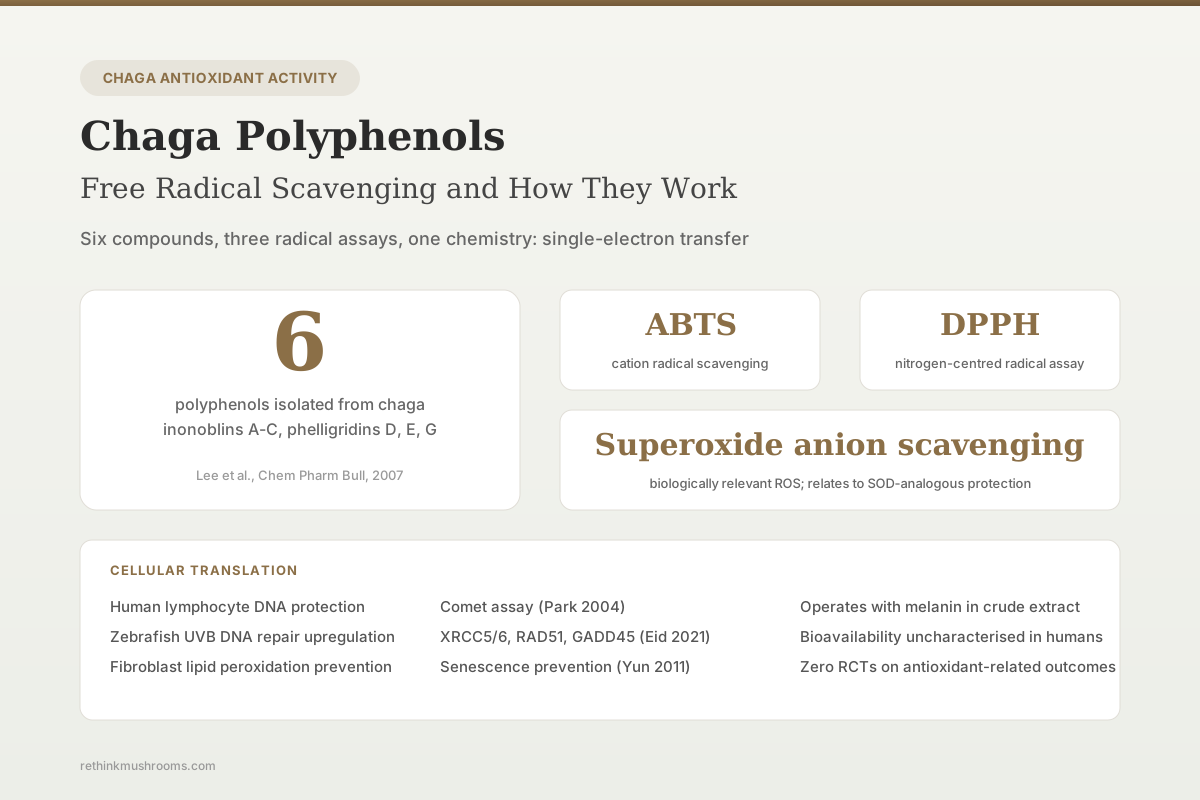
Lee et al. (2007) isolated six previously unknown antioxidant polyphenols from Inonotus obliquus: inonoblins A, B, and C, and phelligridins D, E, and G. All six scavenged ABTS, DPPH, and superoxide radicals in vitro. The mechanism is characteristic single-electron transfer chemistry of conjugated phenolic systems, with measurable differences in potency across the six compounds and versus reference antioxidants.
Lee et al., Chemical and Pharmaceutical Bulletin, 2007
3 radical assays
ABTS, DPPH, and superoxide anion scavenging confirmed for all six chaga polyphenols (Lee et al., 2007)
DNA protection
chaga extract reduced oxidative DNA damage in human lymphocytes by comet assay (Park et al., 2004)
0 human trials
no randomised clinical trial has tested isolated chaga polyphenols for any antioxidant-related health outcome
Lee et al., Chemical and Pharmaceutical Bulletin, 2007
 View as image ↗
Free radicals are reactive molecular species with unpaired electrons that abstract electrons from biological molecules, damaging DNA, proteins, and lipids in the process. Endogenous antioxidant systems (superoxide dismutase, catalase, glutathione peroxidase, glutathione, ascorbate, tocopherols, urate) contain most radical activity under normal conditions, but oxidative stress from ageing, chronic inflammation, UV exposure, or chemical toxicants can overwhelm these systems. Dietary and topical antioxidants supplement endogenous defences. Chaga (Inonotus obliquus) is among the most chemically diverse sources of fungal polyphenols; Lee et al. (2007) isolated six previously undescribed polyphenols from chaga that scavenge radicals through characteristic single-electron transfer chemistry.[1] The preclinical radical-scavenging evidence is extensive; human clinical confirmation is absent. For the broader antioxidant context, see chaga and antioxidants: the highest ORAC score in the mushroom kingdom and chaga melanin: the unique antioxidant you won't find elsewhere.
Key Takeaways
- Lee et al. (2007) isolated six new antioxidant polyphenols from Inonotus obliquus: inonoblins A, B, and C, and phelligridins D, E, and G; all six scavenged ABTS, DPPH, and superoxide radicals in vitro with measurable potency differences
- Chaga radical scavenging proceeds through single-electron transfer from catechol or phenolic hydroxyl groups to free radicals, producing stable phenoxyl radicals that resonance-delocalise the unpaired electron through extended π-conjugation
- Park et al. (2004) demonstrated that chaga mushroom extract inhibited oxidative DNA damage in human lymphocytes in a comet assay, providing cellular-level evidence that the in vitro radical-scavenging chemistry translates to DNA protection
- Burmasova et al. (2019) documented chaga melanin as a second major antioxidant component operating through the same single-electron transfer chemistry but in polymeric rather than monomeric form
- Glamočlija et al. (2015) confirmed polyphenols and melanin as the dominant antioxidant contributors across chaga samples from multiple geographic sources, with total antioxidant capacity varying by sample origin and extraction method
- No randomised clinical trial has tested chaga polyphenols or chaga extract for any human antioxidant-related health outcome (oxidative stress markers, disease incidence, ageing biomarkers)
What "Scavenging a Free Radical" Actually Means Chemically
Free radicals have an unpaired electron that makes them unstable and reactive. The reactive oxygen species (ROS) that matter biologically include superoxide (O₂•⁻, from electron leakage in mitochondrial electron transport), hydrogen peroxide (H₂O₂, not itself a radical but a ROS precursor), hydroxyl radical (•OH, highly reactive, produced from Fenton reaction with iron), and lipid peroxyl radicals (propagating through membrane lipids).
A compound scavenges radicals either by donating a hydrogen atom (hydrogen atom transfer, HAT) or by donating an electron and then deprotonating (single-electron transfer followed by proton transfer, SET-PT). Both pathways end with a radical-quenched product plus a new radical on the antioxidant molecule. The antioxidant is effective if the new radical is stabilised enough not to propagate damage; phenolic antioxidants excel here because the resulting phenoxyl radical delocalises through the conjugated aromatic π-system, spreading the unpaired electron density and preventing further damaging reactions.
Chaga polyphenols operate through this pattern. Catechol groups (two adjacent phenolic hydroxyls) are particularly effective because the resulting semiquinone radical is stabilised by a second intramolecular hydrogen bond and can further oxidise to a stable ortho-quinone.
The Lee 2007 Polyphenol Characterisation
Lee et al. (2007) performed the structural and activity characterisation of six new chaga polyphenols that now anchor much of the chaga antioxidant literature.[1] The compounds fall into two structural classes:
Inonoblins A, B, and C: Novel polyphenol compounds named for their chaga origin (inonotus). All three share a common phenolic scaffold with hydroxyl substitution patterns that enable single-electron donation and conjugation of the resulting phenoxyl radicals.
Phelligridins D, E, and G: Members of a broader phelligridin class found in multiple Phellinus and related genera, representing the shared phenolic-antioxidant chemistry across basidiomycete fungi.
All six compounds were tested in three standard radical-scavenging assays:
- ABTS (2,2'-azino-bis(3-ethylbenzothiazoline-6-sulphonic acid)): A stable cation radical that changes colour when reduced. Standard for testing antioxidants in both aqueous and lipid phases.
- DPPH (2,2-diphenyl-1-picrylhydrazyl): A stable nitrogen-centred radical that decolourises when quenched by hydrogen atom transfer. Standard for testing hydrogen-donating antioxidants.
- Superoxide anion: A biologically relevant ROS; scavenging indicates capacity to interrupt SOD-relevant pathways.
Potency differences across the six compounds reflect substitution pattern differences: more hydroxyl groups and more efficient delocalisation generally correlate with higher scavenging. The specific IC50 values establish dose-response relationships that anchor subsequent extract-level studies.
How Chaga Polyphenols Fit with Chaga Melanin in the Antioxidant Picture
Chaga's antioxidant activity comes from two compound classes operating in parallel: isolated polyphenols (Lee 2007) and the polymeric melanin fraction (Burmasova 2019). The chemistry is related, but the biophysical properties differ.
Polyphenols are small molecules (MW 300–700 Da typically) that distribute in aqueous and lipid phases depending on substitution, cross biological membranes partially, and reach intracellular targets. Melanin is a high-molecular-weight insoluble polymer that operates primarily at surfaces (cell membranes, gut lumen, topical layers) rather than intracellularly.
The implication for antioxidant activity is that the two classes address different compartments. Polyphenols reach cytoplasmic and some nuclear targets, while melanin protects extracellular and membrane-surface targets. In a crude chaga extract, both contribute; in an isolated polyphenol fraction, only the monomers contribute; in an isolated melanin fraction, only the polymer contributes. The strong total antioxidant capacity observed for crude chaga extracts (Glamočlija 2015) reflects their combined action.[2]
Cellular and DNA-Level Translation
In vitro radical-scavenging assays measure chemistry, not biology. Translation to cells and tissues requires that the compounds reach the relevant compartment, persist long enough to engage biological radicals, and do not produce off-target effects at effective concentrations.
Park et al. (2004) bridged part of this gap using the comet assay in human lymphocytes exposed to hydrogen peroxide.[3] Chaga extract pretreatment reduced DNA strand breaks measured as comet tail moment, indicating that chaga components penetrated lymphocytes at effective concentrations and protected DNA from H₂O₂-induced oxidation. The extract tested contained polyphenols alongside other bioactives; isolation of the DNA-protective effect to specific polyphenol versus melanin contributions was not performed.
Eid et al. (2021) documented DNA repair gene upregulation in UVB-exposed zebrafish embryos treated with chaga polysaccharide, with XRCC5, XRCC6, RAD51, and GADD45 upregulated and apoptosis drivers downregulated.[4] UV-induced DNA damage involves ROS generation alongside direct photodamage; the polyphenol and melanin fractions in chaga contribute to reducing the ROS-mediated component.
Yun et al. (2011) extended antioxidant-to-tissue translation by showing that I. obliquus scavenged intracellular ROS and prevented lipid peroxidation in hydrogen peroxide–treated human fibroblasts, with downstream protection against apoptosis and premature senescence.[5]
Comparison with Other Dietary Polyphenols
Chaga polyphenols occupy a specific niche within the broader dietary polyphenol landscape. Green tea catechins (epigallocatechin gallate), red wine resveratrol, blueberry anthocyanins, coffee chlorogenic acids, and olive oil hydroxytyrosol are the best-studied dietary polyphenols with clinical trial data available.
The chemistry is similar: all are phenolic compounds with catechol or related hydroxyl motifs and all scavenge radicals through single-electron transfer. Where chaga polyphenols differ is in the specific scaffolds (inonoblins and phelligridins are not structurally identical to tea catechins or resveratrol) and the context (chaga is consumed as a tea or concentrate, not as part of a whole food with extensive clinical characterisation).
The clinical evidence for polyphenol health benefits is mixed across sources. High-polyphenol dietary patterns (Mediterranean diet) show cardiovascular and metabolic benefits, but isolating these to polyphenol action versus other dietary components is difficult. Isolated polyphenol supplementation has generally shown weaker effects than dietary intake. No chaga polyphenol has entered this clinical evidence tier; the chaga literature remains preclinical.
Review-Level Synthesis
Glamočlija et al. (2015) chemically characterised chaga from multiple geographic sources and quantified total phenolic content and antioxidant capacity across samples.[2] The total phenolic content varied substantially between samples (reflecting geographic, host birch species, and processing differences), and total antioxidant capacity correlated with phenolic content plus melanin content. This variability has practical consequences: a chaga product's antioxidant potency depends on its source and extraction method, not just the species name on the label.
Fordjour et al. (2023), Ern et al. (2024), and Szychowski et al. (2021) all catalogue chaga polyphenols as a central pillar of chaga bioactivity, alongside polysaccharides, triterpenoids, and melanin.[6][7][8] All three reviews flag the absence of clinical trials as the central gap.
What the Evidence Supports and What It Does Not
| Question | Evidence | Confidence |
|---|---|---|
| Do chaga polyphenols scavenge free radicals? | Yes: six compounds characterised in three standard assays (Lee 2007) | High (in vitro) |
| Does chaga extract protect DNA from oxidative damage? | Yes: comet assay in human lymphocytes (Park 2004); zebrafish UVB (Eid 2021) | Moderate |
| Do chaga polyphenols penetrate cells and protect intracellular targets? | Yes in fibroblasts (Yun 2011) | Moderate (cell culture) |
| Do chaga polyphenols reduce oxidative stress in humans? | Not tested; no published RCT measuring oxidative stress biomarkers | None |
| Do chaga polyphenols prevent disease through antioxidant action in humans? | Not tested; no published disease-endpoint RCT | None |
| Is chaga polyphenol content consistent across products? | No: varies by geographic source, host species, and extraction method | Low (consumer consistency) |
Bioavailability: The Translation Bottleneck
Polyphenol bioavailability is the central translation question for any dietary polyphenol. Most polyphenols undergo extensive first-pass metabolism in the gut and liver: glucuronidation, sulphation, methylation, and microbial catabolism substantially reduce the parent compound reaching systemic circulation. The metabolites can retain some antioxidant activity but typically at reduced potency, and tissue distribution of these conjugates differs from the parent.
For chaga polyphenols specifically, no published pharmacokinetic study has characterised inonoblin or phelligridin absorption, metabolism, and tissue distribution in humans. The typical chaga consumption pattern (decoction or concentrate) delivers a complex mixture of parent polyphenols, melanin, polysaccharides, and triterpenoids, making bioavailability characterisation of individual components particularly challenging.
Practically, this means that the in vitro IC50 values at which chaga polyphenols scavenge radicals may not be achievable in human tissues at typical intake levels. The relevant in vivo concentrations would be established by pharmacokinetic studies that have not been performed.
Safety Considerations
Chaga's antioxidant mechanism via polyphenols does not raise unique safety concerns independent of the broader chaga safety profile. However, three considerations apply:
Pro-oxidant activity at high concentrations: Many polyphenols are pro-oxidant at supraphysiological concentrations, generating hydrogen peroxide through autoxidation in the presence of transition metals. Chaga polyphenols have not been specifically characterised for this dose inversion.
Interaction with conventional antioxidant therapy: Patients with cancer on chemotherapy or radiotherapy are sometimes advised to avoid high-dose antioxidant supplementation because of theoretical interference with ROS-dependent tumour killing. No specific chaga clinical data address this.
General chaga safety concerns: Three oxalate nephropathy case reports and documented antiplatelet activity apply to all chaga use patterns regardless of which compound class is the focus.
The Bottom Line
Chaga (Inonotus obliquus) polyphenols are a chemically defined class of radical scavengers. Lee et al. (2007) isolated and characterised six compounds (inonoblins A–C and phelligridins D, E, G) that scavenge ABTS, DPPH, and superoxide radicals in vitro. The scavenging chemistry is single-electron transfer from catechol or phenolic hydroxyl groups, with the resulting phenoxyl radicals stabilised by π-conjugation. Cellular translation is documented: Park et al. (2004) showed DNA protection in human lymphocytes; Yun et al. (2011) showed intracellular ROS scavenging and lipid peroxidation prevention in fibroblasts; Eid et al. (2021) showed DNA repair gene upregulation in UVB-exposed zebrafish. Chaga polyphenols operate alongside chaga melanin (Burmasova 2019) to produce combined crude-extract antioxidant activity. No human pharmacokinetic or clinical trial has tested chaga polyphenols specifically, leaving the in-vivo-relevant exposure-effect relationship unknown.
Frequently Asked Questions
Sources & References
- 1RTHM-00118·Lee, In-Kyoung et al. (2007). “New antioxidant polyphenols from the medicinal mushroom Inonotus obliquus..” Bioorganic & medicinal chemistry letters.Study breakdown →PubMed →↩
- 2RTHM-00373·Glamočlija, Jasmina et al. (2015). “Chemical characterization and biological activity of Chaga (Inonotus obliquus), a medicinal "mushroom"..” Journal of ethnopharmacology.Study breakdown →PubMed →↩
- 3RTHM-00076·Park, Yoo Kyoung et al. (2004). “Chaga mushroom extract inhibits oxidative DNA damage in human lymphocytes as assessed by comet assay..” BioFactors (Oxford.Study breakdown →PubMed →↩
- 4RTHM-00683·Eid, Jehane Ibrahim et al. (2021). “Chaga mushroom (Inonotus obliquus) polysaccharides exhibit genoprotective effects in UVB-exposed embryonic zebrafish (Danio rerio) through coordinated expression of DNA repair genes..” Heliyon.Study breakdown →PubMed →↩
- 5RTHM-00241·Yun, Jong Seok et al. (2011). “Inonotus obliquus protects against oxidative stress-induced apoptosis and premature senescence..” Molecules and cells.Study breakdown →PubMed →↩
- 6RTHM-01694·Fordjour, Eric et al. (2023). “Chaga mushroom: a super-fungus with countless facets and untapped potential..” Frontiers in pharmacology.Study breakdown →PubMed →↩
- 7RTHM-01886·Ern, Phoebe Tee Yon et al. (2024). “Chaga Therapeutic Properties: What This 2024 Review Actually Shows.” Mycology.Study breakdown →PubMed →↩
- 8RTHM-00722·Szychowski, Konrad A et al. (2021). “Inonotus obliquus - from folk medicine to clinical use..” Journal of traditional and complementary medicine.Study breakdown →PubMed →↩