Chaga Antioxidants
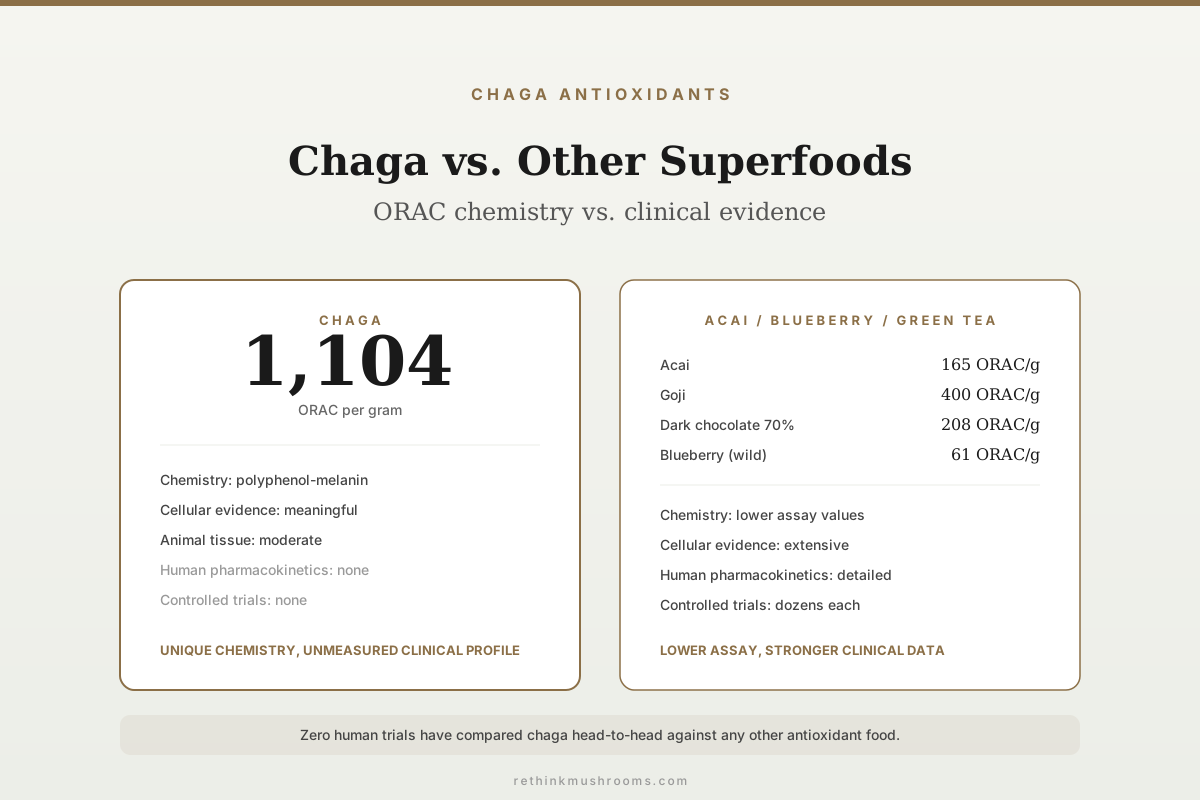
1,104 ORAC per gram
The figure most commonly quoted for chaga is roughly 6.7x acai and 46x blueberry per gram by ORAC. The number is real chemistry. The implied health ranking is not.
Supplement industry compilations; USDA withdrew the reference database in 2012
Chaga Ranks #1 by ORAC
among commonly marketed antioxidant foods
Ranking Evaporates
once bioavailability is accounted for
Zero Head-to-Head Trials
no human clinical comparison exists
Supplement industry compilations; USDA withdrew the reference database in 2012
 View as image ↗
The marketing claim is simple: chaga has the highest ORAC score of any natural food, several times higher than acai, dozens of times higher than blueberries, and far above green tea or dark chocolate. The number is chemically real. The ranking, as a statement about which food delivers more antioxidant protection to a human body, is not supported by any published clinical comparison. Chaga vs other superfoods for antioxidant power is a comparison that works on a lab bench and breaks down everywhere that matters for health: in the gut, the liver, the bloodstream, and the target tissues. This article walks through what the comparison shows, where it holds, and where the evidence simply stops.
For the broader framework, see the sibling article on chaga and antioxidants: the highest ORAC score in the mushroom kingdom. For why the ORAC number itself is a limited metric, see chaga ORAC score: marketing hype vs actual antioxidant science.
Key Takeaways
- By ORAC per gram, chaga (approximately 1,104) outranks acai (165), goji (400), blueberries (24), green tea brewed (1,253 per 100 g equivalent), and dark chocolate (208 per gram), but these are chemical assay values, not bioavailable activity
- Chaga's antioxidant chemistry is driven by a polyphenol-melanin complex with three previously uncharacterized polyphenols isolated by Lee et al. (2007), Bioorganic & Medicinal Chemistry Letters
- Glamoclija et al. (2015) chemically characterized the chaga fraction and confirmed the concentration and structural novelty behind the high assay values
- Park et al. (2004) demonstrated over 40% reduction in oxidative DNA damage in human lymphocytes at 10 to 500 microg/mL, a cellular-level endpoint closer to biological relevance than ORAC
- Hong et al. (2015) showed dose-dependent tissue-level protection in primary rat hepatocytes against oxidative injury, extending the activity signal beyond chemistry
- No human controlled trial has compared chaga head-to-head against acai, blueberries, green tea, or any other dietary antioxidant for clinical oxidative stress endpoints (Szychowski et al., 2021; Fordjour et al., 2023)
The Comparison Table Everyone Cites
The chaga marketing comparison typically uses ORAC values per gram, drawn from a mix of the withdrawn USDA database, industry-funded testing, and laboratory publications with inconsistent methodology. A representative version of the table looks like this.
| Food | ORAC per gram (approx) | Source quality |
|---|---|---|
| Chaga extract | 1,100 to 3,600 | Industry reports; lab papers vary widely |
| Acai pulp (freeze-dried) | 165 | USDA data (withdrawn) |
| Goji berries | 400 | USDA data (withdrawn) |
| Blueberries (wild) | 61 | USDA data (withdrawn) |
| Dark chocolate (70%) | 208 | USDA data (withdrawn) |
| Green tea brewed | 13 (per gram brewed) | USDA data (withdrawn) |
| Pomegranate juice | 22 | USDA data (withdrawn) |
Two caveats apply immediately. First, the USDA withdrew the underlying database in 2012 precisely because these numbers were being used in exactly the way this table uses them. Second, the chaga range is wide because chaga ORAC values depend heavily on extraction solvent, harvest source, and assay protocol, and there is no standardized reference value in the peer-reviewed literature.
The numbers are real within their assays. The comparison is misleading the moment it is interpreted as a ranking of health benefit.
What the Chaga Chemistry Actually Contains
The assay values are driven by a specific polyphenol-melanin complex. Lee et al. (2007), publishing in Bioorganic & Medicinal Chemistry Letters, isolated three new antioxidant polyphenols from Inonotus obliquus and demonstrated radical-scavenging activity in each exceeding several reference antioxidants at equivalent concentrations.[1]
Glamoclija et al. (2015) characterized the chaga polyphenol-melanin fraction in detail and demonstrated that the chemistry behind the high assay values is structurally distinctive, not simply a bulk phenolic concentration.[2] The melanin component is a high-molecular-weight pigment polymer that accounts for a substantial fraction of the chaga radical-scavenging signal and is, importantly, not a compound class found in acai, blueberries, or green tea. This is one of the few places where the chaga vs other superfoods comparison holds on chemistry grounds: chaga has a genuinely unique structural contribution to its antioxidant signature.
For the melanin chemistry specifically, see chaga melanin: the unique antioxidant you won't find elsewhere. For the polyphenol mechanism, see chaga polyphenols and free radical scavenging: how they work.
Where the Comparison Breaks Down: Bioavailability
The central problem with ranking any food by ORAC is that the radical-scavenging capacity of a compound in a test tube has little to do with what that compound does once it is eaten. Four variables determine whether a high-ORAC food produces a measurable biological effect, and the chaga vs other superfoods comparison changes dramatically when each is accounted for.
Digestive stability. Polyphenols vary enormously in their survival through the stomach and small intestine. Anthocyanins (the primary antioxidant class in blueberries and acai) are partially degraded at gastric pH. Catechins (green tea) are relatively stable but poorly absorbed. The high-molecular-weight melanin polymer in chaga is essentially not absorbed intact in any form; most of the chaga activity in living organisms comes from smaller polyphenol components and from microbial metabolites generated in the colon.
Absorption percentage. Bioavailability of most dietary polyphenols falls in the 1 to 5 percent range for the parent compound. EGCG from green tea reaches peak plasma concentrations an order of magnitude below what in-vitro assays use. Anthocyanins from blueberries reach peak plasma concentrations typically below 100 nmol/L. Chaga human pharmacokinetics have not been measured in any published study.
Metabolism changes activity. Liver and gut enzymes conjugate polyphenols into glucuronides, sulfates, and methylated forms. These metabolites often have different (and sometimes opposite) antioxidant behavior compared to the parent compound. The ORAC value of the starting material and the antioxidant behavior of the circulating metabolites can diverge substantially.
Tissue distribution is pathway-specific. Some polyphenols concentrate in liver tissue, some in gut epithelium, some cross the blood-brain barrier, and most do not. A high ORAC per gram on the plate says nothing about whether the compound reaches a target tissue at active concentration.
The net effect: a food can have a spectacular ORAC score and negligible in-vivo activity, or a modest ORAC score and demonstrable biological effect through minor but bioavailable components. The chaga vs other superfoods ranking by ORAC is a ranking by chemistry the gut never sees.
Where Chaga Has Stronger Evidence Than the Assay Suggests
On assay numbers alone, chaga wins. On cellular and tissue-level evidence, chaga also has meaningful data, which is not the same as assay evidence but is closer to biological relevance.
Park et al. (2004) used the comet assay to measure oxidative DNA fragmentation in human lymphocytes exposed to hydrogen peroxide.[3] Chaga aqueous extract reduced oxidative DNA damage by over 40% at concentrations of 10 to 500 microg/mL. This is a meaningful endpoint because comet assay damage in human cells correlates with long-term cancer risk in epidemiological studies. It is not a clinical endpoint, but it is one inferential step closer than an ORAC number.
Hong et al. (2015) tested chaga water extract against tert-butyl hydroperoxide-induced oxidative injury in primary rat hepatocytes and demonstrated dose-dependent tissue-level protection.[4] Liver tissue is particularly relevant because it is the first-pass metabolic site for orally ingested polyphenols and the site where many polyphenol metabolites are generated.
Debnath et al. (2013) tested chaga extracts in parallel for antioxidant and anti-inflammatory activity and found that the two activities tracked together at the same concentration ranges, consistent with a unified phenolic chemistry driving both.[5] This matters because many dietary polyphenol health effects are now understood to be mediated through anti-inflammatory signaling (Nrf2 activation, NF-kB suppression) rather than bulk radical scavenging.
Comparable cellular and tissue-level evidence exists for blueberries, green tea, pomegranate, and dark chocolate, in most cases with more extensive human pharmacokinetic data than chaga has. The honest comparison is: chaga has interesting cellular evidence that places it in the same evidence tier as several other studied antioxidant foods, not clearly above or below them.
The Clinical Trial Gap
A proper food comparison for antioxidant power would look like a randomized controlled trial in which matched groups consume defined doses of different foods over weeks or months, with serial measurement of plasma antioxidant biomarkers, urinary oxidative stress markers (8-OHdG, F2-isoprostanes), and clinical endpoints like blood pressure, lipid profiles, or disease incidence.
This kind of trial has been done repeatedly for green tea, for blueberries, for dark chocolate, and for pomegranate juice, with mixed and often modest results. It has not been done for chaga in any published form.
Szychowski et al. (2021), in a review tracing chaga from folk medicine to clinical use, identified the absence of well-powered human trials as the key constraint on translating the preclinical chemistry into demonstrated clinical benefit.[6] Fordjour et al. (2023) used the phrase "untapped potential" to describe the same gap.[7] Ern et al. (2024), in a comprehensive therapeutic review, listed antioxidant activity among chaga's best-supported pharmacological properties while noting the limited clinical coverage.[8]
This is the single most important data point in any chaga vs other superfoods comparison. Green tea and blueberries have been studied in dozens to hundreds of human trials for oxidative stress outcomes. Chaga has been studied in essentially none. A ranking that puts chaga above them based on assay chemistry is a ranking that inverts the evidence base.
Head-to-Head Comparison With Other Medicinal Mushrooms
Within the mushroom kingdom, the comparison picture is somewhat clearer because the chemistry is more similar across species. Debnath et al. (2013) and Glamoclija et al. (2015) both compared chaga to other tested medicinal mushrooms in parallel assays and found chaga consistently at or near the top.[5][2] The melanin-polyphenol content is the reason. Reishi, turkey tail, and lion's mane have strong activity in immune and neurological assays but lower radical-scavenging capacity than chaga on equivalent dry-weight bases.
This within-category comparison is more meaningful than the cross-category comparison with plant foods because the assay conditions, extraction methods, and publication standards are more consistent. It is also the comparison most medicinal mushroom consumers actually care about.
What an Honest Comparison Looks Like
A precise statement of chaga vs other superfoods for antioxidant power:
- On chemical assay values (ORAC, DPPH, ABTS), chaga is genuinely at or near the top among commonly marketed antioxidant foods
- The chemistry driving the high assay values is structurally distinctive, particularly the polyphenol-melanin complex, which is not found in plant-source antioxidant foods
- On cellular and tissue-level evidence, chaga has meaningful but limited data; other foods have similar or more extensive cellular evidence
- On human pharmacokinetic data, chaga has essentially nothing published; other foods have substantial data
- On human controlled trial evidence for oxidative stress or clinical endpoints, chaga has no published data; other foods have dozens to hundreds of trials with mixed results
- No head-to-head human trial has ever compared chaga to any other antioxidant food for any clinical outcome
The implication: the marketing claim that chaga is the most powerful antioxidant food is defensible only within a narrow technical frame (the chemical assay) and fails as a general statement about comparative health impact.
For the broader compound landscape that produces chaga's antioxidant identity, see the sibling article on chaga polyphenols and free radical scavenging: how they work. For a cross-cluster view of how chaga's bioactive profile compares across health domains, see chaga bioactive compounds: betulinic acid, melanin, and polysaccharides.
Why the Comparison Keeps Being Made Anyway
The chaga vs acai vs blueberries comparison survives in marketing for the same reason ORAC itself survives in marketing: a single large number is an easier sell than a multi-step evidence discussion. "Chaga: 6.7x the antioxidant power of acai" fits on a label. "Chaga has distinctive polyphenol-melanin chemistry with cellular and tissue-level activity but no human clinical trial data comparing it to other foods" does not.
The cost of the shortcut is inversion of the real evidence base. Blueberries, green tea, and dark chocolate have dozens of published human trials on oxidative stress biomarkers. Chaga has zero. The assay-based ranking treats chaga as strictly superior, and the clinical-evidence-based ranking places it in a different category entirely, one with interesting chemistry and a research gap rather than an established clinical profile.
The Bottom Line
Chaga sits at or near the top of antioxidant assay rankings versus acai, blueberries, goji, green tea, and dark chocolate, driven by a distinctive polyphenol-melanin complex. The ranking collapses once bioavailability, metabolism, and clinical evidence are accounted for. Other superfoods have extensive human pharmacokinetic and controlled trial data; chaga has essentially none. The honest comparison is that chaga has unique chemistry and an unmeasured clinical profile, not proven superiority.
Frequently Asked Questions
Sources & References
- 1RTHM-00118·Lee, In-Kyoung et al. (2007). “New antioxidant polyphenols from the medicinal mushroom Inonotus obliquus..” Bioorganic & medicinal chemistry letters.Study breakdown →PubMed →↩
- 2RTHM-00373·Glamočlija, Jasmina et al. (2015). “Chemical characterization and biological activity of Chaga (Inonotus obliquus), a medicinal "mushroom"..” Journal of ethnopharmacology.Study breakdown →PubMed →↩
- 3RTHM-00076·Park, Yoo Kyoung et al. (2004). “Chaga mushroom extract inhibits oxidative DNA damage in human lymphocytes as assessed by comet assay..” BioFactors (Oxford.Study breakdown →PubMed →↩
- 4RTHM-00374·Hong, Ki Bae et al. (2015). “Hepatoprotective Activity of Water Extracts from Chaga Medicinal Mushroom, Inonotus obliquus (Higher Basidiomycetes) Against Tert-Butyl Hydroperoxide-Induced Oxidative Liver Injury in Primary Cultured Rat Hepatocytes..” International journal of medicinal mushrooms.Study breakdown →PubMed →↩
- 5RTHM-00283·Debnath, Trishna et al. (2013). “Anti-oxidant and anti-inflammatory activities of Inonotus obliquus and germinated brown rice extracts..” Molecules (Basel.Study breakdown →PubMed →↩
- 6RTHM-00722·Szychowski, Konrad A et al. (2021). “Inonotus obliquus - from folk medicine to clinical use..” Journal of traditional and complementary medicine.Study breakdown →PubMed →↩
- 7RTHM-01694·Fordjour, Eric et al. (2023). “Chaga mushroom: a super-fungus with countless facets and untapped potential..” Frontiers in pharmacology.Study breakdown →PubMed →↩
- 8RTHM-01886·Ern, Phoebe Tee Yon et al. (2024). “Chaga Therapeutic Properties: What This 2024 Review Actually Shows.” Mycology.Study breakdown →PubMed →↩