Chaga Introduction
1955 Soviet Pharmacopoeia
Chaga's medicinal use in Russia traces to the 12th century, was codified in the 1955 Soviet Pharmacopoeia as Befunginum, and now anchors a preclinical literature covering diabetes, inflammation, cancer cell lines, viral defence, and skin protection. No randomised clinical trial has tested chaga for any of the traditional indications in modern medicine.
Szychowski et al., World J Microbiol Biotechnol, 2021
12th century
earliest written reference to chaga medicinal use in Russia, primarily for gastrointestinal and tumour conditions
Befunginum
chaga-based preparation listed in 1955 Soviet Pharmacopoeia for gastrointestinal disease and as a general tonic
0 RCTs
no randomised clinical trial has been published testing chaga for any traditional indication in modern human medicine
Szychowski et al., World J Microbiol Biotechnol, 2021
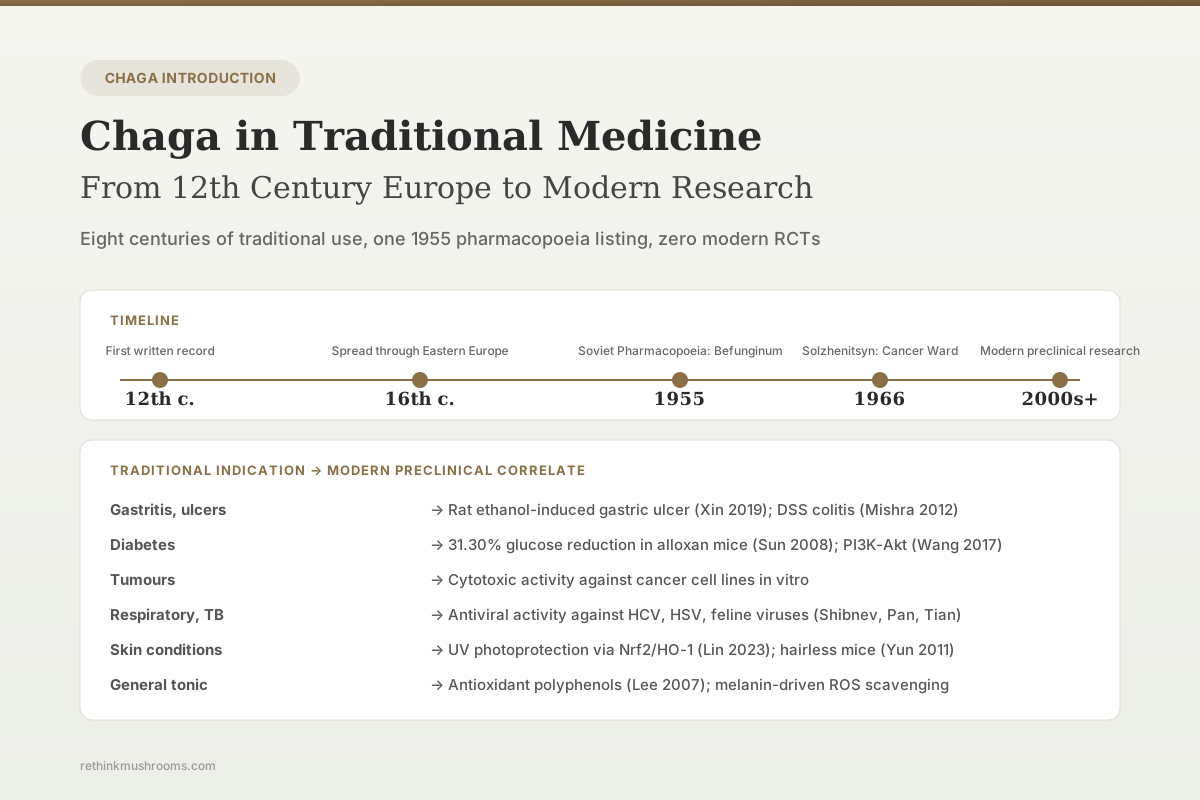 View as image ↗
Chaga (Inonotus obliquus) is one of the few medicinal mushrooms with a documented European medicinal tradition long before laboratory characterisation. Written references to its use for gastrointestinal complaints and tumours appear in 12th-century Russian sources. Siberian and circumboreal indigenous groups used it as a broad tonic and for specific conditions of the digestive tract, skin, and respiratory system. By the mid-20th century, chaga had moved from folk remedy to official pharmacopoeia: in 1955 the USSR Ministry of Health added Befunginum, a chaga-based concentrate, to the Soviet Pharmacopoeia, where it remained as an approved preparation for gastrointestinal disease and general tonic use.[1] The modern preclinical literature (Fordjour 2023; Ern 2024) tests many of the same indications the traditional texts list, with antidiabetic, anti-inflammatory, antiviral, and cytotoxic activity all replicated in cell and animal models.[2][3] No randomised controlled trial has confirmed any of these effects in human populations. For a deeper look at what chaga actually is biologically, see why chaga isn't technically a mushroom: the sclerotium explained.
Key Takeaways
- The first written reference to chaga medicinal use dates to 12th-century Russia, where it was used for gastrointestinal disorders and tumours; oral traditions among circumboreal indigenous groups (Khanty, Mansi, and other Siberian peoples) likely predate the written record
- In 1955, the USSR Ministry of Health added Befunginum, a chaga concentrate preparation, to the Soviet Pharmacopoeia for gastrointestinal disease and as a general tonic; the preparation remained in use in Russia and Eastern Europe throughout the 20th century
- Traditional indications for chaga included gastrointestinal complaints (gastritis, ulcers, stomach cancer), cardiovascular disease, tuberculosis, diabetes, and skin conditions; several of these map directly onto endpoints now tested in preclinical laboratory research
- The modern preclinical literature replicates many traditional claims in cell and animal models, including antidiabetic activity (Sun 2008; Wang 2017), anti-inflammatory effects (Kim 2007), antiviral activity against HCV and HSV (Shibnev 2011; Pan 2013), and UV photoprotection (Lin 2023)
- Chemical characterisation across multiple geographic sources (Glamočlija 2015) documents that chaga contains melanin, phenolic acids, flavonoids, polysaccharides, and triterpenoids whose bioactivity is consistent with at least some of the traditional indications
- No randomised controlled trial has tested chaga for any condition in human populations, despite 800 years of traditional use and the clinical uptake of Befunginum in 20th-century Russian medicine
The Oldest Written References
The medicinal use of chaga in Russia predates most modern pharmacological texts. Historical sources describe chaga preparations, usually as a decoction of the dried sclerotium, used for gastrointestinal complaints from the 12th century onward. The specific folk terminology (berezovaya guba, birch sponge; tschaga from the Komi language) reflects the fungus's exclusive association with birch trees (Betula species) in the boreal forest belt.
Beyond the written record, chaga figured in the materia medica of Siberian indigenous groups including the Khanty (formerly Ostyak) and Mansi (Vogul) peoples of Western Siberia, and further east among Evenki and related circumboreal groups. Their traditional use extended beyond gastrointestinal complaints to include general tonics, skin washes, respiratory support, and ritual applications. Oral transmission means precise historical dates for these traditions cannot be fixed, but ethnobotanical fieldwork in the 20th century documented continuous contemporary use extending back as far as informants could recall.
By the 16th to 17th centuries, chaga use had spread through Poland, the Baltic states, and parts of Scandinavia, following the boreal birch forests. Its use continued concurrently as folk remedy and, in some regions, as part of herbal-trained medical practice. Through much of this period, chaga was consumed as a hot-water decoction of the dried sclerotium, either alone or in combination with other herbs, and drunk in substantial volumes over extended periods.
The Solzhenitsyn Effect
Aleksandr Solzhenitsyn's 1966 novel Cancer Ward drew on the author's own experience with cancer treatment in a Tashkent hospital and featured chaga prominently as a folk remedy used by a country doctor with reputedly positive outcomes. The novel circulated internationally after its publication and brought chaga to Western attention in ways that prior scientific and ethnographic sources had not. Much of the subsequent English-language interest in chaga traces to this single literary reference rather than to direct ethnobotanical or clinical sources.
The translation gap between Solzhenitsyn's narrative and the clinical evidence has not been closed. The novel describes anecdotal cases within a fictional frame; no systematic clinical evaluation of the Tashkent-era chaga preparations followed. The contemporary commercial market for chaga in North America and Western Europe was substantially shaped by this literary reference, which is important context for evaluating marketing claims that invoke a long tradition of cancer use.
Befunginum and the Soviet Pharmacopoeia
The 20th century saw chaga transition from folk remedy to pharmacologically characterised product within the Soviet medical system. In 1955, the USSR Ministry of Health added Befunginum, an alcoholic concentrate of chaga, to the Soviet Pharmacopoeia.[1] The approved indications were gastrointestinal disease (gastritis, peptic ulcer) and use as a general tonic to improve wellbeing and appetite in chronic illness. Befungin remained in production and clinical use in the Soviet Union and subsequent Russian healthcare system throughout the 20th century and is still available in Russian and Eastern European pharmacies.
The evidence base used to support the 1955 pharmacopoeia listing would not meet modern regulatory standards for a new drug approval. Soviet-era evaluations relied primarily on case series, hospital-based observational studies, and uncontrolled open-label use rather than randomised controlled trials. The listing reflected both the observational clinical experience and the strategic need for low-cost domestic remedies in the post-war Soviet healthcare system. The contemporary Western pharmacovigilance record for Befungin is limited; adverse event reporting through the USSR and successor Russian systems does not map cleanly onto modern signal detection frameworks.
Traditional Indications and Modern Preclinical Correlates
The traditional indications for chaga map with surprising consistency onto the modern preclinical literature. Szychowski et al. (2021) reviewed I. obliquus from folk medicine to clinical use and categorised the overlaps.[1]
Gastrointestinal use: Traditional use for gastritis, peptic ulcer, and stomach cancer. Modern preclinical correlates include gastroprotective activity in rat ethanol-induced gastric ulcer (Xin 2019) and anti-inflammatory activity in DSS colitis mouse models (Mishra 2012; Choi 2010; Chen 2019). For the specific gastric and colitis sibling articles, see chaga and ulcers: can it protect the stomach lining? and chaga for digestive inflammation: IBD and colitis evidence.
Diabetes: Traditional use as a blood sugar remedy. Modern preclinical correlates include Sun et al. (2008) showing 31.30% blood glucose reduction at 1000 mg/kg in alloxan-induced diabetic mice, plus PI3K-Akt and AMPK/ACC engagement in subsequent studies (Wang 2017; Zhang 2021).[4] For the full diabetes sibling, see chaga for type 2 diabetes: evidence and mechanisms.
Tumour and cancer: Traditional use for tumours, famously amplified by Solzhenitsyn. Modern preclinical correlates include cytotoxic activity against cancer cell lines and immunomodulation studies. No clinical trial has tested chaga for any cancer indication in humans.
Tuberculosis and respiratory: Traditional use for tuberculosis and respiratory infections. Modern preclinical correlates are thinner, as direct antimycobacterial studies of chaga against Mycobacterium tuberculosis are limited, though general antiviral (Shibnev 2011; Pan 2013; Tian 2017) and anti-inflammatory mechanisms are documented.[5]
Skin conditions: Traditional use for skin problems including eczema-like conditions and sun exposure. Modern preclinical correlates include UV photoprotection in HaCaT keratinocytes via Nrf2/HO-1 (Lin 2023) and reduced UV-induced skin damage in hairless mice (Yun 2011). For the photoprotection sibling, see chaga and UV damage: photoprotective properties.
Chemical Basis for the Traditional-Modern Overlap
Glamočlija et al. (2015) performed chemical characterisation of chaga samples from multiple geographic origins and catalogued the major compound classes: melanin (the dominant pigment driving much of the antioxidant and free-radical scavenging activity), phenolic acids (caffeic acid, gallic acid, and derivatives), flavonoids, triterpenoids (inotodiol, trametenolic acid, betulin derivatives originating partly from the birch host), and polysaccharides (β-glucans and heteroglycans).[6] The compound profile varied substantially between geographic sources and between wild and cultivated material.
Lee et al. (2007) isolated specific chaga polyphenols (inonoblins A–C; phelligridins D, E, G) with antioxidant activity that contributes to the proposed mechanism behind many traditional indications.[7] The chemical evidence supports the biological plausibility of at least partial effect for traditional claims involving oxidative stress, inflammation, and tissue protection. It does not support clinical efficacy claims in the absence of human trial data.
What Traditional Use Does and Does Not Tell Us
Traditional use has two distinct functions as evidence. First, it signals that a preparation is broadly tolerated across long-term use in diverse populations, which is a coarse safety signal. Eight hundred years of widespread chaga consumption without a dominant adverse event narrative is evidence that the preparation is not acutely highly toxic. This does not mean chaga is safe in all contexts: the modern case reports of oxalate nephropathy (Kikuchi 2014; Kwon 2020; Lee 2022) describe a specific harm from long-term high-dose use that may or may not have been common enough to enter traditional safety folklore.
Second, traditional use can point research toward plausible biological activity that warrants laboratory testing. The overlap between 12th-century indications and 21st-century preclinical findings on chaga is substantial and suggests the traditional observations had real empirical basis. What traditional use cannot establish is clinical efficacy in the modern sense: effect size, specificity, dose-response, drug interactions, and comparison against available alternatives. Those questions require controlled human studies that have not been done for chaga.
The Missing Clinical Translation
For a preparation with 800 years of traditional use, an official Soviet Pharmacopoeia listing for 70+ years, and a converging preclinical evidence base, the absence of randomised controlled trial data is notable. Szychowski et al. (2021), Fordjour et al. (2023), and Ern et al. (2024) all flag this gap as the central weakness in the chaga evidence base.[1][2][3]
Structural reasons for the gap include the commercial difficulty of patenting a naturally occurring preparation, the variable extract composition that complicates regulatory trials, and the historical divide between the Soviet-era clinical tradition and Western regulatory science. Practical next steps would include pharmacokinetic studies of specific chaga bioactives in humans, standardisation of extract composition for clinical testing, and phase 2a adjunct trials in conditions where preclinical evidence is most robust (type 2 diabetes, ulcerative colitis, UV photodamage).
What the Evidence Supports and What It Does Not
| Question | Evidence | Confidence |
|---|---|---|
| Was chaga used medicinally in pre-modern Russia? | Yes: written references from the 12th century, ethnographic documentation of Siberian indigenous use | High |
| Was chaga officially recognised as a medicine in the 20th century? | Yes: Befunginum added to Soviet Pharmacopoeia in 1955; still available in Russia | High |
| Do modern preclinical studies replicate traditional chaga effects? | Yes in many areas: diabetes, inflammation, gastric protection, UV protection, antiviral | Moderate (preclinical only) |
| Did Soviet-era evaluation of Befungin meet modern regulatory standards? | No: case series, observational studies, uncontrolled open-label trials | N/A |
| Does traditional use establish chaga's safety for modern dosing? | Partially: coarse safety signal, but specific harms (oxalate nephropathy) have emerged | Low to moderate |
| Is chaga clinically proven for any traditional indication? | No randomised controlled trial has been published | None |
The Bottom Line
Chaga (Inonotus obliquus) has an 800-year traditional medicinal record in Russia, Siberia, Poland, the Baltic states, and parts of Scandinavia. Written references trace to the 12th century for gastrointestinal complaints and tumours, and oral traditions among Siberian indigenous groups extend the use further. In 1955, the USSR Ministry of Health listed Befunginum, a chaga concentrate, in the Soviet Pharmacopoeia for gastrointestinal disease and general tonic use. Solzhenitsyn's 1966 novel Cancer Ward brought chaga to Western attention. Modern preclinical research replicates many traditional indications: antidiabetic activity (Sun 2008), anti-inflammatory effects (Kim 2007), UV photoprotection (Lin 2023), and antiviral activity (Shibnev 2011; Pan 2013). Chemical characterisation (Glamočlija 2015; Lee 2007) identifies melanin, polyphenols, polysaccharides, and triterpenoids as the bioactive compound classes. No randomised controlled trial has tested chaga for any human indication. The traditional-to-modern translation remains incomplete at the clinical level.
Frequently Asked Questions
Sources & References
- 1RTHM-00722·Szychowski, Konrad A et al. (2021). “Inonotus obliquus - from folk medicine to clinical use..” Journal of traditional and complementary medicine.Study breakdown →PubMed →↩
- 2RTHM-01694·Fordjour, Eric et al. (2023). “Chaga mushroom: a super-fungus with countless facets and untapped potential..” Frontiers in pharmacology.Study breakdown →PubMed →↩
- 3RTHM-01886·Ern, Phoebe Tee Yon et al. (2024). “Chaga Therapeutic Properties: What This 2024 Review Actually Shows.” Mycology.Study breakdown →PubMed →↩
- 4RTHM-00145·Sun, Jun-En et al. (2008). “Antihyperglycemic and antilipidperoxidative effects of dry matter of culture broth of Inonotus obliquus in submerged culture on normal and alloxan-diabetes mice..” Journal of ethnopharmacology.Study breakdown →PubMed →↩
- 5RTHM-00300·Pan, Hong-Hui et al. (2013). “Aqueous extract from a Chaga medicinal mushroom, Inonotus obliquus (higher Basidiomycetes), prevents herpes simplex virus entry through inhibition of viral-induced membrane fusion..” International journal of medicinal mushrooms.Study breakdown →PubMed →↩
- 6RTHM-00373·Glamočlija, Jasmina et al. (2015). “Chemical characterization and biological activity of Chaga (Inonotus obliquus), a medicinal "mushroom"..” Journal of ethnopharmacology.Study breakdown →PubMed →↩
- 7RTHM-00118·Lee, In-Kyoung et al. (2007). “New antioxidant polyphenols from the medicinal mushroom Inonotus obliquus..” Bioorganic & medicinal chemistry letters.Study breakdown →PubMed →↩