Chaga and Diabetes
PI3K/Akt + AMPK Two Convergent Pathways
Inonotus obliquus polysaccharides improved glycemia in streptozotocin and high-fat-diet T2D mouse models through two insulin-sensitising axes: PI3K-Akt signalling and AMPK/ACC activation. Chromium-complexed chaga polysaccharide also inhibited α-amylase, α-glucosidase, and advanced glycation end-product formation. No randomised controlled trial has tested chaga in humans with type 2 diabetes.
Wang et al., Int J Biol Macromol, 2017
7 mouse studies
preclinical T2D evidence across STZ, HFD+STZ, and alloxan diabetes induction methods
AGE inhibition
Cr(III)-IOP complex reduced AGE formation alongside α-amylase and α-glucosidase inhibition (Wang et al., 2018)
0 human trials
no RCT has tested chaga for fasting glucose, HbA1c, or insulin sensitivity in people with T2D
Wang et al., Int J Biol Macromol, 2017
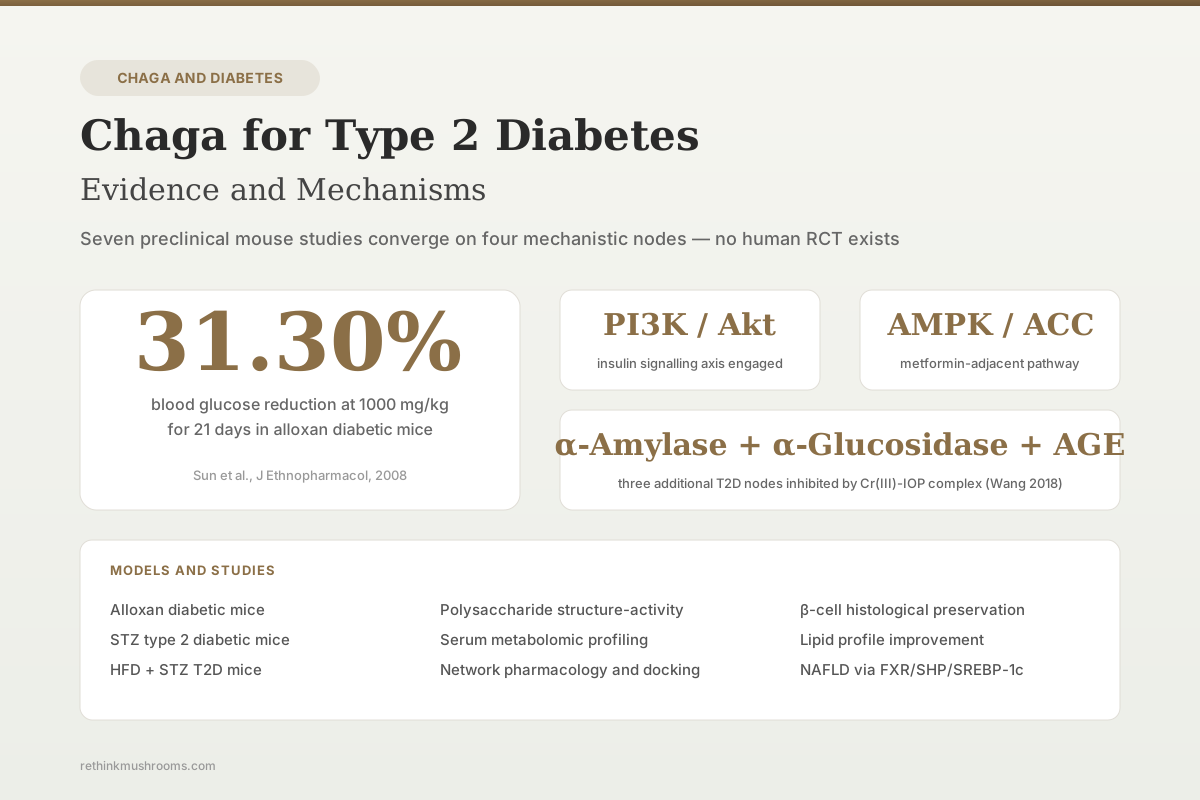 View as image ↗
Type 2 diabetes (T2D) is driven by insulin resistance in skeletal muscle, liver, and adipose tissue compounded by progressive β-cell dysfunction. Hallmark features include fasting hyperglycemia, postprandial glucose excursions, elevated glycated haemoglobin (HbA1c), hepatic insulin resistance with elevated gluconeogenesis, and accumulation of advanced glycation end-products (AGEs) that drive vascular and tissue complications. Current pharmacotherapy targets these nodes: metformin (AMPK activation, hepatic gluconeogenesis suppression), GLP-1 receptor agonists, SGLT2 inhibitors, sulfonylureas, thiazolidinediones, α-glucosidase inhibitors, and insulin. Against this clinical architecture, chaga (Inonotus obliquus) has a preclinical literature across seven independent T2D-relevant mouse studies targeting the same mechanistic nodes, with zero randomised human trials.[1][2][3] For the glycemic-outcome-focused sibling, see chaga and blood sugar: hypoglycemic research, and for the complications-focused sibling see chaga and diabetic complications: kidney and eye protection.
Key Takeaways
- Sun et al. (2008) reported that dry matter of I. obliquus culture broth at 1000 mg/kg for 3 weeks reduced blood glucose by 31.30% in alloxan-induced diabetic mice, increased hepatic glycogen and insulin, and improved lipid profile (FFA, TC, TG, LDL-C reduced; HDL-C increased)
- Wang et al. (2017) demonstrated that I. obliquus polysaccharide (IOP) ameliorated hyperglycemia in STZ-induced type 2 diabetic mice via the PI3K-Akt signalling pathway, a canonical insulin-sensitisation axis
- Zhang et al. (2021) showed that I. obliquus extract regulated glycolipid metabolism via PI3K/Akt and AMPK/ACC pathways in mice, linking chaga to the same AMPK axis targeted by metformin
- Wang et al. (2018) characterised I. obliquus polysaccharide and its chromium (III) complex as inhibitors of advanced glycation end-product formation, α-amylase, and α-glucosidase activity
- Chen et al. (2022) tested I. obliquus extract in high-fat-diet combined with streptozotocin-induced type 2 diabetic mice, showing antidiabetic effects in this physiologically more realistic T2D model
- Randeni et al. (2025) applied LC-MS, network pharmacology, molecular docking, and bioinformatics to integrate chaga's antidiabetic compound landscape, identifying multiple targets convergent with the in vivo mechanistic studies
- Review-level synthesis (Fordjour 2023; Ern 2024) frames chaga's antidiabetic activity as mechanistically consistent across studies and entirely preclinical, with no randomised controlled trial testing glycemic or HbA1c outcomes in humans
The T2D Targets Chaga Hits in Preclinical Models
Type 2 diabetes pharmacology targets a small number of high-leverage nodes. Insulin signalling after receptor binding proceeds through IRS-1/2, PI3K, and Akt (PKB), with downstream translocation of GLUT4 to the plasma membrane enabling glucose uptake in muscle and adipose tissue. Insulin resistance reflects impaired signal propagation through this axis. AMPK is the cellular energy sensor activated under low ATP:AMP conditions; AMPK activation suppresses hepatic gluconeogenesis, increases fatty acid oxidation through ACC inhibition, and promotes insulin sensitivity independent of insulin binding. α-Amylase and α-glucosidase in the gut hydrolyse dietary starch to glucose; inhibiting these enzymes slows postprandial glucose absorption (acarbose, miglitol). Advanced glycation end-products form non-enzymatically between reducing sugars and proteins/lipids; AGE accumulation drives diabetic nephropathy, retinopathy, and vasculopathy.
Chaga's preclinical literature hits each of these nodes across different studies: PI3K-Akt (Wang 2017; Zhang 2021), AMPK/ACC (Zhang 2021), α-amylase and α-glucosidase (Wang 2018; Liu 2018), AGE formation (Wang 2018), pancreatic β-cell preservation (Sun 2008; Diao 2014), and global metabolomic shifts in serum (Xu 2021). The convergence across mechanisms from independent groups using different diabetes induction methods is the strongest signal in the chaga diabetes literature.
Alloxan-Induced Diabetes: The Sun 2008 Foundational Study
Sun et al. (2008) used the dry matter of I. obliquus culture broth (DMCB) in normal mice, glucose-loaded mice, and alloxan-induced diabetic mice.[1] DMCB at 500 and 1000 mg/kg for 21 days produced dose-related reductions in diabetic blood glucose: 11.90% and 15.79% at day 7 rising to 30.07% and 31.30% at day 21. Treatment also decreased serum free fatty acids, total cholesterol, triglycerides, and LDL-C while increasing HDL-C, insulin level, and hepatic glycogen. Antioxidant enzyme activity (CAT, SOD, GPx) increased and MDA decreased, consistent with reduced oxidative stress. Histology showed restoration of pancreatic tissue damage.
The alloxan model destroys pancreatic β-cells via ROS, producing a type 1–like diabetic state rather than the insulin-resistant phenotype of human T2D. The Sun 2008 findings therefore document β-cell preservation and insulin secretion restoration more than insulin sensitisation per se, but the lipid and antioxidant effects observed are mechanistically relevant to T2D as well.
STZ Type 2 Models: PI3K-Akt Signalling Engagement
Wang et al. (2017) tested I. obliquus polysaccharides (IOP) in streptozotocin-induced type 2 diabetic mice and characterised the mechanism as operating via the PI3K-Akt signalling pathway.[2] STZ at lower doses combined with high-fat feeding produces a T2D-like phenotype with preserved but dysfunctional β-cell mass and peripheral insulin resistance, which is a closer fit to human T2D than pure alloxan models. Engagement of PI3K-Akt by IOP implies restoration of insulin signal propagation past IRS-1/2, which is the proximal defect in T2D insulin resistance.
The same research group extended this with a second study of polysaccharides separated from I. obliquus modulating oxidative stress in STZ-diabetic mice, where antidiabetic activity was attributed to improved redox balance alongside the direct glycemic effects.[3] Liu et al. (2018) purified two hypoglycaemic polysaccharides from chaga (HIOP1-S and HIOP2-S) and structurally characterised them, linking specific polysaccharide structures to glycemic activity.[4]
AMPK/ACC and the Metformin-Adjacent Mechanism
Zhang et al. (2021) tested I. obliquus extract on glycolipid metabolism and identified two convergent pathways: PI3K/Akt and AMPK/ACC.[5] AMPK activation is the primary mechanism of metformin, the most widely prescribed T2D medication; AMPK phosphorylates acetyl-CoA carboxylase (ACC), reducing malonyl-CoA and increasing fatty acid oxidation while decreasing lipogenesis. AMPK also suppresses hepatic gluconeogenesis through reduced expression of PEPCK and G6Pase.
A compound engaging both PI3K/Akt (insulin-dependent) and AMPK/ACC (insulin-independent) would be mechanistically attractive as a T2D adjunct because these axes address different components of insulin resistance. The Zhang 2021 data do not establish that the clinical magnitude of effect approaches metformin; they document mechanistic engagement.
Peng et al. (2022) tied the AMPK axis to non-alcoholic fatty liver disease (NAFLD) mechanics via FXR/SHP/SREBP-1c regulation, which is relevant because NAFLD and T2D share pathogenic mechanisms and often co-occur in metabolic syndrome.[6] SREBP-1c drives hepatic lipogenesis; FXR and SHP suppress it; AMPK activation reinforces this suppressive axis.
Advanced Glycation End-Products and Carbohydrate-Digesting Enzymes
Wang et al. (2018) tested polysaccharides from I. obliquus and their chromium (III) complex against three linked T2D targets: α-amylase activity, α-glucosidase activity, and AGE formation.[7] Inhibition of α-amylase and α-glucosidase slows carbohydrate digestion and reduces postprandial glucose peaks, which is the mechanism of acarbose. AGE inhibition addresses the long-term consequences of persistent hyperglycemia by blocking non-enzymatic glycation of long-lived proteins.
Chromium (III) is an insulin-sensitising micronutrient with its own body of T2D research. The Cr(III)-IOP complex tested by Wang 2018 combines chaga polysaccharide activity with chromium's insulin-sensitising effects, producing a single agent with multiple mechanisms. Whether this combined formulation offers added value over either component alone has not been established in comparative studies.
High-Fat-Diet Combined with STZ: The Closest T2D Phenotype
Chen et al. (2022) used the high-fat-diet plus low-dose-STZ model, which produces the insulin-resistant plus β-cell-dysfunction phenotype that most closely approximates human T2D.[8] Chaga extract in this model showed antidiabetic effects, extending the earlier single-induction findings to a more complex physiological context.
Xu et al. (2021) applied serum metabolomic profiling to STZ-diabetic mice treated with I. obliquus polysaccharide and documented broad metabolic shifts consistent with improved glucose and lipid handling.[9] Metabolomic signatures provide a systems-level view of chaga's action that individual-pathway studies cannot, though they require careful interpretation because changes can reflect downstream consequences of improved glycemia rather than direct pharmacological effects.
Network Pharmacology and the Compound Landscape
Randeni et al. (2025) integrated LC-MS chemical characterisation, network pharmacology, molecular docking, and bioinformatics to map chaga's antidiabetic action across compounds and targets.[10] The approach identifies candidate compounds (triterpenoids, phenolics, polysaccharide fragments) and candidate protein targets (kinases, transcription factors, metabolic enzymes) with molecular docking scores supporting plausible binding. Network pharmacology output is hypothesis-generating rather than definitive; it suggests targets worth biochemically validating rather than proving direct engagement.
The convergence between Randeni 2025's predicted targets and the experimentally documented nodes from the in vivo studies (PI3K-Akt, AMPK, AGE formation, α-amylase, α-glucosidase) strengthens the overall mechanistic case. Divergence between prediction and experiment exists and should prompt further biochemical work before specific claims are made.
Where the Reviews Land
Fordjour et al. (2023) and Ern et al. (2024) frame chaga's antidiabetic activity as one of the most consistently documented preclinical effects in the chaga literature.[11][12] Both note the complete absence of clinical trial data in humans with type 2 diabetes. Neither recommends chaga for T2D use. Both flag the need for phase 1 pharmacokinetic work and phase 2 glycemic outcome trials before any clinical positioning is possible.
A reasonable next step would be a phase 2a study of standardised chaga polysaccharide as an adjunct to metformin in patients with T2D and HbA1c 7.5–9%, powered to detect a 0.5% absolute HbA1c reduction over 12 weeks. Such a trial has not been registered.
What the Evidence Supports and What It Does Not
| Question | Evidence | Confidence |
|---|---|---|
| Does chaga lower blood glucose in mouse T2D models? | Yes: STZ, HFD+STZ, and alloxan models all show significant reductions | Moderate (multiple studies, multiple groups) |
| Does chaga engage insulin signalling? | Yes: PI3K-Akt activation documented (Wang 2017; Zhang 2021) | Moderate (preclinical) |
| Does chaga activate AMPK like metformin? | Yes in the Zhang 2021 model; strength vs metformin not directly compared | Low to moderate |
| Does chaga inhibit α-amylase and α-glucosidase? | Yes in vitro (Wang 2018; Liu 2018); clinical postprandial effect not tested | Moderate (in vitro) |
| Does chaga reduce AGE formation? | Yes with Cr(III)-IOP complex in vitro (Wang 2018) | Low to moderate |
| Does chaga preserve or restore pancreatic β-cells? | Partial evidence from histology (Sun 2008) and STZ rat studies (Diao 2014) | Low to moderate |
| Does chaga improve glycemic control in humans with T2D? | Not tested; no published RCT | None |
| Is chaga safe for T2D patients long-term? | Three oxalate nephropathy cases; antiplatelet activity; unknown drug interactions | Precautionary |
Safety Considerations for T2D Populations
Patients with T2D face several compounded safety considerations relevant to chaga use:
Renal risk: Diabetic nephropathy affects a substantial fraction of long-standing T2D patients. Three published oxalate nephropathy case reports (Kikuchi 2014; Lee 2020; Kwon 2022) document chaga-induced renal injury from long-term high-dose use. In patients with existing diabetic kidney disease, the baseline renal reserve is reduced, making oxalate-driven injury proportionally more dangerous. Lee et al. (2020) specifically reported end-stage renal disease after long-term chaga ingestion.
Hypoglycemia risk from combination therapy: Chaga's glucose-lowering effects combined with sulfonylureas, insulin, or meglitinides could theoretically increase hypoglycemia risk. No clinical pharmacokinetic or pharmacodynamic interaction data exist to quantify this. Patients on metformin monotherapy face lower hypoglycemia risk but the AMPK engagement overlap is relevant for mechanism-consistency considerations.
Antiplatelet activity: T2D patients frequently receive low-dose aspirin for cardiovascular prevention or are candidates for anticoagulation. Chaga's documented antiplatelet activity (Hyun et al., 2006) adds a bleeding risk component.
Drug interactions with CYP450: T2D patients are commonly polypharmacy users (statins, antihypertensives, antiplatelets, glucose-lowering drugs). Chaga's preclinical effects on some CYP450 enzymes are documented but not characterised in humans; pharmacokinetic interaction risk is unquantified.
The Bottom Line
Chaga (Inonotus obliquus) shows consistent antidiabetic activity in type 2 diabetes-relevant mouse models through multiple mechanisms: insulin signalling via PI3K-Akt (Wang et al., 2017), AMPK/ACC activation comparable to metformin (Zhang et al., 2021), inhibition of α-amylase, α-glucosidase, and AGE formation (Wang et al., 2018; Liu et al., 2018), and metabolomic shifts consistent with improved glycemic control (Xu et al., 2021). Foundational glycemic data show 31.30% blood glucose reduction at 1000 mg/kg in alloxan diabetic mice (Sun et al., 2008), and HFD+STZ studies extend the evidence to physiologically realistic T2D phenotypes (Chen et al., 2022). Network pharmacology confirms convergent compound-target mapping (Randeni et al., 2025). No randomised clinical trial has tested chaga in humans with type 2 diabetes for HbA1c, fasting glucose, or insulin sensitivity. Patients with T2D face compounded safety considerations from renal risk, polypharmacy interactions, and antiplatelet activity.
Frequently Asked Questions
Sources & References
- 1RTHM-00145·Sun, Jun-En et al. (2008). “Antihyperglycemic and antilipidperoxidative effects of dry matter of culture broth of Inonotus obliquus in submerged culture on normal and alloxan-diabetes mice..” Journal of ethnopharmacology.Study breakdown →PubMed →↩
- 2RTHM-00495·Wang, Jia et al. (2017). “Anti-diabetic effects of Inonotus obliquus polysaccharides in streptozotocin-induced type 2 diabetic mice and potential mechanism via PI3K-Akt signal pathway..” Biomedicine & pharmacotherapy = Biomedecine & pharmacotherapie.Study breakdown →PubMed →↩
- 3RTHM-00498·Wang, Juan et al. (2017). “Antidiabetic activities of polysaccharides separated from Inonotus obliquus via the modulation of oxidative stress in mice with streptozotocin-induced diabetes..” PloS one.Study breakdown →PubMed →↩
- 4RTHM-00520·Liu, Ping et al. (2018). “Structure Characterization and Hypoglycaemic Activities of Two Polysaccharides from Inonotus obliquus..” Molecules (Basel.Study breakdown →PubMed →↩
- 5RTHM-00736·Zhang, Zhe et al. (2021). “Effect of Inonotus obliquus (Fr.) Pilat extract on the regulation of glycolipid metabolism via PI3K/Akt and AMPK/ACC pathways in mice..” Journal of ethnopharmacology.Study breakdown →PubMed →↩
- 6RTHM-00789·Peng, Ankang et al. (2022). “Inonotus obliquus and its bioactive compounds alleviate non-alcoholic fatty liver disease via regulating FXR/SHP/SREBP-1c axis..” European journal of pharmacology.Study breakdown →PubMed →↩
- 7RTHM-00533·Wang, Cong et al. (2018). “Effects of polysaccharides from Inonotus obliquus and its chromium (III) complex on advanced glycation end-products formation, α-amylase, α-glucosidase activity and H2O2-induced oxidative damage in hepatic L02 cells..” Food and chemical toxicology : an international journal published for the British Industrial Biological Research Association.Study breakdown →PubMed →↩
- 8RTHM-00750·Chen, Shanshan et al. (2022). “Anti-diabetic effects of Inonotus obliquus extract in high fat diet combined streptozotocin-induced type 2 diabetic mice..” Nutricion hospitalaria.Study breakdown →PubMed →↩
- 9RTHM-00729·Xu, Tanye et al. (2021). “Inonotus obliquus polysaccharide ameliorates serum profiling in STZ-induced diabetic mice model..” BMC chemistry.Study breakdown →PubMed →↩
- 10RTHM-00948·Randeni, Nidesha et al. (2025). “Elucidating the Anti-Diabetic Mechanisms of Mushroom Chaga (Inonotus obliquus) by Integrating LC-MS, Network Pharmacology, Molecular Docking, and Bioinformatics..” International journal of molecular sciences.Study breakdown →PubMed →↩
- 11RTHM-01694·Fordjour, Eric et al. (2023). “Chaga mushroom: a super-fungus with countless facets and untapped potential..” Frontiers in pharmacology.Study breakdown →PubMed →↩
- 12RTHM-01886·Ern, Phoebe Tee Yon et al. (2024). “Chaga Therapeutic Properties: What This 2024 Review Actually Shows.” Mycology.Study breakdown →PubMed →↩