Chaga and Diabetes
31.30% glucose reduction
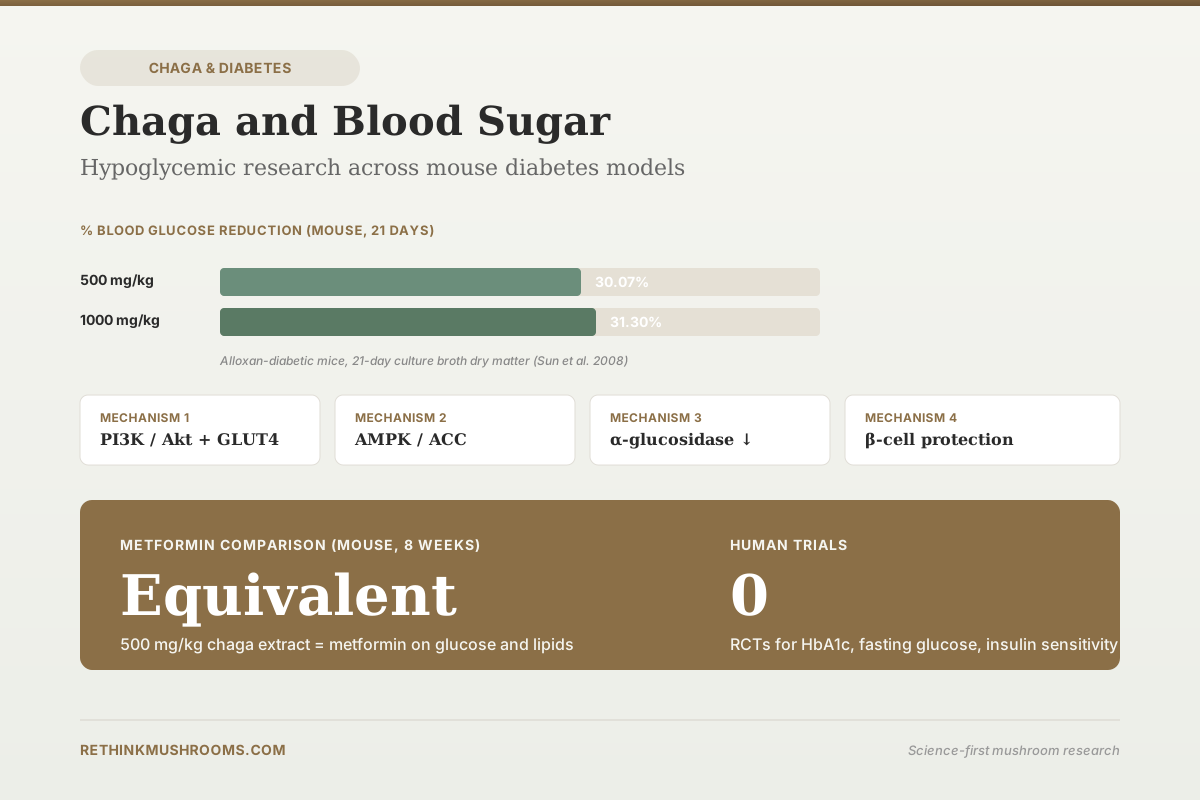
Three weeks of chaga culture broth at 1000 mg/kg reduced blood glucose by 31.30% in alloxan-induced diabetic mice, one of the largest reductions documented in the mouse chaga literature.
Sun et al., Journal of Ethnopharmacology, 2008
3 Models
alloxan, STZ, and high-fat diet diabetes models all tested
α-glucosidase
chaga polysaccharides inhibit the enzyme more than acarbose in vitro
0 Human Trials
no randomized controlled trial for chaga glycemic outcomes exists
Sun et al., Journal of Ethnopharmacology, 2008
 View as image ↗
Chaga (Inonotus obliquus) has been used as a folk remedy for diabetes in Russia and parts of Eastern Europe for centuries. The modern research record has tested that traditional use in animal models using three different diabetes induction methods: alloxan, streptozotocin (STZ), and high-fat diet. Across these models, chaga extracts and polysaccharides consistently lower blood glucose by 15-31% at effective doses, with dose-response relationships visible in most studies. What the record does not contain is a single randomized controlled trial of chaga for blood sugar in humans. This article walks through the numbers one study at a time. For the mechanistic story behind these numbers, see our companion piece on chaga and AMPK activation.
The honest read: the preclinical evidence for chaga as a glucose-lowering agent is broader and more consistent than for most medicinal mushrooms. The clinical evidence is absent.
Key Takeaways
- Chaga culture broth dry matter at 1000 mg/kg for 3 weeks reduced blood glucose by 31.30% in alloxan-induced diabetic mice, compared to 30.07% at 500 mg/kg (Sun et al., Journal of Ethnopharmacology, 2008)
- Chaga extract at 500 mg/kg produced glycemic effects equivalent to metformin in high-fat-diet plus low-dose-STZ type 2 diabetic mice over 8 weeks (Zhang et al., Journal of Ethnopharmacology, 2021)
- Two purified chaga polysaccharides (HIOP1-S, HIOP2-S) showed stronger α-glucosidase inhibition than acarbose, a standard oral hypoglycemic agent, in vitro (Liu et al., Molecules, 2018)
- Chaga polysaccharides at 900 mg/kg increased GLUT4 expression and restored hepatic glycogen content in STZ-induced type 2 diabetic mice (Wang et al., Biomedicine & Pharmacotherapy, 2017)
- Polysaccharide treatment partially restored STZ-damaged pancreatic β-cells over 6 weeks and improved insulin secretion in treated diabetic rats (Diao et al., Evidence-Based Complementary and Alternative Medicine, 2014)
- Zero randomized controlled trials of chaga for HbA1c, fasting glucose, or insulin sensitivity in humans have been published
The Core Hypoglycemic Numbers
A useful way to read the chaga diabetes literature is to line up the percent reductions in blood glucose across studies that used comparable outcomes.
| Study | Diabetes Model | Preparation | Dose | Duration | Glucose Reduction |
|---|---|---|---|---|---|
| Sun 2008 | Alloxan, mice | Culture broth dry matter | 500 mg/kg | 3 weeks | 30.07% |
| Sun 2008 | Alloxan, mice | Culture broth dry matter | 1000 mg/kg | 3 weeks | 31.30% |
| Zhang 2021 | HFD + low STZ, mice | Water extract | 500 mg/kg | 8 weeks | Equivalent to metformin |
| Wang 2017a | HFD + STZ, mice | Polysaccharide (IOPS) | 900 mg/kg | ~4 weeks | Significant vs control |
| Diao 2014 | STZ, rats | Polysaccharide (PIO) | Range | 6 weeks | Significant vs control |
The alloxan model used by Sun and colleagues produces severe beta-cell destruction and near type 1 diabetes.[1] The STZ model similarly destroys β-cells but can be dose-titrated to produce a type 2 phenotype when combined with high-fat feeding. The high-fat diet plus low-dose STZ model used by Zhang and Wang is considered the closest rodent analog to human type 2 diabetes.[2][3] Across all three models, chaga lowered blood glucose at gram-level oral doses.
Sun 2008: The Dose-Response Baseline
Sun and colleagues published one of the most cleanly designed hypoglycemic studies of chaga in 2008.[1] The preparation was dry matter of culture broth (DMCB), obtained by submerged fermentation of I. obliquus. Three mouse groups were tested: normal mice, glucose-loaded hyperglycemic mice, and alloxan-induced diabetic mice.
Findings at 500 and 1000 mg/kg body weight:
- Mild hypoglycemic effect in normal mice (not enough to cause dangerous lows)
- After glucose loading, euglycemia was achieved at 120 minutes in the 1000 mg/kg group and the glibenclamide positive control group, but not the lower chaga dose
- In alloxan-diabetic mice, 7-day glucose reductions were 11.90% and 15.79% at the two doses
- After 21 days, reductions reached 30.07% and 31.30%
- Serum free fatty acids, total cholesterol, triglycerides, and LDL all decreased
- HDL, insulin levels, and hepatic glycogen all increased
- Antioxidant enzymes (CAT, SOD, GPx) increased while MDA (a lipid peroxidation marker) decreased
- Histology showed partial restoration of damaged pancreatic tissue
The dose-response curve is shallow between 500 and 1000 mg/kg for glucose, but the broader metabolic and antioxidant effects are clearer at the higher dose. The 21-day reduction is meaningfully larger than the 7-day reduction, indicating the effect builds over time rather than acting acutely.
Zhang 2021: Head-to-Head With Metformin
Zhang and colleagues ran the closest thing to a drug comparison trial for chaga in 2021.[2] Type 2 diabetic C57BL/6 mice received chaga water extract at 250 or 500 mg/kg, or metformin, daily for 8 weeks.
At 500 mg/kg, chaga:
- Reduced fasting blood glucose
- Improved insulin resistance indices
- Increased hepatic glycogen content
- Produced the same lipid-profile improvements as metformin (higher HDL, lower TC, TG, and LDL)
The molecular substrate was upregulated phosphorylated PI3K, Akt, AMPK, and ACC, with downregulated SREBP-1c and fatty acid synthase. The detailed pathway analysis is covered in the AMPK activation article; what matters for the hypoglycemic question is that a natural product matched a first-line diabetes drug on both the glucose and lipid outcomes in this model.
One caveat: the metformin equivalence was in an 8-week mouse study. Metformin's benefits in humans accumulate over months to years and are measured against hard endpoints like cardiovascular events. Short-term glucose equivalence in mice is an encouraging signal, not a clinical claim.
Wang 2017: Glucose Transporter Translocation
Wang and colleagues tested a purified polysaccharide fraction (IOPS) at 900 mg/kg in STZ-induced type 2 diabetic mice.[3] The results added detail on where chaga's glucose-lowering effect happens at the cellular level:
- Body and fat mass restored toward controls
- Fasting blood glucose reduced
- Glucose tolerance improved
- Hepatic glycogen levels increased
- Cholesterol panel normalized
- GLUT4 protein expression upregulated
- Evidence of GLUT4 translocation to the cell membrane
- Organ-level tissue protection in liver, kidney, and pancreas
GLUT4 is the insulin-responsive glucose transporter in muscle and adipose tissue. When insulin signaling is working, GLUT4 moves from intracellular vesicles to the cell surface, letting glucose in. Insulin resistance impairs that translocation. Wang's data suggests chaga polysaccharides restore it, which is mechanistically distinct from insulin-independent routes like α-glucosidase inhibition.
The related 2017 study by Wang and colleagues focused on oxidative stress modulation, showing that chaga polysaccharides reduced STZ-induced oxidative damage in pancreatic and hepatic tissue.[4] Oxidative stress is one of the mechanisms by which hyperglycemia worsens insulin resistance, creating a self-reinforcing loop. Breaking that loop is another way to achieve glycemic improvement.
The α-Glucosidase Route: Liu 2018
Most of the studies above act by improving insulin sensitivity or glucose uptake. Liu and colleagues in 2018 characterized a distinct mechanism.[5]
Two polysaccharides (HIOP1-S and HIOP2-S) were isolated from I. obliquus and tested against α-glucosidase, an intestinal enzyme that breaks down complex carbohydrates into absorbable glucose. Acarbose, a prescription diabetes drug, works by inhibiting this enzyme, which delays glucose absorption and blunts postprandial glucose spikes.
Both HIOP1-S and HIOP2-S showed stronger α-glucosidase inhibition than acarbose in vitro. They also increased glucose consumption in HepG2 liver cells and reduced blood glucose in STZ-induced hyperglycemic mice, with HIOP2-S showing the clearer in vivo effect.
This adds a pre-absorption mechanism to chaga's profile. If the α-glucosidase effect translates to humans, it would specifically blunt post-meal glucose rises, which is a different clinical target than fasting glucose reduction. For a broader look at how mushroom fiber affects post-meal glucose, see our article on mushroom dietary fiber and postprandial blood sugar (once published).
β-Cell Recovery: Diao 2014
Diao and colleagues focused on pancreatic histology in STZ-induced diabetic rats.[6] After 6 weeks of PIO (chaga polysaccharide) treatment:
- Blood glucose decreased
- Oxidative stress markers normalized
- Proinflammatory cytokines decreased
- STZ-damaged β-cells showed partial structural recovery
β-cell preservation is a separate outcome from glucose reduction. It addresses the progressive loss of insulin-producing capacity that drives type 2 diabetes over years. A compound that simultaneously improves insulin action and supports β-cell survival would act on both sides of the disease. The preclinical data suggests chaga does both. The human data to confirm this does not exist.
Xu 2021 and the Metabolomic Picture
Xu and colleagues used serum metabolite profiling in STZ-induced diabetic mice treated with IOP.[7] Multiple metabolites associated with glucose dysregulation normalized after treatment. This is a systems-level view rather than a single pathway, and it suggests the glucose-lowering effect integrates into broader metabolic changes rather than being a narrow biochemical response.
What Binds It All Together
Randeni and colleagues applied network pharmacology in 2025 to the complete chaga compound set.[8] From 30 identified bioactive compounds (21 triterpenoids, 4 flavonoids, 2 diterpenoids), they predicted 432 anti-diabetic targets. The PI3K/Akt pathway emerged as the central hub. Molecular docking confirmed strong binding affinities for five key chaga compounds to seven core targets.
Ern and colleagues' 2024 review synthesized the broader chaga literature, placing the hypoglycemic evidence within the full pharmacology of polysaccharides, triterpenoids (including inotodiol, betulinic acid derivatives), polyphenols, and melanin pigments.[9] The review treats the anti-diabetic activity as one of several converging pharmacological signals, alongside anti-inflammatory, antioxidant, and anti-tumor effects documented in separate literatures.
Preparation Matters: Extract, Polysaccharide, Culture Broth, Powder
The studies above used four distinct chaga preparations, and the distinction matters. Sun 2008 used dry matter of submerged culture broth, produced by fermenting chaga mycelium in liquid medium. Wang 2017 and Diao 2014 used purified polysaccharide fractions obtained by hot water extraction followed by column chromatography. Zhang 2021 used a whole water extract prepared by high-pressure water extraction. Liu 2018 used two structurally defined polysaccharides (HIOP1-S and HIOP2-S) isolated through DEAE-52 cellulose and Sephadex G-100 chromatography.
None of these match a consumer chaga product off the shelf. The chaga chunks, powder, or tea most people encounter contain the full fungal biomass (including oxalate, which is central to the chaga safety picture), variable polysaccharide content depending on source, and no standardization of triterpenoid or polyphenol content. The dose-response findings from the research cannot be directly transferred to commercial products without knowing the specific extract profile. A polysaccharide-enriched extract at 2g would deliver a different active compound mix than 2g of raw chaga powder, and both would differ from a standardized triterpenoid-enriched extract.
For any hypoglycemic claim in humans to rest on solid ground, the preparation tested would need to match the preparation being sold. Currently, it does not.
Why the Human Trial Data Is Missing
The question is not whether chaga lowers blood glucose in mice. It does, across multiple models, doses, preparations, and labs. The question is why none of this has been confirmed in a human trial.
The structural answers are three. Chaga cannot be patented as a drug, so no pharmaceutical company has incentive to fund a Phase II or III trial. Chaga is regulated as a dietary supplement in most jurisdictions, which does not require efficacy trials. And chaga carries a documented safety signal (oxalate nephropathy, covered in chaga long-term safety) that creates regulatory friction for any IRB-approved human glycemic trial, especially in a population that is already at elevated risk of kidney disease.
What exists in the human literature is case reports (all negative, describing kidney injury), observational data from populations using chaga tea traditionally (without controlled outcomes), and the indirect human signal from related mushroom polysaccharide trials on insulin sensitivity markers like the Agaricus blazei trial covered separately.
The practical implication is that mushroom supplement marketing claiming chaga "lowers blood sugar" is citing mouse data and implying human applicability. The mouse data supports biological plausibility. It does not support a claim of human efficacy, and it does not address the dose-duration safety questions that would have to be answered before any such claim could be made responsibly.
The Bottom Line
Chaga (Inonotus obliquus) lowers blood glucose by 15-31% at gram-level doses in alloxan, STZ, and high-fat-diet rodent diabetes models across independent studies. Mechanisms include insulin sensitization via PI3K/Akt, AMPK activation, GLUT4 translocation, α-glucosidase inhibition (stronger than acarbose in vitro for purified polysaccharides), β-cell preservation, and oxidative stress reduction. One mouse study found 500 mg/kg chaga extract equivalent to metformin over 8 weeks. No randomized controlled trial has tested chaga for HbA1c, fasting glucose, or insulin sensitivity in humans. Chaga's documented kidney safety signal at chronic high intake is the practical constraint on any future human trial design.
Frequently Asked Questions
Sources & References
- 1RTHM-00145·Sun, Jun-En et al. (2008). “Antihyperglycemic and antilipidperoxidative effects of dry matter of culture broth of Inonotus obliquus in submerged culture on normal and alloxan-diabetes mice..” Journal of ethnopharmacology.Study breakdown →PubMed →↩
- 2RTHM-00736·Zhang, Zhe et al. (2021). “Effect of Inonotus obliquus (Fr.) Pilat extract on the regulation of glycolipid metabolism via PI3K/Akt and AMPK/ACC pathways in mice..” Journal of ethnopharmacology.Study breakdown →PubMed →↩
- 3RTHM-00495·Wang, Jia et al. (2017). “Anti-diabetic effects of Inonotus obliquus polysaccharides in streptozotocin-induced type 2 diabetic mice and potential mechanism via PI3K-Akt signal pathway..” Biomedicine & pharmacotherapy = Biomedecine & pharmacotherapie.Study breakdown →PubMed →↩
- 4RTHM-00498·Wang, Juan et al. (2017). “Antidiabetic activities of polysaccharides separated from Inonotus obliquus via the modulation of oxidative stress in mice with streptozotocin-induced diabetes..” PloS one.Study breakdown →PubMed →↩
- 5RTHM-00520·Liu, Ping et al. (2018). “Structure Characterization and Hypoglycaemic Activities of Two Polysaccharides from Inonotus obliquus..” Molecules (Basel.Study breakdown →PubMed →↩
- 6RTHM-00319·Diao, Bao-Zhong et al. (2014). “Protective Effect of Polysaccharides from Inonotus obliquus on Streptozotocin-Induced Diabetic Symptoms and Their Potential Mechanisms in Rats..” Evidence-based complementary and alternative medicine : eCAM.Study breakdown →PubMed →↩
- 7RTHM-00729·Xu, Tanye et al. (2021). “Inonotus obliquus polysaccharide ameliorates serum profiling in STZ-induced diabetic mice model..” BMC chemistry.Study breakdown →PubMed →↩
- 8RTHM-00948·Randeni, Nidesha et al. (2025). “Elucidating the Anti-Diabetic Mechanisms of Mushroom Chaga (Inonotus obliquus) by Integrating LC-MS, Network Pharmacology, Molecular Docking, and Bioinformatics..” International journal of molecular sciences.Study breakdown →PubMed →↩
- 9RTHM-01886·Ern, Phoebe Tee Yon et al. (2024). “Chaga Therapeutic Properties: What This 2024 Review Actually Shows.” Mycology.Study breakdown →PubMed →↩